
To avoid these ads, REGISTER NOW!

Pumpless TIG Chiller Concept

garboui

Well-known member
Joined
Jun 30, 2011
Messages
999
Location
Southern Ontario
With trying to make things easier living with tendonitis/injuries, I am looking at improving my TIG setup. Mainly dumping my 26 air cooled torch for a less bulk/less fight smaller water cooled 20 size torch. I thought about going air cooled 9/17 rotaflex but I have been finding I am often duty cycle limited from needing to take breaks to ley my 26 cool down. The materials I weld vary so much as well that I would spend way too much time switching over between sized of air cooled torches. 20 seems like it would be a one size fits all solution for me.

Being cheap I am a slave to sunken cost fallacy and wasting time and money to try and find the optimum solution. Reading into the DIY chillers the pump is usually the crux of most projects and usually results in the buy one cry one aspect of getting a procon pump. AT that price, I might as well just get an Amazon cheapo chiller. I have some 12V diaphragm pumps sitting around, aside from the complexities of needing to add safety measures for a positive displacement pump, they are noisy, I don't like that!

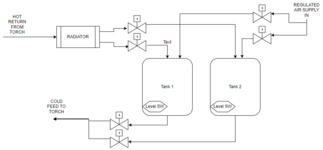
This brings me to an idea of a pumpless setup. The setup would run off shop air and essentially be an air over coolant design to push water through the torch. When one tank is depleted a set of solenoids reverse the direction of everything; triggered by some float switches; and teh process repeats. As the amount of air volume needed is minimal, it would barely cause the compressor to cycle more than it will when running tools I would be working with anyways.

Here is a simplified diagram of what I am envisioning. Things like wiring, interlocks for flow, directional solenoids, etc... are omitted for simplicity. Control wiring should be easy enough with a little relay logic. + Getting a couple gallon'ish tanks that can be safe at 50psi should hopefully be not that hard (sunken cost fallacy anyone?). Is there something I am maybe missing here that would keep that silent system (aside from some PC fans) from working?
1700839645304.png
 
To avoid these ads, REGISTER NOW!

APEowner

Well-known member
Joined
Oct 2, 2009
Messages
4,169
Location
Sunny, New Mexico
That's interesting. I think you'll need to not only close off the air supply to the empty tank but also vent it so that it can refill but otherwise I think that it would work. I'm not sure that the added complexity gains you anything over a conventional system however.
 
OP
G

garboui

Well-known member
Joined
Jun 30, 2011
Messages
999
Location
Southern Ontario
That's interesting. I think you'll need to not only close off the air supply to the empty tank but also vent it so that it can refill but otherwise I think that it would work. I'm not sure that the added complexity gains you anything over a conventional system however.
Yes, I would likely source some "directional valves so the closed position would be a vent for the tank. Just wanted to keep the concept diagram simple.

Theres other details to solve like, how does the relay logic start when both tanks are half full, or empty. Not showstopping but can be solved by either letting the relays race and one will inevitably lock the the other out first or just adding some on delay to one of the relays. As an EE by trade, I'll worry about the controls bridge when I get there.

As for your comment about gains. The gain for me would be removing the pump, and noise reduction. Valves and relays are cheap ($5-10 cad), a procon pump is going to cost me ~200 even before i source a motor for it. At that point I might as well spend $300 for the amazon solution.
 

txvwnut

Well-known member
Joined
Jan 1, 2015
Messages
7,720
Location
Bedford, Texas
My only thought is the air would aerate the water and cause bubbles which would lesson the cooling effect of the water. A diaphragm tank setup might be a better design idea.
 

American Locomotive

Well-known member
Joined
Jan 8, 2017
Messages
11,129
Location
Rhode Island
While your proposed solution is quite clever, and I think it would work fine, I don't really think it's an "optimum" solution.

- You're worried about the noise, but how much noise is venting a gallon of 50 PSI air is going to make each cycle? What about the 6 solenoids that are going to be clacking away?

- Finding a gallon sized container that has all the ports you need, and a provision for wire pass-thrus AND can deal with 50 PSI of air pressure safely is going to be a tall order, unless you make something yourself, and trust something you make to hold air pressure.

- half-decent, brass-bodied solenoid valves are not exactly cheap - even for Chinese no-name valves. You could get cheapo plastic valves for $5-7, but do you really want to do that? Realistically you're going to be $120+ into this project in valves and relays. Now factor in the cost of acquiring/building your pressure vessel/tanks, and you're easily well over $200.

- If a hose pops off the tank or something breaks before the solenoids - you will not be able to stop the system. You're going to have 50 PSI worth of air pushing on a gallon of coolant, and all of the coolant is going to come spraying out no matter what.

Ultimately I think you're going to end up with a "project" that takes up a lot more space, makes more noise, and is more unreliable.

If you hop on ebay, you can easily find new and used procon pump + motor assemblies selling for $200 or less: https://www.ebay.com/itm/151352970969
 
OP
G

garboui

Well-known member
Joined
Jun 30, 2011
Messages
999
Location
Southern Ontario
- Noise, Its 1lpm@1ATM for the fillling tank and 1LPM@50PSI a diffuser will have this being a light hiss. As for teh clikkity clack of relays. a 1gal tank would have a periodic click of all valves and relays changing over about every 4mins.

- The tanks as you mention are absolutely gong to be the crux to this. My hopes is that I could find/repurpose something on the cheap. Basically the qualifier before building this.

- Solenoids. Brass bodied ones are an option at 2x the price. I have had good luck with the plastic bodied ones in the last 6 years or so, one running 120psi duty as an auto-drain on my compressor. I've had a couple bad ones and they usually almost fail out of the gate if they are bad.

- This is the same problem if a pump based system decides to pop a line and dump a gal of coolant. A gallon of coolant on the garage floor is not the end of the world either. Its also possible to have a low pressure switch to shut things down.

- I am in Canada. That pump you linked is going to be $350+ CDN by the time it gets to my door.


In all, its about $100 in solenoids and relays (i have most of the electrical sitting around already). Another $60 for a couple level switches and a regulator. The tank, yeah the tanks might be a pain to source on the cheap.
 

American Locomotive

Well-known member
Joined
Jan 8, 2017
Messages
11,129
Location
Rhode Island
- Noise, Its 1lpm@1ATM for the fillling tank and 1LPM@50PSI a diffuser will have this being a light hiss. As for teh clikkity clack of relays. a 1gal tank would have a periodic click of all valves and relays changing over about every 4mins.
You're thinking as if it were hydraulics. It's different when dealing with a compressible fluid like air.

When a tank fills up, and gets switched to pressurized mode, you need to pressurize the tank fast. The entire "air space" above the coolant needs to be instantly pressurized to 50 PSI in order to keep flow continuous. Once it's pressurized, yes, the flow is only ~1 LPM @ 50 PSI. But it will have a high initial in-rush of air, every cycle.

You have the opposite issue when a tank is nearly empty and needs to vent/dump the pressure. When you're venting the "empty" tank, you can't vent 1 lpm @ 50 PSI through a diffuser. You need to dump the entire gallon of 50 PSI air instantly. This is because any air pressure in the "vented" tank will reduce your pressure differential across the torch. You need that ~50 PSI differential to keep an adequate flow through the torch. Dumping a gallon of air at 50 PSI instantly is going to require a high flowing solenoid, and a good muffler to keep it quiet.
- This is the same problem if a pump based system decides to pop a line and dump a gal of coolant. A gallon of coolant on the garage floor is not the end of the world either. Its also possible to have a low pressure switch to shut things down.
Fair enough. However, you can just hit the power switch and the pump turns off. If a hose pops off your pressure tank, all of the coolant will come spraying out uncontrolled. Small issue, but still a consideration. Most pump based systems have a reservoir below the pump, so they can't just dump all the coolant out if a hose pops off.
- I am in Canada. That pump you linked is going to be $350+ CDN by the time it gets to my door.
That was just an example. Hop on ebay.ca and see what you can find. You also don't need a "procon" pump. You can just search for "Carbonator pump". Shoot, even a standard $150 shallow-well pump from Home Depot (or Canadian equivalent) would provide adequate pressure.
 
OP
G

garboui

Well-known member
Joined
Jun 30, 2011
Messages
999
Location
Southern Ontario
@American Locomotive, yes, I completely overlooked teh accumulation and blow-off at each cycle change. That's starting to sound like it can get old quick now.

Thanks for the advice on the search terms. I will keep doing some searching for the "Carbonator pump" as well as watching more local classifieds for what I can scavenge. This is a months off project (still in rehab for a elbow recon), but want to have as many parts in place for when I am able to running start for such projects in the shop again!
 

American Locomotive

Well-known member
Joined
Jan 8, 2017
Messages
11,129
Location
Rhode Island
@American Locomotive, yes, I completely overlooked teh accumulation and blow-off at each cycle change. That's starting to sound like it can get old quick now.

Thanks for the advice on the search terms. I will keep doing some searching for the "Carbonator pump" as well as watching more local classifieds for what I can scavenge. This is a months off project (still in rehab for a elbow recon), but want to have as many parts in place for when I am able to running start for such projects in the shop again!
People have also successfully used gear pumps and "transfer pumps" successfully, but I cannot comment on their noise levels (or durability for extended use)
 
OP
G

garboui

Well-known member
Joined
Jun 30, 2011
Messages
999
Location
Southern Ontario
Gear pumps I would put in consideration with a caveat. Being positive displacement, some kind of pressure bypass/regulator would be required to prevent an overpressure from a clog or even a hose kink. I have not yet looked into if a peristaltic could provide adequate pressures (sounds possible in a hand wavy way). Building one of these pumps is feasible with some cheap bearings and a 3D printed housing. There are ways to build in pressure control to these style pumps as well.
 

LopezBart

Well-known member
Joined
Oct 13, 2023
Messages
2,581
Location
Lopez Island, WA
If you're going to use compressed air, there are inexpensive air-driven diaphragm pumps that would handle this sort of service. Your pump should be capable of 50 psi and 4 gpm. I'd also fit a flow switch in the line that would let you know if the water flow stops, esp. if you use high power levels. The Procon-style vane pumps are quite reliable and fail due to wear slowly.
 
OP
G

garboui

Well-known member
Joined
Jun 30, 2011
Messages
999
Location
Southern Ontario
Just for devils advocate sake. What if a total loss system was used from my city water feed?

Water and sewer are billed together, so about $3.20/1000L. Lets round up to $4/1000L to make the math easier and we dont want to go below 1L/min.

1000/60 = 16.666 Hours/1000L
$4/16.666 = $0.24/hour of welder on time.

Lets say I get this system built all in for $200 (likely best case). That's equivalent to 833 hours of welder on time! Now we dont have to run the water as long as the welder is running. We can add a rotameter ($25), solenoid ($10) and a Timer relay ($15) to run a post flow cycle after running the torch. This would be triggered from tapping the pedal/switch sig. NOw we are only running water for weld time + some post flow.

In the summer its easy to let the water run out the garage door. In the winter It would be easy enough to run a return line inside to a drain in the house. Now This becomes an almost a zero maintenance system, just need to blow the lines out with some compressed for storage/winter.

As with all solutions, thar be dragons. In the summer 80-90%RH is common. With 15C water water flowing from teh city feed, thats going to be a significant amount of condensation at the torch head and the lines. Back to adding a fan and heat-x for room temperature normalization.

1700851002050.png
 
Last edited:

mike93lx

ALLIANCE MEMBER
Joined
Dec 9, 2013
Messages
38,398
Location
Richmond, VA
As with all solutions, thar be dragons. In the summer 80-90%RH is common. With 15C water water flowing from teh city feed, thats going to be a significant amount of condensation at the torch head and the lines. Back to adding a fan and heat-x for room temperature normalization.

1700851002050.png
Sounds like you need a/c now too :) instead of warming the water, drop the RH
 
To avoid these ads, REGISTER NOW!

American Locomotive

Well-known member
Joined
Jan 8, 2017
Messages
11,129
Location
Rhode Island
A few things to keep in mind with liquid cooled tig torches:

- The coolant is part of the electrical circuit. They actually pump the coolant around the main current carrying conductor. If you tie your city water system to the tig torch, your house is now effectively part of the welding circuit.

- The HF start of some tig sytems can be picky, and dissolved minerals (and other contaminants) in the water could negatively impact the HF operation. Also once again, the HF operation would be coupled into your household plumbing. Maybe not a great idea.

- The hoses and passages in the torch are very small. Scale and mineral build up may occur with city water

- There are dissimilar metals in some tig systems - brass, copper, steel, aluminum, etc.. Water with minerals is conductive, and you may get accelerated corrosion when the weld power is on and current is flowing.

The pneumatic diaphragm pump is an interesting idea, and might work. They can be pricey though.
 
OP
G

garboui

Well-known member
Joined
Jun 30, 2011
Messages
999
Location
Southern Ontario
Aaaah electrochemistry. That's a good point about the electrical CCT. While the dissolved solids are conductive, the house I am in is mostly PEX so just the water as the conductive medium is a pretty good attenuation to the HF. The specific feed I would be using would also terminate close to the grounding point of the house plumbing first too!

For discussion/ thought experiment sake on this. A pretty basic isolator like in an IV drip could be built. As for the minerals and buildup, this should have been more at the front of my mind. Our municipal water is well based and quite hard! Non starter! (I went from descaling my coffee pot yearly (maybe) to now monthly when I moved into this home)

1700859447090.png


On a note about dissimilar metals in the system and electrolysis effects. If teh parts in the torch are all at the same potential not much 'should' happen. I have worked on products in the past where it was expected that moisture would be tolerated because it was distilled condensate and not conductive. That is true, for a small amount of time. As soon as the "non-conductive" distilled picks up any contaminate (dirt, dust etc..)) or dissolved solid from oxides, it becomes a runaway situation of conduction as it causes more solids to electrolyze and become dissolved ions in the solution. This was at >200VDC so not so apples to apples, but was significant.
 

Jswain

Well-known member
Joined
Apr 26, 2013
Messages
2,467
Location
Calgary, AB
I had a similar idea after I bought my tig and started wanting a Watercooler for it. I looked at Amazon and spent a lot of time on YouTube planning to build my own, each version having its downsides if you didn't use a recommended pump.

Then I thought about using a coolant mister like one would use on a mill/lathe. But plumb the mister into the tig torch and spray air w/water/coolant to keep it cooled. I was pretty set on this as I had a mister already to try.

LUCKILY I came across a long a Lincoln water cooler, came with a brand new weldcraft torch w/25ft leads & a bunch of 3/0 cable for $300 and I was glad I didn't invest anything other then time & thoughts into a Frankenstein setup.

So my advice, if you don't need it right now, is wait around.
 

American Locomotive

Well-known member
Joined
Jan 8, 2017
Messages
11,129
Location
Rhode Island
Why not use a band saw coolant pump instead of the Procon pump?

https://www.amazon.com/dp/B07JNS5BXG/?tag=atomicindus08-20
Then I thought about using a coolant mister like one would use on a mill/lathe. But plumb the mister into the tig torch and spray air w/water/coolant to keep it cooled. I was pretty set on this as I had a mister already to try.
The problem is that tig torches are very restrictive, and need high pressure to get any kind of flow through the torch. Typically around 50-60 PSI is needed. Liquid cooled tig torches also have a very undersized wire in the whip. A "250A" torch head might have something like a 10 or 12 gauge wire. The wire itself is liquid cooled. Sending an air/water mist down that wire will likely just result in hot spots and it melting through the jacket.

Source: Seen what happens when you run a tig cooler out of water. The main wire melts through the jacket at high power.
 
OP
G

garboui

Well-known member
Joined
Jun 30, 2011
Messages
999
Location
Southern Ontario
If you really want to diy a cooler, I have just what you need. If you’re interested let me know.

IMG_8581.jpeg
I'm going to earmark this as a backup plan. Thanks! I have most of the winter to get this figured out so I don't want to take the easy (logical) way yet. I got to have fun somehow.
 
OP
G

garboui

Well-known member
Joined
Jun 30, 2011
Messages
999
Location
Southern Ontario
In the spirit of using what I have on hand, even though if if means being slightly annoyed by the noise until a more optimal opportunistic solution comes around. Is there anything that would prevent a cheapo universal FPR being used with coolant? This would get me going with the diaphragm pump that I already have sitting around (from some other sunken cost fallacy project).

Example from amazon
1700944527700.png
One thing I am not sure of is what effect not having the vacuum line connected would have?

Alternatey, fab up some adapters to use a fixed pressure 3.5bar (~52psi) GM FPR
 

no704

Well-known member
Joined
Apr 27, 2016
Messages
5,257
Couple of used pressure cookers should be pretty easy to come up with.
 

Beelzeboss

Well-known member
Joined
Jul 31, 2020
Messages
568
Location
Sydney
The coolant setup I have for my CNC water cooled spindle just uses a cheap 12v aquarium pump, I realise a welder puts a lot more heat into the fluid, but how much flow do you need?
 
OP
G

garboui

Well-known member
Joined
Jun 30, 2011
Messages
999
Location
Southern Ontario
Min 1L/min @ min 50psi seem to be whats required. There is quite a bit of restriction at the torch heads from what I gather and more psi in a rota/flex-loc style which is what I am planning on grabbing from Everlast when they are back in stock next week. Since I'll have the torch well ahead of having a cooler or being able to use it I plan on doing some testing to see how close this is. I also have a WP-18 euro style that came with the welder that I plan on testing out as well.
 

cannuck

Well-known member
Joined
Nov 30, 2021
Messages
4,705
Location
Rural SK
- Noise, Its 1lpm@1ATM for the fillling tank and 1LPM@50PSI a diffuser will have this being a light hiss. As for teh clikkity clack of relays. a 1gal tank would have a periodic click of all valves and relays changing over about every 4mins.

- The tanks as you mention are absolutely gong to be the crux to this. My hopes is that I could find/repurpose something on the cheap. Basically the qualifier before building this.

- Solenoids. Brass bodied ones are an option at 2x the price. I have had good luck with the plastic bodied ones in the last 6 years or so, one running 120psi duty as an auto-drain on my compressor. I've had a couple bad ones and they usually almost fail out of the gate if they are bad.

- This is the same problem if a pump based system decides to pop a line and dump a gal of coolant. A gallon of coolant on the garage floor is not the end of the world either. Its also possible to have a low pressure switch to shut things down.

- I am in Canada. That pump you linked is going to be $350+ CDN by the time it gets to my door.


In all, its about $100 in solenoids and relays (i have most of the electrical sitting around already). Another $60 for a couple level switches and a regulator. The tank, yeah the tanks might be a pain to source on the cheap.
I would use 2 profane tanks, but you may want to weld up a pretty aluminum pair (that will dissipate heat much better). You will also want to look at a cooling fan for the radiator - quad or bike rad with computer fan I have used for vac system cooling.
 
To avoid these ads, REGISTER NOW!
Top Bottom