To avoid these ads, REGISTER NOW!

push button switch to lighted toggle switch - HELP!

Ryan Wilke

Well-known member
Joined
Mar 12, 2006
Messages
89
Location
Michigan
Hey Fellas,
It's been a while since I was here - but I need some help...

I have a 110V light operated from a push button on/off switch. I believe the switch is shot. So I purchased a lighted toggle switch to replace it.

So, when I pulled the cover off the Push switch, I see it was only spliced into / operating from the black wire. How do I wire up the lighted toggle switch? The lighted toggle switch appears to want a white, black and ground wire to operate??? :confused:

Thanks in Advance for all advise/help/guidance, Guys! :bowdown:

Ryan :eyecrazy:
 
To avoid these ads, REGISTER NOW!

cybrdyke

Well-known member
Joined
Sep 9, 2014
Messages
3,442
Location
USA
If you had a regular switch, you could just use the black wire the same way the old switch was. Since there is a light in the new switch, it needs black and white just like any other load. If you cant bring white to the lighted switch, it wont work.
 

fitter30

Well-known member
Joined
Jun 23, 2019
Messages
2,960
Location
Peace Valley,mo
If you don't have neutral (white) wire this switch will not work. Did you happen to replace the light bulb with a cfl or led bulb? Put a incandescent bulb back in with your push button switch and see if it lights. That type of switch needs a resistance load to make them light.
 

Git

Well-known member
Joined
May 18, 2008
Messages
6,894
Location
S Cal
Yep - the switch needs a neutral to complete the circuit for the light to work
 

walta

Well-known member
Joined
Jan 13, 2017
Messages
2,308
Location
Dutzow Missouri
How to make the light work depends on what switch you bought and what type of lamps you are using.

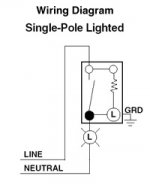
There are 2 types of “lighted switches” generally” illuminated switches” do not have a neutral connection , pilot light switches do require a neutral connection.


To make a illuminated switch work reliably you need an incandescent lamp in the circuit to provide the return path to the neutral. If you are using LED lights you may need a pilot light switch as the LEDs may not pass enough current to light an illuminated switch.

Walta
 

Attachments

  • Document-34867-Wiring Diagram.jpg
    Document-34867-Wiring Diagram.jpg
    27 KB · Views: 37
  • pilot.jpg
    pilot.jpg
    10.9 KB · Views: 34
OP
R

Ryan Wilke

Well-known member
Joined
Mar 12, 2006
Messages
89
Location
Michigan
How to make the light work depends on what switch you bought and what type of lamps you are using.

There are 2 types of “lighted switches” generally” illuminated switches” do not have a neutral connection , pilot light switches do require a neutral connection.


To make a illuminated switch work reliably you need an incandescent lamp in the circuit to provide the return path to the neutral. If you are using LED lights you may need a pilot light switch as the LEDs may not pass enough current to light an illuminated switch.

Walta

Walta,
Well, I don't know which type switch I have. The switch I bought (local hardware store) is a COOPER Wiring Devices brand, "Lighted Single Pole Switch", 15A-120V AC/CA; it has two brass screws on the right side and a single green screw on the lower left side (looking at the face of the switch). Inside the wall box is a white wire and a bare wire...I could cut the power and probably install a jumper wire into the white wirenut and the same for the bare ground wire. Does that make sense?

The switch is intended to operate a a simple, standard incandescent 75-watt bulb.

Again, THANKS EVERYONE for the advise/help/guidance! :bowdown:

Ryan
 

Git

Well-known member
Joined
May 18, 2008
Messages
6,894
Location
S Cal
How to make the light work depends on what switch you bought and what type of lamps you are using.

There are 2 types of “lighted switches” generally” illuminated switches” do not have a neutral connection , pilot light switches do require a neutral connection.


To make a illuminated switch work reliably you need an incandescent lamp in the circuit to provide the return path to the neutral. If you are using LED lights you may need a pilot light switch as the LEDs may not pass enough current to light an illuminated switch.

Walta

Apples and Oranges

OP is talking about, a "a lighted toggle switch" which the majority of the time requires a neutral to work.

A pilot light is completely different animal since it's main purpose is to show if there is a load on the line (if a light or piece of equipment is 'on' for example)

OP - if the switch didn't come with a piece of paper showing how to wire it, look inside the cardboard box it came in - often times it is printed therr
 

teamextreme

Well-known member
Joined
Aug 10, 2013
Messages
867
Location
Lakewood, CO
The switch you bought is a standard single pole illuminated switch that does not need a neutral. Walta explained how they operate. Hook up just like the old switch, although it's not clear what kind of switch you had since you described it as a pushbutton and the only residential pushbutton switches I've ever seen are ancient things from the 50's. Connect 3 wires to the new switch, 2 hots which attach to the 2 brass screws, doesn't matter which is which, and the bare ground wire attaches to the green screw.
 

walta

Well-known member
Joined
Jan 13, 2017
Messages
2,308
Location
Dutzow Missouri
Walta,
Well, I don't know which type switch I have. The switch I bought (local hardware store) is a COOPER Wiring Devices brand, "Lighted Single Pole Switch", 15A-120V AC/CA; it has two brass screws on the right side and a single green screw on the lower left side (looking at the face of the switch). Inside the wall box is a white wire and a bare wire...I could cut the power and probably install a jumper wire into the white wirenut and the same for the bare ground wire. Does that make sense?

The switch is intended to operate a a simple, standard incandescent 75-watt bulb.

Again, THANKS EVERYONE for the advise/help/guidance! :bowdown:

Ryan

Ryan The old switch had two wires on it connect those two wires to your new switch two brass colored screws. If your house wiring has ground wiring run up to this box connect a green or a bare wire to the green screw and connect it to the green or a bare ground wiring.

Under no circumstance should you or anyone else connect the white wire to the green terminal in a light switch box.

Your new switch will not have or need a neutral wire connection. The light in the switch will light when the switch is turned off reliably as long at the lamp is an old fashion incandescent lamp. You could have a problem getting the switch to light up if someone screws in LED bulbs.

Walta
 
Last edited:

walta

Well-known member
Joined
Jan 13, 2017
Messages
2,308
Location
Dutzow Missouri
Apples and Oranges

OP is talking about, a "a lighted toggle switch" which the majority of the time requires a neutral to work.

A pilot light is completely different animal since it's main purpose is to show if there is a load on the line (if a light or piece of equipment is 'on' for example)

OP - if the switch didn't come with a piece of paper showing how to wire it, look inside the cardboard box it came in - often times it is printed therr

GIT on second thought you are correct that the diagrams of lighted switches I posted are very different from each other in that one lights when the switch is off and the other lights when it is on.:bowdown:

I have been looking unsuccessfully to find a find a lighted single pole switch with a neutral connection. All the smart switches I see require a neutral but the only mechanical switch I found with a neutral was the pilot light version.


Git If you are correct that the majority require a neutral, please help me find one by post a link to single pole mechanical switch that has a neutral connection.

Walta
 

Git

Well-known member
Joined
May 18, 2008
Messages
6,894
Location
S Cal
GIT on second thought you are correct that the diagrams of lighted switches I posted are very different from each other in that one lights when the switch is off and the other lights when it is on.:bowdown:

I have been looking unsuccessfully to find a find a lighted single pole switch with a neutral connection. All the smart switches I see require a neutral but the only mechanical switch I found with a neutral was the pilot light version.


Git If you are correct that the majority require a neutral, please help me find one by post a link to single pole mechanical switch that has a neutral connection.

Walta

No - you are right and I was wrong, sorry

I was thinking of a 'smart switch'. All of my illuminated switches are Z-Wave switches that require a neutral. I did have a leftover illuminated switch 'still in the box' from an old project. Pass & Seymour from Lowes. Only 3 terminals - 1 for the ground and the other 2 for the circuit. I cut the box open - instructions printed inside

attachment.php
 

Attachments

  • GR8-942.jpg
    GR8-942.jpg
    148.5 KB · Views: 271
OP
R

Ryan Wilke

Well-known member
Joined
Mar 12, 2006
Messages
89
Location
Michigan
BigGarage,
Yeah,,,no,,, the switch I took out does not have two buttons. It has a single (larger - like the diameter of a 50 cent coin) center button that the operator simply pushes to turn on; then pushes the same button to turn off. The large button also turns, (like as it if was a dimmer switch) but it does not effect the brightness of the bulb. It says it is a General Electric switch, but no part #.

Here is what I want to install: https://www.lowes.com/pd/Eaton-15-a...-Illuminated-Residential-Light-Switch/1101159

Above I said this switch is: Lighted Single-Pole Switch. However, on the back side of the cardboard it is called a 'Grounding Lighted Single Pole Switch'. Does that help distinguish it? The directions says, "Connect one wire to each terminal screw. Connect green or bare wire to green terminal screw. Handle glows with switch is off."

Git,
I do not know what a Z-wave switch is or looks like....... The instructions on the inside of your switch box says the same,,, "Loop each wire around terminal screws..." The diagram doesn't indicate black or white wires....

Sounds like both you and Walta may have been confused along the way...

So, Fellas,,,,,, do I remove the two blacks from the push button switch and install one black on each screw of the lighted switch, or do I add a jumper from the two black wires and a jumper from the two white wires (in the back of the electrical box, not connected at all to the original push button switch) and place each jumper on a screw of the lighted switch?


.....and I'll install a jumper from the bare copper wire (also tucked in the back of the box) to attach to the green screw of the new switch......

I'm sorry to keep bugging you guys with this, but my head is mush.... Ryan
 

walta

Well-known member
Joined
Jan 13, 2017
Messages
2,308
Location
Dutzow Missouri
Honeywell Tap-Lite is this what you have?
Too cool the replace. New old stock replacement $39.00


Walta
 

Attachments

  • s-l1600.jpg
    s-l1600.jpg
    97.3 KB · Views: 32
  • s-l1600 (1).jpg
    s-l1600 (1).jpg
    84.5 KB · Views: 24

teamextreme

Well-known member
Joined
Aug 10, 2013
Messages
867
Location
Lakewood, CO
BigGarage,

So, Fellas,,,,,, do I remove the two blacks from the push button switch and install one black on each screw of the lighted switch, YES or do I add a jumper from the two black wires and a jumper from the two white wires (in the back of the electrical box, not connected at all to the original push button switch) and place each jumper on a screw of the lighted switch? ABSOLUTELY NOT, THIS WILL RESULT IN A SHORT CIRCUIT AND TRIP THE BREAKER


.....and I'll install a jumper from the bare copper wire (also tucked in the back of the box) to attach to the green screw of the new switch...... CORRECT

Answers above...
 
OP
R

Ryan Wilke

Well-known member
Joined
Mar 12, 2006
Messages
89
Location
Michigan
Yep, I'm finally getting back to installing this switch........

I shutoff the main power breaker. I removed the two black wires from the old switch and installed them on the two brass screws of the new switch. I installed a short jumper wire from the bare copper wires in the box to the green screw on the new switch.

I turned the power back on..... nothing.

The switch toggle does not light up with the toggle up or down..nor does the incandescent lamp (75W) bulb light up that the switch should be operating.

No power breaker has tripped. All other nearby lights operate just fine.

So now what, Guys? Where did I go wrong?

What is simple to some is not so simple to others.....
 

Shiftless

Well-known member
Joined
Mar 9, 2014
Messages
14,463
Location
East Bay SFO
You don’t have a system where there are low voltage switches with relays operating the lights do you? Is your whole house wired up with push button on off switches?

Are the wires leading to your old switch 14 ga. wire or are they much thinner?

I have seen push button switches like you described installed in those low voltage relay wired houses.

I can’t think of any other reason your new switch won’t work.
(But I’m not a electrician)

With the breaker in the off position, have you tested by temporarily twisting the 2 black wires together, then turned the power back on to see if the light lights up?


Here is a pic of a modern replacement for the old, usually GE, low voltage relay switches.
I don’t believe those systems ran green ground wires to each box, like you said you had, but I could be wrong.
 

Attachments

  • BE6E5BBE-3B11-415E-A5D2-30587008C765.jpeg
    BE6E5BBE-3B11-415E-A5D2-30587008C765.jpeg
    34.1 KB · Views: 5
Last edited:
OP
R

Ryan Wilke

Well-known member
Joined
Mar 12, 2006
Messages
89
Location
Michigan
You don’t have a system where there are low voltage switches with relays operating the lights do you?
No. This is an older late 60s ranch home (1000 sq.ft)

Is your whole house wired up with push button on off switches?
No. That was the only one.

Are the wires leading to your old switch 14 ga. wire or are they much thinner?
The old switch had 14ga. coming into the box, then two finer, 6" long, non-solid, jumper wires wire nutted from the std 14ga. solid black wire to the jumpers. The jumpers appeared to be part of the push button switch, bought with them. I cut the fine wired jumpers flush at the switch, stripped each wire back a bit and fastened each to a screw.

I have seen push button switches like you described installed in those low voltage relay wired houses.

I can’t think of any other reason your new switch won’t work.
(But I’m not a electrician)

With the breaker in the off position, have you tested by temporarily twisting the 2 black wires together, then turned the power back on to see if the light lights up? No, I did not do this. But,,,I can.

Here is a pic of a modern replacement for the old, usually GE, low voltage relay switches.

I don’t believe those systems ran green ground wires to each box, like you said you had, but I could be wrong. My old switch did not have a ground wire attached to it. But there was a ground wire in the box.

So, does the fine wired old switch indicate something - or - simply indicate it was a weekend novice project wired in years later?

What you pictured is not what I had.... it has a metal post in the center, with a 50cent diameter button....It acted as if it was a rotary dimmer switch, since the center post rotates ~180 degrees..... but it didn't dim when turned. No biggie, as we only used it as an on/off switch...until it quit altogether.

Ryan
 
Last edited:

Shiftless

Well-known member
Joined
Mar 9, 2014
Messages
14,463
Location
East Bay SFO
Can you post a pic of your old switch? It sure sounds like an old style push on push off dimmer switch like you said. Big plastic box on the back side, right?

Go ahead and test to see if something else is amiss. When the 2 wires are twisted together the light should light. If not, something else is wrong.

Just for the hell of it, clean off any corrosion on the 2 black wires, or if they are plenty long, trim the ends and re strip to expose fresh copper.
 
Last edited:
To avoid these ads, REGISTER NOW!
OP
R

Ryan Wilke

Well-known member
Joined
Mar 12, 2006
Messages
89
Location
Michigan
Can you post a pic of your old switch? It sure sounds like an old style push on push off dimmer switch like you said. Big plastic box on the back side, right?
Yep, sounds like you're correct. I took a magnifying-glass to the front of it and noticed it had stamped on it, "GENERAL ELECTRIC, INCANDESCENT LIGHT DIMMER, D1 61 , 600W, 120VAC, FOR PERMANENT FIXTURES ONLY, PROVIDENCE, R.I. MADE IN USA"

Go ahead and test to see if something else is amiss. When the 2 wires are twisted together the light should light. If not, something else is wrong.
I will remove the switch again and then twist the two black jumper wires together.

Just for the hell of it, clean off any corrosion on the 2 black wires, or if they are plenty long, trim the ends and re strip to expose fresh copper.
I can also do that.

But..not tonight. Tomorrow mid-morning I can cut the power again and do the above..... and then I'll report back here.

Thanks for the help, Shiftless! :bowdown:

Ryan :thumbup:
 

Shiftless

Well-known member
Joined
Mar 9, 2014
Messages
14,463
Location
East Bay SFO
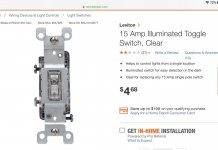
Here is a picture I grabbed from the HD website. Is this the switch you bought?

It is designed to have the clear handle light up when the switch is in the off position. Users report that the glow from the handle is pretty dim so I hope you’re OK with that?

And again...its designed to control an incandescent bulb. Not LED or fluorescent.
 

Attachments

  • 7AAC38D0-648E-4214-95A6-CAD71F929D33.jpg
    7AAC38D0-648E-4214-95A6-CAD71F929D33.jpg
    104.2 KB · Views: 13
Last edited:

Hawk

Well-known member
Joined
Oct 21, 2009
Messages
1,019
Location
Kannapolis, NC
Sounds like you have this?
dimmer.jpg
I am not sure how to help you, but thought that if this is what you have then it may jog some thoughts.
 
OP
R

Ryan Wilke

Well-known member
Joined
Mar 12, 2006
Messages
89
Location
Michigan
Here is a picture I grabbed from the HD website. Is this the switch you bought?

It is designed to have the clear handle light up when the switch is in the off position. Users report that the glow from the handle is pretty dim so I hope you’re OK with that?

And again...its designed to control an incandescent bulb. Not LED or fluorescent.

Shiftless,
Yes, very similar; only difference is the one I bought (and hope to get working) does not have a clear toggle switch,,, refer to the link I posted back on #13.

https://www.lowes.com/pd/Eaton-15-a...H26R&cjevent=7e2f9860088911ea82e1025f0a24060b

Yes, I am simply asking it to control a (old-fashioned) standard 70W incandescent bulb.

So - I tossed the power breaker off again, removed the new switch, released the two black wires from it and twisted them together..... flipped the main power breaker on again, still no light. I removed the target fixture bulb (it is in a recessed light box in the ceiling) by placing it in a different fixture, the bulb lights just fine there.

Hawk,
Yes, that does look like the old switch.

Wylie,
Yes, I do own a multi-meter, but I am very much a novice with it. I also have a two-prong power detector. Like this: https://www.amazon.com/dp/B00093DZZU/?tag=atomicindus08-20

I'm all ears, Guys..... where do I go now? Use my power detector across the black wires twisted together and the bare ground wire inside the box - will that indicate if I have power at the black wires?

Ryan
 

Dustball

Well-known member
Joined
Jun 25, 2011
Messages
2,081
Location
Hudson, WI
I'm all ears, Guys..... where do I go now? Use my power detector across the black wires twisted together and the bare ground wire inside the box - will that indicate if I have power at the black wires?

Ryan

Judging by your skill level, I'd get yourself a non-contact voltage detector
(less than $15 at your local home improvement store) and detect if there's voltage at the switch location first and at the light fixture second if there is voltage at the switch location.

It might be as simple as a bad contact in the bulb socket.
 
OP
R

Ryan Wilke

Well-known member
Joined
Mar 12, 2006
Messages
89
Location
Michigan
Dustball,
I agree, I have a very limited prowess in electrical repairs/properties, but, rather than saddle up and drive 25 miles (one way, yep, I am not a city dweller) to purchase a third tester, is there a way I can use my two wire/prong tester to determine if there's voltage at the switch and at the fixture? If so, please share your knowledge in how I can do so...

Thanks, Ryan
 

Shiftless

Well-known member
Joined
Mar 9, 2014
Messages
14,463
Location
East Bay SFO
So it seems like there is something wrong with the fixture or the wiring that connects the fixture.

Preliminary question...Are there only the 2 black wires and one green you describe in the switch box? Or are there others?

Recessed light box?
Is that a square sheet metal box screwed into your ceiling rafters with a glass diffuser? I used to have a few of those in my 1951 vintage house. Accessible only from the attic. I yanked mine out and put in round recessed lighting fixtures from HALO. (Had to do sheet rocking of course)

Maybe take a pic?

Sounds like that fixture is not readily accessible to check the wiring connections. If the wires going into the fixture are accessible, you could test for voltage there using your tester. Be careful...you have to of course test when the power is ON.
If that tests OK then you have to replace or rewire your fixture.

Are the contacts for the bulb clean and tight like Dustball mentioned?

With the switch box wires twisted together (and taped or secured with a wire nut) you can test for power at the light fixture by putting one wire from your tester on each terminal of the fixture. (If it’s accessible and if you still feel comfortable doing that. The electricity will be ON and you run the risk of shock.

Depending on how accessible those terminals are, you might not be able to safely perform that test.

Here again..risky. You can test for power at the switch box with your 2 wire tester as long as you have a known good ground wire. One of the black wires should be “hot” compared to ground. The other one will not.

With you being a self confessed electrical novice, realize that testing live exposed wires is certainly dangerous. That’s where the non contact tester comes in handy. (As suggested by Dustball). It tests for power on conditions right through the insulation.


At what point do you want to hire an electrician?
.
.
 
Last edited:
OP
R

Ryan Wilke

Well-known member
Joined
Mar 12, 2006
Messages
89
Location
Michigan
So it seems like there is something wrong with the fixture or the wiring that connects the fixture.

Recessed light box?
Is that a square sheet metal box screwed into your ceiling rafters with a glass diffuser? I used to have a few of those in my 1951 vintage house. Accessible only from the attic. I yanked mine out and put in round recessed lighting fixtures from HALO. (Had to do sheet rocking of course)

Yep, I have the square unit as you described.

Maybe take a pic?

Nope, unable to provide a picture.

Sounds like that fixture is not readily accessible to check the wiring connections. If the wires going into the fixture are accessible, you could test for voltage there using your tester. Correct, the wires are in the attic. The attic is not easily accessible.

Be careful...you have to of course test when the power is ON. If that tests OK then you have to replace or rewire your fixture.

Are the contacts for the bulb clean and tight like Dustball mentioned?

I will need to get a mirror and flashlight to look into the socket as the bulb socket is parrallel to glass and ceiling, not pointing down. I can say the inside of the box isn't visibly corroded though.

With the switch box wires twisted together (and taped or secured with a wire nut) you can test for power at the light fixture by putting one wire from your tester on each terminal of the fixture. (If it’s accessible and if you still feel comfortable doing that. The electricity will be ON and you run the risk of shock.
Depending on how accessible those terminals are, you might not be able to safely perform that test.
Yeah, I'll look again, but I'm thinking that option isn't a good one for me. Would it do any good to use the two-wire tester at the switch wires?

At what point do you want to hire an electrician?
As simple as this task seemed to start out, it is quickly approaching that level.....

I'll round up a mirror and inspect the bulb socket for visible corrosion,,,I will look at trying to get my two-wire tester into the socket (without the power on). If it looks doable, then I MAY try it with the power on.

Ryan
 

Shiftless

Well-known member
Joined
Mar 9, 2014
Messages
14,463
Location
East Bay SFO
I just edited my post to describe testing at the switch box.

Go ahead and use your tester in the socket. If it tests good then hooray!
What you might do then is to clean and gently pull the center contact outwards to make better contact with the center contact of the bulb.

Do you have any evidence of rodents up in your attic? I hope not. I had a squirrel up there once..thankfully I got rid of him before he ate through any wiring.
 
Last edited:
OP
R

Ryan Wilke

Well-known member
Joined
Mar 12, 2006
Messages
89
Location
Michigan
So it seems like there is something wrong with the fixture or the wiring that connects the fixture.

Preliminary question...Are there only the 2 black wires and one green you describe in the switch box?
Or are there others?

The box contains two black wires, two white wires and two bare copper wires. The original (dimmer) switch had two black wires coming out of the switch...no screws. Each switch black wire was connected to one of the black wires within the box with a wire nut. So to me, it was evident that the switch was only within the black wire line. Neither the white wires nor the bare copper wires were connected to the swich at all.

With the new switch, I connected each of the two black wires (that were going into the old switch) at each of the brass nuts of the new switch. I added a 4" copper jumper wire attached attaching the two bare copper wires within the box to the green screw on the new switch.


With the switch box wires twisted together (and taped or secured with a wire nut) you can test for power at the light fixture by putting one wire from your tester on each terminal of the fixture. (If it’s accessible and if you still feel comfortable doing that. The electricity will be ON and you run the risk of shock.

The fixture terminals are not accessable, as they are in the attic. However, I may be able to test for power within the bulb socket... one probe at the center post and one at the metal of the bulb socket side threads..?
Depending on how accessible those terminals are, you might not be able to safely perform that test.

Here again..risky. You can test for power at the switch box with your 2 wire tester as long as you have a known good ground wire. One of the black wires should be “hot” compared to ground. The other one will not.

So, if I'm hearing you correctly, I kill the power again. Then disconnect the two black wires from each other. Turn the power back on and CAREFULLY touch one tester wire (of my my two-wire tester) on one of the black wires and the other tester wire on the bare copper wire? If neither black wire lights up the tester, then there is no power coming to the switch....as the hot wire should come to/through the switch...then on to the fixture...correct?

Thanks again for your patience and guidance, Guys... Ryan
 
OP
R

Ryan Wilke

Well-known member
Joined
Mar 12, 2006
Messages
89
Location
Michigan
Do you have any evidence of rodents up in your attic? I hope not. I had a squirrel up there once..thankfully I got rid of him before he ate through any wiring.

I know that's possible. 5+ years ago I had one too, I could hear it running around up there. But I put some DECON killer in the attic and then it got quiet again...... I haven't noticed any attic 'activity / noise' in the past few years......

Ryan
 

Shiftless

Well-known member
Joined
Mar 9, 2014
Messages
14,463
Location
East Bay SFO
You said...
“So, if I'm hearing you correctly, I kill the power again. Then disconnect the two black wires from each other. Turn the power back on and CAREFULLY touch one tester wire (of my my two-wire tester) on one of the black wires and the other tester wire on the bare copper wire? If neither black wire lights up the tester, then there is no power coming to the switch....as the hot wire should come to/through the switch...then on to the fixture...correct?”

.........................

Yes
and Good luck.
 
OP
R

Ryan Wilke

Well-known member
Joined
Mar 12, 2006
Messages
89
Location
Michigan
You said...
“So, if I'm hearing you correctly, I kill the power again. Then disconnect the two black wires from each other. Turn the power back on and CAREFULLY touch one tester wire (of my my two-wire tester) on one of the black wires and the other tester wire on the bare copper wire? If neither black wire lights up the tester, then there is no power coming to the switch....as the hot wire should come to/through the switch...then on to the fixture...correct?”

.........................

Yes
and Good luck.

Thanks for the quick reply.......
I can do this.......

I'll report back shortly....

- Ryan
 

Shiftless

Well-known member
Joined
Mar 9, 2014
Messages
14,463
Location
East Bay SFO
If those white wires are actually neutrals, I’m confused about the wiring at that box.
Were those white wires connected to anything?

I can’t imagine a switch leg with 2 black wires and a couple of “extra” neutrals present in the box. :dunno:
Maybe one of the white wires is half of the switch leg and wasn’t properly identified by painting the white insulation black or wrapping with black tape.

Has anybody been messing around in that box prior to your difficulty with the light fixture? If your old dimmer switch used to work and you used the same 2 wires (black), that MUST be the 2 wires for the switch leg.
I’m still mystified about the 2 whites.

As far as you know, was that circuit installed by a licensed electrician?
 
Last edited:
OP
R

Ryan Wilke

Well-known member
Joined
Mar 12, 2006
Messages
89
Location
Michigan
If those white wires are actually neutrals, I’m confused about the wiring at that box.
Were those white wires connected to anything?

Two cables come into the box, each cable has a black conductor wire, a white conductor wire and a paper-wrapped copper ground wire. The two white wires were / still are connected to each other via a wire nut. The two black wires went to the old switch. The two copper wires were connected to each other.


I can’t imagine a switch leg with 2 black wires and a couple of “extra” neutrals present in the box. :dunno:
Maybe one of the white wires is half of the switch leg and wasn’t properly identified by painting the white insulation black or wrapping with black tape.

I am no help here..there is no evidence of painted wires...


Has anybody been messing around in that box prior to your difficulty with the light fixture?

Not since I've lived here - about 14 years.

If your old dimmer switch used to work and you used the same 2 wires (black), that MUST be the 2 wires for the switch leg.

I’m still mystified about the 2 whites.

Was that circuit installed by a licensed electrician?

I don't know..but if I were to guess, I'd say this whole place was wired by someone's "Uncle Louie".... meaning, I doubt it.

So, as planned - I killed the power again. I disconnected the two black wires from each other. I turned the power back on and CAREFULLY touch one tester wire (of my my two-wire tester) on one of the black wires and the other tester wire on the bare copper wire. ONE BLACK WIRE LITE THE TESTER, the other black wire did not. So, I guess that means we've got juice to the switch. Now - question - would it matter which screw on my toggle switch recieved the hot black? Maybe I need the hot on the top screw -or- on the bottom screw? I don't recall which black I had on which screw... I think we're getting closer!

Ryan
 

Shiftless

Well-known member
Joined
Mar 9, 2014
Messages
14,463
Location
East Bay SFO
The light in your new switch works when a tiny bit of electricity flows in the circuit through the light bulb and the light in the switch handle even when the switch is off. Not enough to light the 70 watt bulb but enough to light the switch. So polarity doesn’t matter. It’s AC. Current flows back and forth each way 60 times per second.

So now we know you’ve got power to the switch leg wire. You need to find the break in the circuit.
1. The hot between the switch box and the junction box in the light fixture?
2. Within the light fixture itself, such as the socket?
3. Somewhere in the neutral between the light fixture and the house fuse box or breaker box.

House wiring is very durable unless rodents chew it. I would first suspect the fixture itself. It’s more than 50 years old, right?

Just guessing here but...
If somebody somehow routed the neutral down and back up from the attic via those 2 white wires in your switch box, a loose connection there would cause your symptoms. Just for the hell of it, turn off the power, untwist those 2 white wires clean ‘em up or clip them and re strip and reinstall the wire nut or better yet, a new wire nut. Can’t hurt...
 
Last edited:

walta

Well-known member
Joined
Jan 13, 2017
Messages
2,308
Location
Dutzow Missouri
Do I have this correct?

1 You are unable to provide the make and model of the original switch or if it is the one I linked to in post #14 based on your vague description.

2 You are unable to provide the make and model and a link for the new switch you purchased.

3 You are unable to take and post a photo of any thing related to this problem?

4 You do not own a volt meter and are unwilling to acquire one.


One has to wonder if you want help or just attention?

Walt
 
To avoid these ads, REGISTER NOW!
Top Bottom