To avoid these ads, REGISTER NOW!

Putty Knife Vs Drywall Taping Knife: Differences?

oldschoolcraft

Well-known member
Joined
Dec 31, 2017
Messages
1,829
Location
Bay Area, California
I picked up a 1.5" putty knife recently for the first time. In the past I've always used old hotel room keys (same size and material as a credit card) when I wanted to fill in some spackle in drywall to plug a small hole from an old screw.

I figured it was time to be a pro about it and picked up an actual putty knife. I also bought a 6" and 10" drywall taping knife set recently because I do need to help out on some drywall repairs.

It seems like the putty knife is just a smaller version of the taping knife. Is that right or is there any differences? I got stainless steel versions of each.

Side question -- am I really going to notice any difference using a putty knife compared to an old PVC card?
 
To avoid these ads, REGISTER NOW!

ssdave

Banned
Joined
Apr 11, 2015
Messages
2,913
Location
Eastern Oregon
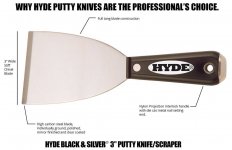
The putty knife is stiffer than a drywall knife or a credit card. It can be used PUSHING, to scrape or cut things. It's edge is usually sharp, so it can be used to cut or chip stuff.
In drywall, it is used to scrape off thick lumps of dry mud, cut a rough edge off before embedding tape, tear tape, and in general, do rough prep work in the first mud coat. I pound on mine sometimes to use it as a chopping blade. You can put a lot more pressure on a putty knife to force mud or caulking or grout or mortar into a crack. It's re-usable; I'd wear out 100 credit cards trying to tape a house drywall job. The handle of the putty knife keeps the mortar or drywall mud off your hands. You can do some limited prying with a putty knife; for instance lifting a tile out of mortar bed to reset it. The putty knife is great for scooping a gob of drywall mud out of a bucket and slopping it onto a joint, or tile mortar out of a bucket to spread out on a floor. Use it to fill a mud tray to use with a drywall knife when you're finishing drywall.

Using the 2 to 3 inch putty knife in drywall is only for the first coat, filling cracks and embedding tape. It's stiffer configuration is good for that. After that, you use a drywall knife to spread compound and feather it out thin. A credit card is just a no tools alternative for one time use.
 

Trey T

Well-known member
Joined
Aug 3, 2011
Messages
3,749
Location
Houston, TX
In the hand of a pro, a 1.5" wide knife of either type does not make a difference. A 1.5" knife is NOT intended to be used for finished work. Finished work requires feathering and any feathering would have to be completed using 6"+ drywall knife.
 

rlitman

Well-known member
Joined
Oct 18, 2010
Messages
24,705
Location
Long Island
In the hand of a pro, a 1.5" wide knife of either type does not make a difference. A 1.5" knife is NOT intended to be used for finished work. Finished work requires feathering and any feathering would have to be completed using 6"+ drywall knife.

A 1.5" soft blade can be good for filling in gouges (made by a putty knife perhaps), and screwholes. Perhaps a plasterer may not use it for finish work, but I find it indispensable before paint goes up.

A 3" knife is perfectly suitable for feathering around box openings, even if it's not large enough to feather over tape.
 

NUTTSGT

Super Moderator
Staff member
Joined
Sep 14, 2009
Messages
51,238
Location
Northern Central Ohio
I think Dave summed it up nicely.

Doing drywall or not, I believe every garage should have a couple of putty knives of various sizes, depending on what you do.
 
To avoid these ads, REGISTER NOW!

CGT80

Well-known member
Joined
Aug 29, 2014
Messages
873
Location
IE, SoCal, USA
Just fill nail holes like a pro............use your fingers!
Same goes for getting a nice bead of caulk.......a tile sponge and fingers.

A knife can leave more material than is needed and on textured walls, you end up with a smooth spot. If the holes are small, just dab the mud/spackle in/on the hole. Leave it overfilled a bit if needed. It will be faster to sand or hit with a wet sponge and look better than using a knife. On new drywall, I used a 6" steel (more flexible than stainless) knife to fill screw holes.

For taping joints, I used mostly 10" and 14" knives. I could cover the area faster with the bigger knives and would start with filling just the joint or recessed portions of drywall (maybe 6" wide) and then would feather out the joint with the second or third coat. I used a 6" knife more for placing mud than for smoothing it out.

My primary/first trade was paint and finish work and I was never on a drywall "crew" but have drywalled plenty of rooms and did a great deal of repairs from various types of damage and also commercial buildouts where a few walls or rooms were added, or doors and windows were moved.

A 1.5" knife is good for window glazing or mixing bondo or similar fillers. They can let you put more force on a small area. It all depends on what works best for you.
 

rlitman

Well-known member
Joined
Oct 18, 2010
Messages
24,705
Location
Long Island
My understanding was pushing vs pulling, stiff vs flexible, scraping up vs pushing down material

Well, the flexible is just for pulling. The stiffer knives can be for both. It depends on what you're applying. For a muddy spackle, more flexible helps you get a smoother finish when pulling. But when spreading something like bondo, that's quite a bit thicker in consistency, you may want a slightly stiffer knife, and that's where a putty knife comes into play.

Ever work with glazier's putty? That stuff is harder than modeling clay, though it softens a bit when you warn and work it in your hands. You'd never be able to spread it with a very flexible knife.
 

kctyphoon

Banned
Joined
Jun 9, 2014
Messages
9,102
Location
Jersey/Staten Island
Well, the flexible is just for pulling. The stiffer knives can be for both. It depends on what you're applying. For a muddy spackle, more flexible helps you get a smoother finish when pulling. But when spreading something like bondo, that's quite a bit thicker in consistency, you may want a slightly stiffer knife, and that's where a putty knife comes into play.

Ever work with glazier's putty? That stuff is harder than modeling clay, though it softens a bit when you warn and work it in your hands. You'd never be able to spread it with a very flexible knife.

I speaking in terms of drywall and taping.. i have zero experience with that other stuff.
 

rlitman

Well-known member
Joined
Oct 18, 2010
Messages
24,705
Location
Long Island
I speaking in terms of drywall and taping.. i have zero experience with that other stuff.

Understood. I'm just bringing up where the "putty" term came from.
But yeah, a stiffer knife is great for scraping down spackle. It makes much less dust than sanding.
 

kctyphoon

Banned
Joined
Jun 9, 2014
Messages
9,102
Location
Jersey/Staten Island
Generally speaking, a small putty knife is probably like the leatheramn of the drywall world.. it probably gets used for EVERYTHING it can possibly be MISused for..
 

rlitman

Well-known member
Joined
Oct 18, 2010
Messages
24,705
Location
Long Island
Generally speaking, a small putty knife is probably like the leatheramn of the drywall world.. it probably gets used for EVERYTHING it can possibly be MISused for..

Is it just me picturing using one on switch plate screws now? I know I've gently used mine as a pry bar. Not for prying, but just to wedge open enough of a gap to then get a real prybar in behind molding.
 
To avoid these ads, REGISTER NOW!
Top Bottom