To avoid these ads, REGISTER NOW!

PVC drainage questions

MerlinsBeard

Well-known member
Joined
Mar 27, 2020
Messages
397
Location
MD
I have a small first-timer drainage project where I'm planning to trench 4" PVC drainage from gutters installed from my shed to daylight near the pond. Here is the basic outline.

Two gutters, approximately 10 feet apart on right hand side of shed (small shed, only 10x16).

2x3" to 4" PVC adapter, both gutters
4"x4"x3" Wye fitting, 3" for cleanout, both gutters
90 deg PVC elbow, both gutters

The back gutter PVC run is basically a straight run to daylight after the 90 elbow. The front gutter PVC run I plan to use a 45 deg elbow after the 90 deg elbow and connect to the back PVC run via 4x4x4" Wye fitting.

My questions are:

1. Grade - 1/4" or 1/8" per foot
2. Burial depth - is there a minimum depth I should shoot for?
3. Glue conduit - yes, no, certain sections?

If I do glue conduit, my thought is that it's best to glue all the underground components, which would be everything after the outgoing section from 90 deg elbows in the ground. I'm not familiar with the effects of frost heave, but I'd prefer to avoid drainage problems from ground movement if I can put in a little extra effort to avoid them.

The length is not excessive, perhaps 30 feet at most from side of shed to expected outlet near pond. The backyard does have a grade that slopes downward toward the pond.

Any suggestions are appreciated.
 
To avoid these ads, REGISTER NOW!

56Mark

Well-known member
Joined
Oct 26, 2014
Messages
359
Location
Fall Branch, TN
1. I would follow the grade of the ground if it is sloping away. It is collecting from a small area, any slope should work.
2. I would not worry about frost heave on a gutter pipe, however most of mine is below the frost line here, 16", but obviously shallower where it comes out of the ground. If you might drive anything heavy across it, I would go at least a foot and use schedule 40 pipe, not the thin wall stuff.
3. If you never plan to move it, I would glue. If you might move or rework, you can put short sheet metal screws in each joint about 3 places around each joint and it should hold.
 

65ranchero

Well-known member
Joined
Dec 16, 2020
Messages
5,068
Location
Danville, VT left NJ forever
When I did mine I used bell end green thin wall and just slip fitted them and it's buried ant where from 6/8 " to 2 feet and goes to day light.
Like this :https://www.lowes.com/pd/Charlotte-...VZAnnCh3qHwBJEAQYASABEgJ-RvD_BwE&gclsrc=aw.ds https://www.googleadservices.com/pa...jV8-Glg4TyAhVxFzQIHa_nDi8Q9aACegQIARBI&adurl= https://www.googleadservices.com/pa...jV8-Glg4TyAhVxFzQIHa_nDi8Q9aACegQIARBI&adurl=
the only time I have a problem is one pipe will freeze near the end of the winter is because the snow pack in the ditch at the end of snow clearing season blocks the daylight end
 

ace10

Well-known member
Joined
Dec 17, 2017
Messages
1,490
Location
Rural NoVA
Coupling the downspouts directly to drainpipes can lead to blockages due to freezes and debris. With no practical way to clear them.

Dumping into basins will greatly reduce the chances of those problems.

Like this
.20210722_104624.jpg
 

kbs2244

Well-known member
Joined
Nov 11, 2006
Messages
14,065
This is how my sump pump and down spout system works.

The first PIC is the over all “Christmas Tree” at the back r of the house.

It shows the two downspouts into 4 inch PVC tees and the smaller 2 inch sump pump into a 4x2 inch tee.

The 2 inch goes in under the down spout trash screens. The exit into the larger pipe provides a vacuum break that prevents any back flow. You might be able to make out tee and a ball valve in the 2 inch line. That is because I use that tee in the spring to the sump water for filling the swimming pool.

(I have borrowed the term Christmas Tree from the oil industry. It is their term for a collection point of many underwater wells to a pumping to a station. I am relying on gravity, but I am collecting from 3 sources.)

The two down spouts are from the front and back sides of the house. Between them they collect over 80% of the roof area of a 4 bed room, two story, Colonial. Sorry, I don’t know the SF off the top of my head.

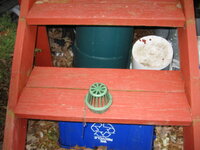
This is what I use to keep leaves and such out of the long pipe. It is meant to be a leaf guard for flat roof drains.

I turned it upside down and slipped it into the 4 inch PVC bell. I did have to whittle away a bit on the flange to get it to fit. I used the wire brush on my bench grinder for this. It is shown right side up, I flipped it over.

This PIC shows the screens in place. I have tied some twine on them to make it easier to take them out for cleaning. They work very well. Even with down spout guards in the gutters some stuff gets through. The peace of mind it gives me by keeping trash out of the long underground run was worth the small cost and effort.

This is where the drain goes. 180 feet away.

This is the end in the woods.

I had to keep the pipe high. It goes over some of my septic system. It is no where near being below the frost line. So I had to keep enough slope in it to drain it dry after each use to prevent a freeze blockage. This was my biggest concern of the whole project. Over the 180 feet of run I did not have more than a foot of elevation to work with.

To maintain that slope I used a 4 foot level with a full bubble off level at each joint. I used the light weight gray pipe because I will never be driving over it with anything but a lawn tractor. It came in 20 foot lengths. To make sure I wouldn’t get low spots in the run I did several light back fills with soaking after each. That settled the dirt under the pipe. I checked the slope a day after each backfill. If I got low spots I had loops of twine that I had put around the pipes as I laid it. This gave me an easy handle to lift the pipe with before throwing in more dirt and soaking again.

The soaking of the backfill is absolutely needed. The pipe will sag without a firm base and you will get low spots that will freeze. I don’t remember how long it took. It may have been a week of small backfills before I felt comfortable covering it up.
 

Attachments

  • House to Woods.JPG
    House to Woods.JPG
    241 KB · Views: 99
  • Open End.JPG
    Open End.JPG
    269 KB · Views: 113
  • Overall tree.JPG
    Overall tree.JPG
    214.2 KB · Views: 109
  • Roof Drain.JPG
    Roof Drain.JPG
    167.1 KB · Views: 110
  • showing drain screens.JPG
    showing drain screens.JPG
    126.1 KB · Views: 101
  • Two Downspouts.JPG
    Two Downspouts.JPG
    161.7 KB · Views: 104

NWOhioChevyGuy

Well-known member
Joined
Feb 20, 2007
Messages
1,923
Location
Buckeye Hill (Morenci, MI)
I am using these basins however instead of the single downspout elbow I am using two and turning the water/discharge down straight into the basin. Do a search and they show on heavy rain flow can shoot high flow right across the grate.
Coupling the downspouts directly to drainpipes can lead to blockages due to freezes and debris. With no practical way to clear them.

Dumping into basins will greatly reduce the chances of those problems.

Like this
.20210722_104624.jpg
 

Bretny

Well-known member
Joined
Jul 31, 2017
Messages
3,918
Location
Dutchess county NY
I have downspouts directly to smooth pipe. In fact about 1500sqft of roof with maple trees over them. The pipe flushes its self out. I usualy get more clogs at the top of the down spout elbows. I also get freezing temps and only clean my gutters about 2x a year. Anything in the gutter that makes it to the downspout is flushed out the pipe that is day lighted about 30ft away.
 

ace10

Well-known member
Joined
Dec 17, 2017
Messages
1,490
Location
Rural NoVA
I am using these basins however instead of the single downspout elbow I am using two and turning the water/discharge down straight into the basin. Do a search and they show on heavy rain flow can shoot high flow right across the grate.

The 12" are much better than the 9s at containing the running water. The next step is landscape rock in the beds which will serve as a backstop for the really heavy rains that still flow over.
 

Leaflessshadetree

Well-known member
Joined
Aug 1, 2013
Messages
7,146
Location
Don't ask.
Mine are buried about 6" deep to the top of the pipe). I can lift my downspout adapters if I ever need to "clean out" the pipes (I glued the straight secions and elbows).
In your situation I'd probably run both downspouts to a wye (or Tee) and then just one one pipe. Just to save some digging, a few fittings and 20-30 ft of pipe.
 
OP
M

MerlinsBeard

Well-known member
Joined
Mar 27, 2020
Messages
397
Location
MD
Thanks for the feedback. I was planning to do pretty much exactly what you said, use a wye to tee the two drainage lines together and glue the straight sections up to the outlet of the 90 deg elbow. I may glue the inlet to the elbow, haven't decided yet. I plan to leave all the above ground connections glue free. Hopefully weather holds out and I can get try to get it in this weekend.

Other thing I've run into is that I had a big dirt pile next to the shed that had a bunny burrow with 4 little baby bunnies. They weren't in the direct path of the drainage, PVC I planned but I can't get the landscaper to finish with them there. And I researched and found that relocating them at that age is a death sentence if the mom can't find them (they don't really have a smell that bunnies can track). When I found them, they all had their eyes closed. I still move the big pile of dirt, but built a little sod burrow. Have to wait and see, they're still alive since I did this last weekend.
 

PoorUB

Well-known member
Joined
Mar 29, 2021
Messages
11,622
Location
Fargo, ND
I wouldn't let some wild bunnies hold up my projects, and I wouldn't kill them needlessly either, but, trust me, there will be more bunnies! We have a bunch of rabbits around here. We see 2 to 3 sets of young ones every summer. They breed like....well, rabbits!

In a way it is funny. We like to see the rabbits running around. They don't do any damage other than eat out some of our outdoor plants and my wife has figured out what they like and what they won't touch. We toss the rabbits table scraps in the winter, and my neighbor is always trying to figure out how to get rid of them! He complains that they eat his flowers. They do, and they eat our flowers too, we just plant more!
 

ace10

Well-known member
Joined
Dec 17, 2017
Messages
1,490
Location
Rural NoVA
You really don't want rabbits around your house.

Beside the landscape destruction, they are fantastic hosts for ticks and may perpetuate Lyme disease.
 
To avoid these ads, REGISTER NOW!

nashbalto

Active member
Joined
Aug 14, 2020
Messages
43
Location
Baltimore
Dear magical facial hair,

I would recommend a 2 % grade (as you have stated) 1/4" ÷ 12" = 2%.

Other option from spout to grate (as Ace has suggested) is adding a wye conn at the spout connection as a clean out for flushing and inspection access but making it closed at that connection point. Less stuff to hit with the mower

Both options allow a camera view if desired to inspect the pipe. My house came with this set up and it has worked well for the 23 years for me (thanks to the civil engiineer who lived here with his family from 1947 through 1983).

I also added gutter helmets in 2002 (+/-) time frame to keep the debris out in the first place. I have 24 squares of roof area to drain.

During normal rains the 2% will help flush. More than that and the debris can build up and the water will run past it. (Municipal sewer experience).

Cheers, Nashbalto
 

Attachments

  • 20210801_091127.jpg
    20210801_091127.jpg
    629.5 KB · Views: 57

nashbalto

Active member
Joined
Aug 14, 2020
Messages
43
Location
Baltimore
Magic,

One more thing: i am in favor of gluing pvc once evrything is laid out and fitted.

If you need to change something in the future, and after cutting out the section you need to alter, it is very easy to accomodate with a straight slip coupling (no stop in the inside diameter). The slip type coupling allows you to slide the coupling to one side, drop your new piece in place, then slide the coupling back over and glue. Black Sharpies help keep track of insertion depth.

Cheers,
Nashbalto
 

nashbalto

Active member
Joined
Aug 14, 2020
Messages
43
Location
Baltimore
I missed the detail where you back yard slopes to a pond. 2% would probably put your outfall in mid slope.

As '56 said, follow the existing slope.
 
OP
M

MerlinsBeard

Well-known member
Joined
Mar 27, 2020
Messages
397
Location
MD
Update

I got rained out last weekend so I'm looking to get things finalized and installed this weekend.

I've started cutting and dry fitting the material together over this past week and I'm planning to glue the underground pieces together this weekend. The issue is that with 4" PVC I don't really have the strength to force a quarter turn after the two glued PVC ends are connected like I see recommended. I was able to do this quarter turn with the 1 1/2" and 1" electric schedule 80 PVC conduits I put in earlier this year, just not with this size.

The fit is already tight when I try to join two dry pieces together, so the best I can do by myself is hit one end with a mallet to force the PVC into the joint. If it's an elbow, I can spin the elbow a little bit with a mallet to force a little rotation. I just can't seem to wrench it at all bare handed.

I know it's just storm water pipe, but I'm wondering if anyone has any tips from their experience. I have a couple sawhorses that I use to cut PVC, but nothing to really anchor it down. Any suggestions are welcome.
 

csp

Well-known member
Joined
Mar 23, 2010
Messages
5,719
Location
Franktown, CO
It's drain pipe and if it leaks a little bit of drain water into the ground does it really matter? Not being under pressure the likelihood of a leak is minimal. If this were under pressure the quarter turn would be important to ensure even gluing, but you're making this a bigger deal than it needs to be. Glue up the joints, push them together and walk to the next one.

Sometimes instructions and best practices require some context of what they were written for vs the job at hand.
 

Bretny

Well-known member
Joined
Jul 31, 2017
Messages
3,918
Location
Dutchess county NY
Just push it together and turn it as much as you can. It's not an interior drain pipe. You may also want to "bed the pipe" to prevent the soil from seddling different or causing a belly in the pipe.

I ran 100ft of septic line from my tank to my Dbox a year ago so I needed it to be prety dead nuts on and not have a belly. Bedding the bottom of the trench then bedding around the trench seamed to help.
 
OP
M

MerlinsBeard

Well-known member
Joined
Mar 27, 2020
Messages
397
Location
MD
I got the 4" drainage pipe installed over the weekend and pretty happy with it except for one small section where the slope changes as it goes down to the pond.

If I buried it as is, I feel that the tension in the PVC will over time cause the pipe to push up and potentially break back to the surface. I tried to solve it with a 22 1/2 degree elbow but the amount of angle change was too much.

I think I'm going to try hot sand to try to soften the pipe where the angle needs to change and see if I can localize a bend to reduce the tension for the PVC pipe to straighten out. Saw some videos of filling PVC with hot sand, seems like if I can surround the exterior in a localized area with hot sand that I can get a similar effect.

I'm thinking of cutting two pieces of plywood with a rounded gap that I can hammer into the dirt, kind of like a croquet hoop over the pipe, using that and the trench to make a makeshift sandbox to pour heated sand into. Then I can hammer one of the plywood ends after the PVC is heated to try to force an angle change. Let it cool and should turn back rigid.

Any other ideas?
 

K'ledgeBldr

Well-known member
Joined
Aug 22, 2011
Messages
1,925
Location
Johns Creek, GA
I have a small first-timer drainage project where I'm planning to trench 4" PVC drainage from gutters installed from my shed to daylight near the pond. Here is the basic outline.

Two gutters, approximately 10 feet apart on right hand side of shed (small shed, only 10x16).

2x3" to 4" PVC adapter, both gutters
4"x4"x3" Wye fitting, 3" for cleanout, both gutters
90 deg PVC elbow, both gutters

The back gutter PVC run is basically a straight run to daylight after the 90 elbow. The front gutter PVC run I plan to use a 45 deg elbow after the 90 deg elbow and connect to the back PVC run via 4x4x4" Wye fitting.

My questions are:

1. Grade - 1/4" or 1/8" per foot
2. Burial depth - is there a minimum depth I should shoot for?
3. Glue conduit - yes, no, certain sections?

If I do glue conduit, my thought is that it's best to glue all the underground components, which would be everything after the outgoing section from 90 deg elbows in the ground. I'm not familiar with the effects of frost heave, but I'd prefer to avoid drainage problems from ground movement if I can put in a little extra effort to avoid them.

The length is not excessive, perhaps 30 feet at most from side of shed to expected outlet near pond. The backyard does have a grade that slopes downward toward the pond.

Any suggestions are appreciated.
This is a lot of work- for what?
What exactly are you wanting to achieve? Do the drains really need to go that far for downspouts? If the end goal is to get roof runoff away from the structure/foundation, 10-12' should be more than ample. Just use pop-ups at the end of the pipe.
 

csp

Well-known member
Joined
Mar 23, 2010
Messages
5,719
Location
Franktown, CO
If I buried it as is, I feel that the tension in the PVC will over time cause the pipe to push up and potentially break back to the surface. I tried to solve it with a 22 1/2 degree elbow but the amount of angle change was too much.

Any other ideas?
Sounds like you're looking for a problem to solve.
 

mcspeed

Well-known member
Joined
Jul 13, 2017
Messages
82
You want a sealed system. Proper micro mesh gutter screens will keep debris out of your drainage. Downspouts connect and seal to your pvc drains. They will not require cleaning if you prevent debris from entering.

Basins will allow debris in and plug your drains.

Don’t use corrugated pipe either…..it has about 1/2 the flow rate of pvc for same size.

I’m in the irrigation and drainage business and find that people know very little about doing it properly (even though they think they do).

People spend thousands on drainage done poorly only to have it fail in a short period of time.

Do it properly and you will never have to clean your gutters or drains.
 

p00p

Well-known member
Joined
Nov 23, 2019
Messages
1,997
Location
42.4974° N, 82.8964° W
What I find with most draining situations is that the system is trumped by achieving an aesthetically pleasing outcome over actual functionality; mainly for exposed systems.

My gutters looked "good" in regards to appearance, but I was tired of the poor performance & redid the pitch to have it facilitate better directional flow. Does it "look" slightly off from the curb? Yes, but I have not had to take runoff to the face when it's raining while using the entry door, going into the garage. The change also decreased the need for me to clean the gutters annually. Rather have function over looks in this case. It's not a huge noticeable change in pitch, but if you're looking for it, it'll stand out to the trained eye.
 
To avoid these ads, REGISTER NOW!
Top Bottom