Everything I've been able to find on youtube has people using long pieces of flexible repair pipes. My leak is at the splice. Do I just cut both ends of the splice and glue in a new splice? Sorry if that's the wrong term. I bought some PVC primer and cement, just need to know what else I need. For extra fun, I think that may be my gas line and telecom.


You are using an out of date browser. It may not display this or other websites correctly.
You should upgrade or use an alternative browser.
You should upgrade or use an alternative browser.
PVC leak at union/splice
- Thread starter czgunner
- Start date
75gmck25
Well-known member
What is the purpose of this pipe? Is it just a lawn sprinkler pipe?
At minimum you'll need to add some pipe back in.
The "right" way is a coupling and a slip coupling, but that takes a bit of skill.
If it's just irrigation, I've seen a lot of fixes using 90's to offset/jog the repair section to the side, allowing for standard fittings and straight on glueing.
The "right" way is a coupling and a slip coupling, but that takes a bit of skill.
If it's just irrigation, I've seen a lot of fixes using 90's to offset/jog the repair section to the side, allowing for standard fittings and straight on glueing.
Hooked
Well-known member
It's possible that the pipe itself may have cracked/split at the union. I would cut the pipe a few inches back on each side to repair it.
Yes, it is a sprinkler line. Thank you.What is the purpose of this pipe? Is it just a lawn sprinkler pipe?
Thank you.It's possible that the pipe itself may have cracked/split at the union. I would cut the pipe a few inches back on each side to repair it.
If it's for an always pressurized line, do it right. I'd almost just replace the whole line.
Irrigation you have a few options. Your local sprinkler supply shop should have a lot of options. The slip fix ones that are telescoping work well.
 www.ewingoutdoorsupply.com
Irrigation you have a few options. Your local sprinkler supply shop should have a lot of options. The slip fix ones that are telescoping work well.
Search results for: 'Slip-fix' - Ewing
rlitman
Well-known member
No. The maximum test pressure on that is 4.3PSI. Even on an irrigation zone that is not continuously on, sprinkler heads should be getting a minimum of 30PSI (and really 40PSI and up for ideal pattern), and a Fernco (even a shielded one) is NOT up to that task.
tl;dr: Fernco couplings are for unpressurized gravity drains.
ALinCarolina
Well-known member
rlitman is right. That is for Drain/waste/vent pipe. you probable don't have any slack in the pipe at that location unless it is near a 90 or something so after you cut out that coupling (that is what that fitting is called) you will have a gap. Look up and down the pipe to see what size it is. Generally 1/2, 3/4, 1, or 1 1/4 inch. Go to the big box store and get that size in a slip repair fitting. You will need to also buy a coupling for that size to use on one end of the fitting. The other end will have a female fitting of that size already. Part of the fitting will slide to make it longer or shorter, with an O ring inside to seal. Cut the pipe out just a little bigger than the shortest length of the fitting you can make it with the coupling glued to the sliding end of the fitting. Then glue and slide the moving part to the other end of the pipe.
ALinCarolina
Well-known member
If you can't see what size pipe that is take the cut piece to the store with you to match it.
You also could use a union to join your pipes.
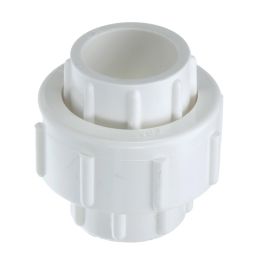
 www.247garden.com
3/4 in. PVC Union w/ EPDM O-Ring Schedule-40 Pipe Fitting Slip/Socket
Need NSF-certified? Click here.
www.247garden.com
rlitman
Well-known member
Could be telecom. Do I read 80PSI on the black pipe. That looks like more irrigation line to me. Do you have PVC for the pressurized main and black poly pipe past the zone valves?...For extra fun, I think that may be my gas line and telecom.
Around here, poly gas pipe is yellow. My 20+ year old poly natural gas service was just dug up and replaced last week, and that line was orange. Black would be very unusual for gas, and 80PSI poly pipe is thin wall. Gas uses a heavy wall poly.
Could be telecom. Do I read 80PSI on the black pipe. That looks like more irrigation line to me. Do you have PVC for the pressurized main and black poly pipe past the zone valves?
Around here, poly gas pipe is yellow. My 20+ year old poly natural gas service was just dug up and replaced last week, and that line was orange. Black would be very unusual for gas, and 80PSI poly pipe is thin wall. Gas uses a heavy wall poly.
100% that black pipe is irrigation poly especially with an 80psi rating. The fact its all super shallow and within close proximity to each other I'd bet the black cable is a multiconductor cable for the valves.
75gmck25
Well-known member
Irrigation pipe that size is usually quite flexible if you dig the dirt out in both directions along the line, or from side to side. Then use a short section of new pipe and two slip-on couplings you install with PVC cement.
It helps to have someone work with you, since you have to bend the pipe a little to get it in the 2nd coupling when you glue it, but PVC like that will flex quite a bit.
It helps to have someone work with you, since you have to bend the pipe a little to get it in the 2nd coupling when you glue it, but PVC like that will flex quite a bit.
Yes, I had to repair a 2" pvc line that the landscapers found with a ditch witch (yes, it was buried to code, but they were going deep for new pipes). If you can get about 3' of slack on either side, it should be pretty easy. Cut out the bad coupling, glue in a new coupling and overlapping length of pipe. Drop both lines back down and mark where they "meet" and cut it back just a hair, maybe 1/16" gap. Glue one side of the coupling, let it set, pick up both sides and prep (primer, glue), then lower both sides until you can start/wedge the pipe end into the coupling, and then quickly lower all the way to final depth, all the while forcing the pipe into the coupling. If the pipe is warm (sunny day), it's easier.Irrigation pipe that size is usually quite flexible if you dig the dirt out in both directions along the line, or from side to side. Then use a short section of new pipe and two slip-on couplings you install with PVC cement.
CraigStu
Well-known member
I don't see any evidence primer was used in the initial install so be sure you use it on the repair. I really does make a stronger joint.
fitter30
Well-known member
Standard coupling, short piece of pipe, repair coupling ( doesn't have the center stop in middle) glue and primer. Pipe and standard coupling get glued, then on to existing pipe, new pipe should be cut close to old pipe, clean pipe and fitting put glue on both pipe and fitting. Watch you tube video or two.