To avoid these ads, REGISTER NOW!

Quarter inch bolts

bluedog225

Well-known member
Joined
Jan 31, 2012
Messages
3,296
Location
Texas
For whatever reason, I’ve ended up with a bunch of quarter inch bolts. And a hundred or so quarter inch strut nuts.

The bolts are ungraded. At least they’re not marked with the lines that would tell me they were grade 5 or grade 8.

I was hanging a couple of inverters off some unistrut at the place. 120 pounds apiece. I just couldn’t bring myself to hang the horizontal strut with quarter inch bolts. Though when I look up the specs on even the ****** bolts, they seem entirely adequate for the job.

I guess I’ve had too many small bolts snap when I was snugging them up.

Am I being unreasonable or can these bolts be trusted for loads under 100 pounds or so. I’m thinking of things like attaching 2 inch rigid metal conduit to a piece of strut or similar lighter applications. One place I could use these things is to attach solar panels to unistrut. I think the panel would run into issues from wind load before a quarter inch bolt would snap.

My default to date has been to use a minimum of 3/8. Though I know it’s overkill. it feels 100% more reliable.

I’m obviously no engineer; do you guys trust those little bolts with serious stuff?

ps-these Schneider XW Pro inverters are discontinued and on sale for around $900. NAZ solar. 10 year warranty.

IMG_6041.jpeg
 
Last edited:
To avoid these ads, REGISTER NOW!

The Cobbler

Super Moderator
Staff member
Joined
Oct 24, 2013
Messages
25,928
Location
Niagara Region, Ontario, Canada
I’ve had too many small bolts snap when I was snugging them up
maybe you're tightening them too tight . for what you're doing a light snug is probably good enough. and unless they are really garbage, I am sure they're up to your task.
I remember an old timer ( years ago) telling me that a 3-1/4" spike into wood will hold something like a ton of weight
 

wssix99

Well-known member
Joined
Mar 2, 2011
Messages
5,161
Location
Chicago, IL
Yea, I trust crappy bolts in that situation because they are in shear vs. tension. The force vs. what the material can hold is minor.

As you pointed out, your biggest enemy is snapping bolts due to over-tightening. You can use tables like this: https://boltdepot.com/Fastener-Info...issA1FdVrV_alObUH6YkBYsNXSD7AbN-rksdmUkt5fr2e

^ Then test some of your bolts with a proper torque wrench to see where you are or use a torque wrench for the final tightening.
 

four.cycle

Well-known member
Joined
Oct 19, 2015
Messages
28,953
Location
Tacoma, Washington
I don't have a clue.

When OSHA came into our warehouse, they noted that the handrail around the upstairs deck didn't meet their requirements, so we had to do some modifications and install "toe plates" at the bottom and beef it up a bit.
In the process, I thought it would be a great idea to double the capacity of our fan-belt hanging area - we were using the outboard side of the top rail of the handrail as the fan belt rack.
So i figured all I needed to do was go up 48 inches, and put another "handrail" up on top of the lower handrail.
I was working in a steel building, so I had to attach dimensional lumber (2" x 4") to 10-inch steel I-beams.
I went down to Northwest Fastener (they were only a few blocks from the warehouse) and showed them the plan I'd drawn up and asked what I could use for hardware to put it all together.
They sold me 1/4-20 USS cap screws and hex nuts.
I was skeptical about the amount of weight a little bolt like that would hold, as several thousand fan belts collectively is a lot of weight.
He said that a 1/4-20 USS cap screw can carry a static load of something like 10,000 pounds.

I snapped off a few dozen of them with a 3/8" Indestro ratchet and a 2743H 7/16" deep-well socket - that was before I finally figured out how strong my right arm really was. (Also required learning how to use a 1/4-20 tap and a thing called a "screw extractor") ;)
 
OP
B

bluedog225

Well-known member
Joined
Jan 31, 2012
Messages
3,296
Location
Texas
Quarter inch tapcons are the worst. They are grabby as heck before they set. I just snapped one of those this weekend. Even being careful.
 

CV428

Well-known member
Joined
Dec 12, 2019
Messages
156
Tension vs shear. In pure static tension, a 1/4" or M6 can hold far, far more than you might imagine. Shear, that's a different story (which is where I use other techniques). Moment loading, same thing (if it isn't fastening two flat surfaces together, or there's a gap, there's a moment factor). A Grade 8 1/4-20 can hold up a small car in even, static tension (meaning no bouncing). Would I ever do this? Absolutely not. This is the example I give to new engineers who aren't sure what hardware sizes to go with. Rule of thumb, I like to aim for a minimum of 1x thread dia on ferrous, 1.5x ideal, 2x for non-ferrous, thread reinforced if intended to be removed. Either the substrate dictates the maximum bolt size (for low load applications), or the substrate thickness is adjusted to appropriate bolt size based on required strength.

Truth be told, if everything was designed to simply a 4x safety factor, everything would look flimsy.


Over-torquing weakens the bolt. Other aspects are the rating and coating. Black oxide rusts. Black zinc has hydrogen embrittlement risks. Lots of factors to consider.

For what you're doing, it'll likely be fine.
 
OP
B

bluedog225

Well-known member
Joined
Jan 31, 2012
Messages
3,296
Location
Texas
I got two boxes of these things at restore. A buck a pound. If I never use another tapcon, I’ll be happy.

IMG_3733.jpeg
 

micromind

Well-known member
Joined
Sep 24, 2023
Messages
3,066
Location
Fernley, Nevada, about 30 miles east of Reno.
If the head are not marked, most likely they are grade 2.

A 1/4 - 20 grade 2 can be overtightened to the point of failure with a 6" ratchet or wrench.

As noted, most bolts fail because of over tightening, using a reasonable amount of torque will make the bolt hold a lot more than you'd think.
 

Spareparts

Well-known member
Joined
Mar 12, 2010
Messages
2,045
Location
Lansing Ks.
At TSC their bolts are around $ 5.00 q lb, and on the tag on the bin will show
Quanty in a pound. For about $10. get the 5/16" bolts and not worry about it failing
Piece of mind is priceless.
 

Torque&Recoil

Well-known member
Joined
Dec 13, 2015
Messages
433
Location
NE Ohio
My excuse - I have been drinking. That said, 1/4-20, even grade 2, is surprisingly strong Should be absolutely no problem with your requirement.
 

no704

Well-known member
Joined
Apr 27, 2016
Messages
5,224
Recently looked into this. I need to move an 80lb load around. Due to space constraints I’m restricted to a 1/4” elevator bolt. Rated on McMaster site to be 70,000ksi. Ran tha thru an online calculator. In tension one is good for over 2k pounds.

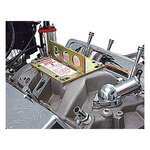
I alwas thought those engine lifting plates that bolt on with the carb screws were pretty sketchy, but I guess not!
 
OP
B

bluedog225

Well-known member
Joined
Jan 31, 2012
Messages
3,296
Location
Texas
Quarter inch bolts are like 2x4’s. I’m sure they are fine but I’m going for the 2x6 every time. Same thing with half inch plywood instead of 3/4.
 
To avoid these ads, REGISTER NOW!

wyb2

Well-known member
Joined
Dec 27, 2012
Messages
188
Location
Southern NH
Unmarked would be Grade 1 or 2, with a min material yield strength of 36,000 psi. That strength times the minor area of a 1/4-20 bolt gets your right around 1,000 lbs.

To get single shear strength, a typical factor is 60%, so 600 lbs.

A safety factor of 3 is generally nice and safe, so we are down to 200 lbs.

If you are concerned that the bolts are of questionable quality, well that’s a judgement call, but I’d go down half again, so 100 lbs.

So I would consider 100 lbs per bolt to be a safe load. Assuming you are using 4 or more bolts to mount 120lbs, you should good to go.

Or you could bolt something to the wall with a single bolt and hang from that something. Bounce up and down a few times for good measure. Assuming you weigh more than 120 lbs, that’s a pretty good indicator.
 

wyb2

Well-known member
Joined
Dec 27, 2012
Messages
188
Location
Southern NH
I will add, as others have said, don’t over torque them. It seems a lot of people used to larger or grade 8 hardware grab their 3/8 ratchet, give it a good yank, and complain that “this crappy home-depot bolt just snapped right off”

A grade 2 1/4-20 bolt wants like 5 ft-lbs, not 25. You could probably get 5 ft-lbs out of a nut driver, though a 1/4 ratchet would be a lot more comfortable.
 

CraigStu

Well-known member
Joined
May 22, 2014
Messages
4,038
Location
Blacksburg, Va
OP I am with you. I used 1/4" to bolt 3/8 pvc sheet to the sides of my little utility trailer to hold the plastic trash cans in on the way to the dump. I thought I'd be smart when building it and used SS. Then a small tree fell on it and I had to partially disassemble to replace one side panel. That's when I learned that SS galls as I had to twist half the bolts until they snapped to remove them and the nuts. It took a lot less effort to twist them off than I thought it would. For your use I'd go 5/16 in a heartbeat. I came back to ad; I used our utility trailer and saw where I attached the tag recently to the expanded metal of the hinged back wall(?). 1/4" bolts worked fine there. :)
 
Last edited:

nateo

Well-known member
Joined
Jul 4, 2018
Messages
186
Location
Embrun, ON
yup four 5/16 bolts holding up a 700 lb Big Block Chevy :)
Huh, I just spent a minute playing with AI search and it looks like four bolts for a big block is actually pretty reasonable.

A 1/4"x20 bolt tightened by hand might put the bolt under 60-90 lbs of tension. Torque it to 5 ft-lbs (less than the spec for a grade 2 bolt) and you're looking at 1500 - 2500 lbs of tension. 4 bolts holding up a 700 lb engine would put about 175 lbs per bolt, which would be in the noise compared to the tension developed by just torquing them down.
 

nadogail

Well-known member
Joined
Jan 23, 2009
Messages
31,998
Location
Coronado, CA
I would use several bolts (4) for that job. If using only one is theoretically strong enough, then 4, one in each corner, would give you a good margin of error.
 

junkyardwarrior

Well-known member
Joined
Nov 17, 2014
Messages
174
yup four 5/16 bolts holding up a 700 lb Big Block Chevy :)

Did junkyard work for a while. I pulled a many 429 and 460 and 390, 360, 302, 351 (W, C, and M) and that I can remember a couple 352's as well--by the distributor. Single 5/16 bolt holding it in. Wrap a cut-off seat belt around it, make a loop on the other end which attaches to the fork, cut bolts and exhaust and such and jerk it on out, sometimes transmission and all.. Never had one break. My personal 460 I pulled from a late 70's Mercury, didn't have a distributor so I used the original 5/16 bolt, a washer I found on the ground and just ran it through a seat belt (pocket knife for a hole). No issue.
 

NUTTSGT

Super Moderator
Staff member
Joined
Sep 14, 2009
Messages
51,021
Location
Northern Central Ohio
When I started filling up my fastener bins, I used Grade 2 bolts. I soon realized how easily they break and swapped to Grade 5 or 8. I figured it was worth the extra cost.

If you have them, I'd probably use them and if need be swap them as out as you go.
 
Last edited:

Codyboy

Well-known member
Joined
Jan 31, 2019
Messages
1,674
Location
S.E. TEXAS
I believe he is referring to the carburetor mounting bolts, which are commonly used to lift engines.
Ahh. I was thinking about on the engine stand.
I guess threw me off as I've never pulled one using the carburetor bolts and have always used the intake manifold bolts which are still 5/16.
 

Fixr

Well-known member
Joined
Dec 23, 2012
Messages
9,708
Location
SW VA
One of those bolts in simple tension would likely be plenty if not overtorqued. But since any one of them would probably be subject to considerable bending stress due to the load being way off-center of any one of them, 4 is probably a safe bet.
 

NUTTSGT

Super Moderator
Staff member
Joined
Sep 14, 2009
Messages
51,021
Location
Northern Central Ohio

One of those bolts in simple tension would likely be plenty if not overtorqued. But since any one of them would probably be subject to considerable bending stress due to the load being way off-center of any one of them, 4 is probably a safe bet.
I wouldn't lift an engine by the carb pad unless I was using a lifting mount, like pictured above, and all 4 bolts.

I think the carb mounting holes was by far the most common "heli-coil repair" on an engine.
 

Codyboy

Well-known member
Joined
Jan 31, 2019
Messages
1,674
Location
S.E. TEXAS
I wouldn't lift an engine by the carb pad unless I was using a lifting mount, like pictured above, and all 4 bolts.

I think the carb mounting holes was by far the most common "heli-coil repair" on an engine.
Ive always just used the opposing corners factory lifting rings. Ive never seen that type adapter before.
Looks like it would probably work OK, but I'd rather go into the heads for lifting.
 
To avoid these ads, REGISTER NOW!
Top Bottom