To avoid these ads, REGISTER NOW!

Question about air compressor wiring

BuffettFan

Well-known member
Joined
Jul 11, 2017
Messages
10,910
Location
Central Illinois
So back in July, I started cleaning, organizing, and generally "Spiffing Up" my garage.
Coincidently, that was about the time I found this site and started perusing the forum almost daily.
This has been good.....and bad. The bad part is that after seeing what a lot of you have done in your garages and shops, I have taken my simple organization project much farther than originally planned. I am happy with the results, don't get me wrong.
I am closing in on the final stages of reconstruction and have one area that I have a couple of questions about and was hoping for some ideas and examples of how others have made the transition of wiring from the electrical panel to their air compressor with finished walls.
Currently, the wire comes out of the breaker box and goes directly to the magnetic starter which is located within a couple of feet of the box.
I want to finish the wall where the breaker box is located, so I don't want a hole with wire coming out of it going to my compressor.
My thought is to mount a disconnect on the wall, wiring between the disconnect and the breaker will be inside the wall, literally about 6" of wire between them, and then from the disconnect to the compressor for a neat installation. Again, just a couple feet of wire.
The breaker is 220V 60amps, #6-2w ground wire. Compressor is rated at 24FLA, has been on this breaker for 15 years with no issues.
Looking at 60 amp disconnects, most seem to be listed as for use with air conditioners. I assume that as long as the disconnect and the breaker are the same rating, and above the max load of the compressor, I am ok. Is this true?
Thanks in advance for any suggestions!
 
Last edited:
To avoid these ads, REGISTER NOW!

amolaver

Well-known member
Joined
Mar 10, 2009
Messages
835
I'm sure someone will have the exact code requirement, but being so close to the breaker (in the same room), I don't believe you need a disconnect at all - the breaker itself suffices. I'd just surface mount a metal box and run liquid tite from the box to compressor. Looks nice and protects the wiring well.

ahm
 
OP
B

BuffettFan

Well-known member
Joined
Jul 11, 2017
Messages
10,910
Location
Central Illinois
I'm looking for a clean looking transition through the wall, not necessarily needing a disconnect.
amolaver, I have to admit that I hadn't considered that option, which was the reason for the thread, to get new ideas. I did stop at Lowes tonight and looked at some options, but didn't se exactly what I had in mind, but this may be a good option. Thanks for the idea!
sberry, if it was more of an industrial shop, I wouldn't be worried about changing anything as I've lived with it this way as long as I've owned the compressor.
I use my garage as an extension of the finished basement at times, as well as beer and wine making, sausage making, etc. almost as much as I do for mechanical repairs and woodworking projects.
I've spent the last 6 months and several thousand dollars making the garage look better and function better and I just would like a nice looking transition for my compressor wiring.
I'd like to see what others have done on their setups.
Thanks!
 

PoorOwner

Well-known member
Joined
Feb 10, 2007
Messages
5,032
Location
CA
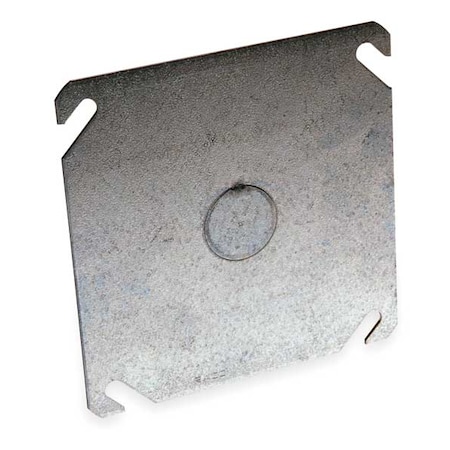
So I was going to say you can just use a 4" metal box with a cover like this too put a whip on, or one of the side conduit holes and blank cover.

Z064sxfo5oy.JPG


However I do think you are required to have a disconnect in sight of such a compressor. Unless, the starter have a switch on it to prevent the motor from energizing, which could satisfy this requirement?
 

Bert_

Well-known member
Joined
Dec 24, 2016
Messages
9,771
Location
NW Iowa
The rating you need to worry about for your disconnects and starters is horsepower, NOT amps. Just because your motor uses less amps that the disconnect rating does not mean it's the right size.
 

wyliesdiesels

Well-known member
Joined
Aug 14, 2012
Messages
20,067
Location
Modesto, CA
So back in July, I started cleaning, organizing, and generally "Spiffing Up" my garage.
Coincidently, that was about the time I found this site and started perusing the forum almost daily.
This has been good.....and bad. The bad part is that after seeing what a lot of you have done in your garages and shops, I have taken my simple organization project much farther than originally planned. I am happy with the results, don't get me wrong.
I am closing in on the final stages of reconstruction and have one area that I have a couple of questions about and was hoping for some ideas and examples of how others have made the transition of wiring from the electrical panel to their air compressor with finished walls.
Currently, the wire comes out of the breaker box and goes directly to the magnetic starter which is located within a couple of feet of the box.
I want to finish the wall where the breaker box is located, so I don't want a hole with wire coming out of it going to my compressor.
My thought is to mount a disconnect on the wall, wiring between the disconnect and the breaker will be inside the wall, literally about 6" of wire between them, and then from the disconnect to the compressor for a neat installation. Again, just a couple feet of wire.
The breaker is 220V 60amps, #6-2w ground wire. Compressor is rated at 24FLA, has been on this breaker for 15 years with no issues.
Looking at 60 amp disconnects, most seem to be listed as for use with air conditioners. I assume that as long as the disconnect and the breaker are the same rating, and above the max load of the compressor, I am ok. Is this true?

Thanks in advance for any suggestions!

Youre way off...

Code does not require a disconnect when less than 50' from and within sight of the breaker box. Dont waste the money on a disconnect.

Second, motor circuits, disconnects and breakers are sized by HP and the FLC table in the NEC NOT the FLA on the nameplate.

So what is the HP rating as listed on the motor nameplate?

Without that, no way to size anything or give you the code permissible answer.
 
OP
B

BuffettFan

Well-known member
Joined
Jul 11, 2017
Messages
10,910
Location
Central Illinois
View media item 79562
I'm learning things here! I thought the amp draw would be the critical information needed.
I realize that a disconnect probably not required, but again, looking for a clean transition.
The motor is rated at 5hp.
Looking at Lowes online last night, I went back to the 60 amp air conditioner disconnect. It is rated for 10hp max. IIRC, price is $16 and change. Non-fused, basically a switch. Not that I have to buy something from Lowes, they just happen to be the closest.
If there is a better option, I am all for it. I want to do this correctly the 1st time.
There is a switch wired in the pressure switch circuit that I use to control the compressor as well.
 

Norcal

Well-known member
Joined
Mar 16, 2008
Messages
13,769
A pullout A/C disconnect is a cheap way to go I prefer safety switches but they cost a lot more then the A/C discos, your choice will be fine.
 
To avoid these ads, REGISTER NOW!

Norcal

Well-known member
Joined
Mar 16, 2008
Messages
13,769
The compressor is in the working space required for that panel.
 
OP
B

BuffettFan

Well-known member
Joined
Jul 11, 2017
Messages
10,910
Location
Central Illinois
It isn't really in front of the panel, but the angle of the picture sure makes it look like it is.
In the 1st pic, the compressor is pulled out from the wall to allow room for me to build the stud wall, so 2 or 3 feet.
IIRC, there is over 30" from the left side of the panel to the wall and the compressor is maybe 24" deep.
The only reason I would have an inspector look at it is if I were selling, and the compressor would be coming with me anyway.
 
OP
B

BuffettFan

Well-known member
Joined
Jul 11, 2017
Messages
10,910
Location
Central Illinois
IIRC, 3' in front, which I have and then some. After I move my tool box, at least.
From laying out a large-ish machine shop in my previous life, I recall the clearance distance increases as the voltage increases.

Off-topic, I once bought a house for a rental property without ever being inside it.
You had to stand in the bathtub to change the fuses.
 

roc_on_the_rocks

Well-known member
Joined
Mar 14, 2010
Messages
1,533
Location
South central Indiana
IIRC, 3' in front, which I have and then some. After I move my tool box, at least.
From laying out a large-ish machine shop in my previous life, I recall the clearance distance increases as the voltage increases.

Off-topic, I once bought a house for a rental property without ever being inside it.
You had to stand in the bathtub to change the fuses.
Advertise it as a feature: electric hair curler included! :shocking:
 
OP
B

BuffettFan

Well-known member
Joined
Jul 11, 2017
Messages
10,910
Location
Central Illinois
Why didn't I think of that!
Silly me, I gutted the bathroom and moved it to another room instead!

I checked the compressor/panel clearance when I got home tonight.
OK, there may be a little interference, but it's my garage, not a commercial shop. Plenty of room to get to the panel, and as I said, if I sell the house, the compressor won't be included in the deal.
Appreciate the extra eyes on the install!
 
To avoid these ads, REGISTER NOW!
Top Bottom