7th Kahuna
Well-known member
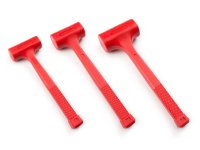
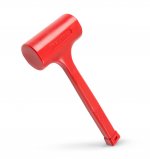
Last week there was a thread here that mentioned Estwing had changed suppliers for their 45 oz deadblow hammer and suggested if anyone was in the market they should take a look as the old style red hammers, made in the USA by Trusty-Cook, were likely superior to the new blue hammers, made in Taiwan by unknown. As a deadblow was on my list of tools to be on the lookout for, I decided to hit a couple of Home Depots and see what I could turn up. I had heard that the Harbor Freight deadblows were 'ok' but I take any HF tool rating with a grain (or maybe three grains) of salt. I read the reviews for the Estwing hammer and they were all great but the buyers were using them to drive stakes and set bricks and other uses that in my estimation are not preferred deadblow applications. In any case, I was able to find myself an Estwing 'Trusty-Cook' Deadblow. At three times the cost of the Harbor Freight model, I would like to get at least three times the use out of it. Thus my questions.
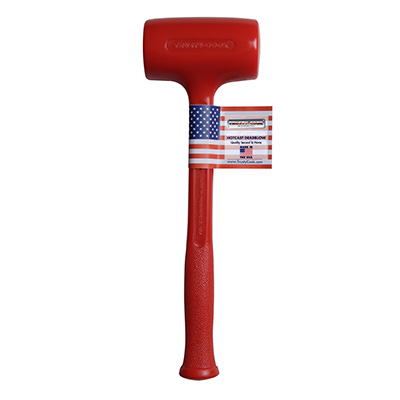
During my tour of local Home Depots, I actually found several of the older red hammers, half had been abused, either in store by employees, or returned by a customer who, given the benefit of the doubt, thought the cuts to the face of the hammer were a result of an inferior construction rather than an improper use. I don't want that to be my fate as well.
Questions:
My primary question goes to the proper use of a deadblow. Obviously (or maybe not?) if you are replacing chrome or a similar material, the deadblow would be in direct contact with the part. If I am driving a motor arbor out of a mounting bracket, then I assume I would place a piece of wood or something soft between the hammer and the 'target'. In reading online, it seems there are a fair number of individuals who treat deadblows as disposable. Just how long should a deadblow be expected to last? I still have the tools my parents gave me as a kid. Can I expect the deadblow, if used properly, to give me similar durability? Are cuts and abrasions to be expected and 'within spec'? What are the rules for proper deadblow use?
My second question is just what is a deadblow for. More specifically, the market is full of different 'soft face' hammers. I assumed they had different uses but then read the following with respect to the Trusty-Cook deadblow:
"Outlasts Rawhide, Rubber, Brass, Lead, Nylon and Other Plastic Type Heads by 10-20 Times"
So how specific are the uses to the individual hammer types? In practice, is it more about size and weight than about material composition? If I were setting bricks or tile I think a rubber mallet would be my preferred tool. If I were disassembling a lot of electric motors, maybe I'd choose a nylon face. I have a small rawhide hammer I picked up a while back I use for setting hand plane blades. Not sure what that one is 'best' suited for. Does a set of Trusty-Cook deadblows really replace the other hammer types or is that just good marketing?
Thanks in advance for your instruction.
During my tour of local Home Depots, I actually found several of the older red hammers, half had been abused, either in store by employees, or returned by a customer who, given the benefit of the doubt, thought the cuts to the face of the hammer were a result of an inferior construction rather than an improper use. I don't want that to be my fate as well.
Questions:
My primary question goes to the proper use of a deadblow. Obviously (or maybe not?) if you are replacing chrome or a similar material, the deadblow would be in direct contact with the part. If I am driving a motor arbor out of a mounting bracket, then I assume I would place a piece of wood or something soft between the hammer and the 'target'. In reading online, it seems there are a fair number of individuals who treat deadblows as disposable. Just how long should a deadblow be expected to last? I still have the tools my parents gave me as a kid. Can I expect the deadblow, if used properly, to give me similar durability? Are cuts and abrasions to be expected and 'within spec'? What are the rules for proper deadblow use?
My second question is just what is a deadblow for. More specifically, the market is full of different 'soft face' hammers. I assumed they had different uses but then read the following with respect to the Trusty-Cook deadblow:
"Outlasts Rawhide, Rubber, Brass, Lead, Nylon and Other Plastic Type Heads by 10-20 Times"
So how specific are the uses to the individual hammer types? In practice, is it more about size and weight than about material composition? If I were setting bricks or tile I think a rubber mallet would be my preferred tool. If I were disassembling a lot of electric motors, maybe I'd choose a nylon face. I have a small rawhide hammer I picked up a while back I use for setting hand plane blades. Not sure what that one is 'best' suited for. Does a set of Trusty-Cook deadblows really replace the other hammer types or is that just good marketing?
Thanks in advance for your instruction.