To avoid these ads, REGISTER NOW!

Question about pressure testing Mini Split

newpain01

Well-known member
Joined
Nov 3, 2023
Messages
128
Location
Eastern NC
I installed a mini split in my garage last year and it worked fine for 6+ months and then stopped. When I turn it on, the fan kicks on but not the compressor. I suspected that the refrigerant leaked out, so hooked up some gauges and it's shows 0 psi, guess that's why the compressor doesn't turn on. It's should have 17oz of that eco gas, R32.

Called a couple HVAC guys and they do not want to work on DIY mini splits. The other day I found a guy who said he can refill it after I fix the leak, but other than that he doesn't want to work on it to find the leak or do a pressure test.

I know they use nitrogen for pressure testing, but I don't have any and don't really want to spend $200+ to get a tank just for this one time use.
I do have a lot of CO2 and two tanks of pure argon for welding, so I am wondering if I can use those for the pressure test. I heard CO2 is not recommended because it might have moisture but I want to hear opinions if anyone used argon or CO2.

If so, what kind of adapter do I need to connect the regulator to the HVAC gauges (yellow hose) and what pressure do I need for the test? He told me if I am using nitrogen to get it to 300psi and listen for hissing.

Any help appreciated!
 
To avoid these ads, REGISTER NOW!
OP
N

newpain01

Well-known member
Joined
Nov 3, 2023
Messages
128
Location
Eastern NC
I have used argon on my ac units. Worked just fine. For me it was better than buying a nitrogen tank for a small amount of use.
Thanks! That's my point too, I already have the argon. How did you connect the HVAC manifold to the argon regulator and what pressure did you use?
 

danski0224

Well-known member
Joined
Jan 29, 2005
Messages
13,659
Location
Near Naperville, IL
If so, what kind of adapter do I need to connect the regulator to the HVAC gauges (yellow hose)
A nitrogen regulator has a SAE flare fitting for the A/C charging hoses. If you will not be using a N2 regulator, then you may need to remove the existing low side fitting on the regulator that you have or will use, and get a low side fitting that will work.
and what pressure do I need for the test?
The individual components will have a test pressure specified on the product label. That is the information you need.
He told me if I am using nitrogen to get it to 300psi and listen for hissing.
I would not assume the pressure number without verifying on YOUR equipment. I would not take random advice from random strangers on the internet about the proper test pressure for your piece of equipment. I have seen anything fro 250 to 700 psi specified as a test pressure, and the duration is typically 24 hours.

I would also not assume that you will be able to hear the leak.

You may be able to see evidence of a leak by oil staining. If I was a betting person, my money would be on a leaking flare connection, or two. It isn't easy to make a GOOD flare that doesn't leak. They leak/fail when people do not use a torque wrench as specified by the manufacturer. Leaking flare connections have ALWAYS been oily in my experience.

If it is leaking in the evap or condenser coil, you are probably screwed.

The people you talked to do not want to mess with finding the leak because it can be a pain in the ***. It very quickly escalates into a whole lot of money at customer pay rates.

You may want to find an installation and operating manual and read it to see if there is a service mode that is required in order to recover refrigerant, pressure test or install refrigerant. Doing it wrong will **** up the equipment. Some new equipment is "preset" from the factory, and it all changes when power is applied for the first time.
 
Last edited:

Firebrick43

Well-known member
Joined
May 12, 2015
Messages
14,307
Location
West central Indiana
I installed a mini split in my garage last year and it worked fine for 6+ months and then stopped. When I turn it on, the fan kicks on but not the compressor. I suspected that the refrigerant leaked out, so hooked up some gauges and it's shows 0 psi, guess that's why the compressor doesn't turn on. It's should have 17oz of that eco gas, R32.

Called a couple HVAC guys and they do not want to work on DIY mini splits. The other day I found a guy who said he can refill it after I fix the leak, but other than that he doesn't want to work on it to find the leak or do a pressure test.

I know they use nitrogen for pressure testing, but I don't have any and don't really want to spend $200+ to get a tank just for this one time use.
I do have a lot of CO2 and two tanks of pure argon for welding, so I am wondering if I can use those for the pressure test. I heard CO2 is not recommended because it might have moisture but I want to hear opinions if anyone used argon or CO2.

If so, what kind of adapter do I need to connect the regulator to the HVAC gauges (yellow hose) and what pressure do I need for the test? He told me if I am using nitrogen to get it to 300psi and listen for hissing.

Any help appreciated!
What brand and model is it?
 

danski0224

Well-known member
Joined
Jan 29, 2005
Messages
13,659
Location
Near Naperville, IL
For $600 bucks, I would just buy a new one. And follow the installation instructions.

Odds are, they will not honor the warranty if the evap/condenser coil is bad.

If you used the factory flare fittings out of the box, then that's where it failed.
 
OP
N

newpain01

Well-known member
Joined
Nov 3, 2023
Messages
128
Location
Eastern NC
A nitrogen regulator has a SAE flare fitting for the A/C charging hoses. If you will not be using a N2 regulator, then you may need to remove the existing low side fitting on the regulator that you have or will use, and get a low side fitting that will work.

The individual components will have a test pressure specified on the product label. That is the information you need.

I would not assume the pressure number without verifying on YOUR equipment. I would not take random advice from random strangers on the internet. I have seen anything fro 250 to 700 psi specified as a test pressure, and the duration is typically 24 hours.

I would also not assume that you will be able to hear the leak.

You may be able to see evidence of a leak by oil staining. If I was a betting person, my money would be on a leaking flare connection, or two. It isn't easy to make a GOOD flare that doesn't leak. They leak/fail when people do not use a torque wrench as specified by the manufacturer. Leaking flare connections have ALWAYS been oily in my experience.

If it is leaking in the evap or condenser coil, you are probably screwed.

The people you talked to do not want to mess with finding the leak because it can be a pain in the ***. It very quickly escalates into a whole lot of money at customer pay rates.

You may want to find an installation and operating manual and read it to see if there is a service mode that is required in order to recover refrigerant, pressure test or install refrigerant. Doing it wrong will **** up the equipment. Some new equipment is "preset" from the factory, and it all changes when power is applied for the first time.
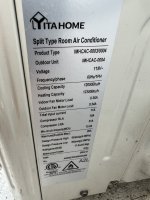
Not much info on them honestly. There is a manual but it's just basic stuff. If I screw it up, I'm not going to fret about it. I thought, I already have the argon, see if I can pressure test it, re-check the flares and put some Nyloc and get it filled for $100.

IMG_3069.JPG
 
OP
N

newpain01

Well-known member
Joined
Nov 3, 2023
Messages
128
Location
Eastern NC
For $600 bucks, I would just buy a new one. And follow the installation instructions.

Odds are, they will not honor the warranty if the evap/condenser coil is bad.

If you used the factory flare fittings out of the box, then that's where it failed.
I actually paid $400 for it. It's not about the money, it's about the effort of going through it again. It was already installed and was running fine, so if I can get it fixed, I prefer to do that instead.

Also, it's not my first mini-split install, I have installed another one 2yrs ago and it's been running great since. I went through the instructions but I think I might have overtightened the connections and might have a leak there. I don't have one of those hvac torque wrenches.
 

todd_fuller

Well-known member
Joined
Jul 9, 2013
Messages
302
You can look for a purge regulator. Some have presets for purging for brazing and for pressure testing. I don’t know if N2 bottle share the came tank fitting but the regulators for nitrogen are fairly inexpensive.


You can buy those cheap manifolds, but for a minisplit, there is only one connection. I would recommend a wireless probe. You’ll also need a valve core removal tool and you can get ones that have the 5/16 flare for minisplits which also have two 1/4 flare connections (one for nitrogen and one for probe). The knock off valve core tools are probably fine, I think it’s on vacuum that the name brands work better.

I’ve seen videos showing techs use windex for leak detection. Make sure you cap the service port if you want to check the schrader valve.
 
OP
N

newpain01

Well-known member
Joined
Nov 3, 2023
Messages
128
Location
Eastern NC
This looks like something used instead of a vacuum pump is that right? I do have this set with a vacuum pump, gauges and a leak detector. When I installed it I pulled vacuum and held it for 30 min without changes.
 

Firebrick43

Well-known member
Joined
May 12, 2015
Messages
14,307
Location
West central Indiana
You can look for a purge regulator. Some have presets for purging for brazing and for pressure testing. I don’t know if N2 bottle share the came tank fitting but the regulators for nitrogen are fairly inexpensive.


You can buy those cheap manifolds, but for a minisplit, there is only one connection. I would recommend a wireless probe. You’ll also need a valve core removal tool and you can get ones that have the 5/16 flare for minisplits which also have two 1/4 flare connections (one for nitrogen and one for probe). The knock off valve core tools are probably fine, I think it’s on vacuum that the name brands work better.

I’ve seen videos showing techs use windex for leak detection. Make sure you cap the service port if you want to check the schrader valve.
1785375047523.png

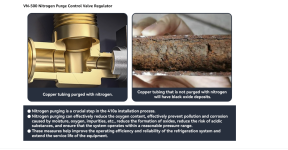
Got to love that AI advertising. Showing a brass manifold sectioned as "copper tubing" and a steel pipe full of poo if you don't purge. LOL
 

Firebrick43

Well-known member
Joined
May 12, 2015
Messages
14,307
Location
West central Indiana
I actually paid $400 for it. It's not about the money, it's about the effort of going through it again. It was already installed and was running fine, so if I can get it fixed, I prefer to do that instead.

Also, it's not my first mini-split install, I have installed another one 2yrs ago and it's been running great since. I went through the instructions but I think I might have overtightened the connections and might have a leak there. I don't have one of those hvac torque wrenches.
A regular torque wrench with a crowsfoot will work, just position the crowsfoot at 90 degrees to either side to maintain very close to the correct torque.
 
OP
N

newpain01

Well-known member
Joined
Nov 3, 2023
Messages
128
Location
Eastern NC
A regular torque wrench with a crowsfoot will work, just position the crowsfoot at 90 degrees to either side to maintain very close to the correct torque.
Didn't think of that but that is a great idea, thank you! I do have a regular torque wrench, just need to grab some crowsfoot.
 
To avoid these ads, REGISTER NOW!

Snapped-off

Well-known member
Joined
Feb 22, 2012
Messages
4,832
Location
Indiana

WildBill

ALLIANCE MEMBER
Joined
Aug 20, 2021
Messages
2,043
Location
PNW
This looks like something used instead of a vacuum pump is that right? I do have this set with a vacuum pump, gauges and a leak detector. When I installed it I pulled vacuum and held it for 30 min without changes.
It's a pressurized can of dry inert gas designed for purging lines during installation but you can use to try and find leaks if you don't have any other way to pressurize the system. Your argon setup would be better if you can get the connection parts, but if that's too hard or expensive this could be a potential option.
 
OP
N

newpain01

Well-known member
Joined
Nov 3, 2023
Messages
128
Location
Eastern NC
It's a pressurized can of dry inert gas designed for purging lines during installation but you can use to try and find leaks if you don't have any other way to pressurize the system. Your argon setup would be better if you can get the connection parts, but if that's too hard or expensive this could be a potential option.
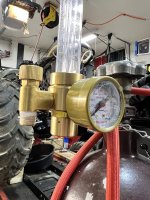
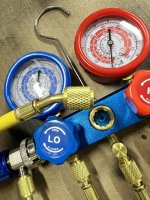
Got it, thanks for explaining. I think my argon setup will work fine and won't be expensive because I already have a tank with argon and a regulator, just need to find an adapter to connect these two:
IMG_3294 2.JPGIMG_3295 2.JPG
 

462867aa

Well-known member
Joined
Jun 19, 2018
Messages
70
Location
Oklahoma
My mini split blew a connection. When I used the argon from my welder, I had to buy a regulator off amazon. Pretty cheap. I had to get a fitting for the connection to the mini split. It was also pretty cheap. I also had to buy r32 from an online supply house. But it wasn't very cheap, maybe $250 for a 20lb jug. All in all it was better than replacing an already installed unit and I have all the supplies to do it again if needed.
 
OP
N

newpain01

Well-known member
Joined
Nov 3, 2023
Messages
128
Location
Eastern NC
My mini split blew a connection. When I used the argon from my welder, I had to buy a regulator off amazon. Pretty cheap. I had to get a fitting for the connection to the mini split. It was also pretty cheap. I also had to buy r32 from an online supply house. But it wasn't very cheap, maybe $250 for a 20lb jug. All in all it was better than replacing an already installed unit and I have all the supplies to do it again if needed.
Any chance you have a link of the regulator and the fitting? Thanks
 
OP
N

newpain01

Well-known member
Joined
Nov 3, 2023
Messages
128
Location
Eastern NC
I just did mine and used this. Had a nitrogen tank my dad used to use for rebuilding shocks. I went to use the regulator off the mig welder then realised it wouldnt go high enough,

https://www.amazon.com/dp/B0F21GB6QJ?tag=atomicindus08-20
Thanks a lot for sharing an actual link. I bought this regulator after @462867aa mentioned and it fits the argon tank and the manifold. I have some Nylog and some Flareseal. I am going to disconnect all the flare seals (I suspect one of them might have the slow leak), apply Nylog, torque everything with the crowsfoot tomorrow and let it sit for a day, then pressure test with argon, vacuum and fill with R32.
 

bob smith1

Well-known member
Joined
Jul 2, 2026
Messages
123
Thanks a lot for sharing an actual link. I bought this regulator after @462867aa mentioned and it fits the argon tank and the manifold. I have some Nylog and some Flareseal. I am going to disconnect all the flare seals (I suspect one of them might have the slow leak), apply Nylog, torque everything with the crowsfoot tomorrow and let it sit for a day, then pressure test with argon, vacuum and fill with R32.
No, before you do a single thing, you need to push the dry gas into the system and find that leak! Why? Because you want to know where your problem actually is, because you will find out that Nylog is not a long term solution to a bad flare. Those flare faces would need visual inspection and many times you actually find the burr or debris that caused it. And in many cases, the thermal cycling causes them to get loose so simple retorque solves in. In short, find the problem, then work the solution.
 
OP
N

newpain01

Well-known member
Joined
Nov 3, 2023
Messages
128
Location
Eastern NC
Hard to believe you have a leak on a FlareTite seal. As a test I used 1/3 of the recommended torque at 600psi and 100 micron vacuum, no leaks.
I guess I didn't make it clear. I just bought the Nylog and the Flareseal, they were not used when I originally installed the mini split. So I was thinking to redo all the connections and then do a pressure test, followed by a vacuum test. I am not sure if I should use the Flareseal or only Nylog.

No, before you do a single thing, you need to push the dry gas into the system and find that leak! Why? Because you want to know where your problem actually is, because you will find out that Nylog is not a long term solution to a bad flare. Those flare faces would need visual inspection and many times you actually find the burr or debris that caused it. And in many cases, the thermal cycling causes them to get loose so simple retorque solves in. In short, find the problem, then work the solution.
Thank you, that sounds like a good approach.
 

Firebrick43

Well-known member
Joined
May 12, 2015
Messages
14,307
Location
West central Indiana
Thanks a lot for sharing an actual link. I bought this regulator after @462867aa mentioned and it fits the argon tank and the manifold. I have some Nylog and some Flareseal. I am going to disconnect all the flare seals (I suspect one of them might have the slow leak), apply Nylog, torque everything with the crowsfoot tomorrow and let it sit for a day, then pressure test with argon, vacuum and fill with R32.
Did you use the factory flares or redo them with a roll flaring tool?
 

American Locomotive

Well-known member
Joined
Jan 8, 2017
Messages
11,079
Location
Rhode Island
The factory flares on most of those chinese minisplit linesets are very poor. I installed a Senville unit for a friend, and one flare shared off before torque was achieved, and another failed months later with a leak.

I got a bundled kit with some Mitsubishi minisplits, and the linesets were actually made in the USA, and those flares were good. Been holding up like 4 years later with no issue.

FWIW: I always pressure test at 400 PSI for 24 hours.
 
OP
N

newpain01

Well-known member
Joined
Nov 3, 2023
Messages
128
Location
Eastern NC
The factory flares on most of those chinese minisplit linesets are very poor. I installed a Senville unit for a friend, and one flare shared off before torque was achieved, and another failed months later with a leak.

I got a bundled kit with some Mitsubishi minisplits, and the linesets were actually made in the USA, and those flares were good. Been holding up like 4 years later with no issue.

FWIW: I always pressure test at 400 PSI for 24 hours.
Good to know. I got everything I need to pressure test this system. I honestly don't care where they make them as long as they work like they are supposed to. I've purchased many US made products that failed and were not perfect so I don't want to bring politics into this. As long as the product works as it's supposed to and they honest their warranty, I could care less where they made it.
 
To avoid these ads, REGISTER NOW!
Top Bottom