To avoid these ads, REGISTER NOW!

Question: does each building need expansion tank and relief valve?

Status
Not open for further replies.

Rytis

Member
Joined
Jan 13, 2024
Messages
11
Hello, I'm setting up a huge wood boiler in between my house and garage, with expansion tank, pressure relief, gauges, air remover, manifold inside the house etc.
But outside boiler has 2 pairs of in/out pipes, one will go to warehouse (there only one zone heat exchanger), and I was wondering if that side will also need it's own relief valve/expansion tank and anything else? or will the pressure be taken care of on the house side?
 
To avoid these ads, REGISTER NOW!

Sturgeon

Well-known member
Joined
Oct 9, 2021
Messages
279
Location
W. Mt.
Sounds like you have two independent hot water, main supplys so yes you would need the prv and expansion tanks. Can't imagine that heated water coming out of that boiler not having some kind of mechanical safety relief, boiler mite end up at your neighbors ?
 
Last edited:
OP
R

Rytis

Member
Joined
Jan 13, 2024
Messages
11
Sounds like you have two independent hot water, main supplys so yes you would need the prv and expansion tanks. Can't imagine that heated water coming out of that boiler not having some kind of mechanical safety relief, boiler mite end up at your neighbors ?
Thanks
 

larry_g

Well-known member
Joined
Apr 28, 2007
Messages
16,927
Location
oregon
I would guess that the answer to your question could vary with each brand and style of boiler. Without specific information on your brand and model of boiler any answer you get from the information given is just a guess. Then the variables of the piping system that is installed after the boiler also play into what is the correct answer.

lg
no neat sig line
 

fitter30

Well-known member
Joined
Jun 23, 2019
Messages
3,027
Location
Peace Valley,mo
Yes and air eliminate device. Unless it's a open system. Lets discuss glycol has to made for a boiler system NO auto antifreeze. Freeze protection doesn't have to be frozen solid can be shush if the amount is at least 30% total volume. Boiler/ chiller glycol lists slush %. The more % of glycol the more the pump has to work harder.
 

PoorUB

Well-known member
Joined
Mar 29, 2021
Messages
11,925
Location
Fargo, ND
Hello, I'm setting up a huge wood boiler in between my house and garage, with expansion tank, pressure relief, gauges, air remover, manifold inside the house etc.
But outside boiler has 2 pairs of in/out pipes, one will go to warehouse (there only one zone heat exchanger), and I was wondering if that side will also need it's own relief valve/expansion tank and anything else? or will the pressure be taken care of on the house side?
The big question is if the two inlets and outlets are separated in the boiler. If there is only one heat exchanger and all the water intermingles then only one expansion tank and air bleed it required. If the heat exchanger has two separate heat exchangers then two expansion tanks and air bleeds are required.

Make and model of the boiler would help.
 

Sturgeon

Well-known member
Joined
Oct 9, 2021
Messages
279
Location
W. Mt.
Not sure where your located but check with your locale plumbing wholesale house's. Ferguson's, Bowel's/Consolidated or Keller. Watt's is one brand thats older than sin.
 
OP
R

Rytis

Member
Joined
Jan 13, 2024
Messages
11
The big question is if the two inlets and outlets are separated in the boiler. If there is only one heat exchanger and all the water intermingles then only one expansion tank and air bleed it required. If the heat exchanger has two separate heat exchangers then two expansion tanks and air bleeds are required.

Make and model of the boiler would help.
Heat exchanger only in the warehouse side, on the house side it's underground pipes.
The name of the boiler is Biomass direct 500, high efficiency series
 

PoorUB

Well-known member
Joined
Mar 29, 2021
Messages
11,925
Location
Fargo, ND
Biomass direct 500
Every wood boiler I have seen runs at atmospheric pressure. The boiler itself is vented. No need for an air eliminator and pressure tank.

The correct answer would be to call the manufacturer.
 
OP
R

Rytis

Member
Joined
Jan 13, 2024
Messages
11
Is there a special heat exchanger that I wrap around hot water tank? not even sure what to search for on google, coz different stuff coming up
 

Red 17

Well-known member
Joined
Oct 25, 2018
Messages
442
Location
Pasadena CA
Are you scratch building something or is this a manufactured, purpose built boiler that you are starting with?

Done right, it could be a multiple use device.

--heat some water
--plenty of exercise feeding it wood
--activity will keep you warm

Whatever you do, be sure you have temperature & pressure relief valves in the system, probably multiples.
 

LopezBart

Well-known member
Joined
Oct 13, 2023
Messages
2,582
Location
Lopez Island, WA
If you run antifreeze, it must be non-toxic. Best way is a plate-type heat exchanger and two pumps, one in each loop. Since you have no way of shutting the fire off, you need to plan on what your control system will do when there's more fire than you need heat. This is actually a fairly complicated problem to make safe enough for daily use.
 

u3b3rg33k

Well-known member
Joined
Dec 18, 2017
Messages
4,071
Is there a special heat exchanger that I wrap around hot water tank? not even sure what to search for on google, coz different stuff coming up
 

Firebrick43

Well-known member
Joined
May 12, 2015
Messages
14,419
Location
West central Indiana
Brazed Plate type, tube and shell, and side arm heat exchangers all will work. Also wrapping a tank and insulating will work.

Tube in shell is the most serviceable but most expensive.

Brazed plate is in the middle for efficiency but throw away

Side arm and wrap around the tank can be diy but side arm has terribly bad efficiency (but so do wood boilers)

Wrap around depends on how good of job you do.

As the guy from Lopez island said, don’t use any antifreeze other than propylene glycol if you don’t want to end up dead.
 

juddspaintballs

Well-known member
Joined
Sep 1, 2011
Messages
324
Location
Hedgesville, WV
There are two common ways to do it. A flat plate heat exchanger will heat the domestic water as an "on demand" feature. The best setup is to plumb this on the cold "incoming" water into the water heater. I leave the heating elements on in the water heater so they just have to keep the incoming water (which has already been heated by the flat plate exchanger) hot when you're not using hot water. If you use more water than the water heater capacity, then it is constantly being replenished by incoming heated water and you'll never run out of hot water. I've used those and they work very well.

The other is called a "side arm" heat exchanger. This uses a tube inside of a tube where the domestic water flows through the inner tube via thermostatic flow from the bottom of your water heater to the hot water outlet at the top of the water heater. The boiler water flows via the pump from the top of the outer tube and out the bottom. This is a passive design and will heat the tank of water slowly so you can shut off the heating elements (if you want to). I've used one of those as well and it worked, but I would prefer a flat plate heat exchanger most of the time.
 

juddspaintballs

Well-known member
Joined
Sep 1, 2011
Messages
324
Location
Hedgesville, WV
If you run antifreeze, it must be non-toxic. Best way is a plate-type heat exchanger and two pumps, one in each loop. Since you have no way of shutting the fire off, you need to plan on what your control system will do when there's more fire than you need heat. This is actually a fairly complicated problem to make safe enough for daily use.
Antifreeze doesn't need to be non-toxic. The flat plate heat exchanger just needs to be lead-free. The outdoor boiler liquid (water or antifreeze) doesn't interact with the domestic water at all. You don't need a loop with a pump on the domestic water, just use the normal pressurized domestic water to move it through the exchanger when a tap is opened.

As for the outdoor boiler controls, they almost all come as a package with built-in controls that handle the fire stoking and damping system based on water temperature. It's actually a very simple solution to make safe enough for daily use.
 

Firebrick43

Well-known member
Joined
May 12, 2015
Messages
14,419
Location
West central Indiana
Antifreeze doesn't need to be non-toxic. The flat plate heat exchanger just needs to be lead-free. The outdoor boiler liquid (water or antifreeze) doesn't interact with the domestic water at all. You don't need a loop with a pump on the domestic water, just use the normal pressurized domestic water to move it through the exchanger when a tap is opened.

As for the outdoor boiler controls, they almost all come as a package with built-in controls that handle the fire stoking and damping system based on water temperature. It's actually a very simple solution to make safe enough for daily use.
If you use standard heat exchangers the antifreeze has to be non toxic.

They do fail with some regularity and mixing poisonous ethylene glycol in the potable water will result in kidney/liver failure and most of its sweet and undetectable

There are double wall heat exchangers but they are uncommon and typically have poor transfer.
 

juddspaintballs

Well-known member
Joined
Sep 1, 2011
Messages
324
Location
Hedgesville, WV
Stainless steel (316 specifically) heat exchangers don't care if you use ethylene glycol or other "toxic" antifreezes.

IF the heater exchanger were to fail, these outdoor wood boilers are designed to be either zero pressure (closed) or very low pressure systems. Domestic water is typically 30 psi or more, so if a leak were to occur, it would push pressurized domestic water into the boiler loop as opposed to the other way around. It would still be a concern that needs addressed, but the health hazard is very low.
 
To avoid these ads, REGISTER NOW!

LopezBart

Well-known member
Joined
Oct 13, 2023
Messages
2,582
Location
Lopez Island, WA
If there are heat exchangers connecting domestic hot water with the outdoor system, you must use a non-toxic antifreeze in the outdoor system. Note that if the heat exchanger develops a leak, the domestic system will pressurize the outdoor system, or if properly protected the outdoor system will spew its contents out a relief valve.

See https://codes.iccsafe.org/content/IMC2018P4/chapter-14-solar-thermal-systems which is largely applicable here.

If you keep firing the outdoor furnace, what happens to the extra heat? Big radiator and fan? Or does something got wrong?
 

juddspaintballs

Well-known member
Joined
Sep 1, 2011
Messages
324
Location
Hedgesville, WV
It's not a solar thermal system.

The outdoor boiler system is a self-contained and controlled package. It doesn't continue to fire when it isn't calling for heat. You clearly don't understand how these systems work, so maybe you should stop offering advice to the OP on these systems.
 

PoorUB

Well-known member
Joined
Mar 29, 2021
Messages
11,925
Location
Fargo, ND
If you use standard heat exchangers the antifreeze has to be non toxic.

They do fail with some regularity and mixing poisonous ethylene glycol in the potable water will result in kidney/liver failure and most of its sweet and undetectable
Is that a local code? Or some recent code change?

I have installed many side arm boilers and heat exchangers for domestic water and not once has the subject of not using ethylene glycol in the boiler. Plus we have pretty stringent code enforcement in this area.
 

Firebrick43

Well-known member
Joined
May 12, 2015
Messages
14,419
Location
West central Indiana
Is that a local code? Or some recent code change?

I have installed many side arm boilers and heat exchangers for domestic water and not once has the subject of not using ethylene glycol in the boiler. Plus we have pretty stringent code enforcement in this area.
International mechanical code

“1402.8.4 Heat exchangers.​

Heat exchangers used in domestic water-heating systems shall be approved for the intended use. The system shall have adequate protection to ensure that the potability of the water supply and distribution system is properly safeguarded.

1402.8.4.1 Double-wall heat exchangers.​

Heat exchangers utilizing a non-food-grade fluid shall be separated from the potable water by double-wall construction. An air gap open to the atmosphere shall be provided between the two walls. The discharge location from the double-wall heat exchanger shall be visible.


International plumbing code

“608.17.3 Heat exchangers.​

Heat exchangers utilizing an essentially toxic transfer fluid shall be separated from the potable water by double-wall construction. An air gap open to the atmosphere shall be provided between the two walls. Heat exchangers utilizing an essentially nontoxic transfer fluid shall be permitted to be of single-wall construction.


So any state that has adopted these codes, which most have including North Dakota according to the state webpage, do not allow toxic antifreeze in single wall heat exchangers

“The North Dakota Legislative Assembly has mandated that the state building code consist of the International Building Code (IBC), International Residential Code (IRC), International Mechanical Code (IMC), and International Fuel Gas Code (IFGC).”

I don’t know when it entered the code but I imagine it’s been there for a long time?

One of the premier text on the subject “Modern hydronic heating” has warnings against it in my 1995 edition”
 
Last edited:
OP
R

Rytis

Member
Joined
Jan 13, 2024
Messages
11
Just finished plumbing my boiler system that will (hopefully) heat two buildings.
How do I wire in the combustion fan of the boiler (to keep fire at certain temperature) from two different thermostats: One thermostat I'm assuming is inside the boiler, on/off depending how hot fire is, and the second is for house circulating pump. I'm assuming if the house pump thermostat decides it doesn't need to trigger boiler combustion fan for too long, the fire may die completely, so both thermostats must able to trigger power? if anyone has a diagram, probably would be easier than explanation, I'm not sure what to search for on google.
Thank you to those who answered my previous questions
 

PoorUB

Well-known member
Joined
Mar 29, 2021
Messages
11,925
Location
Fargo, ND
International mechanical code

“1402.8.4 Heat exchangers.​

Heat exchangers used in domestic water-heating systems shall be approved for the intended use. The system shall have adequate protection to ensure that the potability of the water supply and distribution system is properly safeguarded.

1402.8.4.1 Double-wall heat exchangers.​

Heat exchangers utilizing a non-food-grade fluid shall be separated from the potable water by double-wall construction. An air gap open to the atmosphere shall be provided between the two walls. The discharge location from the double-wall heat exchanger shall be visible.


International plumbing code

“608.17.3 Heat exchangers.​

Heat exchangers utilizing an essentially toxic transfer fluid shall be separated from the potable water by double-wall construction. An air gap open to the atmosphere shall be provided between the two walls. Heat exchangers utilizing an essentially nontoxic transfer fluid shall be permitted to be of single-wall construction.


So any state that has adopted these codes, which most have including North Dakota according to the state webpage, do not allow toxic antifreeze in single wall heat exchangers

“The North Dakota Legislative Assembly has mandated that the state building code consist of the International Building Code (IBC), International Residential Code (IRC), International Mechanical Code (IMC), and International Fuel Gas Code (IFGC).”

I don’t know when it entered the code but I imagine it’s been there for a long time?

One of the premier text on the subject “Modern hydronic heating” has warnings against it in my 1995 edition”
Interestring! It was never enforced here. I find that strange.
 

jblnut

ALLIANCE MEMBER
Joined
Jan 17, 2015
Messages
7,282
Location
In the Middle of MN
I use a sidearm and it works very well. I plumbed it into the bottom drain valve and back into the top pressure relief valve. It is a rather slow recovery but we can take 5 showers and not run out of hot water. I will post pictures later.

Lots of misleading info in here or maybe folks that don’t understand wood boilers. Yes following codes is important but I know dozens of people around me with wood boilers and no one has anything in them other than soft water and a corrosion resistant something or other. The house pressure will easily overcome any leaks and your stove will overfill before it leaks into the water heater. My sidearm is one solid pipe from bottom to top so the 316SS pipe would have to rot out before a leak could happen. Not likely.

Antifreeze is a non issue unless you intend to let the fire go out. That totally defeats the purpose of a wood boiler. Light it once and keep it going until spring when you shut it off until next fall. They do not do well heating and cooling often. More corrosion and excessive wood consumption will be the result of that.

If you have made the commitment to having a wood boiler you must realize it’s like being married to something. You have to check it and make sure it’s happy and had enough wood. I check mine twice a day weather it needs wood or not. When it’s -20f and windy I check it every 8hrs min.

@Rytis - what do you have for an outdoor boiler ? Make model etc. Also, where are you located ? What other heat loads do you have on the stove ? Are you comfortable doing the work yourself ?
 

jblnut

ALLIANCE MEMBER
Joined
Jan 17, 2015
Messages
7,282
Location
In the Middle of MN
Is this an indoor wood boiler ? If not you’ll want the circulating pumps running all the time between the stove and the buildings.

Every boiler I’ve ever seen has been setup with its own control panel that keeps the water at a certain temp and it fires and idles when it needs to in order to maintain that temp. The house/shop or whatever you’re heating need their own completely independent thermostat and control setups.

House calls for heat and drags the stove temp down and the stove sees that and fires up to raise temp back up. When no heat calls are present you can set most stoves to fire for a preset time after a preset idle time to maintain a coal bed.

I know I for sure need more details on what stove you have and what type of heating setups you have in the buildings to be more helpful. Do you have plate exchangers ? Primary/secondary loops? Forced air coils ? Homemade stuff or purchased stuff ?
 

juddspaintballs

Well-known member
Joined
Sep 1, 2011
Messages
324
Location
Hedgesville, WV
I use a sidearm and it works very well. I plumbed it into the bottom drain valve and back into the top pressure relief valve. It is a rather slow recovery but we can take 5 showers and not run out of hot water. I will post pictures later.

Lots of misleading info in here or maybe folks that don’t understand wood boilers. Yes following codes is important but I know dozens of people around me with wood boilers and no one has anything in them other than soft water and a corrosion resistant something or other. The house pressure will easily overcome any leaks and your stove will overfill before it leaks into the water heater. My sidearm is one solid pipe from bottom to top so the 316SS pipe would have to rot out before a leak could happen. Not likely.

Antifreeze is a non issue unless you intend to let the fire go out. That totally defeats the purpose of a wood boiler. Light it once and keep it going until spring when you shut it off until next fall. They do not do well heating and cooling often. More corrosion and excessive wood consumption will be the result of that.

If you have made the commitment to having a wood boiler you must realize it’s like being married to something. You have to check it and make sure it’s happy and had enough wood. I check mine twice a day weather it needs wood or not. When it’s -20f and windy I check it every 8hrs min.

@Rytis - what do you have for an outdoor boiler ? Make model etc. Also, where are you located ? What other heat loads do you have on the stove ? Are you comfortable doing the work yourself ?
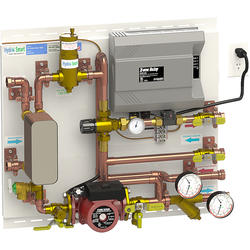
To add to this, if you're using any type of heat exchanger to heat your domestic water at the water heater, if you let your fire go out and leave your water heater "on," it'll back feed enough heat into the outdoor boiler's loop to keep the water (or whatever fluid) from freezing as well. It isn't ideal, but it is a protection available if you do have to be gone for a couple of days without having someone to feed the fire.
 
OP
R

Rytis

Member
Joined
Jan 13, 2024
Messages
11
Makes sense what you say, thanks. Outdoor, biomass 500. in the house in floor pex pipes for now (later plate for water heater), in the warehouse heat exchange/blower.

Is this an indoor wood boiler ? If not you’ll want the circulating pumps running all the time between the stove and the buildings.

Every boiler I’ve ever seen has been setup with its own control panel that keeps the water at a certain temp and it fires and idles when it needs to in order to maintain that temp. The house/shop or whatever you’re heating need their own completely independent thermostat and control setups.

House calls for heat and drags the stove temp down and the stove sees that and fires up to raise temp back up. When no heat calls are present you can set most stoves to fire for a preset time after a preset idle time to maintain a coal bed.

I know I for sure need more details on what stove you have and what type of heating setups you have in the buildings to be more helpful. Do you have plate exchangers ? Primary/secondary loops? Forced air coils ? Homemade stuff or purchased stuff ?
 

jblnut

ALLIANCE MEMBER
Joined
Jan 17, 2015
Messages
7,282
Location
In the Middle of MN
We should start calling them circulators as even though they’re moving liquid they’re not really pumps. They are made to run nonstop for years. I’ve got a neighbor that uses his central boiler to heat domestic water all year around and his circulators have been running for over 10yrs nonstop. I have a spare of one size and he has a spare of another and we haven’t needed them yet. I’d get a spare on hand after a few years for a piece of mind deal but wouldn’t worry about them running nonstop.

Without them running nonstop the system will always be playing catch up trying to get the lines heated and water moving again while there is a call for heat. You’ll have really cold water going back into the stove and that will cause corrosion inside the stove and greatly decrease its useable life. Return temps above 140f are the target.

Lots of good info on other sites out there as well. Here is a link to a thread I put together on my install over on hearth.com. The same info is in my gallery thread here on GJ but it’s fairly spread out. You can see how I plumbed the heat exchangers and how I set the back of the stove up. Nothing about this was done on the cheap as I want it to last for a while. If you want more pictures of anything I’ll gladly do so.

I hope links to another forum are allowed 😬
 

pcmeiners

Well-known member
Joined
Aug 13, 2009
Messages
8,074
Location
In the only town in Pennsylvania, Bloomsburg.
"How do I wire in the combustion fan of the boiler (to keep fire at certain temperature) from two different thermostats: "

You don't. Your boiler needs an aqua-stat. It keeps the boiler water at a specified temperature range by turning on/off the combustion fan. Then you need (2) zone valves, one for each building. One thermostat from each building goes to one of the two zones valve control circuits.
The zone valves controls 1 or 2 pumps, the pump (s) do not run constantly unless the boiler is under sized. As the water temperature drops or reaches it maximum temp the aquastat turns on /off the combustion fan . I have the same setup on my coal boiler. As mentioned you may need a timer which fires up the combustion fan for a short period every hour to keep the fire from going out when there is no demand for heat/hotwater
 
Last edited:

LopezBart

Well-known member
Joined
Oct 13, 2023
Messages
2,582
Location
Lopez Island, WA
The outdoor boiler system is a self-contained and controlled package. It doesn't continue to fire when it isn't calling for heat. You clearly don't understand how these systems work, so maybe you should stop offering advice to the OP on these systems.

I'm glad you were able to intuit that this was a manufactured system built and installed by professionals from the original poster.
 

jblnut

ALLIANCE MEMBER
Joined
Jan 17, 2015
Messages
7,282
Location
In the Middle of MN
To add to this, if you're using any type of heat exchanger to heat your domestic water at the water heater, if you let your fire go out and leave your water heater "on," it'll back feed enough heat into the outdoor boiler's loop to keep the water (or whatever fluid) from freezing as well. It isn't ideal, but it is a protection available if you do have to be gone for a couple of days without having someone to feed the fire.

We did this last winter late January and the water heater in the house dumped enough heat into the system that it kept the stove at 85f. Since I have my mixing valves turnt down as far as possible when the shop called for heat it pulled from the stove water so my electric water heater in the house was essentially keeping the shop warm. Small price to pay for wanting to go somewhere for a week. Not the end of the world.
 

Mr onetwo

Well-known member
Joined
Apr 6, 2011
Messages
2,029
Location
Coastal Maine
I would pump this system (1 for each zone) rather than use zone valves.Not much more expensive but you are assured of proper flow.Make sure you size your pumps properly.
 
OP
R

Rytis

Member
Joined
Jan 13, 2024
Messages
11
Just got my new (used) boiler system running last night, super excited. However the combustion fan which worked when I first fired it up couple days ago stopped working several hours later that day. System wasn't completely filled with water at that time (limited water supply here). If the gauge ON BOILER read correctly it was about 200 degrees at that time, house pipes were not circulating yet at that time because wasn't filled all the way to the top. Last night I finally saw the magic moment of water going from 60 to 180 degrees (as it started coming back from boiler after filling to the top). then stayed steady for a while at around 170. I was hoping those couple days that boiler's combustion fan must kick on and off as needed to keep fire smoldering just enough as it did. However this morning the house pipe incoming temperature was only 80, so I went to check the boiler it was out and combustion fan still not functioning, so I must assume it either died or perhaps cables along boiler burned out on first day when I ran it without enough water in pipes? (there's power in the back of boiler, but how would I test front wires on upper door, too short to cut?.
Anyway, I cut up some kindling wood and left it on door which I left open (since fire seemed completely out. thank god I did not leave torch on there since fire started on by itself after about 10 minutes without me lighting anything, just by having door open 1 inch, which I keep it at now. I now it's not exactly safe since it can overheat, so I would like to fix combustion fan ASAP to better control temperature.
 
Status
Not open for further replies.
To avoid these ads, REGISTER NOW!
Top Bottom