To avoid these ads, REGISTER NOW!

Question for cabinet makers

Marctrees

Well-known member
Joined
Mar 5, 2015
Messages
6,265
Location
TX/LA border - Toledo Bend
A 3/8" deep dado on the sides and rear of the carcass, with 3/4" plywood used on all sides is insanely strong. It also has the benefit of giving you perfectly clean corners with no gaps, hides any edge tear out, etc. The overall look is just much cleaner than pocket screws. And with pocket screws, even if you plug them they never visually dissapear due to differences in the grain.

No argument... as long as someone is willing to pay for it then OK.

More time and labor than pocket screws.

That's why most shops went to pockets, AFAIK years ago, and AFAIK continue to do so.

Marc
 
Last edited:
To avoid these ads, REGISTER NOW!

scottydosnntkno

Well-known member
Joined
Aug 8, 2010
Messages
670
That is a STEAL ! I assume no interior voids ?

I honestly don’t know and don’t care. We just use it for our sides backs and bottoms, so the edges are never exposed anyways.

It’s the going price in michigan. You just need to find a supply company that sells large volumes of specialty plywood’s. Every city has one. Home Depot pricing is consumer retail price.

Plus, the 2x4 sheets are usually 60-70% the cost of a full sheet of the same thing. So a full sheet isn’t worth 4x as much as the partial is
 

Verado1250

Well-known member
Joined
Feb 9, 2016
Messages
97
I used to be a pro cabinet builder, still do some, at my own leisure. High end cabs do not have screw on raised panels on end cabinets, rather, the raised panel/frame are integrated into being the end, by itself. I used to use a local door company on large jobs, but quit that and do all my own doors and end panels now. Reason..the door companies will not pre-stain a raised panel edge before they put it in the frame. When the relative humidity changes and it's dry in the winter, the panel will shrink and you may see an unstained line on the edges of the raised panel. Seen this happen many times. This don't happen on high end cabinet doors/end panels. Also, some shops attach the drawer fronts to the drawers then stain the drawer front, attempting to keep stain off the natural wood drawer sides. This is cheesy. Drawer fronts get stained by themselves first, then attached to the drawer, then sprayed. Type of finish is another factor. Cheap lacquer looks good originally, but will not withstand a working kitchen long term (10 years). I, personally, use conversion varnish from SW. Expensive, but, like most things in life, you get what you pay for. I only use 3/4" domestic ply, grade A1. Anything else, you likely will have voids. And if you don't care about voids, fine, but at some point when someone slides a plate into a cabinet and the void is just under the veneer, and a hole appears, then, you can't say it's a high end cabinet. Also, like what was mentioned, no filler strips, dovetailed drawers (all 4 corners), undermount/soft close drawer slides for drawers and pull out shelves, taller/deeper end and corner upper cabinets, under cabinet lighting with hidden wires into dados, etc. These are just some of the basics of what I call "high end" cabinets. When I bid a job, the first thing I do is measure, but more importantly, if a wall is more than 3/4" out of plum in 8', I decline the job, as it's too much of a pita to mess with. Wall levelness is a big factor in getting everything to install properly. Someone can make a perfectly square/door-drawer fitting cabinet in their shop, only to "rack" it when they install it on an unlevel wall, and then all the sudden, drawers don't open correctly, sit un-level, etc. Same with a floor..if it is out of level 1" in 8', I decline it, too, for the same reasons. Sure, I can work around it, but, my time is better spent than trying to fix someone else's screw-up.
 

glentre

Well-known member
Joined
May 21, 2016
Messages
909
Location
Gloucester, Virginia
I know I'll get a lot of flack for saying this but, for me, any face frame cabinet with partial overlay doors and wide frames and fillers screams of poor quality and is out of style as well. It says to me the builder did not have the expertise or proper machinery to build a case, frame or door that was perfectly square. A door partially overlaying a frame disguises this problem because the case, frame and door don't have to be totally square.

A full overlay door/drawer frameless cabinet with equal 1/8" gaps everywhere or a framed cabinet with beaded frames and full inset doors and consistent gaps, both types with no fillers, to me looks like quality, maybe because it is not easy to do.

For DIY guys, I recognize and accept the necessity of face frames because they don't have the equipment to allow them to make a square case or frame, especially a wide, deep or tall one. In this situation, the incorporation of many of the finer cabinet features mentioned in the above posts will show quality in a different way but not necessarily appealing to my aesthetic taste.

Glen
 

ddawg16

Well-known member
Joined
Jul 11, 2008
Messages
21,005
Location
S. California
I know I'll get a lot of flack for saying this but, for me, any face frame cabinet with partial overlay doors and wide frames and fillers screams of poor quality and is out of style as well. It says to me the builder did not have the expertise or proper machinery to build a case, frame or door that was perfectly square. A door partially overlaying a frame disguises this problem because the case, frame and door don't have to be totally square.

A full overlay door/drawer frameless cabinet with equal 1/8" gaps everywhere or a framed cabinet with beaded frames and full inset doors and consistent gaps, both types with no fillers, to me looks like quality, maybe because it is not easy to do.

For DIY guys, I recognize and accept the necessity of face frames because they don't have the equipment to allow them to make a square case or frame, especially a wide, deep or tall one. In this situation, the incorporation of many of the finer cabinet features mentioned in the above posts will show quality in a different way but not necessarily appealing to my aesthetic taste.

Glen

I won't disagree a frameless inset is more effort and takes more skill....but I don't think they necessarily look better. It needs to be the right application. I prefer overlay in the kitchen. Less of an air gap....keeps the dust out better.
 

Attachments

  • IMG_4167.jpg
    IMG_4167.jpg
    151.8 KB · Views: 85
  • IMG_20171229_165411178.jpg
    IMG_20171229_165411178.jpg
    84.6 KB · Views: 75

Verado1250

Well-known member
Joined
Feb 9, 2016
Messages
97
I know I'll get a lot of flack for saying this but, for me, any face frame cabinet with partial overlay doors and wide frames and fillers screams of poor quality and is out of style as well. It says to me the builder did not have the expertise or proper machinery to build a case, frame or door that was perfectly square. A door partially overlaying a frame disguises this problem because the case, frame and door don't have to be totally square.

A full overlay door/drawer frameless cabinet with equal 1/8" gaps everywhere or a framed cabinet with beaded frames and full inset doors and consistent gaps, both types with no fillers, to me looks like quality, maybe because it is not easy to do.

For DIY guys, I recognize and accept the necessity of face frames because they don't have the equipment to allow them to make a square case or frame, especially a wide, deep or tall one. In this situation, the incorporation of many of the finer cabinet features mentioned in the above posts will show quality in a different way but not necessarily appealing to my aesthetic taste.

Glen
I agree, mostly. If the kitchen is in a high humidity area, and the doors/drawer fronts are solid wood/wood frames, then there is a good chance the gap on the side to side will expand and potentially rub, even the slightest bit when opening/closing the door. On veneer wrapped doors/drawers, not a problem. I put a small back side chamfer on the non-hinge side to be able to attempt to avoid that inside corner from rubbing.
 

theoldwizard1

Well-known member
Joined
Feb 22, 2011
Messages
43,102
Location
SE MI
Discussed earlier. Make your carcasses out of finished one side cabinet grade plywood. If you use "cabinet grade" plywood it has more plies and no voids so you can use 1/2".

The question is, if using 1/2" plywood, how do you attach the sides to the bottom, back and face frame ? Glue alone is not adequate. 1/2" is too thin for dowels or biscuits.
 

glentre

Well-known member
Joined
May 21, 2016
Messages
909
Location
Gloucester, Virginia
I agree, mostly. If the kitchen is in a high humidity area, and the doors/drawer fronts are solid wood/wood frames, then there is a good chance the gap on the side to side will expand and potentially rub, even the slightest bit when opening/closing the door. On veneer wrapped doors/drawers, not a problem. I put a small back side chamfer on the non-hinge side to be able to attempt to avoid that inside corner from rubbing.


The use of Euro hinges would have the adjustment capability to easily take care of this issue, although in twenty years of building custom commercial cabinetry with solid slab or solid raised panel doors, we never had a single job we had to go back to to adjust for expansion or contraction. The doors/drawer fronts do move with changes in humidity but all of them move rather equally so our 1/8" gaps never touched or looked like they needed to be adjusted. I can see where this might be a problem if non-Euro hinges are used and chamfering the back side would help this problem.

Glen
 
To avoid these ads, REGISTER NOW!

glentre

Well-known member
Joined
May 21, 2016
Messages
909
Location
Gloucester, Virginia
I won't disagree a frameless inset is more effort and takes more skill....but I don't think they necessarily look better. It needs to be the right application. I prefer overlay in the kitchen. Less of an air gap....keeps the dust out better.

I agree with your reasoning, although I would prefer full overlay in the kitchen which would provide less air gap as you say. In the den, office or for other built-ins, I would like a beaded frame style with full inset doors/drawers. Just a personal preference.

Glen
 

ddawg16

Well-known member
Joined
Jul 11, 2008
Messages
21,005
Location
S. California
I agree with your reasoning, although I would prefer full overlay in the kitchen which would provide less air gap as you say. In the den, office or for other built-ins, I would like a beaded frame style with full inset doors/drawers. Just a personal preference.

Glen

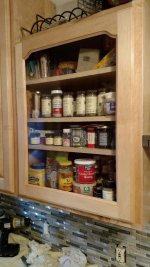
I posted two pics....one was the base of a china hutch I'm building....inset drawers and 'kinda' inset doors.
 

yeldogt

Well-known member
Joined
Jan 2, 2012
Messages
18,184
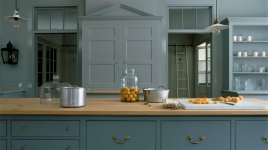
This is an example of true inset drawers and doors -- don't ask the price
 

Attachments

  • plain_english_9.jpg
    plain_english_9.jpg
    121.1 KB · Views: 96
  • plain-english-kitchens-1.jpg
    plain-english-kitchens-1.jpg
    56.6 KB · Views: 96

ddawg16

Well-known member
Joined
Jul 11, 2008
Messages
21,005
Location
S. California
Since we are on the topic, what is the general take on toe kick drawers?

Well...considering my toe kicks are only about 3.5" or so above the floor, it doesn't leave a lot of space for a drawer.

You pretty much can't use bottom slides like the Blum

At 3.5" of 'space'....figure 1/2" to the inside bottom of the drawer...when you consider all other spacing factors, that leaves you with a realistic 2.5 to 3" of working space in the drawer.

Except for some really flat ****....not worth the trouble,
 

acer66

Well-known member
Joined
Dec 4, 2010
Messages
4,418
Location
Western North Carolina
Well...considering my toe kicks are only about 3.5" or so above the floor, it doesn't leave a lot of space for a drawer.

You pretty much can't use bottom slides like the Blum

At 3.5" of 'space'....figure 1/2" to the inside bottom of the drawer...when you consider all other spacing factors, that leaves you with a realistic 2.5 to 3" of working space in the drawer.

Except for some really flat ****....not worth the trouble,

I have seen them use blum under mount some with push open on houzz and that is why I was asking because I was afraid that was just some useless designer idea and you are right about usable space, they showed baking sheets or cat food cans.

I don't do toe kicks unless it's a tight city kitchen -- I like extending the counter.

Good point, I think my kitchen is big enough but this is my first kitchen build in my first house
so I am trying to put some extra effort in.
I am doing the labor and also like to learn new things by trying new things out.

Counter top is the equivalent to displacement in an engine,
there is never enough.
:beer:
 

ddawg16

Well-known member
Joined
Jul 11, 2008
Messages
21,005
Location
S. California
I have seen them use blum under mount some with push open on houzz and that is why I was asking because I was afraid that was just some useless designer idea and you are right about usable space, they showed baking sheets or cat food cans.


Good point, I think my kitchen is big enough but this is my first kitchen build in my first house
so I am trying to put some extra effort in.
I am doing the labor and also like to learn new things by trying new things out.

Counter top is the equivalent to displacement in an engine,
there is never enough.
:beer:

Acer....consider this.....

If you have granite or quartz counter tops, that is a lot of weight. The backside of my toe kicks are actually 2x material to hold the weight and help keep the cabinet straight.

Putting in a drawer would drastically reduce the stiffness
 
To avoid these ads, REGISTER NOW!
Top Bottom