To avoid these ads, REGISTER NOW!

Question for the engine builders?

07classic

Active member
Joined
Jul 10, 2009
Messages
26
Location
Edmonton AB
So I am about to build my first engine, or at least take it apart and get somebody to put it back together. :) It is a 292 Chev inline 6. So my question is what do you guys do to organize your parts when you are doing a engine build? Do you use something you can buy or do you have homemade organizers for the engine parts to keep everything in order? Any pic's you guys have will be a huge help. Thanks
 
To avoid these ads, REGISTER NOW!

MechanicNamedJohn

Well-known member
Joined
Jun 3, 2010
Messages
1,344
They sell trays designed for that; pretty cheap too.

I use 2liter crates to hold pistons and rods, and I also have these desk organizers "got them at a $1 store," holds rocker arms and push rods perfectly. I also use regular baking trays also.

I am actually building an LT-1 tomorrow.
 

Stinger

Well-known member
Joined
Jul 20, 2009
Messages
839
Location
Basehor, KS
Ziplock bags work well for all the fasteners and small parts (label them and don't put everything in one bag though).
 

stopdroplol

Well-known member
Joined
Jan 8, 2011
Messages
640
Ziplock bags along with a inventory paper explaining what goes where (4x 10mm bolt=water pump / 5x Phillips air filter cover)

If you take apart any piston (including brakes) or valves make sure you keep ALL their components labeled,together, and separate from the others.. I label mine as well (piston 1,2,3,4... // Exhaust 1,2,3,4...)

And i'd advise against taking apart an engine and waiting more than a month to put it back together, or taking any lengthy break for that matter. Even with properly labeled items you'll likely spend hours/days trying to figure out how to put it back together.
 

eurokid

Well-known member
Joined
Dec 20, 2010
Messages
104
Location
Tacoma, WA
So I am about to build my first engine, or at least take it apart and get somebody to put it back together. :) It is a 292 Chev inline 6. So my question is what do you guys do to organize your parts when you are doing a engine build? Do you use something you can buy or do you have homemade organizers for the engine parts to keep everything in order? Any pic's you guys have will be a huge help. Thanks

Have you thought of swapping that I6 for a V8? just curious.
 

jdl25

Well-known member
Joined
Jun 12, 2010
Messages
356
I am not as confident as some but I have rebuilt a few engines. I have found a comfort in snapping pictures as I go. I also label stuff and use zip lock bags as I go.
 
Last edited:

diesel research

Well-known member
Joined
Sep 12, 2010
Messages
5,440
Location
gulf coast, TEXAS
A 5 gallon bucket.

I recall the 1st time rebuilding a diesel for the military. Meticulously laid out each piece. Instructor sweeps them all into a 5 gallon bucket and shakes it up. Replies "aint got no time for organization when you are taking fire. Now put it back together".

The one thing that bit me, and occurs quite often to beginners is fasteners that are the same size/thread, but of various lengths. Sure you labeled the bolt bag for the water pump, yet for some reason 1 or 2 bolts are longer. Now just remember where.
 

mrholeshot

MEMBER EMERITUS
Joined
Jun 22, 2010
Messages
8,043
So I am about to build my first engine, or at least take it apart and get somebody to put it back together. :) It is a 292 Chev inline 6. So my question is what do you guys do to organize your parts when you are doing a engine build? Do you use something you can buy or do you have homemade organizers for the engine parts to keep everything in order? Any pic's you guys have will be a huge help. Thanks
For me most of the time the only thing I reuse is the block but if this is going to be just an overhaul. and are reusing the cam/lifters you have to keep the lifters in order. Flat tappet cams develop a wear pattern and switching lobes will just eat the lobes off the cam sending microscopic particles of metal through the oiling system creating more problems.

If reusing push rods and rocker arms they also need to stay in order as the pushrod cup and rocker arm have developed a wear patern.

Connecting rods and their caps need to be put back together as they come out. and marked as to the number cyclinder it came out of. Rod nuts need to go back on as you go.

Main bearing caps are normally marked but need to be kept in order and as soon as the crank is out they need to be loosely bolted on. You lose one and youre screwed.

The rest of the bolts can be put in labled baggies.

You best bet is if you arn't going to be the one to put it together then don't be the one to tear it down. Chances are it will get a lot more expensive in the long run. Those things have ruined engines, friendships and customer relationships. Do the build yourself and use cardboard to hold things where they should be or let your builder tear it down.
 

creativecars

Well-known member
Joined
Nov 15, 2010
Messages
4,300
Location
Indiana- where horse and buggies still roam
For me most of the time the only thing I reuse is the block but if this is going to be just an overhaul. and are reusing the cam/lifters you have to keep the lifters in order. Flat tappet cams develop a wear pattern and switching lobes will just eat the lobes off the cam sending microscopic particles of metal through the oiling system creating more problems.

If reusing push rods and rocker arms they also need to stay in order as the pushrod cup and rocker arm have developed a wear patern.

Connecting rods and their caps need to be put back together as they come out. and marked as to the number cyclinder it came out of. Rod nuts need to go back on as you go.

Main bearing caps are normally marked but need to be kept in order and as soon as the crank is out they need to be loosely bolted on. You lose one and youre screwed.

The rest of the bolts can be put in labled baggies.

You best bet is if you arn't going to be the one to put it together then don't be the one to tear it down. Chances are it will get a lot more expensive in the long run. Those things have ruined engines, friendships and customer relationships. Do the build yourself and use cardboard to hold things where they should be or let your builder tear it down.

Mr. Holeshot is exactly right.

Classic: The 292 is a great place to start, simple and basic… everyone has to start somewhere.

Also note and replace the rod and main caps exactly in the same place and orientation. Turning them around, even in the same location can cause major problems.

Disassembly is the time to diagnose problems. Checking bearings for uneven wear, looking for gaskets that have pushed out, lifter bores that have wear, piston rings and skirts ect…

Find a book (or net) on rebuilding the 292 and read it before you start, having an idea what you are tearing into helps. A good article will also help you look for problem areas to look for.

Don’t just rip it apart, disassemble it
Good luck
 

Packard V8

Well-known member
Joined
Mar 16, 2009
Messages
7,380
Location
Spokane, WA
The storage things sound good on paper, but every part coming off an engine should go through the parts washer. If you are doing it yourself and in your garage, determine how you are going to clean the parts. No point in organizing stuff which will have to be scrambled if washed in bulk. If you are going to clean it a piece at a time, do this as you disassemble it, so it can stay in the tray, pan, whatever, when clean.

BTW, most engines, the rods and main caps are marked for location. Pistons are marked for direction. Just double check with a manual when you are reassembling which way the marks are oriented.

jack vines
 

Theloniousmonk

Well-known member
Joined
Sep 10, 2010
Messages
1,814
Location
Where the tall corn grows!
I use ziplocs of various sizes, I wipe down the parts and mark location w/ a metallic permanent marker as needed... on fragile parts or parts that MUST NOT get nicks or whatever, I wrap them in a microfiber cloth and then stuff them in labeled bags. I like bags because I can grab everthing up off the bench and put into a rubbermaid container if i need the workspace inbetween beers and taking about doing something. As long as you keep individual locations of each part straight and seperate, you have a nearly limitless choice of ways to organize.

Oh, on the hardware end, most engines I work on require replacement of hardware, so I just keep one of each fastener labeled for size/placement reference when I pick up the new pieces.
 

mrholeshot

MEMBER EMERITUS
Joined
Jun 22, 2010
Messages
8,043
BTW, most engines, the rods and main caps are marked for location.

I have rarely run into a factory marked rod cap. The general rule is that if it's marked it been rebuilt before. I have never built a domestic engine with factory marked rods. many domestics don't have indexing marks and aftermarket pistons many times don't have them either.
 

Packard V8

Well-known member
Joined
Mar 16, 2009
Messages
7,380
Location
Spokane, WA
Guess it is just because I rebuild mostly Studebaker and Packard V8s, but nearly every older engines have the rods and caps marked from the OEM install. Every piston I've ever installed has some mark indicating which way is front.

many domestics don't have indexing marks and aftermarket pistons many times don't have them either.
Having never seen the pistons you use, I can't guess, but how do you determine which way they go in if there are no marks?

EDIT - GM doesn't mark most of their rods. Ford was very consistent about marking them up through the OHV8 era. As CNC machining made tolerances almost negligible, marking rods became unimportant.

FWIW, Packard measured every piston and every bore to the tenth and marked it as such. Then, the engines were assembled with a piston and a bore which was exactly to the blueprint spec. Interesting that hand labor of measuring was less expensive than holding that tolerance on the machining line. Just the opposite of today. The only engine which gets that level of hand work is the 600hp supercharged Corvette.

jack vines
 
Last edited:

mrholeshot

MEMBER EMERITUS
Joined
Jun 22, 2010
Messages
8,043
Having never seen the pistons you use, I can't guess, but how do you determine which way they go in if there are no marks?

jack vines

Most of what I install has a set of specific valve releifs or domes. I havent reinstalled a factory pistion in many years. The last set I reused was a set of Buick 455 pistons.
 
To avoid these ads, REGISTER NOW!

stock z/28

Well-known member
Joined
Dec 17, 2006
Messages
298
I have rarely run into a factory marked rod cap. The general rule is that if it's marked it been rebuilt before. I have never built a domestic engine with factory marked rods. many domestics don't have indexing marks and aftermarket pistons many times don't have them either.

I see quite a few engines that have factory marked rods, but most dont.

About all of the big block Chevys I have disassembled have had the caps marked.

Im not sure of the 292.

In my opinion the 292 Chev is one of the best engines ever built. It makes massive torque at fairly low rpm.

Mr Pakard is right about everything having to go though a parts washer sooner or later if you are going to do this right. In my opinion you just cant get things "too" clean.

You might look at the thrust main on this to see how it aligns.
 

Freeborn John

Well-known member
Joined
Jul 25, 2010
Messages
351
Location
Great Britain
When you're removing head bolts (or whatever) and they're coming out different lengths poke them through a piece of cardboard in the correct pattern and store them like that until it's time for them to go back.
This works with valves, push rods or anything else that needs to be kept in order and go back in the same place.
 
Last edited:

moparmuscle88

Well-known member
Joined
Apr 30, 2010
Messages
250
Location
Westminster, MD
ziploc sandwich bags all labeled... or fold a tag out of painters tape and wrap it around the valves and pushrods and mark them like #3int or #1 exh etc
 

mrholeshot

MEMBER EMERITUS
Joined
Jun 22, 2010
Messages
8,043
I see quite a few engines that have factory marked rods, but most dont.

About all of the big block Chevys I have disassembled have had the caps marked.

Big Block Chevys are my thing. The only one I've opened up that had marked caps was a Gen5 502 Mercruiser engine. It broke a piston with only 5 hours on it. I just suspected it had problems from the factory. None of the factory built MK IV blocks I've built have been marked. (hard to find on that hasn't been gone through).

The L88s were marked but they were thinly disguised race engines. I've never had the pleasure of a old ZL1 but would assume it's the same. I have the factory LS5 MKIV out of my Chevelle that has 55K on it and it's not marked. I just hold on to in case one day (and it's coming) that the car gets a full on resto.

The 572's I've done are marked but they came from GMPP build shops so it's a custom engine right out of the gate. Most of the BBC's I built over the last 10 years start off with a World block because 500 cubic inch factory blocks just isn't cutting the mustard on the street anymore. The 540 in my Chevelle is getting a little old in the tooth. Time to either move up in cubes, get a power adder or slow down and do the resto. I'd prob enjoy the car a lot more with the resto.
 

creativecars

Well-known member
Joined
Nov 15, 2010
Messages
4,300
Location
Indiana- where horse and buggies still roam
Back to the OP, just make sure you pay attention when you disassemble the motor. If it’s not marked, mark it.
Coming mostly from the old school Ford camp here, but most every rod and main cap is marked from the factory. The problem comes up when a builder has been into the motor before and threw parts everywhere. Even if the builder balanced and resized everything, if they didn’t remark things correctly, you now have a problem. Having 2 rods marked #3 and rod caps with no 4 makes it difficult unless you paid real attention during disassembly. Ford was real good about marking things, is the hacks that can make it difficult.
 

mrholeshot

MEMBER EMERITUS
Joined
Jun 22, 2010
Messages
8,043
Mr Pakard is right about everything having to go though a parts washer sooner or later if you are going to do this right. In my opinion you just cant get things "too" clean.

.
True, but when you reuse push rods and rocker arms they need to go back in exactly as they came out. If you dont the chances of it trashing the rocker arm end of the pushrods in short order is great. Even though the pushrods spins it still has a wear pattern. swapping them around just makes matters worse. It's just a case where you have to go to the trouble of washing each part by itself. Most people don't go to that much trouble but most people don't put a warranty on their personal builds. I got out of rebuilds long ago because of this and stuck with ground up builds. If the engine had to use a stock style rockers it got new ones as well as push rods and lifters. It's cheap insurance.
 

stock z/28

Well-known member
Joined
Dec 17, 2006
Messages
298
Big Block Chevys are my thing. The only one I've opened up that had marked caps was a Gen5 502 Mercruiser engine. It broke a piston with only 5 hours on it. I just suspected it had problems from the factory. None of the factory built MK IV blocks I've built have been marked. (hard to find on that hasn't been gone through).

The L88s were marked but they were thinly disguised race engines. I've never had the pleasure of a old ZL1 but would assume it's the same. I have the factory LS5 MKIV out of my Chevelle that has 55K on it and it's not marked. I just hold on to in case one day (and it's coming) that the car gets a full on resto.

The 572's I've done are marked but they came from GMPP build shops so it's a custom engine right out of the gate. Most of the BBC's I built over the last 10 years start off with a World block because 500 cubic inch factory blocks just isn't cutting the mustard on the street anymore. The 540 in my Chevelle is getting a little old in the tooth. Time to either move up in cubes, get a power adder or slow down and do the resto. I'd prob enjoy the car a lot more with the resto.

Hello,

Big Chevs might be your thing, but I have built a lot over the years, and while I would not say they are my thing I have had a lot apart.

I honestly cant recall a rat that didnt have the rods stamped. I disassemble a lot of engines and I stamp a lot of rods and caps, but not on the big bocks I have had apart.

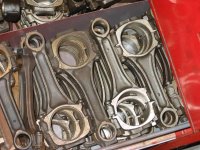
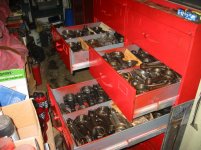
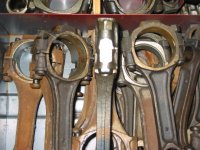
I have a "collection" of probably a couple of hundred big block rods and everyone is factory stamped. I took some pics but I dont think the numbers show very well. Some of these are "dimple" rods both 3/8 and 7/16, as well as some standard 3/8.

There is also a 1967 Camaro 350 "dimple" rod in one pic that is kinda rare. I think its the only large journal rod ever made with 11/32 rod bolts.

I am not doubting that you have never seen any rats that were numbered but I do know what I have found.

Jeff
 

Attachments

  • craigs 018.jpg
    craigs 018.jpg
    119.1 KB · Views: 15
  • craigs 019.jpg
    craigs 019.jpg
    141.6 KB · Views: 15
  • craigs 020.jpg
    craigs 020.jpg
    142.8 KB · Views: 17
  • craigs 021.jpg
    craigs 021.jpg
    144.9 KB · Views: 16
  • craigs 022.jpg
    craigs 022.jpg
    150.5 KB · Views: 16

Drdaves49

Well-known member
Joined
Oct 26, 2009
Messages
219
Location
Myrtle Creek, Oregon
I have rarely run into a factory marked rod cap. The general rule is that if it's marked it been rebuilt before. I have never built a domestic engine with factory marked rods. many domestics don't have indexing marks and aftermarket pistons many times don't have them either.


Hmmmm, I can't remember any engine I've rebuilt that didn't have marked pistons or rods......but then again all the stuff I have done is vintage.:headscrat

Dammit now i'll have to go pull one apart to check.....LOL:lol_hitti
 

mrholeshot

MEMBER EMERITUS
Joined
Jun 22, 2010
Messages
8,043
Z/28 I don't doubt the rods you have are marked. It was just common practice to mark rods before removal. On BBC it was often. I won't say that they never were but it's just been my experiance they they were not except on specialty engines. I just pulled an old L35 apart and the rods on it are clean with no marks. I don't save the rods on most because I don't reuse them or will sell off a nice set of 7/16 bolted ones on Ebay. Most of them hit the trash can. Nice collection you have there
 

Chris Adams

Well-known member
Joined
Oct 21, 2007
Messages
2,117
Had to think back to when I was doing them 'the hard way' and things I found really useful were beer flats.
No, not the beer, the low tray boxes, that can goods come in.
I could lay the stuff out in the boxes and stack or move the boxes, keeping things together.
Worst things I have used were deep boxes. The little stuff gets lost, things get banged together.

A number marker of some sort, even if it's a sharp awl is essential.
I always stamped pistons on the front.
I have opened engines, freshly rebuilt, that had the pistons in backwards three times.

Baggies seem useful, but I haven't had good luck with them. Oily fingers and parts, smear up the bag, the bags have nothing to tell them apart, etc.

Mark the piston before pulling, pull the piston and put the rod cap back on right then, finger tight. May feel like it takes longer, but it shortens the time of the whole job. Not sitting going um, didn't this belong to that one?
If it's going to be a long time before you put it back together mark every hose, line, etc.
An old pro will just laugh and know where everything goes. You won't remember a week from now.
 

stock z/28

Well-known member
Joined
Dec 17, 2006
Messages
298
Z/28 I don't doubt the rods you have are marked. It was just common practice to mark rods before removal. On BBC it was often. I won't say that they never were but it's just been my experiance they they were not except on specialty engines. I just pulled an old L35 apart and the rods on it are clean with no marks. I don't save the rods on most because I don't reuse them or will sell off a nice set of 7/16 bolted ones on Ebay. Most of them hit the trash can. Nice collection you have there

All of the big block stuff I am refering to were factory marked, not later.

But no problem.

I started doing this stuff back in about 1970 and I have had a lot of rats apart.

On some occasions if a "core" engine has an obviously bad rod or more I will not stamp the remaining rods and keep them as replacements for a bad rod and then stamp them with the appropriate cyl number. This is not the case with big blocks as the rods I have found have been factory numbered, so I have to either find a matching number rod or re stamp them.

I save about all of the rods as I have found when restoring this stuff if some genuinly wants a factory piece they can be hard to find.

Same with the main caps, I keep about all of the main caps off "junk" blocks and all of the rats are numbered.

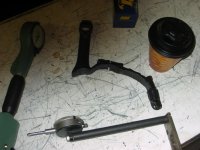
On a bit of a side not here's a pic of a "bad" rod, and this engine still rotated.
 

Attachments

  • craigs 023.jpg
    craigs 023.jpg
    143.2 KB · Views: 14

mrholeshot

MEMBER EMERITUS
Joined
Jun 22, 2010
Messages
8,043
All of the big block stuff I am refering to were factory marked, not later.

But no problem.

I started doing this stuff back in about 1970 and I have had a lot of rats apart.

On some occasions if a "core" engine has an obviously bad rod or more I will not stamp the remaining rods and keep them as replacements for a bad rod and then stamp them with the appropriate cyl number. This is not the case with big blocks as the rods I have found have been factory numbered, so I have to either find a matching number rod or re stamp them.

I save about all of the rods as I have found when restoring this stuff if some genuinly wants a factory piece they can be hard to find.

Same with the main caps, I keep about all of the main caps off "junk" blocks and all of the rats are numbered.

On a bit of a side not here's a pic of a "bad" rod, and this engine still rotated.

Yeah, main caps on the BBC have the numbers. The thing I hate about BBC is that no matter the casting number you never really know if it's 2 bolt of 4 bolt mains until the oil pan comes off. I do save all of the open chamber Oval Port heads (781 and 049s) and sell off the ret port and and closed chamber. With a switch to 2.19/1.88 and some minor porting and they make a great street head.
 

stock z/28

Well-known member
Joined
Dec 17, 2006
Messages
298
Yeah, main caps on the BBC have the numbers. The thing I hate about BBC is that no matter the casting number you never really know if it's 2 bolt of 4 bolt mains until the oil pan comes off. I do save all of the open chamber Oval Port heads (781 and 049s) and sell off the ret port and and closed chamber. With a switch to 2.19/1.88 and some minor porting and they make a great street head.

I typically look for the oil cooler boss to be drilled and tapped along with the oil pressure boss, if I am looking for OE appearing 4 bolt blocks with 1/4" pipe threads in side oil galley plugs.

The oval port open chamber heads do make a very good performance head with right modifications.

In my opinion the closed chamber heads are wort quite a bit for restoration purposes.
 

mrholeshot

MEMBER EMERITUS
Joined
Jun 22, 2010
Messages
8,043
The oval port open chamber heads do make a very good performance head with right modifications.

In my opinion the closed chamber heads are wort quite a bit for restoration purposes.

The Oval Ports make a nice head for heavy cars having to run a factory casting. Makes better overall power than say a typical 990.

I have a set of 291 castings I'm putting guides in right now. Should bring decent coin. If you ever need a block or set of heads of a certain year shoot me a PM. I keep a good many ready to build blocks and lot of older still assembled engines. Even keep some peanut ports ready for the motorhome crowd
 
To avoid these ads, REGISTER NOW!
Top Bottom