To avoid these ads, REGISTER NOW!

Question for the experts regarding a TILE floor 09/27/23

four.cycle

Well-known member
Joined
Oct 19, 2015
Messages
29,225
Location
Tacoma, Washington
I am out of my element on this one.

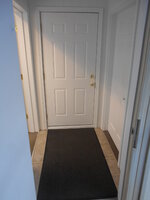
Entry way is about 4 feet x 5 feet. Floor is some sort of ceramic tile - large squares about 9" x 9". grouted in between with a whitish grout-looking stuff about half an inch wide between them. (It got a LOT lighter when I washed the floor down with TSP and hot water.)

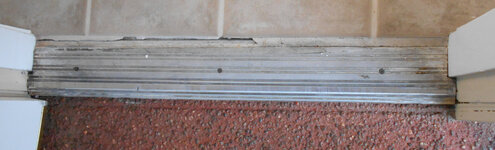
Where the tile floor meets the extruded aluminum threshold plate, the grout has cracked and broken into pieces along a section. Maybe a third of the grout stuff is missing.

grout stuff 092723.jpg
When I first ran into this - while working on the painting job I'm immersed in - I figured I could just mix up some of that fabulous DAP Concrete Patch powder that you just mix up with water and pour in the hole. It worked great on my mom's driveway to fill in some big cracks.

Except....

A closer look at this thing - down on my hands and knees - shows that one side of the tile is about 1/8" HIGHER above the threshold plate as the other side - meaning that the guy who laid this grout in had to TAPER it so that there was a smooth transition.

This is the main entry to a ballet studio. Even 1/8" of a "tripper" is NOT okay. Girls' feet and ankles are at stake here.

I already bought the DAP stuff. There won't be any issues with returning it.

QUESTION IS:

Exactly WHAT kind of a product to I need to use? Powdered, mix-up with water grout? Ready-mix-just-open-the-tub-and-lay-it-in grout? (Does that make any difference?)

Do I need to remove ALL of the OLD grout from that seam? What TOOL do I use to remove the grout so I don't crack or break or chip the tiles? Cold chisel and a mallet? Any old tool that will work? Is there some secret trick to get it to "loosen up" from where it's bonded to the tile and the threshold plate?

Grout and tile are two things I've never had to deal with so I am completely out of my element on this one.
 
Last edited:
To avoid these ads, REGISTER NOW!

steves_001

Well-known member
Joined
May 30, 2011
Messages
528
Location
Southern MN / Northern MN
Assuming you are just replacing the failing grout, remove all the loose stuff back to where it is still bonded. Various grout removal tools exist for this (one even for a reciprocating saw!). Clean it all up good. Take a sample of the old stuff to the store so you can try to color match and get a small bag of grout. With gaps that big I would guess it's sanded grout (most common). Mix it up per instructions, then using a spray bottle, wet the area a little bit and apply the new grout using a float. With the float you can match the grade to whatever level you need. Complete by again following the grout package instructions. (sponge off excess, wipe, buff etc.)

Grout is pretty easy to work with and you can't mess it up too bad.
 
OP
F

four.cycle

Well-known member
Joined
Oct 19, 2015
Messages
29,225
Location
Tacoma, Washington
If I am understanding your correctly I do not need to remove the grout that is still intact and bonded to both the tile and the threshold plate, correct?
All I need to do is fill the hole?
And wet it down first before applying the grout so it bonds to the OLD grout?
 

steves_001

Well-known member
Joined
May 30, 2011
Messages
528
Location
Southern MN / Northern MN
I picture might help but generally, if you are just repairing a section then removal of the bonded stuff is not necessary. In some cases people remove all the old grout and redo it all but usually to change color, or just to replace stuff that's overall in bad shape.

And yea, wetting the area helps bond new to old.
 

cgrutt

Well-known member
Joined
Mar 4, 2016
Messages
8,360
As stated don't need to remove old grout but I would probably try to get most of it out along the threshold so that entire "line" is filled with fresh grout and to make any color difference less noticeable. They make small carbide grout saws that will remove it easily. Found in tile section of any big box store. They also make them for osolating multi-tools which is more expensive but makes the job much easier. I'd use a modified grout or mix grout with a bottle of latex additive it will adhere better and believe will hold up better being next to the threshold. The modified grout and/or additive is relatively expensive but much better than standard grout, esp in commercial environment. Lay it in with a float or piece of hard rubber. Let it set up until it is firm and hazes over then wipe off excess with a damp (not soaking wet) grout sponge. The sponge will remove any excess off tile and threshold and taper the transition. I like to wipe one direction one time then dump sponge in 5 gal bucket of clean water (1/2 full) to rinse it out then wipe again. You can turn sponge over and even use each side before rinsing but point is always wipe with a clean sponge. After it dries there will be a haze over tiles just buff it off with a clean microfiber rag. Seal grout line after a couple days if you didn't use modified grout or a latex additive.
 

Armorpoxy

Well-known member
Joined
Aug 18, 2013
Messages
3,735
Location
NJ
We carry Epoxy Mortar which is stronger than grout and concrete and can be feathered in the areas. Most likely this would be a good solution.
 

duneslider

Well-known member
Joined
Jan 20, 2013
Messages
2,268
Location
Riverton, Utah
If I am understanding correctly, this is the joint between the tile and the door threshold? A picture of the area would be great.

Either way, grout shouldn't have been used in this location technically as it will have movement there and crack and fall out. Now, you can certainly just grout it again and it will last a while before coming out again.

A premixed grout will probably stay in longer, or maybe forever. I have had really good luck with some of them in these sorts of movement areas.

Industry guidelines call for a flexible caulk for these sorts of areas but I find they don't last too long either. Nowadays, the premixed grouts are what I am using anyway and they tend to work well in areas with a little movement.

It would be good to actually see the area you are working with though.
 
OP
F

four.cycle

Well-known member
Joined
Oct 19, 2015
Messages
29,225
Location
Tacoma, Washington
This is the entry way in a commercial building. the tile is ceramic. this is on an upper floor, so that cement floor on the outboard side isn't exposed to rain.
 

Attachments

  • DNT entry hall 100223 threshold 01.JPG
    DNT entry hall 100223 threshold 01.JPG
    392.9 KB · Views: 28
  • DNT entry hall 100223 threshold 02.JPG
    DNT entry hall 100223 threshold 02.JPG
    633.1 KB · Views: 27
  • DNT entry hall 100223 threshold 03.JPG
    DNT entry hall 100223 threshold 03.JPG
    650.6 KB · Views: 23
  • DNT entry hall 100223 threshold 04.JPG
    DNT entry hall 100223 threshold 04.JPG
    695.2 KB · Views: 22
  • DNT entry hall 100223 threshold 05.JPG
    DNT entry hall 100223 threshold 05.JPG
    737 KB · Views: 23
To avoid these ads, REGISTER NOW!

LeonardY

Well-known member
Joined
Apr 16, 2011
Messages
5,092
Location
Southern California
I would just clean out the loose grout. Do you have a oscillating tool? There are diamond grit blades that would clean it out. You can use a cold chisel and a hammer too.
Vacuum out all the loose stuff. Use a grout with sand. I would mix in a bonding agent too.
Then just trowel it in. Let it set but before it completely hardens use a sponge to smooth.
 

duneslider

Well-known member
Joined
Jan 20, 2013
Messages
2,268
Location
Riverton, Utah
Cement based grout will never stay in that long term. That Aluminum threshold moves and expands and contracts so much grout will never stay put.
I doubt anything will really work like you have it.

Threshold You need something that overlaps the tile, or something that butts up to the tile with a smaller gap that can be filled. The one linked is a good option.
 

coldh2o

Well-known member
Joined
May 21, 2013
Messages
1,441
Location
Ontario, Canada
Another vote for replacing the threshold and/or using caulk, not grout. I don't see a 1/8" lip as being a trip hazard, but you can probably find a heavy caulk that could be tooled enough to eliminate the lip.
 
OP
F

four.cycle

Well-known member
Joined
Oct 19, 2015
Messages
29,225
Location
Tacoma, Washington
okay... obviously I need to take a different approach on this, because those girls may as well be jumping on that threshold plate - note that the inboard most screw is backed out about 2 turns - that end of that aluminum plate is loose.
fortunately the rubber-backed mat that's in that entry way covers up that seam so it's not really exposed.

and yes, 1/8" of an inch is all the difference in the world when you're dealing with dancers.

sounds like what I need is some sort of a heavy-bodied caulking compound that will set up in there.
 

Attachments

  • DNT entry hall 100223 07.jpg
    DNT entry hall 100223 07.jpg
    482.6 KB · Views: 12

gahrajmahal

Well-known member
Joined
Dec 12, 2008
Messages
2,542
Location
Cincinnati, Ohio
If you have a table saw you can make a wood threshold out of oak to the exact thickness of the tile. Where the three screws are should be wood underneath it so shimming using thin cardboard or rosin paper will help to make it exact. You will need to make a template of each side door jambs as this new threshold will be a drop in installation unless the concrete is lower than the tile surface then you can slide it into place from the concrete side.
 

steves_001

Well-known member
Joined
May 30, 2011
Messages
528
Location
Southern MN / Northern MN
After seeing that, I would caulk it then cover it with a flat aluminum transition between the tile and threshold. Carpet section at the builder store should have those transitions. Once covered, you will never have to deal with it again.
 
To avoid these ads, REGISTER NOW!
Top Bottom