To avoid these ads, REGISTER NOW!

Question for the pro plumbers

ManCave

Well-known member
Joined
Sep 16, 2008
Messages
213
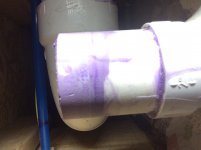
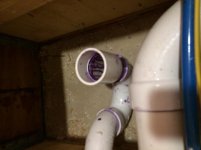
I'm cutting out a bad drain for a shower and installing a new drain before I build the shower. As you can see from the photo, because of the couplers in there I don't have much to work with. I'll have to take some measurements to see if there is enough stub somewhere to glue in a new coupler. I'd like to cut it just below the bottom coupler and get rid of all that garbage and install one new coupler and all new PVC pipe that goes up to a new drain.

I think I can do one of two things. I can either use a PVC wire saw and cut out that coupler at the bottom and hope that I have enough stub sticking up to put in a new coupler and then run a new stub of PVC up to a new drain, or....I believe they make a coupler that would slip inside the 2" stub that's there and the other end would accept a 2" pipe, correct? I know for the drain its not the best idea to reduce it internally below 2" but if I can't get a coupler in there what else can I do?

Also, do you use some emory cloth to remove some of that old primer and glue drips or is priming it with new primer and gluing all that's necessary?

I could really use some suggestions. If you're a professional plumber, please mention that in your reply.
 

Attachments

  • pvc.jpg
    pvc.jpg
    135.5 KB · Views: 168
To avoid these ads, REGISTER NOW!

Charles (in GA)

Well-known member
Joined
Jan 11, 2006
Messages
12,489
Location
50 mi south of Atlanta
Split the bottom coupler in at least one, or two places using a dremel too, saw blade, etc. and peel it off of the pipes. Sandpaper and clean up the old stub and glue onto the old stub. Its a drain pipe, it isn't gonna leak unless you really screw it up.

Charles
 
OP
M

ManCave

Well-known member
Joined
Sep 16, 2008
Messages
213
That might work. Have you done it before? I worry about gluing anything that has old glue and primer on it. If it does fail, its going to cost me thousands of dollars. Literally.
 

dfiler2

Well-known member
Joined
Dec 15, 2014
Messages
2,858
Location
NW Minnesota
Does that pipe go into concrete? Why wouldn't you replace it all including what goes through the floor?

If it does go into concrete I think you would be better off with a fitting that fits inside the 2" pipe, trying to get a coupling off then getting it true enough to re-glue would be tough, I think at that point you would be better off using a Fernco.
 
Last edited:

Elginz

Well-known member
Joined
Dec 29, 2014
Messages
431
Location
Oconto, WI
I have split a coupler or fitting several times, using what ever I can get in the space, like a Dremel, or oscillating tool. Once in a while the glue will not give and the PVC gives chipping a piece out, most of the time there was enough left anyway. Clean it up with sandpaper.
 

fury9

Well-known member
Joined
Mar 4, 2012
Messages
1,277
Location
Mchenry, IlLaHnoYs
^ this, just don't over do it when you use the tool, drill out the old pipe and thats it. Make sure the pipe fits and drill out the old one as straight as you can, you'll want to cut it flush for this operation.
 

James-W

Well-known member
Joined
Feb 3, 2013
Messages
12,432
Location
Southeastern Wisconsin
If you do screw up with a wire cutter, they make a 2" tool that fits on a drill so you can get back a socket to glue into.

Here is a site just for a picture of what one looks like (not the price because this is way high). http://www.spapartsshop.com/RAMBIT-2-2.aspx
I never knew they had a tool like that. Thanks for the tip, once again I learned something new from you guys.
 

SkidooRider15

Well-known member
Joined
Mar 12, 2015
Messages
50
Location
St. Paul, MN
Split the bottom coupler in at least one, or two places using a dremel too, saw blade, etc. and peel it off of the pipes. Sandpaper and clean up the old stub and glue onto the old stub. Its a drain pipe, it isn't gonna leak unless you really screw it up.

Charles

Coming from a master plumber here...That was the first idea that came to my mind was to cut & peel. I don't know the total work area but I would think you would want as much pipe to work with as much a possible.
 

stokefire7

Well-known member
Joined
Oct 5, 2011
Messages
616
Looks to me from your picture that it's coming out of a fitting half way embedded in concrete . What is it ?
 
OP
M

ManCave

Well-known member
Joined
Sep 16, 2008
Messages
213
There is no concrete. The room has truss joists in the floor. There is a 2 inch that comes through the side of the truss joist into the cavity in the photo. The 2 inch has a trap on it for the shower drain. The photo is showing the 2" pipe coming up from the trap. I'm sure I could get the coupler off by splitting it and I could use a heat gun to warm the coupler and soften the glue.

I would then be left with about a 3 1/2" stub of pipe which would be plenty long enough to install a new coupler. That 3 1/2" pipe though would have old primer and old glue on it. I've done a lot of plumbing but I've never glued a coupler to anything but perfectly clean, new, pipe.

Has anyone glued a PVC fitting before to a pipe that had glue and primer on it from a previous fitting? If so, has it ever leaked?

I know this is a drain and not under pressure but if this fails (leaks) it would be a huge and very, very expensive undertaking to fix it.
 
To avoid these ads, REGISTER NOW!

Cave Creek Ray

Well-known member
Joined
Mar 8, 2015
Messages
383
Location
North Central Arizona
ManCave...

Splitting those depends on the way they were installed. Most people and a lot of installers don't use the proper method of gluing: Solvent and then a medium coat of glue. Wait 30 seconds. And then a second coat of glue on both pieces, again, medium thickness with good coverage. Most people use a lot of glue and that just makes a mess and a poor glue joint. Like in your pictures.

Solvent and glue physically welds the two pieces of plastic together. Splitting properly welded joints is almost impossible.

Glue alone just "sticks" them together and that joint splits apart relatively easy.

Another key thing most DIY'ers forget is to bevel the male pipe slightly before gluing. If you don't the sharp edge of the pipe may scrape nearly all the glue away from the bonding area as the pipes joint together. While not as critical with smaller size pipes like 3/4, it IS critical on larger pipes like 1 1/2 and 2". You may not see a leak right away but after a month or so on pressure, the leak may start. Done correctly, you are fine. And on drain pipes, the success rate is much higher.

I wouldn't worry at all about joining over glue. Like others have said, buff the high glue spots with a Dremel sander or, with 220 grit by hand. If you glue the two pieces together properly, your joint will be rock solid. The rotation of 1/4 or more turn on joining after proper glue will fill in the joint contact patch with melted plastic and the joint will be perfect and leak free.

Ray
 

Hpozzuoli

Well-known member
Joined
Dec 11, 2013
Messages
3,428
Location
Rhode Island
Usually if the pvc work is old enough just wrap a strap wrench around it and carefully twist it loose. If you have strong hands just grab and twist.

Next best thing is carefully split the bottom coupler off the stub. I don't like internal joints, especially in a shower drain. They clog fast enough without giving the hair a ledge to fall on inside.
 
OP
M

ManCave

Well-known member
Joined
Sep 16, 2008
Messages
213
I just ran a test on some scrap PVC with a coupling glued to it. I used my PVC saw to cut a slit almost through the PVC coupling. I didn't want to go deep enough to damage the pvc pipe which is why I cut "almost" through the coupling.

Then I heated the coupling with a heat gun and used a screw driver to pry the coupling away from the pipe to where I could finish cutting through the coupling with a knife. Then I grabbed the coupling with a needle nose pliers and started rolling, and using heat as needed, I was able to pry the coupling off the pipe with no damage to the pipe at all.

I used some emory cloth on the pipe to clean it up some. I primed it really good and glued a new coupler on it. I waited about 5 minutes and then tried to twist that coupler loose but it wouldn't budge. So if its that durable before the glue has totally dried I can't image a joint on a drain with no pressure would ever leak.

Seeing as they make special tools for reaming out PVC pipe or heating them and removing pipes...it must be somewhat common to reglue a fitting that was glued before?

Thoughts?
 
Last edited:

Charles (in GA)

Well-known member
Joined
Jan 11, 2006
Messages
12,489
Location
50 mi south of Atlanta
Has anyone glued a PVC fitting before to a pipe that had glue and primer on it from a previous fitting? If so, has it ever leaked?

I know this is a drain and not under pressure but if this fails (leaks) it would be a huge and very, very expensive undertaking to fix it.

I've done this successfully with larger pressure pipe before. Just clean it up with sandpaper and possibly some 3M scotchbrite and it will be good to go. No need for heat or other ****, its just a drain, and use good clear cement on it, will bond just fine. The primer is to soften the plastic before the glue gets to it (and to remove oils, and other contaminates). This whole process is known as solvent welding.

If you are truly scared of re-gluing it, and there is no reason to be, as mentioned by others, a fernco coupling or similar will work for many years to come.

Charles

Edit: posting at the same time............. let it cure and it will be just fine. I've even nicked the pipe before, the glue fills the voids and irregular areas. It isn't coming apart.
 
Last edited:
OP
M

ManCave

Well-known member
Joined
Sep 16, 2008
Messages
213
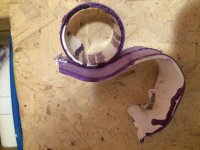
Shown is a photo of the old DWV coupler after I removed it. Next is a photo the pipe before I cleaned it up. Followed by a photo of the pipe after it was cleaned up with emory cloth. Mainly I tried to remove any high spots from the old glue.

I chose to install a PVC slip coupler instead of a DWV coupler. The reason was that the standard PVC slip coupler, normally used for pressure applications, has more surface area of the pipe in which to bond to. So it slipped onto the pipe beyond where the DWV coupler originally sat and actually extended on to some cleaner area of the pipe. You wouldn't want to use a non-DWV fitting anywhere there is a bend, for example, but in a straight run like this it shouldn't matter. The drain will have a strainer installed.

I double primed to keep it wet longer and soften some of the old primer and glue. Then I used the heavy duty PVC cement. I'm confident this will never leak or fail.

Anyway, it was a learning process for me. I've never reused a previously glued pipe before or removed a fitting like I did for this project.

The trick for removing the coupler was splitting it and then using heat.

If I came across as over-thinking this its because its a 3/4 of a million dollar home and the area below is a kitchen with custom cherry wood cabinets and a masonry wood fireplace in the kitchen. Not something where you want water falling from the ceiling. :)

Thanks to everyone who shared your thoughts. I really appreciate you guys! Good people. :)
 

Attachments

  • IMG_0600.jpg
    IMG_0600.jpg
    138.6 KB · Views: 29
  • IMG_0615.jpg
    IMG_0615.jpg
    82.8 KB · Views: 23
  • IMG_0617.jpg
    IMG_0617.jpg
    78.2 KB · Views: 24
  • IMG_0619.jpg
    IMG_0619.jpg
    127.6 KB · Views: 31
Last edited:
OP
M

ManCave

Well-known member
Joined
Sep 16, 2008
Messages
213
By the way, I filled the trap with water (it was dry) before using the heat gun. It was venting methane gas and I wasn't in the mood for a trip to the moon. :p
 

mires

Well-known member
Joined
Jan 12, 2014
Messages
600
Location
Columbia, MO
***** that even in expensive homes, what lurks beneath is generally shoddy workmanship. It's as if his boss told him not to come back with any fittings or primer.
 

mygarageone

Well-known member
Joined
Oct 16, 2013
Messages
2,691
Location
Munising , Mich
I'm cutting out a bad drain for a shower and installing a new drain before I build the shower. As you can see from the photo, because of the couplers in there I don't have much to work with. I'll have to take some measurements to see if there is enough stub somewhere to glue in a new coupler. I'd like to cut it just below the bottom coupler and get rid of all that garbage and install one new coupler and all new PVC pipe that goes up to a new drain.

I think I can do one of two things. I can either use a PVC wire saw and cut out that coupler at the bottom and hope that I have enough stub sticking up to put in a new coupler and then run a new stub of PVC up to a new drain, or....I believe they make a coupler that would slip inside the 2" stub that's there and the other end would accept a 2" pipe, correct? I know for the drain its not the best idea to reduce it internally below 2" but if I can't get a coupler in there what else can I do?

Also, do you use some emory cloth to remove some of that old primer and glue drips or is priming it with new primer and gluing all that's necessary?

I could really use some suggestions. If you're a professional plumber, please mention that in your reply.


Those joints look like they used abs glue ? Or is that just shadow ?
 
To avoid these ads, REGISTER NOW!
Top Bottom