To avoid these ads, REGISTER NOW!

Question for the Sparky's (Sub Panel Connection)

aka Larry

Well-known member
Joined
May 2, 2012
Messages
8,066
Location
Eastern, NC
So my buddy has a sub panel in his attached garage. That part (minus the digging) was easy peasy. Now we need to connect it to the house panel.

We're using 2-2-2-4 aluminum MHF. House panel has and existing slot for a former electric stove that was replaced with a gas unit during a recent kitchen remodel, so we have a connection point.

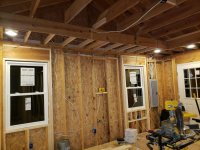
House panel is located in a former garage, which was recently converted to a master bedroom. The panel had to be raised during this remodel and the feed rerouted through the bottom.

At this point it looks like our only option is to enter through the exterior wall in the cavity between the studs to the right of the panel as pictured below.
This pic was taken during the remodel.

attachment.php


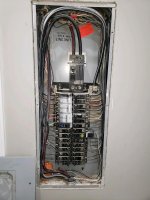
Here's the panel in it's current state:


attachment.php


My question was is the correct and hopefully easiest way to run the new wire into the house panel? I'm pretty sure there is only one existing 2" knockout in the box, and that one contains the main feed.
 

Attachments

  • panel.jpg
    panel.jpg
    154.3 KB · Views: 510
  • panel_ex.jpg
    panel_ex.jpg
    95.1 KB · Views: 520
To avoid these ads, REGISTER NOW!

pattenp

Well-known member
Joined
Jun 4, 2008
Messages
10,175
Location
Virginia - USA
My question is why in the world are you using MHF if the subpanel is in the same structure as the main?
 
OP
A

aka Larry

Well-known member
Joined
May 2, 2012
Messages
8,066
Location
Eastern, NC
My question is why in the world are you using MHF if the subpanel is in the same structure as the main?

The new garage is a detached structure.

Can we create another 2" hole in the bottom of the panel? If so, I've used a 1/2" mechanical type knockout punch before, but a 2" would likely need to be hydraulic right? Can you rent one of those?
 
Last edited:

doctordirt

Well-known member
Joined
May 15, 2014
Messages
492
How about using a hole saw? I have Lennox electrician hold saw kit that I use on boxes all the time while doing pump controls.
 
OP
A

aka Larry

Well-known member
Joined
May 2, 2012
Messages
8,066
Location
Eastern, NC
How about using a hole saw? I have Lennox electrician hold saw kit that I use on boxes all the time while doing pump controls.

Good to know!

Once we get through the wall we don't need any conduit right? Just drill a hole in the stud and elect box and feed the wire? Is it OK to put a 2" hole in a stud?
 

brewchief

Well-known member
Joined
Sep 20, 2008
Messages
2,370
Location
Michigan
Good to know!


Once we get through the wall we don't need any conduit right? Just drill a hole in the stud and elect box and feed the wire? Is it OK to put a 2" hole in a stud?
MHF( or any wire that's individual conductors)needs to be in conduit if above ground in a building, doesn't matter if buried in a wall or exposed.

It might be easier in this situation to bring the conduit out of the ground to a junction box and transition to 2-2-2-4 SER cable for the short run into the panel, you wouldn't need as large of a knockout in the panel this way either.

Sent from my SM-G965U using Tapatalk
 

yatg

Well-known member
Joined
Aug 16, 2019
Messages
2,828
Location
Southern Oregon
Any reason not to go through the wall directly into the back of the panel in the lower right corner? Looks like somebody already did that at one point in the lower left with all that foam leaking in there. Should cover that hole up.
 

sparky 1971

Well-known member
Joined
Oct 9, 2018
Messages
7,975
Location
Central Iowa
The hole in the lower left is probably where the panel used to feed back to back with the meter socket before the panel was raised. If so, there is probably room to bring an LB into the back through the lower right corner. Do some measuring to make sure. Then drill a 1/4" pilot hole through the panel and outside. Then use a hole saw for whatever size conduit you use to go through the panel. Then use a larger saw that the LB will fit into coming from the outside in. #2 MHF doesn't need 2". 1-1/4" would be fine.
 
OP
A

aka Larry

Well-known member
Joined
May 2, 2012
Messages
8,066
Location
Eastern, NC
The hole in the lower left is probably where the panel used to feed back to back with the meter socket before the panel was raised. If so, there is probably room to bring an LB into the back through the lower right corner. Do some measuring to make sure. Then drill a 1/4" pilot hole through the panel and outside. Then use a hole saw for whatever size conduit you use to go through the panel. Then use a larger saw that the LB will fit into coming from the outside in. #2 MHF doesn't need 2". 1-1/4" would be fine.

You are correct about the former hole. My question is can the meter box be used as a raceway? IOW can we run the outside conduit up to the meter box, through it an into the interior panel box?

What is LB BTW?
 
Last edited:

sparky 1971

Well-known member
Joined
Oct 9, 2018
Messages
7,975
Location
Central Iowa
You are correct about the former hole. My question is can the meter box be used as a raceway? IOW can we run the outside conduit up to the meter box, through it an into the interior panel box?

What is LB BTW?

You can't run through the meter can. The meter is probably centered up on the old 2" hole which would leave you approximately half the width of the panel clear on the right side to come into. I don't know how to post links and I don't want to know for anyone that wants help. Google LB conduit body.
 

pattenp

Well-known member
Joined
Jun 4, 2008
Messages
10,175
Location
Virginia - USA
I guess I should have put 2 and 2 together when you said digging to know you were dealing with a detached garage. The subpanel in attached garage comment confused me.
 
Last edited:

wyliesdiesels

Well-known member
Joined
Aug 14, 2012
Messages
20,031
Location
Modesto, CA
The new garage is a detached structure.

Can we create another 2" hole in the bottom of the panel? If so, I've used a 1/2" mechanical type knockout punch before, but a 2" would likely need to be hydraulic right? Can you rent one of those?

you said ATTACHED in the first sentence of your OP.
 
OP
A

aka Larry

Well-known member
Joined
May 2, 2012
Messages
8,066
Location
Eastern, NC
You can't run through the meter can. The meter is probably centered up on the old 2" hole which would leave you approximately half the width of the panel clear on the right side to come into. I don't know how to post links and I don't want to know for anyone that wants help. Google LB conduit body.

Gotcha. We opened up the meter box and there wasn't room anyway.

What you call a "LB" I call a "pull box", from a term I heard years ago. That's what we we used to get through the wall of the detached garage.

Since the easy button was to leave this portion of the job alone until we have a definite game plan, we started running the EMT in the new garage instead.

Thanks for the help so far everyone!
 
OP
A

aka Larry

Well-known member
Joined
May 2, 2012
Messages
8,066
Location
Eastern, NC
Update on this thread and more questions.


It might be easier in this situation to bring the conduit out of the ground to a junction box and transition to 2-2-2-4 SER cable for the short run into the panel, you wouldn't need as large of a knockout in the panel this way either.

So it sounds like the switch from MHF to SER before entering the house would be the easier choice here. I assume we'd use a split-bolt type connection for the splice right? If so, I would think there isn't nearly enough room inside a 2" LB for such a connection. What type box would we use to enclose the splice?
 
OP
A

aka Larry

Well-known member
Joined
May 2, 2012
Messages
8,066
Location
Eastern, NC
I'm bringing this topic back for more Q&A.

We now have all the wire pulled in the EMT inside the shop. Last step before the first inspection is the connection to the main panel in the house. Based on suggestions here, we ran SER all the way to avoid having to deal with conduit in the walls of the house. It was a *****, but we did get it done via a LB outside and 1-1/4" knockout in the box.

My question now is does the new SER connection need a strain relief where it enters the house panel, and does it have to be secured to the stud in the wall like the main feed beside it?
 
To avoid these ads, REGISTER NOW!

pattenp

Well-known member
Joined
Jun 4, 2008
Messages
10,175
Location
Virginia - USA
SER is installed just like NM-b. Use a NM clamp in the knockout of the panel. If the studs are open for securing the cable then it needs to be secured to the stud within 12" of the panel.
 
OP
A

aka Larry

Well-known member
Joined
May 2, 2012
Messages
8,066
Location
Eastern, NC
SER is installed just like NM-b. Use a NM clamp in the knockout of the panel. If the studs are open for securing the cable then it needs to be secured to the stud within 12" of the panel.


Thanks for the info!

We had to cut the drywall (we made about a 4" wide section) to be able to fish the cable up, so I guess you could say it's somewhat 'open', but not open enough to swing a hammer or drive a screw to secure a clamp. The length of the cable from where it enters the house is not much over 12" right now.

Do we need open the drywall up further to be able to clamp the SER to the stud?
 

brewchief

Well-known member
Joined
Sep 20, 2008
Messages
2,370
Location
Michigan
I'm bringing this topic back for more Q&A.

We now have all the wire pulled in the EMT inside the shop. Last step before the first inspection is the connection to the main panel in the house. Based on suggestions here, we ran SER all the way to avoid having to deal with conduit in the walls of the house. It was a *****, but we did get it done via a LB outside and 1-1/4" knockout in the box.

My question now is does the new SER connection need a strain relief where it enters the house panel, and does it have to be secured to the stud in the wall like the main feed beside it?
When you say you ran SER all the way I hope you don't mean that you ran it underground.

Sent from my SM-T510 using Tapatalk
 

pl_silverado

Well-known member
Joined
Jul 1, 2005
Messages
2,033
Location
West Bradford, PA
Yes, we ran it underground, in conduit of course. Is that a problem?

All wires need to be insulated if running in underground conduit, as conduit is considered a wet location. Beings your 4th wire is bare, its not up to code.

Individual XHHW or THWN conductors would have been the way to go in conduit.
 

alfredeneuman

Well-known member
Joined
Mar 3, 2011
Messages
4,582
Location
Fullerton, CA
All wires need to be insulated if running in underground conduit, as conduit is considered a wet location. Beings your 4th wire is bare, its not up to code.

UF cable has a bare ground wire :bounce:

As for SER cable
338.12 Uses Not Permitted.
(A) Service-Entrance Cable. Service-entrance cable (SE) shall not be used under the following conditions or in the following locations:
(2) Underground with or without a raceway
 
Last edited:
OP
A

aka Larry

Well-known member
Joined
May 2, 2012
Messages
8,066
Location
Eastern, NC
All wires need to be insulated if running in underground conduit, as conduit is considered a wet location. Beings your 4th wire is bare, its not up to code.

Individual XHHW or THWN conductors would have been the way to go in conduit.

Just read that...ack! Oh well, we'll I guess we'll have to redo it. Better to find out now than later.

Thanks for the info!
 

pl_silverado

Well-known member
Joined
Jul 1, 2005
Messages
2,033
Location
West Bradford, PA
UF cable has a bare ground wire :bounce:
338.12 Uses Not Permitted.
(A) Service-Entrance Cable. Service-entrance cable (SE) shall not be used under the following conditions or in the following locations:
(2) Underground with or without a raceway

:lol_hitti


I just redid the service to my house, replaced meter can, relocated panel to basement, 2.5" conduit under ground to a mogul LB, then 2" out of mogul to panel. 2/0 Copper XHHW with a #1 Copper XHHW Ground. Overkill....but i hope to never touch it again. :beer:


I'd go with copper over aluminum everyday. The cost difference for XHHW was insignificant, around $300 or so.
 

alfredeneuman

Well-known member
Joined
Mar 3, 2011
Messages
4,582
Location
Fullerton, CA
:lol_hitti
2/0 Copper XHHW with a #1 Copper XHHW Ground. Overkill....but i hope to never touch it again.
I'd go with copper over aluminum everyday. The cost difference for XHHW was insignificant, around $300 or so.

You do know that XHHW is just cross linked polyethelene insulation, and available in both copper and aluminum, don't you?
 
OP
A

aka Larry

Well-known member
Joined
May 2, 2012
Messages
8,066
Location
Eastern, NC
Update.

This weekend we removed the section of in-ground SER and replaced it with MHF. We spliced the MHF to the SER in an LB just outside the main house panel. The SER is now secured to a nearby stud, and strain relief has been added where it enters the main panel.

We now have everything connected to the sub panel, but have to get an initial inspection before we can proceed with the connections in the main panel.

Thanks for everyone's knowledge and advise on this project so far!
 
To avoid these ads, REGISTER NOW!
Top Bottom