CraigStu
Well-known member
This is what I typed. "For swapping tires, just use the jack. No need for stands unless you will be going under the car."


My only "complaint" is that the jack points are deep into the car requiring a drive up the ramps to then get out your long-reach, low profile floor jack - even still, it's nearly not able to reach.BMW probably makes it the easiest to jack up, side note what is that shield? I can't make out the name on it.
I cut pieces of 1/4" Ply as a base plate to put under my jack stands to prevent this.Also consider your driveway material and the vehicle weight.
If I jack up the front of my 3/4 ton pickup from under the front differential it works nicely, but the wheels of the hydraulic jack usually start to sink right into the asphalt. Next time I will put the wheels on a 2"x8" to spread out the load on the asphalt surface. Rear tires are not a problem, since its much lighter in the rear.
Thanks, I don't have an M only a lowly 335iS and was curious if maybe they had something for it, no luck!The shield is an aluminum undertray made specific to the E9x M3 to replace the OEM felt pieces designed & manufactured by MPorium out of the Dallas, TX area. Much sturdier, better airflow for all the coolers, and gains a few inches of ground clearance to boot.
That has nothing to do with a jack pad being steel and despite them not being perfectly flat it's not going to be a tiny surface area that all of the weight is on. Any material that you use to support a car at a point that shouldn't be supported at will cause it to crack. Doesn't matter if it's steel or aluminum or wood if there's not adequate area.a jack pad usually isn't a flat surface it would have 2-4 smaller sections that actually make contact, if one of those points is supporting the load of the car then yes, you can crack it. i've see it done with diffs and transmissions.
Cannot remember having seen someone looking that up in a repair manual. With some experience it is quite straightforward to see where supports can be placed. The loads per support are usually not very high. Also the height of each pad should be adjusted if required.Get or view a factory service manual for your vehicle. It will indicate the lift / support locations.
It is straightforward to someone with experience lifting vehicles. However, if a person asks how to lift or supprt their car on an internet forum- that person needs to find the correct method.Cannot remember having seen someone looking that up in a repair manual. With some experience it is quite straightforward to see where supports can be placed. The loads per support are usually not very high. Also the height of each pad should be adjusted if required.
Many do not follow the instructions and more generally often the manuals do not present the most efficient way to do some repairs. It also depends on available tools. For basic work no one needs any specific vehicle documentation.
As others said, never ever trust any jack. Always expect a jack, be it hydraulic or mechanical, to suddenly fail catastrophically. There have been many tragic accidents.
Not all jack stands are born equal, I've seen some I wouldn't ever trust:
When using jack stands the jack can still be used as additional safety very slighly preloaded, so both the jack stands and jack won't move, or at least it's how I do it. Other risks like failing parts may play a role too.

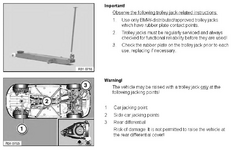
What jackstand is that?Depends on the car of course, but Bimmer typically has a point near the motor and utilize the rear diff. Jack stands go at the specific points at the rail. You can see the front jack point under the motor in this picture.

Opening the door is easy. Shutting it isn't. Also, I was refering to shop manuals, not owners manuals.I'm going to leave this here:
I think a lot of us grew up in a generation where all vehicles had a full frame under them. Everything had a bumper jack. You picked the car up off of the bumper to change a tire on the road. If you had a floor jack you put it under the frame basically anywhere and set the jack stand next to it on the frame at home. Easy peasy.
Some vehicles like trucks and full size SUVs still have frames - the old rules still apply (except for the bumper jack thing - they don't work well with plastic). My 07 Explorer is one of them.
Since the era of unibodies things got more complicated - in a bid to save weight frames were eliminated and the car body itself became the main structure of the vehicle. Sure - most cars still have subframes to attach the engine and the suspension but it's engineered into the design of the structure of the vehicle. They work together so you can't necessarily count on the subframe to take a point load for a jack stand. Hey - maybe the point you think looks good to use was actually designed to be a critical part of the crumple zone so it is actually designed to be a weak point.
So it would be nice if they pointed out the right places in the manual but they don't. Hence the graphic above. Not sure if they don't want you to know so you won't be tempted to work on it yourself rather than bringing it back to them or perhaps a liability thing.
Maybe it's because they know the number of people that actually even own jack stands dwindles every year that passes so why bother.
I've always been tempted to try to open a door when I have a unibody car jacked up on one approved jack point to the point where the tire is off the ground. I've always suspected that the door is playing a part in the structural integrity due to that flimsy pinch weld so I've never tried it.
Those look like Harbor Freight Daytona stands. They are the 3 legged style also made by Esco and others.What jackstand is that?
What jackstand is that?

 www.harborfreight.com
Those look like Harbor Freight Daytona stands. They are the 3 legged style also made by Esco and others.
