To avoid these ads, REGISTER NOW!

Question on retaining wall foundation not done right

vrinner

Well-known member
Joined
Aug 29, 2006
Messages
1,078
Location
Placentia, CA
I posted in my garage thread but figure starting a new one specific to my questions would be better.


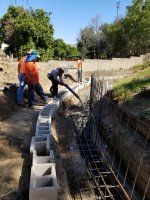
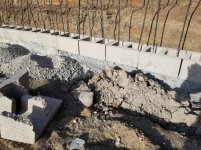
When they were pouring the slab they ran short of concrete (3 truck loads) and didn't pour the front part of the footing to the full 12" depth. It's only about 6-8". Stem width of 24" was done.

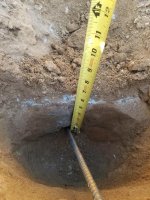
The front and back of the footing are supposed to be 12" thick. The back is good, the front not so much. They did go extra deep on the key part (30" required...they went between 32" and 36").

So it's been a few days, already cured/hard. What should the fix be? I'm thinking epoxy in rebar then pour additional concrete. I can't imagine tearing it all out and starting from scratch. The other 120 feet of the wall is fine.
 

Attachments

  • 20190415_174857.jpg
    20190415_174857.jpg
    154.5 KB · Views: 343
  • 20190417_180850.jpg
    20190417_180850.jpg
    147 KB · Views: 317
To avoid these ads, REGISTER NOW!

MoonRise

Well-known member
Joined
Nov 5, 2010
Messages
4,030
Location
NJ
The 'specs' said 12" thick and they only poured 6" thick?

Not even close.

And the 'excuse' of running short on the concrete is just that, an excuse. They apparently needed 3+ trucks of concrete but only ordered 3 and didn't have that last truckload on 'standby'. Fail on the contractor's part.

Call the building inspector and ask him/her how the pre-pour inspection on footing depth somehow 'missed' that. And ask them what are the Code acceptable ways to 'fix' the insufficient footings.

And Yes, especially in seismic California, Code matters. Without even looking up any code requirement specifics, I'd say that the rebar in the footings is now insufficient/incorrect.

Step ONE : Stop work order. No more progress until this is resolved.
 

GMCGarage

Well-known member
Joined
Jan 31, 2017
Messages
1,264
I posted in my garage thread but figure starting a new one specific to my questions would be better.


When they were pouring the slab they ran short of concrete (3 truck loads) and didn't pour the front part of the footing to the full 12" depth. It's only about 6-8". Stem width of 24" was done.

The front and back of the footing are supposed to be 12" thick. The back is good, the front not so much. They did go extra deep on the key part (30" required...they went between 32" and 36").

So it's been a few days, already cured/hard. What should the fix be? I'm thinking epoxy in rebar then pour additional concrete. I can't imagine tearing it all out and starting from scratch. The other 120 feet of the wall is fine.

Consult the engineer that designed it if you had one, let them decide, bill all time to contractor. If no engineer, then hire one at contractors expense. Its not right, and would you accept a hack job like that if it was a new car? Out of sight out of mind is fine until you start having structural issues.
 
OP
V

vrinner

Well-known member
Joined
Aug 29, 2006
Messages
1,078
Location
Placentia, CA
Great advice. I just got off the phone with the engineering company that designed the wall and sent them over pictures. They will look into it and give me the best option. I've also let my contractor know that no more concrete till we get this figured out.
 
OP
V

vrinner

Well-known member
Joined
Aug 29, 2006
Messages
1,078
Location
Placentia, CA
T...
Call the building inspector and ask him/her how the pre-pour inspection on footing depth somehow 'missed' that. And ask them what are the Code acceptable ways to 'fix' the insufficient footings.
...

The did dig the footings to the proper depth (and then some) so the building inspector pass that phase. They just didn't order enough concrete.
 

readhead

Well-known member
Joined
Dec 8, 2012
Messages
6,181
Location
Durango, Co.
Good call. The engineer will have to design a fix. The fix will probably cost more than the short load. They probably wet set an extra course of block to take up the space. I would watch the mason like a hawk from this point.
 
OP
V

vrinner

Well-known member
Joined
Aug 29, 2006
Messages
1,078
Location
Placentia, CA
Just got off the phone with the engineers...

Rough up the entire surface
totally clean of any dirt and debris
Apply concrete bonding paste/adhesive
Pour remaining concrete so total thickness is 12"

So not as bad as I thought but still a lot of work.

Thanks for the advice...I feel much better knowing the engineers took time to discuss and come up with the proper solution.
 

egdede

ALLIANCE MEMBER
Joined
Dec 20, 2009
Messages
2,094
I don't think those open ended units are going to allow much drainage once the grout is poured in the cells.
 
To avoid these ads, REGISTER NOW!

ConCretin

Well-known member
Joined
Jan 20, 2011
Messages
3,379
Location
Central Maine
Just got off the phone with the engineers...

Rough up the entire surface
totally clean of any dirt and debris
Apply concrete bonding paste/adhesive
Pour remaining concrete so total thickness is 12"

So not as bad as I thought but still a lot of work.

Thanks for the advice...I feel much better knowing the engineers took time to discuss and come up with the proper solution.

Since you have a response from the engineer, I guess it doesn't really matter but I am still confused about the original issue. You said the trench was dug to the proper depth? They ran short of concrete so you only got 6" of depth yet it appears the top of the footing is level? I don't get how that happens. Is there a step in the footing we can't see.

My second thought is that the engineer's response is a bit odd. Are you going to remove the blocks and just add more concrete to the top of the footing? If that's the case, I'd just rip it out and build it properly.

I also question the original design/construction. You said this is a retaining wall, correct? How much earth is it supporting? A retaining wall's ability to resist overturning depends on the weight of the soils 'holding down' the footing and the connection from the wall to the footing. That footing looks awful meager for this purpose.

Finally, make sure you have good drainage to minimize the weight of the soil you are holding back. Good luck with the rest of your project.
 

matt_i

Well-known member
Joined
Mar 14, 2008
Messages
10,730
Location
SE Michigan
Apply concrete bonding paste/adhesive
Pour remaining concrete so total thickness is 12"

This sounds strange to me, it seems like it offers the contractor an easy-out because how is a person going to apply a bonding adhesive that sticks to wet concrete??

If it were my project, after sawing the slab back to where its full-depth, I would edge-drill the existing slab and epoxy some short stubs in after prepping the drilled-holes with compressed air and a long tube to reach the bottom of the holes. Now you have a mechanical feature that the wet concrete can bond to, the rebars have the extra benefit of keeping the different slabs in alignment until they rust out which is probably a problem for another generation.

Somewhat harder is going to force your contractor to comply with engineering. Beware the "we've run into this before and its never been an issue we offer full warranty" type soothing responses which don't add up to a small hill of beans.
 
Last edited:

joey1320

Well-known member
Joined
Jun 14, 2015
Messages
1,813
Location
NE Ohio
This project should had been stopped the moment the last and needed concrete truck was MIA and should not have gotten past that point.

For the contractor to just blankly disregard the engineering departments' requirements lets me know he's a hack. Sorry but for the guy to just cut the footers depth in half and "run with it" is complete BS.

Best of luck with the repairs.
 

MoonRise

Well-known member
Joined
Nov 5, 2010
Messages
4,030
Location
NJ
Since you have a response from the engineer, I guess it doesn't really matter but I am still confused about the original issue. You said the trench was dug to the proper depth? They ran short of concrete so you only got 6" of depth yet it appears the top of the footing is level? I don't get how that happens. Is there a step in the footing we can't see.

My second thought is that the engineer's response is a bit odd. Are you going to remove the blocks and just add more concrete to the top of the footing? If that's the case, I'd just rip it out and build it properly.

I also question the original design/construction. You said this is a retaining wall, correct? How much earth is it supporting? A retaining wall's ability to resist overturning depends on the weight of the soils 'holding down' the footing and the connection from the wall to the footing. That footing looks awful meager for this purpose.

Finally, make sure you have good drainage to minimize the weight of the soil you are holding back. Good luck with the rest of your project.

Yeah, something isn't adding up to me either.

Inspector says footing depth was 'correct'. To me, that means that the bottom of the footing 'hole' was deep enough from the top edge of the form that the correct/desired depth of concrete could be poured/placed into said footing form.

But the top surface of that footing is flat and level. And gravity means that when the concrete was put into said form, it went to the bottom of the 'hole' first and then was filled up to the top edge of the form.

But there is only ~6" of concrete there. :headscrat

When you run out of concrete, you don't 'fill' the form all the way to the top. Which means that you wouldn't have a flat and level 'filled' form full of concrete.

And how the heck are you going to get the 12" thick concrete when you already have the top surface of the concrete footings at the correct elevation? :headscrat Dig underneath the footing, magically clean off the bottom of the footing, and somehow pour concrete underneath the existing too thin footing? :headscrat

It kind of sounds like the engineer told you how to fix the footing if it were poured not wide enough.

It sure sounds like the contractor really needs to remove the mispoured zone, re-excavate and re-form the area, get reinspected, and THEN pour the footing correctly. With the clean-up and bonding agent to 'connect' the re-poured concrete to the existing concrete. All while maintaining the rebar connections throughout the footings.

I think the engineers need to actually do a site visit and inspection and then come up with a way to fix the contractor's screw-up, not just tell you a 'fix' based on a picture or two and a phone call.

And absolutely do NOT accept the contractor trying to say that "It's fine". Plans said 12" thick concrete, he only put in 6" thick concrete. Not even close.
 
OP
V

vrinner

Well-known member
Joined
Aug 29, 2006
Messages
1,078
Location
Placentia, CA
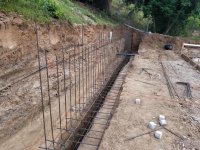
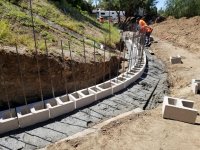
Hopefully the attached photos will clear things up a bit.

Engineering company that designed the wall and made the recommendations for the fix are in no way associated with the concrete company.

All of the footing "holes" were dug as per the plan or even bigger in most cases. For instance the key was to be 2'6" and they went 2'10". In most all areas that we measured they were several inches bigger than the plans called for.

Wall is about 150' long and has a total height of 6'. After going straight for about 40' it steps up two rows and stays at 6' tall.

The section after the step up is fine and built as per plan.

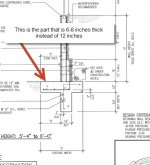
40' straight section of the wall has the issue where the front part of the footing is 6"-8" deep instead of the full 12" deep as required by engineering.

You can see from the pictures that the curved section of the wall is the properly built as per design. This is the section that is stepped up.

One picture before the rebar was in place you can see where the step up is.

When talking it over with the engineering company (they actually had a team meeting on it), they are confident in the recommended fix and did mention that the lack of weight was more of a concern and that was their recommendation on the fix for the issue.
 

Attachments

  • FootingRebar.jpg
    FootingRebar.jpg
    146.7 KB · Views: 116
  • FootingRebar2.jpg
    FootingRebar2.jpg
    143.1 KB · Views: 111
  • Drawing.jpg
    Drawing.jpg
    41.1 KB · Views: 128
  • GoodFooting.jpg
    GoodFooting.jpg
    146.9 KB · Views: 125
  • PouringConcrete.jpg
    PouringConcrete.jpg
    148.9 KB · Views: 113
  • ShortFooting2.jpg
    ShortFooting2.jpg
    148.5 KB · Views: 113
  • Trenching_ForWall.jpg
    Trenching_ForWall.jpg
    150.4 KB · Views: 109

ConCretin

Well-known member
Joined
Jan 20, 2011
Messages
3,379
Location
Central Maine
Seeing the whole picture definitely inspires a bit more confidence in the design but I still see
issues with the implementation. The fact that they oversized the key is fine but it appears that the face of the footing is flush with the face of block. The detail shows a footing that is wider than the wall in front and back. This is a fundamental element to the design that appears to be done incorrectly.

It is correct to say that the footing is not only too thin but also narrower than designed?
 
OP
V

vrinner

Well-known member
Joined
Aug 29, 2006
Messages
1,078
Location
Placentia, CA
Seeing the whole picture definitely inspires a bit more confidence in the design but I still see
issues with the implementation. The fact that they oversized the key is fine but it appears that the face of the footing is flush with the face of block. The detail shows a footing that is wider than the wall in front and back. This is a fundamental element to the design that appears to be done incorrectly.

It is correct to say that the footing is not only too thin but also narrower than designed?

The part thats flush with face of block is the problem area. It's supposed to be filled "up to" the base of the block...like the curved section was done. That is where they will not have to chip away and clean the surface, apply bonding compound then lay the remaining inches of concrete to make the total thickness 12".

The footing (I'm call it the parts that are in front of and behind the blocks), is the area of concern. The footing behind the wall is complete as per plan. The footing in front of the wall is plenty wide enough, just not thick enough.

As for the basic design, I went with a reputable company and the city approved so thats what I went with. Cant/dont really want to change it at this point...just get it fixed as per design.
 

ConCretin

Well-known member
Joined
Jan 20, 2011
Messages
3,379
Location
Central Maine
The part thats flush with face of block is the problem area. It's supposed to be filled "up to" the base of the block...like the curved section was done. That is where they will not have to chip away and clean the surface, apply bonding compound then lay the remaining inches of concrete to make the total thickness 12".

The footing (I'm call it the parts that are in front of and behind the blocks), is the area of concern. The footing behind the wall is complete as per plan. The footing in front of the wall is plenty wide enough, just not thick enough.

As for the basic design, I went with a reputable company and the city approved so thats what I went with. Cant/dont really want to change it at this point...just get it fixed as per design.

I'm not questioning the design at this point. It's the execution that seems questionable. Footing thickness and width both appear to be deficient. Retaining walls are highly stressed and need to be built correctly to perform. i wouldn't rely on bonding agent.
 

machsnell

Well-known member
Joined
Jun 12, 2010
Messages
942
Location
Northern Virginia
Agreed. Wall only needs a millimeter of movement at the footing to crack. At a minimum overpour and dowel into and underpin to existing good footing.

Sent from my SM-G960U using Tapatalk
 

Turbo

Well-known member
Joined
Sep 21, 2018
Messages
54
Location
Norcal
So the contractor over dug his trenches, and then just didn't order enough crete to make that up. Did they fill in the end of the trench with dirt once they figured out they would be short so that they could make the top flat? I would have your contractor saw cut back to where the footing is correct dimension, pin it with rebar and repour. Damn, its always cheaper to do it right the first time. Terry
 

Fluelikesymptoms

Well-known member
Joined
Apr 19, 2019
Messages
289
Location
Midwest snow belt
+1 on turbo

+2 if it sees a lot of freezing climate

The footing, or any portion of the foundation, is the most important part of any structure. Have them cut back and re-pour or dont pay them.
 

blkhonda1991

Well-known member
Joined
May 20, 2008
Messages
608
Location
Connecticut
it also looks like they filled the hole with concrete and while it was still wet trampled all over it and set the first course of block? ive never seen a method where block is set while a footing while was still wet
 
To avoid these ads, REGISTER NOW!
Top Bottom