To avoid these ads, REGISTER NOW!

question on some simple sheet metal work,

Handyfarmer

Well-known member
Joined
Dec 20, 2014
Messages
316
Location
in the high plains of Colorado
I am in need of a grain separator, the comercial ones start at about $2000 and that is for a very small capacity,

there are no power it is gravity ran,

here is a video of one working,
about a min,1:20 to a min 1:30 shows it in operation,

the still picture is a (to my understanding a custom made unit) and has mulipital flights housed in a 55 gallon drum for a catch of the round seed,

the basic operation is the seeds slide down the fighting and the round seeds slide faster, and slide off the fighting, thus separating the oblong seeds from round seeds,

the mulipital flighting increase capacity with out more space, or mulipital units,

I know the shaping of the flighting is basically a simple thing, but still a little confused, on the how to, of it, the last time did tin work was over 40 years ago in high school and that was basic I know the basic design will be nearly a C shaped cut and then pulled or stretched, Ok to get the taper on the flighting to the inside will I need a roller to curve the pieces,

I know it may take a few trys to get the taper and the depth of the flighting correct, but thing it would be worth the effort,

buying some tools/equipment is not a problem, any suggestions,
 

Attachments

  • sprial seperator.jpg
    sprial seperator.jpg
    26.6 KB · Views: 113
  • stirsee7.jpg
    stirsee7.jpg
    9.6 KB · Views: 116
Last edited:
To avoid these ads, REGISTER NOW!

oldironfarmer

Well-known member
Joined
Jun 25, 2016
Messages
6,664
Location
Terlton, Oklahoma
Have you looked at buying replacement flighting? I know it is available to repair augers. Looks like you could screw several together to get the multiple parts, or you could use just one set of flighting with a funnel to feed all the seed into the one location.
 
OP
H

Handyfarmer

Well-known member
Joined
Dec 20, 2014
Messages
316
Location
in the high plains of Colorado
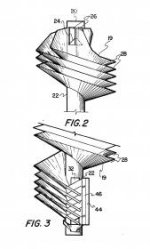
the flighting needs to be tapered up, not flat as auger flighting is, so the grain jsut does not slid off, it is the down hill that gives it speed, and then the angle of the flighing to and the cintrifical force separate the grain,

basically it is a spiraled funnel shape,

here is a patent of one, this has a twist in that the unit spins to add, centrifugal force for a wider range of products it will work on, http://www.google.st/patents/EP0004076A1?cl=en
 

Attachments

  • imgf0002.jpg
    imgf0002.jpg
    9.4 KB · Views: 30

oldironfarmer

Well-known member
Joined
Jun 25, 2016
Messages
6,664
Location
Terlton, Oklahoma
I think it's called cupped flighting that is made with a vee in it.

Some of the separators on YouTube look like they are made of very thin sheet metal.

Rather than invest in the equipment which rolls flighting which involves enough pressure to deform a strip into a spiral, you could make flat material into segments, and for your purpose, the ends of each segment would not have to be riveted or welded, just overlapped a bit, so long as they were supported at the inside or outside.

And, this is not a simple sheet metal work issue.
 

jimgood

Well-known member
Joined
Aug 4, 2014
Messages
2,394
Location
Marshall, VA
The still pic you have there looks to me like it's as you said; "C" shaped pieces overlapped. And lots of them.

I would imagine you should make a paper pattern first. You'll find that making the cup shape means you have to cut slits in the paper radially from the outside edge and spread them or you cut slits from the inside edge and pull them together and tape them. When you lay it flat again and transfer it to the metal, you'll be either shrinking each panel on the inside radius or stretching them on the outside radius (or a combination of both). It probably won't take much.

Edit: now that I think about it, it may be the opposite. In order to create the cup shape, you'd shrink the outside edge or stretch the inside. Yeah. That's it. But stretching the inside edge might mess up the radius where it needs to sit flush against the center column.

The problem I see is consistency. Doing this by hand is going to be tedious with a lot of trial and error.

There are some good metal workers on this forum but you may want to check out the Metal Meet forums too. Lots of very knowledgeable folks there.
 
Last edited:

jimgood

Well-known member
Joined
Aug 4, 2014
Messages
2,394
Location
Marshall, VA
I know the shaping of the flighting is basically a simple thing...
I don't think it's simple unless you have plans that describe all the exact measurements. I'll bet the angle of the spiral, the width of the flighting and the radius in the cup shape of the flighting are all really important to its performance.
 
To avoid these ads, REGISTER NOW!
OP
H

Handyfarmer

Well-known member
Joined
Dec 20, 2014
Messages
316
Location
in the high plains of Colorado
Interesting project! Could you increase capacity by spinning this while running grain through it?
What kind of grain are you sorting, and why?

the grain is wheat and harry vetch,

from what I can tell, by my reading they make them with different widths of flighting, and some what appears to be grain specific,

(as the laboratory/ test) units have a 4 inch 5 inch and 6 inch flighting in them. (guessing it is so one can chose the best for the jog at hand,

my thinking on the revolving of the flighting would so one could use one depth of flighting, and one pitch one could make the grain increase it speed or reduce it depending on what is to be separated,

in the past (old patents) some have made "adjustable" units that one can change the pitch of the flighting or the diameter with many smaller segments that can be adjusted, https://www.google.com/patents/US1516926 see pictures,

The still pic you have there looks to me like it's as you said; "C" shaped pieces overlapped. And lots of them.

I would imagine you should make a paper pattern first. You'll find that making the cup shape means you have to cut slits in the paper radially from the outside edge and spread them or you cut slits from the inside edge and pull them together and tape them. When you lay it flat again and transfer it to the metal, you'll be either shrinking each panel on the inside radius or stretching them on the outside radius (or a combination of both). It probably won't take much.

Edit: now that I think about it, it may be the opposite. In order to create the cup shape, you'd shrink the outside edge or stretch the inside. Yeah. That's it. But stretching the inside edge might mess up the radius where it needs to sit flush against the center column.

The problem I see is consistency. Doing this by hand is going to be tedious with a lot of trial and error.

There are some good metal workers on this forum but you may want to check out the Metal Meet forums too. Lots of very knowledgeable folks there.

the plan in my mind is to make a paper pattern, and may end up making a pattern in segments unless some one can tell me a better way.

(and like I said it has been over 40 years, but my recall is to make a funnel one took a sheet of steel and cut the distance of the out side diameter length and the inside which looks like a large C when layed flat, and then loosened one end of the slip roller and rolled it. to get the curve and then seamed the edges, (fasten the edges), so I would think that the basic piece I would be wanting layed out flat would be an elongated C shaped item, as you have the diameter of the center post, but one is going down it at about 45 degree angle, (spiral) but if I would have to make it small segments that would be doable as in to the pictures posted for the one adjustable unit, (I know I could get a pattern by making a small number small segments and taping them together to get a pattern),

I figure if I get one spiral and get it fine tuned, then it would be simple to reproduce to add the additional flights and to make up to 4 units for capacity,

for the most part each main segment (except for the very top one, a little different most likely) is an elongated cone, and would be made very nearly like a standard cone, as in the drawing posted,

so I am guessing that the center diameter of the cone would have to a tad bit smaller than the center post, to force the pitch of the flighting, is that correct?

I really do not see this project as complicated, once one has the diameter and the pitch figured out, and then getting a pattern to copy,

right now what I am asking is some tips on the forming of the tin, and figuring out the pattern, (how to make the elongated funnel shape).
 

Attachments

  • adjustable US1516926-5.jpg
    adjustable US1516926-5.jpg
    7.3 KB · Views: 20
  • adjustable b US1516926-6.jpg
    adjustable b US1516926-6.jpg
    6.1 KB · Views: 16
  • SheetMetalCone.jpg
    SheetMetalCone.jpg
    14.9 KB · Views: 21

why worry

Well-known member
Joined
Oct 3, 2014
Messages
301
Have a look at this site
http://forum.opensourceecology.org/discussion/139/designing-auger-geometry-for-materials-handling/p1

it pretty well sums it up for a flat auger. Now to get your pitch add in the true length of the flight. As far as fabing it goes I would roll each flight segment for the cone first then assemble per the above site.

It is awfully hard to beat a company that makes these as they have the tooling to build them out of material heavy enough to take the wear. With that being said I found them to be fun to build but very time consuming.
A retired tinner Dave
 
OP
H

Handyfarmer

Well-known member
Joined
Dec 20, 2014
Messages
316
Location
in the high plains of Colorado
Have a look at this site
http://forum.opensourceecology.org/discussion/139/designing-auger-geometry-for-materials-handling/p1

it pretty well sums it up for a flat auger. Now to get your pitch add in the true length of the flight. As far as fabing it goes I would roll each flight segment for the cone first then assemble per the above site.

It is awfully hard to beat a company that makes these as they have the tooling to build them out of material heavy enough to take the wear. With that being said I found them to be fun to build but very time consuming.
A retired tinner Dave

thank you,
I am not the best with math but I have printed it out and will study it over, I know there still will be some trial and error, but I have been told I need a 6 inch x 43 degree pitch for wheat and vetch, and I think the way they figure the 6" is the depth of the slide, or if it had a 2" core,(shaft/pipe) the aprox. OD of the spiral would a little less than 14" (the pitch would make it some smaller)

at my age and no bigger than my farm is, I do not think I will ever will or could wear it out, after talking to a few sales men, it sounds like the capacity per spiral is about 8-9 bushes an hour, so for what I would want to do I would need at least 8 spirals and 12 possibly,
a commercial built unit with 4 cores in it, is $7813 no shipping, so two units would be $15,625, and to get the capacity I would want one would need three, of the commercial 4 core units,
or an investment of over $23,439, so the only way I know of being able to do this is to build them my self,

I may have a shop project this winter,

I am sure I will experiment with it some at the least,
 
Last edited:

why worry

Well-known member
Joined
Oct 3, 2014
Messages
301
Sounds like you will be busy this winter. Also you will be amazed at how fast grain will wear down a surface.
Dave
 

1wook

Active member
Joined
Feb 22, 2014
Messages
42
Location
Central MN
Are you set on that design?

When I was younger on the farm we built a "horizontal" shaker separator. It worked well and wasn't too hard to fab, but it did require some power.
 
OP
H

Handyfarmer

Well-known member
Joined
Dec 20, 2014
Messages
316
Location
in the high plains of Colorado
Are you set on that design?

When I was younger on the farm we built a "horizontal" shaker separator. It worked well and wasn't too hard to fab, but it did require some power.

a fanning mill will not do a good job the vetch and the wheat is to close to the same size,

there is another type of cleaner that may work and would be easier than the spiral mill,

which uses a curtain of air, http://www.farmergain.com/operation_scheme.php and they claim it may be able to separate vetch and wheat, by density and shape, in the air stream,

which I was thinking it may be a first step, (possibly the only step) but it would need some pre cleaning to keep the spiral separator working correctly,

and I am aware on how fast grain can wear some thing,
 
To avoid these ads, REGISTER NOW!
Top Bottom