To avoid these ads, REGISTER NOW!

Question on stair treads and risers, what order?

NewShockerGuy

Well-known member
Joined
Oct 12, 2010
Messages
2,481
Location
Northern Virginia / DC
I can't seem to find a 100% this is the way to do it so I wanted to ask here.

I have complete vinyl stair treads and risers. They will be going on top of my existing stair case in the basement that is not finished.

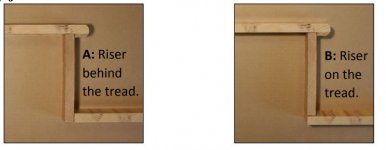
The biggest question I have is do you put the riser behind the tread, or do you put the riser on top of the tread?

I've attached a picture of what I mean. Those that have done stairs which way do you prefer and why?

I thought I was going to do the riser behind the tread, because then the risers is kinda locked in with the tread, but when I looked at our finished stair case in the main level the builder did the riser on top of the tread.

And best practice does one start at the bottom and go up? (this makes sense to me, working your way up), or is it better to start at the top and work your way down? Or does it not matter at all.

Appreciate the help!

-Nigel
 

Attachments

  • riser_tread.JPG
    riser_tread.JPG
    32.3 KB · Views: 215
To avoid these ads, REGISTER NOW!

rlitman

Well-known member
Joined
Oct 18, 2010
Messages
24,675
Location
Long Island
In the past year I assembled and installed two knock-down professionally made staircases. Both were riser behind tread. It's stronger that way. The riser is nailed into the back of the tread. When you step on the tread, the nails are in shear, rather than pulling out.

As for the caps, I think I'd do the same. While riser over tread avoids the vertical seal that dirt can fall into, riser behind tread leaves that seam (and any imperfections) at eye level directly in front of you as you ascent. With riser behind the tread, your eyeline is never directly in-line with the seam, so you cannot see tiny gaps.
 

rlitman

Well-known member
Joined
Oct 18, 2010
Messages
24,675
Location
Long Island
rlitman posted essentially the same thing I did while I was typing.....

Yep, we're completely in agreement, though you stated some parts better than I did.

edit: in retrospect, I forgot about the other joint. We're talking about caps. If we put the riser cap behind the nose, we extend the tread depth by the thickness of the cap, and also make that joint invisible, rather than if the riser cap under the nose, which shortens the depth of the nose by the thickness of the cap.

But that raises one more thing. If we do that, we can install all of the riser caps first, and then do all the tread caps with the noses afterwards.

In a full boxed stair install, the pieces all interlock, so the order matters a lot, but on caps, I don't think there's any interlocking, so doing all the risers first may be both the easiest and best option.

Oh, and be sure you get everything solid and not squeaky before you start capping. If you need to bury some screws, now's the time to do it.
 
Last edited:

johnnyradiant

Well-known member
Joined
Mar 27, 2017
Messages
833
Location
Vancouver, BC
If in doubt you could dado them into place with a sorta best of both compromise which I'm sure shouldn't be much more than double the effort. If you don't have access to the backside to nail/screw the riser to the tread it won't allow you to stiffen or add support to the treads without getting all fancy and making higher risers with a cleat on the bottom to catch the tread. Then you always have the conundrum that if you are needing the riser to support/stiffen the tread if you just nail it in time the nails are likely to start to add squeaks and creaks to the stairs. If you just use a cheap screw it may not be remotely close enough to meet the shear strength if used for actual support. Of course over thinking the whole thing could easily triple the exercise.
 

wrenchguy

Well-known member
Joined
Sep 22, 2011
Messages
4,698
Location
NW Indiana
On my staircases, the risers fit into a dado on the undersides of the tread above. But I'm not sure how that's relevant to the caps in question.

Haven't seen this....anyone else???? 2me seems 2b weakening the nosing area.
 

Viper98912

Well-known member
Joined
Oct 20, 2012
Messages
1,132
Location
GA
I've mostly done riser behind the tread, but it also depends on how much tread depth you have relative to the depth of the stringer. Remember that going above the tread means you need a deeper tread.
 

The Cobbler

Super Moderator
Staff member
Joined
Oct 24, 2013
Messages
25,993
Location
Niagara Region, Ontario, Canada
....
I have complete vinyl stair treads and risers. They will be going on top of my existing stair case in the basement that is not finished.

I would do the riser first then scribe fit the tread to that
whether you start top down or bottom up is up to you. whatever works
lots of times we start with the widest first , that way if you make a mistake you can use that on a narrower tread. yes, you often see variances in widths by 1/8+ .
 

johnnyradiant

Well-known member
Joined
Mar 27, 2017
Messages
833
Location
Vancouver, BC
Haven't seen this....anyone else???? 2me seems 2b weakening the nosing area.

I've encountered it on a few staircases and as rlitman says shallow cuts on thick, solid treads. When I was shooting my mouth off I was talking about the bottom of the riser, for the sake of where or how the crack could be scene.
 
To avoid these ads, REGISTER NOW!

DFB

Well-known member
Joined
Sep 7, 2016
Messages
5,765
Location
Southern VT/Western Mass
The riser normally will go behind the tread and on any commercial job I've done inspector neil will want to see the full width of the stair tread. ;)

And the construction manuals in my library all show the riser located behind the tread also.
 

Showkey

"MEMBER EMERITUS"
Joined
Aug 9, 2014
Messages
8,638
Location
Wausau WI
Hardwood stair only A version is acceptable.

Carpet stair either version is OK abut A version preferred.


Version B in hardwood stair ......every time you walk up the stair you will see the gap, no matter much time is spent fitting the tread.
 
Last edited:
OP
N

NewShockerGuy

Well-known member
Joined
Oct 12, 2010
Messages
2,481
Location
Northern Virginia / DC
So I wanted to update in case anyone might benefit from this. It could possible be just the product I have but, the vinyl/laminate stair treads and risers I've been playing around with test pieces. IE: Cutting smaller pieces to test which I like better.

The following is happening. If I slide the tread in all the way up against the riser you can clearly see the seam from said tread/riser. IF, I put the tread up against the stock stair tread/riser, then put the vinyl/laminate riser on top of the tread, the seam completely disappears... IE, the riser and tread look like one piece.

I think for this reason alone I am going to be putting the tread down first, then the riser on top of the tread. I am going to test a couple more but so far everyone I've tested like this on the tread first, then riser on top of tread, the seam vanishes.. Other way around and you can clearly see the two pieces... tread---- then riser...etc.

-Nigel
 

clonestocker

Active member
Joined
Jan 9, 2018
Messages
41
If the stairs are outside and you **** the tread to the riser it will drink water. If the tread goes under the riser it will shed water. Also, If the stairs are racked at all and the tread goes under the riser the tread is easier to cut in.
 
OP
N

NewShockerGuy

Well-known member
Joined
Oct 12, 2010
Messages
2,481
Location
Northern Virginia / DC
Stairs are in the basement inside. Will never see weather. If they do then the house is flooding and that's another issue..lol

So one thing I wanted to ask. By putting the riser first then the tread, the tread sticks out probably 1/4" more than the old bullnose off the stock stairs. Does this pose a problem?

I know for code the tread depth has to be AT least X amount. And it is. But having it stick out 1/4" more is that noticeable when you walk up and down?

If I put the tread on the stock step after the bull nose has been cut off the stock step, the new tread's nose is exactly where the old nose used to be. (hope that makes sense).

Thanks again,
-Nigel
 

rlitman

Well-known member
Joined
Oct 18, 2010
Messages
24,675
Location
Long Island
With a nosing, the minimum tread depth is 10" (9.5" is the minimum per OSHA, but most sources show 10" for treads with a nose, or 11" for treads without). Will you have that much? There's nothing wrong with a little more, as it leaves more room for your feet when descending.

What will the nosing projection be? It's supposed to be more than 3/4", and less than 1-1/4".
 

DFB

Well-known member
Joined
Sep 7, 2016
Messages
5,765
Location
Southern VT/Western Mass
^^^

Ya to make it meet code the nosing overhang also has to be correct too along with tread depth and riser height.

As for the over or under placement if all the measurements spec right its YOUR house...do it the way you want :beer:
 
OP
N

NewShockerGuy

Well-known member
Joined
Oct 12, 2010
Messages
2,481
Location
Northern Virginia / DC
Yep will definitely meet code with either or honestly. I measured the stock step and it's right around 10" give or take depending on where I am measuring. Plus minus several mm.

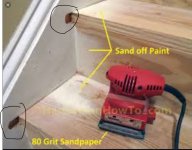
I tend to agree having slightly more step is nice, and I'm sure most wouldn't even noticed 1/4" depth to the tread. The positive if I do the riser first then the tread up against the riser is it will hide where I just cut off the existing tread sides.
They were slightly cut into the sides of the stair casing so when I remove them there is a hole. See black circles.
I was planning on filling those with wood putty even though MOST of it will be covered by the new riser/tread.

-Nigel
 

Attachments

  • stair gap.JPG
    stair gap.JPG
    54.2 KB · Views: 26

rlitman

Well-known member
Joined
Oct 18, 2010
Messages
24,675
Location
Long Island
Oh, then by all means, go for the extra depth and hide the hole.

Over 10" is fine. It's not like you're reaching 11-1/2" or anything, and that extra 1/4" of foot space will be nice.
 
To avoid these ads, REGISTER NOW!
Top Bottom