To avoid these ads, REGISTER NOW!

Question on water heater piping

skamp

Well-known member
Joined
Jul 20, 2007
Messages
644
Location
Cypress, TX
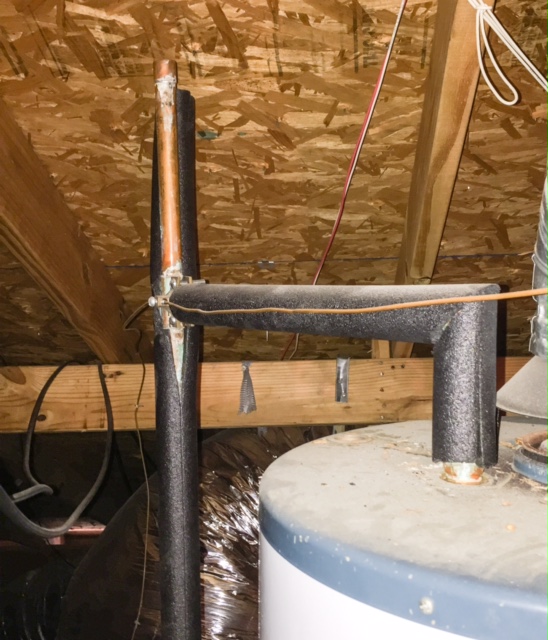
I am getting ready to replace my water heater and was curious why they plumbed it the way they did. The hot and cold come up vertically from the floor and the connection to the water heater is tee'd off that riser but the riser has a good amount of pipe above the tee. Why did they do this instead of using a 90* elbow. I assume there is a reason but I was not able to find the answer. Below is a picture of what I am talking about.

waterheater.jpg


Thanks!
Steve
 
To avoid these ads, REGISTER NOW!

dsimatt

Well-known member
Joined
Dec 9, 2012
Messages
6,465
They maybe did that for any future use of tapping off that for a water supply.
I just replaced my heater last sunday and the tip i'll give you is dont buy those specail pipe ******* with the rubber flaps in them for the top connections because i have noticed a slight loose of water flow, mostly in the shower.
 

FullRaceMerc

Well-known member
Joined
Jan 9, 2015
Messages
3,869
Location
SoCal (SGV)
Sometimes that is used to try to avoid "hammering", where the pipes will vibrate or pound. The idea is that the vertical capped section holds air. The air is able to compress & act as a spring to absorb the shock.

Usually it isn't needed if pipes throughout are anchored properly & valves are in good shape. But it doesn't hurt & some guys will still include them. It used to be a lot more common. In a lot of older homes you will find these in the wall behind a sink.

Another possible purpose is for future add ons. Like an expansion tank or a new run to somewhere else. It can be a little awkward to add a T in the middle. Some plumbers leave an occasional T & cap in systems where they think it is likely to need to be added to.
 
OP
S

skamp

Well-known member
Joined
Jul 20, 2007
Messages
644
Location
Cypress, TX
They maybe did that for any future use of tapping off that for a water supply.
I just replaced my heater last sunday and the tip i'll give you is dont buy those specail pipe ******* with the rubber flaps in them for the top connections because i have noticed a slight loose of water flow, mostly in the shower.

Thanks for the tip. I plan on doing it that way it is now. A copper thread to sweat fitting and then copper pipe and fittings. It is all very accessible. The only ***** is going to be getting the old and new heaters in place. It is in the attic so will be a pain.

Steve
 
OP
S

skamp

Well-known member
Joined
Jul 20, 2007
Messages
644
Location
Cypress, TX
Sometimes that is used to try to avoid "hammering", where the pipes will vibrate or pound. The idea is that the vertical capped section holds air. The air is able to compress & act as a spring to absorb the shock.

Usually it isn't needed if pipes throughout are anchored properly & valves are in good shape. But it doesn't hurt & some guys will still include them. It used to be a lot more common. In a lot of older homes you will find these in the wall behind a sink.

Another possible purpose is for future add ons. Like an expansion tank or a new run to somewhere else. It can be a little awkward to add a T in the middle. Some plumbers leave an occasional T & cap in systems where they think it is likely to need to be added to.

Makes sense. I thought about it for possibly helping with water hammer. It did not seem like it was a code thing as I could not find any reference to having to do that. Thanks!

Steve
 

dsimatt

Well-known member
Joined
Dec 9, 2012
Messages
6,465
Thanks for the tip. I plan on doing it that way it is now. A copper thread to sweat fitting and then copper pipe and fittings. It is all very accessible. The only ***** is going to be getting the old and new heaters in place. It is in the attic so will be a pain.

Steve

Thats pretty much how i did mine, i used those pipe ******* into the heater, then the copper screw on fittings sweated to pipe.

I feel for you on lugging it up there, mines in the basement but still was a 2 man job and only is a 40 gallon.
 

signcrafter

Well-known member
Joined
May 9, 2012
Messages
12,451
It's for air creating water hammer effect. Air will raise to the highest point and if it doesn't have anywhere to go it will create a hammer effect and cause issues. They create that space at the high point so any air will go there and not interfere with the water flow.
 

dfiler2

Well-known member
Joined
Dec 15, 2014
Messages
2,858
Location
NW Minnesota
I would also install unions on the hot and cold side, it makes changing a water heater a really quick job.
 

CNGsaves

Well-known member
Joined
Sep 26, 2012
Messages
13,233
Location
KS and OK
Wowsa, that looks like ATTIC location for hot water tank . . . . right ?

Just 3 feet up, you've got Solar Heat available !! ;)
 

kbs2244

Well-known member
Joined
Nov 11, 2006
Messages
14,065
It is there to provide room for water expansion.
If everything is turned off and the heater is full of cold water, bringing the water up to full temp can expand it a lot, causing a big pressure increase and a scalding danger when a faucet is opened.
 

FullRaceMerc

Well-known member
Joined
Jan 9, 2015
Messages
3,869
Location
SoCal (SGV)
Here's my 2 cents. I have heard that ^ before. In a closed system with a check valve before the water heater that might make sense. Although it doesn't seem like enough volume. An expansion tank would make more sense in that application. Pic below.

With an open water supply from the city thru to the HWH it would just push water back up the cold water pipe until the pressure balanced out, & the expansion space wouldn't be necessary.

With everything off a water heater should never be run at all. That would be taking a chance of running a dry water heater. The expansion space in that bit of pipe would make no difference in a water heater even partially filled with steam. Steam volume to water volume is about 1600:1. Hopefully a TPR would bleed of off enough to prevent a major issue in that situation, but that pipe doesn't seem like it would help if the TPR couldn't keep up. If you're not in a steam situation, then the volume is not nearly so great & the TPR should keep the pressure below 115 to 125 psi.

It might be why someone did it, but it doesn't seem like there would be many situations where it would help.

hw_expansion_tank.jpg
 

yeldogt

Well-known member
Joined
Jan 2, 2012
Messages
18,184
He was out of 90's

I always thought this was for "water hammer" but this seems to be done when the heaters are in an attic also ...

I have a house by the coast --- people have been moving them up out of any flood zone -- mine is like that.

I can't see the reason?
 

dfiler2

Well-known member
Joined
Dec 15, 2014
Messages
2,858
Location
NW Minnesota
It isn't for water hammer, there would be air in the pipe at first but in a pretty short time, unless there is a bladder inside or a way to add air, the air would dissolve into the water and the pipe would be full. I put these in all the time, some I like to run horizontal for a few inches first then back to vertical either up or down, the purpose is so when the home owner goes to replace the tank in 10 years he is compelled to take pictures and post on GJ so people can make random guesses as to what the original meaningful purpose of this 12" piece of copper could have been.:D
 

anthony666

Well-known member
Joined
Dec 29, 2007
Messages
987
Location
kirkfield ontario
lol dfiler :bounce:

i agree with yeldogt .. the plumber was out of fittings and made do .. you should see some of the construction abortions i run into every day .. plumbers are generally famous for it because their stuff is out in the open so you can catch it, last week i saw a 30 foot run of copper with a ball valve every 8 feet as a connector

also x2 on the solar DHW .. my summer power bill is half what it used to be some months .. spring and fall is maybe 10-20% less .. ive put a lot in other buildings too and i'm hearing 3 to 4 years payback on a 30 year system
 

59 wagon man

Well-known member
Joined
Oct 25, 2010
Messages
1,589
Location
hollywood fla
that is an air chamber . your local code may require it but it certainly can't hurt. it wasnt done cause he ran out of fittings. also you could put a loose key vent ot 1/4" petcock to help in charging the chamber. if you get water hammer you shut off the heater drain the heater from a lower faucet open the petcock you put in and let the line drain .close the petcock . turn it back on
 
To avoid these ads, REGISTER NOW!

dfiler2

Well-known member
Joined
Dec 15, 2014
Messages
2,858
Location
NW Minnesota
If that is truly installed as an air chamber it would work for a relatively short period of time. The amount of air that can be dissolved in water increases with the system pressure and decreases with a rise in temperature. So holding 50 lbs of pressure on cold water on a really small amount of air would mean you would need to drain your tank to recharge the vessel really often. A petcock would make it a little easier but still you would need to shut off the water supply, open the petcock then drain some water to refill the pipe with air, seems crazy to me.
 

75gmck25

Well-known member
Joined
Jul 21, 2014
Messages
1,328
Location
Alexandria, VA
In Texas I was required to have an expansion tank on my water heater because I had an in-ground sprinkler system, which had a back-flow preventer. Their logic was that since the back flow preventer meant that the city water system could not absorb excess pressure if my water heater got too hot, I needed another way to absorb the pressure. The expansion tank was not originally required when I built the house, but San Antonio added them into the code in about 2011-2012.

Bruce
 

CNGsaves

Well-known member
Joined
Sep 26, 2012
Messages
13,233
Location
KS and OK
^ ^ ^ Think the Plumber's Union has someone in the "codes" department !! ;) There is no logical reason that sprinkler system water pipe having a back-flow preventer would make it necessary to have expansion tank. Only purpose of backflow preventer is not allow water potentially tainted with chemicals (fertilizer, pesticide, etc) in the sprinkler pipes from getting back into potable water in house.
 

Charles (in GA)

Well-known member
Joined
Jan 11, 2006
Messages
12,489
Location
50 mi south of Atlanta
^ ^ ^ Think the Plumber's Union has someone in the "codes" department !! ;) There is no logical reason that sprinkler system water pipe having a back-flow preventer would make it necessary to have expansion tank. Only purpose of backflow preventer is not allow water potentially tainted with chemicals (fertilizer, pesticide, etc) in the sprinkler pipes from getting back into potable water in house.

The backflow preventer means that there is no place for the pressure to go as the water heats and expands. The anti-back-flow device would be installed right at the pressure regulator coming in from the city water. The city is concerned about ground water (from the sprinklers, remote but possible situation) getting back into the system, especially when pressure is lost in the public main, and then contaminating the main and other peoples water. By using the anti-back-flow device this creates a closed system. The only pressure relief is the TPR valve on the water heater. A Bladder tank as illustrated above, or if you are on a well, you already had a means of expansion in the well water bladder tank, is a very safe way of allowing for expansion. When you install a sprinkler system, you most likely need a permit, and this creates an opportunity for the city to force you to install a Anti-back-flow device (and probably a regulator also). Otherwise they are not in a good situation to require every house to install an anti-back-flow device.

There was a point in time in the past where there was a toilet valve that was improperly designed and allowed water from the tank (think blue water from a bottle of Vanish) to get back into the public water system, during a failure of the water pressure (busted main, repairs necessitating a shut off of the water, etc) and this is one of the big reasons that anti-back-flow devices became a requirement. Its mandatory most places now, and should be.
 

dfiler2

Well-known member
Joined
Dec 15, 2014
Messages
2,858
Location
NW Minnesota
The backflow preventer means that there is no place for the pressure to go as the water heats and expands. The anti-back-flow device would be installed right at the pressure regulator coming in from the city water. The city is concerned about ground water (from the sprinklers, remote but possible situation) getting back into the system, especially when pressure is lost in the public main, and then contaminating the main and other peoples water. By using the anti-back-flow device this creates a closed system. The only pressure relief is the TPR valve on the water heater. A Bladder tank as illustrated above, or if you are on a well, you already had a means of expansion in the well water bladder tank, is a very safe way of allowing for expansion. When you install a sprinkler system, you most likely need a permit, and this creates an opportunity for the city to force you to install a Anti-back-flow device (and probably a regulator also). Otherwise they are not in a good situation to require every house to install an anti-back-flow device.

There was a point in time in the past where there was a toilet valve that was improperly designed and allowed water from the tank (think blue water from a bottle of Vanish) to get back into the public water system, during a failure of the water pressure (busted main, repairs necessitating a shut off of the water, etc) and this is one of the big reasons that anti-back-flow devices became a requirement. Its mandatory most places now, and should be.

That's an interesting point, you would be creating a closed system on the outlet side of any backflow preventer. It seems to me though that as long as the sprinkler system or garden hose were plastic that the possible expansion from the sun heating the lines wouldn't require an expansion tank.
 

zmaxmotorsports

Well-known member
Joined
Jan 11, 2013
Messages
11,948
Location
South of omaha
lol dfiler :bounce:

i agree with yeldogt .. the plumber was out of fittings and made do .. you should see some of the construction abortions i run into every day .. plumbers are generally famous for it because their stuff is out in the open so you can catch it, last week i saw a 30 foot run of copper with a ball valve every 8 feet as a connector

also x2 on the solar DHW .. my summer power bill is half what it used to be some months .. spring and fall is maybe 10-20% less .. ive put a lot in other buildings too and i'm hearing 3 to 4 years payback on a 30 year system

Plumber?By the looks of that job they did sweating that copper together ,it was no plumber! :spit:
 

Elginz

Well-known member
Joined
Dec 29, 2014
Messages
431
Location
Oconto, WI
Do I get to give my 2 cents? --------- To bad here it is. I don't believe it is for "water hammer" prevention, that would be at the end of the line at a valve that shuts off fast like a washing machine. Looks to me like "shoot I didn't bring enough 90s, I have these and I don't need to go back down to get more." Could be some future item, but going in that direction in the attic, don't look like it.
 

Tinman7783

Member
Joined
Oct 28, 2014
Messages
9
In Texas I was required to have an expansion tank on my water heater because I had an in-ground sprinkler system, which had a back-flow preventer. Their logic was that since the back flow preventer meant that the city water system could not absorb excess pressure if my water heater got too hot, I needed another way to absorb the pressure. The expansion tank was not originally required when I built the house, but San Antonio added them into the code in about 2011-2012.

Bruce


That is correct. As municipalities install check valves throughout water lines they (the water lines) can't handle the expansion of the water. You can also install a water pressure regulator if your incoming pressure is above 50 psi.


Sent from my iPhone using Tapatalk
 

Tinman7783

Member
Joined
Oct 28, 2014
Messages
9
I am getting ready to replace my water heater and was curious why they plumbed it the way they did. The hot and cold come up vertically from the floor and the connection to the water heater is tee'd off that riser but the riser has a good amount of pipe above the tee. Why did they do this instead of using a 90* elbow. I assume there is a reason but I was not able to find the answer. Below is a picture of what I am talking about.


waterheater.jpg


Thanks!

Steve


I think it's a bad attempt at stopping water hammer. I mean why make the distance between the tee and the cap as long as he did?


Sent from my iPhone using Tapatalk
 

anthony666

Well-known member
Joined
Dec 29, 2007
Messages
987
Location
kirkfield ontario
I think it's a bad attempt at stopping water hammer. I mean why make the distance between the tee and the cap as long as he did?


Sent from my iPhone using Tapatalk

because he yelled at his helper "give me a ****** with a cap on it" and that's what can back

i do recall guys doing this to stop hammering though now i think about it

could be either way .. or it could be that he put it there for future whatever .. fact is it's extraneous, superfluous and otherwise useless though .. upon that i think we all agree ......... for a change :beer:
 

dfiler2

Well-known member
Joined
Dec 15, 2014
Messages
2,858
Location
NW Minnesota
Okay so now that we all agree on that, why run that ground wire all the way to the tee, I think...........:bounce:
 

Tinman7783

Member
Joined
Oct 28, 2014
Messages
9
Okay so now that we all agree on that, why run that ground wire all the way to the tee, I think...........:bounce:


Lol he didn't have time to cut the wire or the insulation any closer. He had get to his next service call.


Sent from my iPad using Tapatalk
 
To avoid these ads, REGISTER NOW!
Top Bottom