To avoid these ads, REGISTER NOW!

Questions about first time car restoration

Crusher47

Well-known member
Joined
Nov 10, 2012
Messages
85
Location
Fort Worth, TX
My son and I are thinking of getting an older car and fixing it up. Neither of us are professional mechanics, but are fairly handy, know how to use tools, etc. and figure with the help of the internet & service manuals, it shouldn't be too hard.

I have a low ceiling in my garage, so purchasing a lift is not an option. My main questions are:

1. Using jack stands/creepers - I know it's somewhat of a pain and having a lift is truly easier, but what are your thoughts on that? Will there be some jobs where having a lift is absolutely essential?

2. For the non-professional mechanics, how difficult was it to restore your car?
Did you do a ground up restoration including welding, body work, etc?

Thanks!
 
To avoid these ads, REGISTER NOW!

Milton Shaw

Well-known member
Joined
Feb 11, 2011
Messages
4,838
Depends on your final goal. If you want to create a daily driver or a showroom fresh car, there are a lot of differences. Daily driver, motor, trans, tires, brakes, electrical, suspension, interior and paint. Showroom, all that plus body off, clean, rust protect, weld, finish upgrade and reassemble, lots of hand work on paint preparation, $3000 plus for a paint job. I have done a lot of daily drivers including a 67 Firebird my wife drove daily for 12 years. Show car quality is a money pit, you can never get back what you put into it, may get parts cost back but never your labor when you sell it. It all depends on what your eventual goal is. A lift would make any of the easier to do, even if its just a sissor lift that lets you work on suspension off the ground.
 

justanengineer

Well-known member
Joined
Apr 5, 2011
Messages
7,722
Location
Motor City
I agree with Milton, it depends on what youre trying to do, or stated another way - how seriously in-depth do you want to get? For any build you really have to decide beforehand your limitations or you probalby wont finish, I like to do everything but paint myself bc thats usually a lengthy, messy project and I like fairly quick and clean ones.

As for not having a lift, Id say thats not an issue, an engine hoist and a floor jack will handle most everything you cant handle yourself. Pull the engine/trans together, then the rear axle, and you dont have too awful much left underneath besides wiring and plumbing. Once the engine is gone most of us just climb in the engine bay to clean, paint, and change parts.

Good luck, enjoy, and take (and post) lots of pics.
 

ed_h

Well-known member
Joined
Oct 21, 2007
Messages
51
A lift would be great, but if that is not an option, one alternative is a grease pit. That's the way I went in my garage with limited headroom. I dug mine before the floor was poured, but could also be done after cutting a hole in the floor. Mine finished out about 8L x 2.5W x 5.5D. It's lined with concrete blocks, has a concrete floor sloped to a sump with gravel underneath. There are ladder rungs set in one end, and there is electricity and air outlets in a recess in one wall. There is also a 3" exhaust duct so fumes can't collect.

There is a 3 x 3 steel angle around the edge so I can set bridge planks in it level with the floor. the planks are strong enough to drive on. The steel angle sticks up maybe 3/4" above the garage floor to keep water from running into the pit.

It is a fair amont of work, but I bet the two of you could do it in a weekend.
 

Kracin

Well-known member
Joined
Mar 25, 2013
Messages
1,666
Location
Omaha, NE
My son and I are thinking of getting an older car and fixing it up. Neither of us are professional mechanics, but are fairly handy, know how to use tools, etc. and figure with the help of the internet & service manuals, it shouldn't be too hard.

I have a low ceiling in my garage, so purchasing a lift is not an option. My main questions are:

1. Using jack stands/creepers - I know it's somewhat of a pain and having a lift is truly easier, but what are your thoughts on that? Will there be some jobs where having a lift is absolutely essential?

2. For the non-professional mechanics, how difficult was it to restore your car?
Did you do a ground up restoration including welding, body work, etc?

Thanks!


it depends on how much you and your son are willing to jump right on into.

as for myself a bit ago i did a restoration on a 69 c-10 as a sort of spur the moment thing.

everything was done myself, i was paying for an autoport in hawaii to do it in, 2 dollars a day to rent. and did it with a set of hand tools, some power tool purchases, and the help of the autoports air systems and air tools.

i spent somewhere along the lines of 2-3k before finishing, but it was worth it in the end. and i did end up paying someone to install a new windshield after my first attempt at reinstalling the old one myself ended up in a cracked windshield.

key things youll need for a successful teardown/rebuild.

good air compressor, decent size and/or high working cfm at 90 psi for bodywork tools like sanders, grinders.

set of hand tools, doesn't have to be too extensive just has to cover plenty of bases, i had a 60 piece set that pretty much covered most of what i needed.

a decent welder. i purchased a cheap lincoln flux core wire welder and was able to do all the welding i needed with it, the welds weren't pretty, but i was welding outside also, and all of the welds will need to be ground and cleaned up afterwards.

i painted it myself as well, 300 dollars in paint which a friend who worked autobody helped me pick out and mix, and a set of paint guns for 120 did the trick. and after a quick tutorial, i went to town and by the time i got to the clear coat i had it down to spraying 7.5/10 as paint jobs go.


but most of all what youll need is a lot of perseverance and time. even working in the garage for a couple hours a day after work will eventually get the job done. use the internet and how-to's to get a start, practice something, then put it to use. even if you have never welded before, or made a patch panel, everything can be learned with time and a patient hand.
 

turbowoodworker

Well-known member
Joined
Mar 18, 2012
Messages
3,540
Location
Apex NC
The other variable to consider is where your starting point is. Rust bucket in parts, partially restored, good shape? The starting point is critical to answer your questions because the amount of "under car" time depends on rust condition, exhaust, ******, suspension. On the other hand if you start with a better pallette and give a wash and some fluff, you don't need hardly any tools much less a lift.
Good luck, but shop wisely unless you already have a piece in mind.
 

joe_padavano

Well-known member
Joined
Feb 26, 2011
Messages
1,788
Location
Northern VA
I've got a few more fundamental suggestions.

Buy the nicest car you can to start with. No matter how tempting a cheap, rusty project in boxes looks, it will ALWAYS be much more expensive to piece something together. Do NOT ask my how I know this...

If this is your first time, get a car that runs to start with. It's much more difficult for a novice to determine the condition of an old car if it doesn't run. More importantly, a project you can fix while you drive it will avoid the discouragement and loss of interest that happens to non-running projects. I see waaaaay too many projects that are bought, aged for a decade or so, then resold in worse condition.

Do your research ahead of time. For the first time, pick a more popular vehicle that you can get parts for. While I'm not a fan of belly-button 69 Camaros, I am also well aware of how hard it is to find parts for off-brand and off-year cars. On more than one occasion I've had to buy one (or more!) complete parts car(s) and often end up fixing the parts car instead of the original one. Unless you have acres and/or understanding neighbors, you will have a storage problem with parts cars.

Done correctly, body work and paint is EXTREMELY expensive. Expect to pay around $10K for a complete paint job, assuming no metal work. As noted above, there are no patch panels available for the less-popular cars. You will be money ahead to buy a rust-free desert southwest car and pay to have it shipped. Prioritize a solid body shell over ANYTHING else.
 
OP
C

Crusher47

Well-known member
Joined
Nov 10, 2012
Messages
85
Location
Fort Worth, TX
Thanks for the replies so far, I really appreciate it! We are still in the "talking about" stage and don't have a particular car in mind. Knowing my own limitations, I would say a classic muscle car ground up/frame off restoration would not be an option. We often talk about fixing up a Fox body Mustang or even an older Supra or 300zx....not really 100% sure yet.
 

73super

Well-known member
Joined
Jan 17, 2007
Messages
106
Location
Renton, WA
My son and I are thinking of getting an older car and fixing it up. Neither of us are professional mechanics, but are fairly handy, know how to use tools, etc. and figure with the help of the internet & service manuals, it shouldn't be too hard.

I have a low ceiling in my garage, so purchasing a lift is not an option. My main questions are:

1. Using jack stands/creepers - I know it's somewhat of a pain and having a lift is truly easier, but what are your thoughts on that? Will there be some jobs where having a lift is absolutely essential?

2. For the non-professional mechanics, how difficult was it to restore your car?
Did you do a ground up restoration including welding, body work, etc?

Thanks!


Just go for it. I restore cars and I started from not knowing much. Just dive in and have fun. As far as creepers and jack stands go.. that's all I use and have no problem whatsoever. Not everybody has the room or can afford a nice lift. Will be great bonding time for you and your son! Good luck! :thumbup:
 

larry_g

Well-known member
Joined
Apr 28, 2007
Messages
16,880
Location
oregon
I have to second the opinion on getting the best car you can that needs some detail work, or maybe and engine rebuild. For me I find the best body/paint/interior I can and then do the mechanical as that is what I prefer. Body work is not my forte. If you want to paint and polish then find a good runner and go for it. This way you start with 1/2 the project done and a much better chance of getting it done.

Define why you are doing this, making a show car, making a good daily driver, or is this just a project for father son time. Do you want to spend time swapmeeting looking for that elusive part or do you just want to buy parts if needed. Do you want to go fast or just cruise?

Lastly review your budget. Expect to spend at least 2x the price of a high estimate.

lg
no neat sig line
 

Pat Brady

Banned
Joined
Jun 24, 2013
Messages
519
Location
Centerville
If it is your first time expect to make some mistakes. It will cost you double for them. But you'll learn and have fun. Good luck with your project.
 

OctoMan

Well-known member
Joined
Jul 10, 2012
Messages
270
Location
Newport News, VA
Crusher - Research the make/model you're looking for including the aftermarket parts availability. If you get a '67 Mustang for example parts and support is everywhere. If you got an AMC Gremlin, not so much. I would recommend getting something prior to 1974 to avoid any emissions issues your state/county may put you through.

Once you determine a make/model and year range look into a local club. Clubs are where you'll find like minded people, events, parts (Sometimes cheap or free) and there's allways tech advice to be had as well. While you're at it, I would strongly advise joining an on-line forum for the particular car you're interested in and feel out the support/tech info available.

Also, talk to owners, they will be the first to tell you if the car you're interested in presents any problems. For example, Ford Fairlanes share the same platform as the Torinos. So, you could swap mechanical parts and do some upgrades (Drum brakes to discs for example.) Some popular cars such as the Ford Galaxie (1959-1974) there's a lot of support for the '63-'64 but very little for '61-'62. Cars like the Chevelle are popular as you can buy parts all day and do almost any upgrade you like from fuel injection to air conditioning.

I would also buy a runing car. No stalled projects, rust buckets or vehicles without engines/transmissions.

What is your skill level? Do you want to replace body panels/paint ? This is very expensive to have done as was previously noted. I would buy a car with a good body and mechanical issues before I'd buy a rust bucket. There's a lot more work involved in body repair than most people think or are willing to fix. Again a club can help here. The M.G. club I'm in has a resident body guy who does this work and is much cheaper than a commercial body shop. Also most commercial places won't touch an old car because they either don't know what they're doing or will take years to complete the work.

Also most of your TV shows concerning car modification/restoration are only on the air to sell parts. Very few if any of those shows fix or repair anything. They usually rip out original engines/transmissions brakes, and bolt in new components. This is ok and is done for time constraints for the programs and makes the advertisers happy. However, in the real world this approach isn't usually practical. These shows also have teams of people working daily or in some cases in some type of competition for 72 hours straight. This is much different than the average Joe who works on the car when he can.

You may also wish to consider a British sports car like an MG or Triumph. There's tons of support both aftermarket parts and clubs and on-line support. Most British car folks are fanatics when it comes to their vehicle, ask me how I know. The cars are fun, almost all are convertibles (With no price increase.) and get good gas mileage when compared to an American V-8. The rumors about electric gremlins are true, but as with any car they can be made reliable and in some cases the rumors come with a degree of debate.

So, 1. Common car 2. Driver 3. Be willing to put in the work it needs to be completed 4. Decide your goal 5. Have fun !
 
To avoid these ads, REGISTER NOW!

Kracin

Well-known member
Joined
Mar 25, 2013
Messages
1,666
Location
Omaha, NE
Thanks for the replies so far, I really appreciate it! We are still in the "talking about" stage and don't have a particular car in mind. Knowing my own limitations, I would say a classic muscle car ground up/frame off restoration would not be an option. We often talk about fixing up a Fox body Mustang or even an older Supra or 300zx....not really 100% sure yet.


less talk more action typically gets things done quicker!

but seriously, too much talk can lead to too much thinking, if this is a first time, it's sometimes best to look at your starting budget for the car, and devote that talk time to locate time and find something to start on, even if it means something easier that you can both enjoy that could possibly be used to fund the real project later.


heres a few motivational pics from when i did mine, previous to this i had never done any bodywork at all, or paint, just mechanical work on previous cars. jumped in, got deep and had to swim my way out, eventually made it after 8 months though.

it started as a rust bucket, the worst kind, everywhere


then went to the stages of fix it all, an hour here, an hour there when i could spare time.


and then finally became the end product.


its not the best, and the first one won't ever be, and you'll just end up disappointing yourself if you dont take it as a learning experience more than anything. if i did it again, i would do a lot of things differently because i know more now than i did then.

but i hope this is enough motivation for you to get started and push through to the end of the project and have fun doing it from one person who started not knowing anything about bodywork/resto to another.
 

countryroad82

Well-known member
Joined
Mar 18, 2011
Messages
3,447
Location
Kentucky
Thanks for the replies so far, I really appreciate it! We are still in the "talking about" stage and don't have a particular car in mind. Knowing my own limitations, I would say a classic muscle car ground up/frame off restoration would not be an option. We often talk about fixing up a Fox body Mustang or even an older Supra or 300zx....not really 100% sure yet.

I was going to suggest maybe since it is your first tackle job on a vehicle to maybe do something a little newer, unless you find a clean body for decent cash. I was also going to suggest a truck, they seem to be easier to me. As for your questions about a lift, I have done 2 concours quality cars and at least a hundred nice cars without a lift. I really want one but life keeps me from buying one lol. As stated start with the nicest car you can afford, it pays in the long run. :beer:
 

Jeff Ivers

Well-known member
Joined
Apr 9, 2010
Messages
2,557
Location
Oklahoma
There are so many variables to this question. Others have addressed many of them. To this I would add - think about how much disassembly you will be doing and imagine those parts spread out all over the place.

My first restoration (street restoration - remove and refresh drive train and brakes, light body work, haul the body to the body shop without drivetrain for paint) was done on a 71 MGBGT in a standard 2-car garage. It was quite doable as long as the daily driver sat outside.

Second restoration was a 67 Lotus Elan basket case total restoration. Every piece removed inckuding body from chassis. This project stalled due to lack of room and was not completed until I built a shop.

Unibodies with sound metal are much easier than frame-off and require much less room.

You will have fun!
 

crewchief888

Well-known member
Joined
Dec 3, 2009
Messages
13,744
Location
NW indiana
one thing i would suggest is once you decide on a vehicle, is to set a budget, and stick to it.
making a vehicle start, run, stop and drive safely is most important

also, be realistic about how long it's going to take, many "builds" have gone by the wayside simply because it took too long, and the builder lost interest.

i've taken on a couple of "long term" projects in the past,
back in '94 i rebuilt/customized my totalled harley, kept to my budget ($500), and spent approx 9 months doing it.
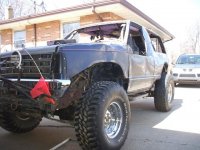
most recently was an '88 s-10 blazer, needed both an engine & trans, i sat down before i ever hauled out of a cornfield, and figured out what it was gonna cost, and set a "deadline" as to when i thought it would be running.
i ended up about $100 over my original budget ($1300), and most of that money was to replace a fuel pump.

the blazer has been an ongoing, neverending project for the past 7 years.
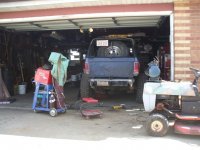
full cage, fuel cell, narrowed sheet metal, chopped doors, bumpers, straight axle swap
all done without a lift in a cramped, dark, and (sometimes) cold 19x22 garage.

anything's possible :thumbup:

:beer:
 

Attachments

  • 019.JPG
    019.JPG
    54.2 KB · Views: 16
  • 014 (2).JPG
    014 (2).JPG
    86.7 KB · Views: 13

saryon7

Well-known member
Joined
Sep 23, 2012
Messages
87
You might want to think about building up a toyota land cruiser or old jeep. They are short and fit in a garage easily. THey are also tall enough to do much of the work from underneath without a jack. Many of the body panels come off like the top and the front quarter panels so it is really easy to get to things and repair the body. They are relatively cheap and when it is done, they make a great family vehicle.
 

spotco2

Well-known member
Joined
May 18, 2012
Messages
1,050
Location
NW Georgia
I've done many and never owned a lift. Good creepers and creeper seats along with quality jack stands (4 minimum) and 2 good floor jacks can get about anything done that you ever need. I've got a set of those plastic ramps that help out a lot also. I don't drive up on them, but jack the front, rear or just a side up and set the tires down on top of the ramps.

It gives you a good working height and is very stable.

Sounds like a great bonding experience for you and your son.
 

devilsnight

Well-known member
Joined
Nov 4, 2012
Messages
181
Excellent idea! Father son time is the best, just don't buy something and get in over your head! get under what your looking at for sure, to make sure its not completely rotted out. The first car I ever bought was a 87 porsche 944. It had a big hole rotted in the floor behind the drivers seat. I began to wonder why the seat leaned back so far..... I was also 17 and didn't have a clue! I welded a new floor pan in a 02 mack the other day, live and learn. Couldn't a done that 13 years ago. If your not up to paint and body work realize the cost for hiring someone to do that, etc... don't bite off more than you can chew. Above all, this is probly mostly for your son? If he wants a mustang or a honda civic, bite the bullet, reguardless of how you feel. If he's happy with it you will be to!
 

countryroad82

Well-known member
Joined
Mar 18, 2011
Messages
3,447
Location
Kentucky
Oh another thing that I tell guys that say they can't do bodywork, "Can't never could!" (you have to imagine a heavy East Kentucky accent on can't, sounds more like caint lol)
 

rsanter

Well-known member
Joined
Dec 22, 2007
Messages
18,514
Location
visalia ca
First off. Yu do not need a lift to do a restoration but it will make your life easier.

Second. If you are as much of a novice as you say. I am going to recommend that you do not take on a full on show car resto. They can be very expensive and you really need to know the specific detailing things, and you can't really drive the he'll out of the car when done.

My opinion.....
Get a nice car that you both like. Rebuild the engine, trans, brakes, and suspension.
Put new interior in the car.
Paint the engine compartment and under the car black after a good clean up.
Give it a nice but not top of the line paint job.
Then go out and drive and enjoy the car.......

Ater you get all that done you can revel in your accomplishments.....
If you still though that was fun and you will have learned something.....then go out and get another car. Do a full on concourse restoration on it and spend more time with your son

I am afraid if you jump in too deep on the first one you may get financially in over your heat or loose interesrt because you are not getting the scence of accomplishment from getting it done and enjoying it.
I have seen people that get their dream car, make it too perfect that they are afraid to drive it so it sits in the garage. They can't enjoy it so they sell it

Bob
 
OP
C

Crusher47

Well-known member
Joined
Nov 10, 2012
Messages
85
Location
Fort Worth, TX
Thanks again everyone, you guys are awesome! I will show my son this thread and we will go from there. Much appreciated!
 

my68spit

Well-known member
Joined
Jun 4, 2013
Messages
137
Location
Illinois
I JUST had this discussion with a friend of mine who is looking for his first project car with limited restoration knowledge. This is the list i came up with:
::WARNING - LENGTHY::

I feel that if you are going to tackle any sort of project, screwing up is going to happen. But when you screw up it’s a good time to learn how to really fix something. Doing a project car isn’t necessarily JUST about taking parts off of the car, cleaning them up, painting them to make them look pretty and then reinstalling. It’s about learning how something you are excited about really works. If something does in fact get “screwed up”, you get to learn about how to fix that problem (or how much money that part costs). Even if it’s something that isn’t easily repairable and you have to replace it, you can now take that entire mechanism apart to see how it works. Example: rear differential on my Spitfire blew up my first time getting it on the road. This gave me an opportunity to tear the thing apart and find out how everything works together inside the casing. I ended up finding a complete replacement, rather than fixing it since it was more cost effective to buy a used one from a guy in Wisconsin rather than buying the parts I needed from England and paying to have them shipped here.

If you are going to work on a car as a “learning project” never be afraid to do something to it for fear of “screwing it up”.

If you are wanting a car to “learn on” here are the considerations that came to me. Some of them are in line with what you and others have already mentioned.
- Decide ahead of time what kinds of projects you have NO DESIRE to work on. Some people can’t stand the thought of body work. Others – electrical work, etc. This will help you as you are trying to find the car. If it’s got a lot of body work and you are excited about that, great. But if you don’t want to do body work, find something with a good body or minimal body damage that you won’t have to pay a TON of money to have someone else do.
- The older the car is, (in general) the easier it will be to work on it.
o More engine space
o Less electrical mess (less technologically advanced)
- Parts availability and cost are definitely considerations, but with the internet, JUST ABOUT everything is available (I had many parts ordered from England) so I wouldn’t let that be a MAJOR concern unless you are picking something exotic.
- Overall size of the vehicle should be considered. If you have a 2.5 car garage – with the intent of storing your project car in there on dollies along with your daily drivers, don’t go for a 1965 Cadillac. Even with a “barely” 3 car garage, a big car can be cumbersome while being worked on.
o Big cars also can equal more body work.
- Know your tools and the limitations of the tools you have.
o Homemade press machines can only get you so far.
o If you are doing a full engine rebuild, you may not have all the tools you will need and you can end up spending a bunch of money on tools if you aren’t careful about what projects you are willing/able to tackle on your own.
- Decide ahead of time what “Good Enough” is as well as what your end goal is with the car.
o As with life, if you don’t set a “good enough” goal for yourself – you will spend a lot of time, energy and money trying to attain a constantly moving “good enough” target that is unattainable.
o When you determine what you ultimately want to use the car for, you will also help determine what kind of car you choose. If you are looking for a big horsepower dragster, you won’t pick an old VW bus. If you want something for a vintage racer, you won’t pick a ‘65 Amphicar.

That all being said, if I were looking for a project car right now I would definitely pick something that is running and driveable. Nothing is more frustrating than having a fun little convertible sitting in your garage on an absolutely perfect convertible driving day, or when a car show comes to town that is specifically set up for your marque. Then you have to go to the show and keep saying “oh, I have one at home, but it doesn’t run”. It gets frustrating. I would not shy away from another small British car. But I would probably go for a drivable TR6, maybe an old Mini, or an MG. Getting away from those, I think another good “learning car” would be something along the lines of what Josh sent out the picture of the other day, an old truck. Old 60’s trucks are still very basic in just about every way and they have a ton of room under the hood to facilitate “easy” work and their parts are still abundant and probably fairly inexpensive. If I had the room and budget for an old muscle car, it’s about the same story as the truck. Usually lots of room under the hood, basic functionality, ease of parts procurement. If you go too recent (80’s and 90’s) you start getting into more technology to deal with.

Some cars I would steer clear of are cars like Porsches, Ferrari’s, or anything else considered “exotic”. Parts are going to be hard to find, those kinds of cars tend to be pretty cramped, and they WILL require specialty tools that you will use once. I would consider a vehicle like that as a second or third “project car”. Not a “learning car”.
 

Garage Dog

Well-known member
Joined
Dec 28, 2012
Messages
633
Location
Minnesota
#1. Rust buckets are time and money buckets - getting a project with a solid shell saves time and money in the long run.

#2. Buy as complete a project as you can - if it is "all there" running or not, you can take pictures documenting how it was put together in the first place before taking things apart.

#3. Thousands of cars and truck have been "restored" without a lift.

#4. Consider that the majority of restoration projects are never finished before changing hands again - that is because people underestimate the time or funds required to finish - thus you should be realistic about how much of each you have when choosing your project.

#5. I applaud your effort to have a father/son project of this type - your son will learn skills he will be able to use for the rest of his life.

Good Luck
 
To avoid these ads, REGISTER NOW!
Top Bottom