To avoid these ads, REGISTER NOW!

Questions about floor heating system

mx842

Well-known member
Joined
Feb 24, 2011
Messages
227
Location
Richmond Va
I've been playing around with different ways to heat my shop for several years now and have almost got it to where it doing ok but would like to do a few things that would make it better.

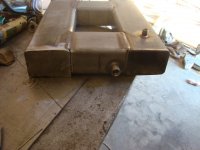
What I have is a wood stove with a ss tank attached to the top of the stove with the exhaust going out through the center of the tank. The water goes in one end and travels around the sections and out the other end. As the water heats up and leaves the tank it rises up a section of 1" copper pipe to a 35 gal water heater. the hot water goes into the WH through the port where the pop off valve was and back to the stove through the drain port. Water leaves the WH out of the hot line through about 75 feet of 1" copper pipe to the manifold and back to the WH through the cold fitting on top of the WH.

Last season this worked pretty darn good but I want to add another WH, probably over the ceiling of the room where the manifold is. I May even hook up electric to this heater and keep the thermostat set at around 60 degrees just to keep the water from cooling all the way off like it does now over the night time. I think this extra tank of hot water will help it get through the night with some tweeks.

My question is what would be better.....to run this extra tank in series with the pipping or run it parallel to the tank like it is at the stove? The copper run to the point where I will tie to the pipping to the second tank is about 9 feet off the floor and the bottom of the second tank will be about two feet higher that that.

My thinking is if I 'T' off the hot line to the hot side port on the tank and then 'T' off the cold pipe returning to the stove it would act more as a mixing valve so to speak than a storage tank. I was think of trying it this way to see what would happen but thought about asking about it before I ran all that pipe.

The biggest problem I have is that even dumping 110 degree water in the slab the return is always to cold when it gets back to the stove and this causes problems with creosote build up. I have to rod out the stove pipe every couple days to keep the keep it drawing.

with 100 degree water going into the slab what should the temp be on the exit manifold with 1/2 pex tube and runs that ave. 230 feet......2600 feet in all. There is 11/2" of pink board under the slab and 1 in. all the way around the outside walls.

That's probably a dumb question but now the water coming out of the manifold with 100 degree water going in is around 50 degrees. the slab temp in the center of the building will get to between 55 and 60 degrees with the slab along the outside walls being around 50 to 53 degrees on ave.

Even on the coldest days last winter I could keep the slab on ave. around 45 to 50 degrees. I usually fill the stove around 8:00 at night but by 4 or 5 am it is pretty much burned out. Most of the time it still has a few coals in it and not too hard to get going again but this cool down period does make a lot of creosote.
 
To avoid these ads, REGISTER NOW!

Radix2

Well-known member
Joined
May 28, 2014
Messages
1,853
Location
the thumb!, MI
I'm not sure I fully understand your system. Maybe you could draw a picture and post it?

The delta across your floor loops is controlled by the flow rate through the loops ( and of course the demand and supply energies). What pump and and flow rate are you getting? Is the flow from the stove tank to the water heater tank pumped or just a thermosiphon?
 
OP
M

mx842

Well-known member
Joined
Feb 24, 2011
Messages
227
Location
Richmond Va
I'm not sure I fully understand your system. Maybe you could draw a picture and post it?

The delta across your floor loops is controlled by the flow rate through the loops ( and of course the demand and supply energies). What pump and and flow rate are you getting? Is the flow from the stove tank to the water heater tank pumped or just a thermosiphon?

I'm not very good at drawing maybe I can find a few pics of what I have going on and that would help. I'll try to get them on later today or by the morning.

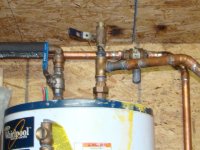
But basically yes the system is a thermosiphon setup with the heater that sits on top of a wood stove. There is a 1' inlet and a 1" outlet that water flows through and as it heats up the heated water flows out the outlet port into a 1" copper pipe that travels upward and Tee's into the port where the pop off valve was on the old water heater tank. There is also a Tee at the bottom drain of the tank for a drain valve and the other outlet of the tee goes back to the stove top heater to the inlet port.

That is the thermosiphon part of the system. The stove top heater just heats up this 30 gal tank by natural rise an fall of temp differential.

Water is drawn out of this tank through the normal hot port of the water heater tank and is pulled through roughly 80 feet of 1" copper to this old pump I got off another boiler. I don't know what size it is or how much it pumps because there is nothing on it anywhere that tells me anything. The water leaves the pump and into the manifold and through the loops and back through the roughly 80' of copper pipe that runs along side the hot pipe and back into the top of the old water heater tank through the normal cold side on the tank where it mixes with the heated water that is being made by natural flow part of the system.

The way it is, if I fired the stove and ran it at a moderate condition it make the water too hot to dump into the floor that's why I have to run the stove too cold and why it's making creosote. I want to add two more old water heaters on the floor over the room where the manifolds are to store more water where I could keep the first two tanks at around 150 to 160 degrees and put a mixing valve between the second storage tank and the last one to feed the loops out of.

This probably still don't make any sense to you but it's the best I can explain it. I was just wondering what would be the best way to pipe these two extra tanks and still keep it simple and not have to run several pumps or expensive valves with all the other control that go along with a normal system.
 

Radix2

Well-known member
Joined
May 28, 2014
Messages
1,853
Location
the thumb!, MI
Ok, I understand a bit better. My comment is that a better solution might be to place your mixing valve where it can control the water temp to your loops. Then get a properly sized pump that can move the water fast enough so that you get a proper delta t across your loops.

Then - if you actually have enough BTUs generated by your stove, the water temps in the main loop should stay above condensing. If you don't have enough BTUs, then what you should have is still a proper delta across your loops, but all of the water will be at a cooler than desired temperature.

IMO adding more tanks is only an exercise to add thermal mass to the system. More thermal mass may well be a good thing, but it will not at all address the issues you are having. It may also make it more difficult to work out your current kinks since things will take longer to settle down.

I would also think about at some point adding a pump to that primary loop if the thermosiphon does not keep the two tanks close in temperature - that would mean you are not getting all the BTUs out of your stove that you might be able to.

But the first thing is to get your loops working to move the heat you are making.

When we say mixing valve above, I am talking about a tempering valve that can make sure the water you send to your loops is a safe temperature. These are critical for a wood fired system that has no other thermostat to protect the loops. These valves basically control how much of the hot is pulled into the loops so the stay safe... is this the kind of mixing valve you have?
 
Last edited:
OP
M

mx842

Well-known member
Joined
Feb 24, 2011
Messages
227
Location
Richmond Va
Ok, I understand a bit better. My comment is that a better solution might be to place your mixing valve where it can control the water temp to your loops. Then get a properly sized pump that can move the water fast enough so that you get a proper delta t across your loops.

Then - if you actually have enough BTUs generated by your stove, the water temps in the main loop should stay above condensing. If you don't have enough BTUs, then what you should have is still a proper delta across your loops, but all of the water will be at a cooler than desired temperature.

IMO adding more tanks is only an exercise to add thermal mass to the system. More thermal mass may well be a good thing, but it will not at all address the issues you are having. It may also make it more difficult to work out your current kinks since things will take longer to settle down.

I would also think about at some point adding a pump to that primary loop if the thermosiphon does not keep the two tanks close in temperature - that would mean you are not getting all the BTUs out of your stove that you might be able to.

But the first thing is to get your loops working to move the heat you are making.

When we say mixing valve above, I am talking about a tempering valve that can make sure the water you send to your loops is a safe temperature. These are critical for a wood fired system that has no other thermostat to protect the loops. These valves basically control how much of the hot is pulled into the loops so the stay safe... is this the kind of mixing valve you have?

here are a few pics. Some of these and a few changes have been made but this is the basic setup at the stove and water storage tank.
 

Attachments

  • DSC03686.JPG
    DSC03686.JPG
    109.7 KB · Views: 10
  • new system plumbed to water tank..JPG
    new system plumbed to water tank..JPG
    124 KB · Views: 13
  • new water heater ready to mate with stove.JPG
    new water heater ready to mate with stove.JPG
    77.2 KB · Views: 8
  • DSC03710.JPG
    DSC03710.JPG
    113.8 KB · Views: 9
  • DSC03709.JPG
    DSC03709.JPG
    126.8 KB · Views: 9
  • DSC03689.JPG
    DSC03689.JPG
    86.9 KB · Views: 7
  • 4 inch SS sq tube fitted and ready for welding.JPG
    4 inch SS sq tube fitted and ready for welding.JPG
    102 KB · Views: 8
To avoid these ads, REGISTER NOW!
OP
M

mx842

Well-known member
Joined
Feb 24, 2011
Messages
227
Location
Richmond Va
here are a few of the newer ones....
 

Attachments

  • DSC03829.JPG
    DSC03829.JPG
    3.6 KB · Views: 81
  • DSC03831.JPG
    DSC03831.JPG
    3.2 KB · Views: 81
  • DSC03832.JPG
    DSC03832.JPG
    2.2 KB · Views: 81
  • DSC03833.JPG
    DSC03833.JPG
    3.4 KB · Views: 81
  • DSC03835.JPG
    DSC03835.JPG
    3.1 KB · Views: 81
OP
M

mx842

Well-known member
Joined
Feb 24, 2011
Messages
227
Location
Richmond Va
Ok, I understand a bit better. My comment is that a better solution might be to place your mixing valve where it can control the water temp to your loops. Then get a properly sized pump that can move the water fast enough so that you get a proper delta t across your loops.

Then - if you actually have enough BTUs generated by your stove, the water temps in the main loop should stay above condensing. If you don't have enough BTUs, then what you should have is still a proper delta across your loops, but all of the water will be at a cooler than desired temperature.

IMO adding more tanks is only an exercise to add thermal mass to the system. More thermal mass may well be a good thing, but it will not at all address the issues you are having. It may also make it more difficult to work out your current kinks since things will take longer to settle down.

I would also think about at some point adding a pump to that primary loop if the thermosiphon does not keep the two tanks close in temperature - that would mean you are not getting all the BTUs out of your stove that you might be able to.

But the first thing is to get your loops working to move the heat you are making.

When we say mixing valve above, I am talking about a tempering valve that can make sure the water you send to your loops is a safe temperature. These are critical for a wood fired system that has no other thermostat to protect the loops. These valves basically control how much of the hot is pulled into the loops so the stay safe... is this the kind of mixing valve you have?

When I mentioned mixing valve I think I was talking about the 30 gal tank next to the stove is acting like a mixing valve. But I do have several mixing valves I'll have to dig around and find them to get some information on them. I'm also going to see if I can find more out about the pump I have at the manifold.

I have several pumps that I could use but they have problems. I got them off e-bay and one of them makes noise when It's started and the Taco circulator I have dumps water out of the shaft at the coupler when you cut it off. I don't leak while it's powered up but as soon as you cut it off it starts leaking. I've never seen on do that before or why it does it. I've asked several people and no one had an answer.

The old pump I'm running seems to be pushing water through the loops ok. Those stewpid little flow valves on those manifold have never been much help or at least I've never seen them show anything no matter how I adjust them. I'm thinking that if I could get them to work where I could adjust them I could send more water to the outer edge loops I could eliminate some of the cold spots in the slab that I now have. Right now I'm just running everything wide open. I hate to have to buy new manifolds these cost a lot but I bought them when I poured the floor and it was several years before I got my stove hooked up and by then the people I got them from didn't seem to interested in helping me out with this problem.
 
To avoid these ads, REGISTER NOW!
Top Bottom