To avoid these ads, REGISTER NOW!

Questions about my compressor plumbing.

jimnickol1986

Well-known member
Joined
Feb 17, 2010
Messages
142
Location
Massillon Ohio
Hello all, I'm looking to re-plumb my garage with a couple drops and a feed to my reel in the ceiling. Question I have is, will my 26 gallon handle about 35-40 ft of 1/2 black steel pipe, or should I go with 3/8 pipe? I will be using shut-off ball valves at all 3 locations as well as drains. Im rumning 1/4 air lines with amflo hi-fi 1/4 fittings. In the near future I will be upgrading to a larger 60 gallon compressor and will utilize the plumbing in question. Thanks in adavnce.
 
To avoid these ads, REGISTER NOW!

Schurkey

Well-known member
Joined
Oct 27, 2011
Messages
2,368
Location
The Seasonally Frozen Wastelands
The larger the pipe, the more effective capacity you're adding to your air tank. Bigger is better, although the compressor may run beyond it's duty cycle to fill the whole system at once. Maybe you should close the shutoff valve to the plumbing, let the tank fill and the compressor rest. Then open the valve, and let the compressor re-pressurize the whole system.

As long as the duty-cycle of the compressor isn't exceeded, more/bigger pipe is better. I'd use 3/4" pipe unless you can afford 1". My shop has 3/4 pipe, two drops, about 30 feet horizontal plus the vertical sections.
 
OP
J

jimnickol1986

Well-known member
Joined
Feb 17, 2010
Messages
142
Location
Massillon Ohio
I just wasn't sure if using the bigger pipe, then reducing it down to 1/4 would be defeating the purpose. Plus, it's only a 2 car garage, I have 50ft in the reel in the center of the garage ceiling, plus I'll have 2 other hoses hanging up on either side of the garage doors.
 
OP
J

jimnickol1986

Well-known member
Joined
Feb 17, 2010
Messages
142
Location
Massillon Ohio
And also, like stated above, I plan on getting a new/bigger compressor eventually. So I'm guessing it should be able to handle all the extra plumbing, right?
 

Woodman920

Active member
Joined
Jan 17, 2016
Messages
26
You're fine in a small shop with 1/2 inch lines. The extra volume is nice from bigger pipe but I'd be more concerned with pressure drop from small lines. Effective system volume increase isn't all that much to warrant the cost of larger pipe if you already have the 1/2". Your new 60 gallon compressor will do fine with
1/2 " lines.

Sent from my SM-G930V using Tapatalk
 

sberry

Banned
Joined
Jun 18, 2005
Messages
35,747
Location
Brethren, Michigan
Either one will work at this distance. 3/8 isn't used much for transportation. 1/2 is super common and cheaper than 3/8 and 1 step to 1/4 reducing bushings are a standard part. A pipe a bit bigger than you need wont hurt anything and so much standard plumbing is 1/2, easy to work with and to get tight.
I just did an all steel job, to tell the truth would consider rolled hose next time due to labor. In a home garage where it could be made from a few simple pieces and easy to reach got nothing against steel and you can re plumb so many ways with simple shate.
Transportation losses are none in this place, you are going to run it thru a 1/4 hose anyway which is fine for small stuff but some shy for 1/2 impact at full power. 3/8 hose with 1/4 ends are standard for full power hand held air tools in the garage/auto mechanic class.
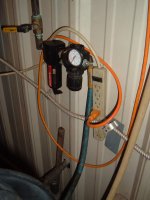
Here is a cutie, there is another 3/8 tap on the regulator but I had this on hand. Its 1/2 tapped from the main to the valve then a 3/8 hyd fitting I had in to the filter. There is a big up and over loop feeding it, not a drop of water and simply feeds this hose reel for occasional ******** and filling tires outside in the winter.
 

Attachments

  • air reggie.jpg
    air reggie.jpg
    133.2 KB · Views: 127
Last edited:

Dr Stan

Well-known member
Joined
Nov 17, 2016
Messages
496
Location
Owensboro, KY
As long as you're re-plumbing I'd go with the 3/4" pipe. Not much more costly than the 1/2" and if you ever want to supply a sand blaster the 1/2" will be way too small. The labor will be virtually the same.

If you can imagine seeing the air flow (called laminar flow) as a cross section of the pipe it would look like the growth rings of a tree. The one next to the pipe is stationary and the one in the center is the fastest. Since the area of a circle is a function of its square root the larger the pipe the more fast moving layers it will contain. This is why the flow rate increases/decreases as a function of the diameter of the pipe.

If you desire to really get fancy look at this: http://www.rockler.com/search/go?w=compressed air tubing&asug=&sli_uuid=&sli_sid=

It's certainly pricey, but never corrodes and is easier to install than black iron pipe.

I'm also willing to bet it can be found at less expensive sites.
 

md21722

Well-known member
Joined
Nov 30, 2015
Messages
1,840
Location
Mt Juliet, TN
1/2" flows a lot especially over such a short distance, but I too would just use 3/4" from the get go. Use 1/2" or 3/4" filters/regulators. But, for such a small space, one connection is usually just fine. If you want two, one by the garage door and another on the opposite side. You don't need 15 connections in a 2 car garage. Filter/regulate at point of use/at each hose connection.
 
Last edited:
OP
J

jimnickol1986

Well-known member
Joined
Feb 17, 2010
Messages
142
Location
Massillon Ohio
I actually planned to do it with 1/2 plastic airline. I work for a company that sells truck supplies and equipment and I can get the 1/2 plastic stuff for .55 cents a foot. But after thinking about it I realized it would look nicer and cleaner with the black pipe. As for the multiple locations, I will have 3 total. 1 hose on the compressor, one between the garage doors, and one air reel in the center of the garage ceiling. Do you guys think that's to much? I just hate when I need air for something and have to drag the hose around the whole garage.
 

sberry

Banned
Joined
Jun 18, 2005
Messages
35,747
Location
Brethren, Michigan
As long as you're re-plumbing I'd go with the 3/4" pipe. Not much more costly than the 1/2" and if you ever want to supply a sand blaster the 1/2" will be way too small. The labor will be virtually the same.
Where did you learn this? A 3/8 hose will drain a 5 hp comp way faster than it can make it on sandblasting.
 
Last edited:

sberry

Banned
Joined
Jun 18, 2005
Messages
35,747
Location
Brethren, Michigan
You can drain a 200 cfm comp on a 3/4 hose blasting, the loss in a 1/2 wouldnt mean a pinch of **** till over 100 cfm at a short distance and he has a comp ,,,,, in the future going to make 15 wringing its guts out.
 

md21722

Well-known member
Joined
Nov 30, 2015
Messages
1,840
Location
Mt Juliet, TN
I actually planned to do it with 1/2 plastic airline. I work for a company that sells truck supplies and equipment and I can get the 1/2 plastic stuff for .55 cents a foot. But after thinking about it I realized it would look nicer and cleaner with the black pipe. As for the multiple locations, I will have 3 total. 1 hose on the compressor, one between the garage doors, and one air reel in the center of the garage ceiling. Do you guys think that's to much? I just hate when I need air for something and have to drag the hose around the whole garage.

Every mechanic I've ever seen has a hose at his bay with a 25 foot hose which can get shorter as the ends blow out and the line is trimmed and repaired. Once it gets too short, it gets replaced. Dragging lines around is part of having air just like an extension cord. PVC is not ductile, it will explode over time and you just hope you aren't in the place when it happens. Depending on your garage layout, it may be fine, I'm not sure what the hose reel is going to do vs the one by the door or the compressor. It's best to filter/regulate at point of use. You don't need rust scale and pipe dope in your air tools. But to be honest, lots of shops don't do any of this and their tools last years in day to day use. There is a balance between being a purist and being practical. In some cases they know they're getting 140-175 PSI to their die grinder because there ain't no regulators, and so they put a regulator on the tool. Whereas Joe homeowner may not and set the pressure at the regulator, or miss it all together.
 

sberry

Banned
Joined
Jun 18, 2005
Messages
35,747
Location
Brethren, Michigan
I absolutely agree that many and maybe even most if one actually counted are very simple hose to unit setups. The advent of piping in small garages is relatively recent and has exploded due to the net, everything we see on it or at work must be a good idea for my 2 car garage, after all if it works in this 20 acre plant it should work for me?
I know 4 masters who do not have a piece of pipe in the garage.
 

493mike

Well-known member
Joined
Jul 24, 2015
Messages
148
Location
mid Michigan
I changed out my schedule 40 black pipe years ago to stop the little chunks of rust that caused my quick connects to leak. I went with soldered copper pipe. Use a ball valve for service on the drops, run a complete loop around shop, pitch entire loop to one spot and add a drain tee, pipe all drops up and then down to keep water in main heading to the drain location. I also have dual feeds from compressor: one full line pressure and one through a regulator. Each valved separately.
Just some tips for your project.
Mike
 

Ironhorse74

MEMBER EMERITUS
Joined
Nov 10, 2014
Messages
998
Location
The Pacific North Wet
I went through this designing my system. My thinking was that if I could build storage capacity by increasing pipe size, that would be an advantage. If you look at this chart the difference in per foot capacity between 1/2 and 1" pipe is negligible. 1/2 is .010 gallons per foot and 1" is .041 gallons per foot or over 100 feet 1 gallon and 4.1 gallons. Use 1/2".


http://www.engineeringtoolbox.com/pipe-water-content-volume-weight-d_1734.html
 

sberry

Banned
Joined
Jun 18, 2005
Messages
35,747
Location
Brethren, Michigan
If I was running a kit in a big building would also use the 3/4. A 1/2 black is closer to 5/8 than 1/2 and often treat ******* with a 5/8 bit which will go thru them. I like 1 size to deal with in a small garage, buy an extra fitting and you got a chance to use it but if you have to use 3 sizes it gets spensive for nothing. I believe the kits are hose size and have internal barbs. A black pipe has quite a bit more than a 1/2 hose near 2x and only slightly less than a 3/4 and once we get to this capacity is irrelevant to this class of tool.
A lot of the line loss charts are based on 100# but a 2 stage air main operating from 130 to 175 can move the same cfm as one at 90 with way less drop. I don't recall the total drop but with a 1/2 gun on a 1/2 or 3/4 pipe main he difference between the 2 is about 1/2 a pound or so in 100 ft. Hose sizes a bit more difference and a few # if you step up to a 3/4 air gun and maybe another 10 with inch,,, maybe a bit more. I used a quite a bit of inch and some 1 1/4 with 3/4 hose. Had a couple sections 100 ft, some longer.
 

sberry

Banned
Joined
Jun 18, 2005
Messages
35,747
Location
Brethren, Michigan
All that small rental ****, 185 cfm units, 3/4 hose and connections at the comp to a sand pot. 10 times the air of a home comp. I set one up in a shop, 1/2 pipe to a blaster, 25 hp. Had to regulate it. and we were using a 1/4 nozzle.
 
Last edited:
To avoid these ads, REGISTER NOW!

sberry

Banned
Joined
Jun 18, 2005
Messages
35,747
Location
Brethren, Michigan
50 ft of inch on a comp with a 15 gallon tank and bitty piping would or could give it a lot of poop. Not so noticeable on a bigger tank or higher pressure. I had considered adding a 2 inch column, T in to it a foot from the bottom and take it off any elevation but once I revamped a couple things don't need it.
When I first started doing this work tried every contingency there was. Today way more a tune to meeting the demand and see how it works and found out I wont help myself with fridgerated air and I can do it for free if I really wanted to but rather re work some simple concepts with design having done this more than once and made a couple changes in the manifold and solved a lot of problem passively.
In an old system they worked and caught water, I can stop adding pieces as its not going to make it any better despite the compulsion to fix it when it aint broke.
 

sberry

Banned
Joined
Jun 18, 2005
Messages
35,747
Location
Brethren, Michigan
Today in a home garage would start with a couple pieces of hose and go from there. figure oyut how you are going to hang it out of the way. My Bud had pitiful plumbing where he should hasve fixed it to avoid foot traffic but as an air supply the filter/reg hooked to the ball valve with a hose screwed to it and a common auto quick connect worked pretty good.
The piping and hose loss is really non issue on this scale and being simple to start with can figure out where its at and fix it with a little tailoring. Tooooo much pre plan makes it less with more rather than more with less.
This is not to say not to plan especially for known load but do we really need pipe enough for a whole crew of Mexicans turned loose in our 2 car and 5 hp comp?
 

Woodman920

Active member
Joined
Jan 17, 2016
Messages
26
Every mechanic I've ever seen has a hose at his bay with a 25 foot hose which can get shorter as the ends blow out and the line is trimmed and repaired. Once it gets too short, it gets replaced. Dragging lines around is part of having air just like an extension cord. PVC is not ductile, it will explode over time and you just hope you aren't in the place when it happens. Depending on your garage layout, it may be fine, I'm not sure what the hose reel is going to do vs the one by the door or the compressor. It's best to filter/regulate at point of use. You don't need rust scale and pipe dope in your air tools. But to be honest, lots of shops don't do any of this and their tools last years in day to day use. There is a balance between being a purist and being practical. In some cases they know they're getting 140-175 PSI to their die grinder because there ain't no regulators, and so they put a regulator on the tool. Whereas Joe homeowner may not and set the pressure at the regulator, or miss it all together.
I believe he's talking about plastic stirrings that they run on trucks and trailers, not pvc. If he's paying $.55 for pvc, he's got more than one problem!

Sent from my SM-G930V using Tapatalk
 

Schurkey

Well-known member
Joined
Oct 27, 2011
Messages
2,368
Location
The Seasonally Frozen Wastelands
I believe he's talking about plastic stirrings that they run on trucks and trailers, not pvc. If he's paying $.55 for pvc, he's got more than one problem!
If his tubing is the stuff I'm thinking of, it's a product called "Synflex" (or a competing product.) Synflex is an Eaton brand name for a whole range of plastic tubing products, at least some of which are used for mobile compressed-air applications.
http://www.eaton.com/Eaton/ProductsServices/ProductsbyName/Synflex/index.htm

The stuff I worked with was a hard, flexible plastic tubing with a fabric (Nylon?) reinforcement, intended for compressed-air use in all weather conditions. The stuff is available in a heap of colors, and a variety of sizes. We used miles of the stuff when building city buses--air brakes, air bag suspension, etc. The buses had metal storage tanks where the compressed air could cool; and many of the buses were optioned with automatic moisture ejaculators--but as with all mobile applications, ice in the compressed air system can be a problem in freezing weather because often the moisture isn't dealt with appropriately.

In short, the tubing is fine for compressed-air use, assuming you use the proper connectors (they have a brass stub-tube inside to support the plastic tubing, and a goofy-looking compression ferrule--otherwise they're similar to ordinary brass compression fittings.) The plastic tubing won't cool the air like metal plumbing. The plastic will retain the heat--and therefore the moisture. Sure, it's cheap and easy, but it's not the proper product for the application.

I knew a guy who took home a small mountain of Synflex scraps and fittings left over from building buses, he put them into the walls of his garage for compressed-air use. I don't know how successful it was. I didn't have a good feeling about it, and he never talked about it once it was done.
 
Last edited:

Diese1nut

Member
Joined
Mar 13, 2016
Messages
9
Location
New Hampshire
I used 3/4 Pex tubing from Home Depot. .48/ft. Held 175psi with no issues. Will use it again on my next build. Use crimp on clamps. Real easy to work with.
 

Schurkey

Well-known member
Joined
Oct 27, 2011
Messages
2,368
Location
The Seasonally Frozen Wastelands
I used 3/4 Pex tubing from Home Depot. .48/ft. Held 175psi with no issues. Will use it again on my next build. Use crimp on clamps. Real easy to work with.
From the Roth .pdf download
http://www.roth-usa.com/PDF_Download_Files/Plumbing_Install_Manual.pdf

(My emphasis)

The maximum working pressure of the tubing is based on the operating temperature and exceeding these limits may result in a tubing failure that is not covered by our warranty. These limits are:160 psi @ 73.4°F, 100 psi @ 180°F and 80 psi @200°F (1103 kPa @ 23°C, 690kPa @ 82°C and 556kPa @ 93°C).

I also did a search of the .pdf document for "Compressed air" (No hits) and "air" (hits only for air testing, none for suitability for actual use with compressed air.)

Ross advertises it's ability to retain heat, the opposite of what is needed for a compressed-air system.

Similarly, ZURN also has no recommendation for use with compressed air, but does provide for leak testing with compressed air.

TESTING SYSTEM
• Test pressure shall be at least equal to normal system working pressure
(main pressure), but not less than
40 psi and not greater than 225 psi.
• Test duration should not be less than 15 minutes.
• Test media may be water or compressed air.
• Test should meet local code requirements.


PEX doesn't seem to be rated for use with compressed air and is apparently unsuitable for use with compressed air.
 
Last edited:
OP
J

jimnickol1986

Well-known member
Joined
Feb 17, 2010
Messages
142
Location
Massillon Ohio
Stuff I can get from work is Eaton synflex. We carry it from 1/8 to 5/8. I work on trucks and trailers for a living and install dump beds and snow plows etc. So I have a cess to a lot of different things. I think I'm set on the 1/2 black pipe.
 

PhantomEB

Well-known member
Joined
Feb 6, 2006
Messages
6,728
Location
Medicine Hat, AB, Canuckistan
Mine will be 80' give or take, plus two hose reels but those be on shutoff valves as I may not use them lots. Gonna go with 1/2" along the one wall across the shop with 3/8" down the sides into 1/4" or maybe 3/8" hoses, hard line be copper.
 

Woodman920

Active member
Joined
Jan 17, 2016
Messages
26
If his tubing is the stuff I'm thinking of, it's a product called "Synflex" (or a competing product.) Synflex is an Eaton brand name for a whole range of plastic tubing products, at least some of which are used for mobile compressed-air applications.
http://www.eaton.com/Eaton/ProductsServices/ProductsbyName/Synflex/index.htm

The stuff I worked with was a hard, flexible plastic tubing with a fabric (Nylon?) reinforcement, intended for compressed-air use in all weather conditions. The stuff is available in a heap of colors, and a variety of sizes. We used miles of the stuff when building city buses--air brakes, air bag suspension, etc. The buses had metal storage tanks where the compressed air could cool; and many of the buses were optioned with automatic moisture ejaculators--but as with all mobile applications, ice in the compressed air system can be a problem in freezing weather because often the moisture isn't dealt with appropriately.

In short, the tubing is fine for compressed-air use, assuming you use the proper connectors (they have a brass stub-tube inside to support the plastic tubing, and a goofy-looking compression ferrule--otherwise they're similar to ordinary brass compression fittings.) The plastic tubing won't cool the air like metal plumbing. The plastic will retain the heat--and therefore the moisture. Sure, it's cheap and easy, but it's not the proper product for the application.

I knew a guy who took home a small mountain of Synflex scraps and fittings left over from building buses, he put them into the walls of his garage for compressed-air use. I don't know how successful it was. I didn't have a good feeling about it, and he never talked about it once it was done.
I really gotta see one of those moisture ejaculators! Sorry for picking, but you've got me laughing my *** off!

Sent from my SM-G930V using Tapatalk
 

Woodman920

Active member
Joined
Jan 17, 2016
Messages
26
So many of you are worried about the heat and moisture retention with plastic lines. That's what they make air driers for. On top of that there are literally millions of trucks running up and down the roads with plastic air lines and they meet FMVSS requirements. What is so darn delicate about running air tools with a big *** tank to cool the air and a drier afterwards. I've run my 80 gallon unnumbered for over an hour straight and never felt it get much above ambient Temps. The industry has been heading to plastic. It's cheaper and cleaner. I don't see complaints about installing dirt filters at the tool end for black pipe. I think we tend to over think on forums at times.

Sent from my SM-G930V using Tapatalk
 

md21722

Well-known member
Joined
Nov 30, 2015
Messages
1,840
Location
Mt Juliet, TN
So many of you are worried about the heat and moisture retention with plastic lines. That's what they make air driers for. On top of that there are literally millions of trucks running up and down the roads with plastic air lines and they meet FMVSS requirements. What is so darn delicate about running air tools with a big *** tank to cool the air and a drier afterwards. I've run my 80 gallon unnumbered for over an hour straight and never felt it get much above ambient Temps. The industry has been heading to plastic. It's cheaper and cleaner. I don't see complaints about installing dirt filters at the tool end for black pipe. I think we tend to over think on forums at times.

Sent from my SM-G930V using Tapatalk

Generally automotive shops don't bother with air driers, that's for painting. I don't have an air drier either, nor do I have after coolers, but I do stuff both 5HP compressors into a 60 gallon tank and from there it goes to my tools with a filter/regulator. The 60 gallon tank eliminates a ton of moisture. The best part was I already had that tank. A lot of what works depends on where you live and what your'e running for air tools.
 

Schurkey

Well-known member
Joined
Oct 27, 2011
Messages
2,368
Location
The Seasonally Frozen Wastelands
I really gotta see one of those moisture ejaculators! Sorry for picking, but you've got me laughing my *** off!
You should have seen my supervisor, Joe, first time I called the thing a "moisture ejaculator". I thought he was going to **** his pants. I'm pleased somebody "got it" and that it still provides a giggle.

I think the official terminology at the bus plant was "moisture ejector". Nobody seemed to use the official name, though.

Might have been this, but I remember it as having an electric wire on it. Maybe I'm wrong.
http://www.stemco.com/product/moisture-ejector/
420.jpg


The buses that didn't have that option...sometimes froze the air-brakes in the winter. Then we're laying on the snow, caging the chambers with bare hands because gloves made the work impossible...or hauling a torpedo heater out there and hoping to thaw them. Nobody had any fun doing that.
 
Last edited:

sberry

Banned
Joined
Jun 18, 2005
Messages
35,747
Location
Brethren, Michigan
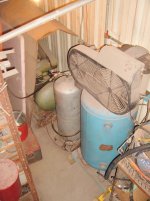
I run 2 comps in to a receiver and then to piping. The breaker to the 3 is the only one is on routinely and used copper tubing makes for the drains, every time I read a thread about a boogered auto drain I go kick it open a few seconds.
 

Attachments

  • air comp drain.jpg
    air comp drain.jpg
    136.7 KB · Views: 31
  • air comps rev.jpg
    air comps rev.jpg
    142.3 KB · Views: 30
  • air comps air.jpg
    air comps air.jpg
    145.3 KB · Views: 33
Last edited:

Schurkey

Well-known member
Joined
Oct 27, 2011
Messages
2,368
Location
The Seasonally Frozen Wastelands
So many of you are worried about the heat and moisture retention with plastic lines. That's what they make air driers for.

Generally automotive shops don't bother with air driers.
Ok, another bus plant story about water in a compressed air system; and a different kind of moisture ejaculator:
The bus plant had 200 workers, give or take. Most of them used air tools for at least part of their job, and many of them used air extensively. There were two down-draft paint booths, each big enough to fit a 60-foot articulated bus with room to work around 'em. We had an enormous air compressor and a refrigerated air dryer. Worked great. (We also had wall-mounted automatic oilers in several places, which never needed to be refilled...but that's another story.) The air was dry as a popcorn fart; a little bit on the low-pressure side due to management not understanding that we needed 90 at the tool with the tool running; which means more than 90 at the regulator. But all in all, it worked well for several years.

One day, the refrigerated dryer dies. Management lays into Maintenance Department--First, how much is it going to cost to fix (answer: Lots!) and Second, DON'T ADMIT THAT THERE'S ANYTHING WRONG.

So being both a Union officer and the lead hand of the two work stations DIRECTLY UNDER the air compressor/dryer, so that my stations had the first drops from the tank/dryer, I spend a month bitching to Management (and Maintenance) that there's water--lots of it--in the compressed air plumbing. I mean, liquid water would shoot out of the air ratchets and die grinders, and you did NOT want someone to point a ratchet your direction. This cannot be good for the air tools--or the people who got wet. Oh, no. Nothing wrong. Uh-uh. C'mon, Schurkey, no-one else in the building is complaining! And it's the same denial and bullsh!t every time I mention it...which was often. 'Cause it was really bad.

So one day, the second-in-command of the plant is walking through my department "first thing" in the morning. This was not a common deal. I stop him, and tell him to watch while my guy plugs an air hose into the lowest fitting on the manifold. First air-hose connection of the morning.

The water sprays four or five feet before the coupler plug can get fully engaged. There's a fan-pattern of water on the floor. My guy's shirt is soaked from the water that sprayed around the coupler plug. Then he pulls the trigger on his air tool that's engaged to the other end of the hose he just plugged in. Water everywhere. I tell Mr. Second-in-Command that this happened every morning for the last month, but never in the years before that, and is he sure that there's nothing wrong with the air dryer?

The air dryer parts were ordered that afternoon, and fixed within a few days. I never did know what went wrong with the refrigerated air dryer, or what it took to fix it. Big secret. Don't tell. We built city buses, you'd think we built SR-71s.


Realistically, nobody in a home (mechanical) shop is going to use an air dryer when metal tubing does the same job with near-zero maintenance. I bet most home-shop painters and woodworkers don't use air driers.
 
Last edited:

sberry

Banned
Joined
Jun 18, 2005
Messages
35,747
Location
Brethren, Michigan
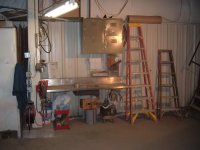
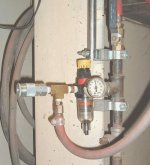
I paint, don't have a dryer. Have a little filter prior to gun reel.
 

Attachments

  • paint air 2.jpg
    paint air 2.jpg
    142.3 KB · Views: 39
  • paint booth half way 2.JPG
    paint booth half way 2.JPG
    42.1 KB · Views: 37
  • paint bay after.jpg
    paint bay after.jpg
    141 KB · Views: 40
  • new hose reel hyd.JPG
    new hose reel hyd.JPG
    41 KB · Views: 38
Last edited:

Diese1nut

Member
Joined
Mar 13, 2016
Messages
9
Location
New Hampshire
I am not saying Pex is the best or even rated for over 160psi.
I had my compressor in my basement and used 3' of 1" Pex from the compressor up to 1" black iron that went from the basement outside across the back of a breezeway and stubbed into an unheated garage. I then ran the 3/4" Pex from there throughout the garage. I am in the cold Northeast and would heat the garage with a ready heater when working.
Even with the constant temperature changes I never had any leaks or issues. I would use a water separator when painting.
I was just trying to suggest an inexpensive easy to run alternative that worked for me.
Everyone's input and suggestions have been worth reading.
 

Woodman920

Active member
Joined
Jan 17, 2016
Messages
26
You should have seen my supervisor, Joe, first time I called the thing a "moisture ejaculator". I thought he was going to **** his pants. I'm pleased somebody "got it" and that it still provides a giggle.

I think the official terminology at the bus plant was "moisture ejector". Nobody seemed to use the official name, though.

Might have been this, but I remember it as having an electric wire on it. Maybe I'm wrong.
http://www.stemco.com/product/moisture-ejector/
420.jpg


The buses that didn't have that option...sometimes froze the air-brakes in the winter. Then we're laying on the snow, caging the chambers with bare hands because gloves made the work impossible...or hauling a torpedo heater out there and hoping to thaw them. Nobody had any fun doing that.
I had agreat laugh with that. Thank you! Ah, the memories! I was a fleet mechanic once. I know your pain. But I wouldn't giv it up for the world.

Sent from my SM-G930V using Tapatalk
 

redmondjp

Well-known member
Joined
Nov 25, 2014
Messages
2,318
Location
Redmond, WA
I am not saying Pex is the best or even rated for over 160psi.
I had my compressor in my basement and used 3' of 1" Pex from the compressor up to 1" black iron that went from the basement outside across the back of a breezeway and stubbed into an unheated garage. I then ran the 3/4" Pex from there throughout the garage. I am in the cold Northeast and would heat the garage with a ready heater when working.
Even with the constant temperature changes I never had any leaks or issues. I would use a water separator when painting.
I was just trying to suggest an inexpensive easy to run alternative that worked for me.
Everyone's input and suggestions have been worth reading.

But just to point out, you used PEX at the absolute worst place in the air system for it, because that's where the air is the hottest. Now maybe with a large tank/receiver, the air cools enough to not make this a problem. It depends a lot on the duty cycle that you are using the compressor at.

I've worked in shops where they used an old compressor tank plumbed in series with the main compressor tank. By the time the air left that second tank, it was at room temp.
 
To avoid these ads, REGISTER NOW!
Top Bottom