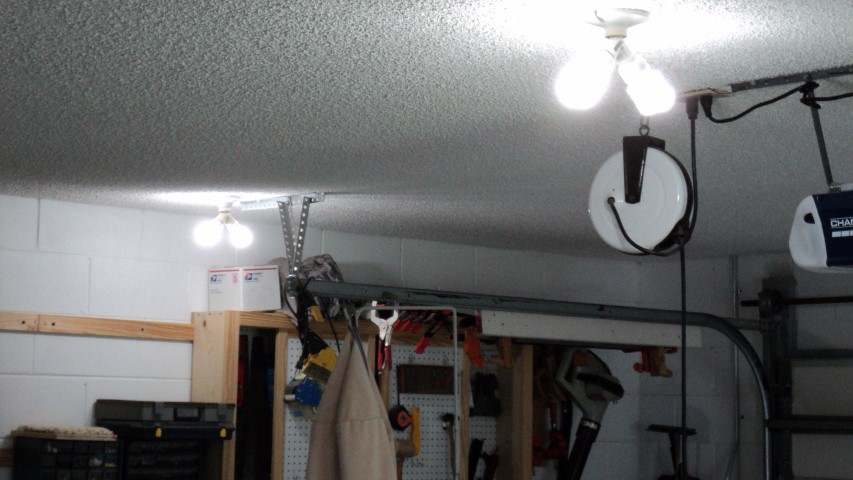
Have used a Number of calculators including visual. Bottom line is I have a 27 x 18 garage that I'm lucky enough to use 90% of it for woodworking.
So far, so good; but one word of caution: Lighting calculators, no matter how sophisticated, are essentially just "starting points" and/or "sanity checks". They cannot and do not take the place of you thinking things through for yourself.
The plan is to use 4 8 foot fixtures ( 4 4 foot bulbs in each). Lights will be 5000k. Any thoughts?
First: Rather than use so-called "tandem" 8-foot fixtures, I would STRONGLY suggest individual 4-foot twin tube fixtures. The tandems really buy you nothing by comparison, except for slightly less installation effort. Conversely, they have a number of downsides: Placement is necessarily less flexible, and will almost certainly lead to larger inter-fixture gaps than would be ideal. They also make it more difficult to implement an effective multi-tier switching scheme (see below); so you wind up running more lights, more of the time, than you would otherwise need to (read: higher "real life" operating cost, even if the "theoretical" numbers match exactly)
Second, in a wood shop, dust is going to be your biggest nemesis. It inevitably gets EVERYWHERE, even presuming a good dust-collection system is part of the plan. With typical open-tube "shop lights" or "wrap" fixtures, some of that dust
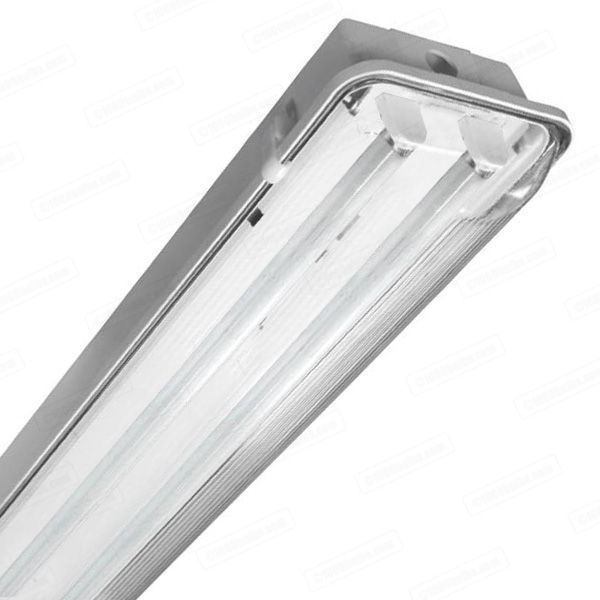
IS is going to settle in/on the fixtures; and it doesn't take much of that to drastically reduce the their effective output, hence efficiency. Therefore, I would urge you to bite the bullet as it were, and go for good weather-sealed fixtures such as:
http://www.1000bulbs.com/product/59133/TCP-WL4WA254USPQS.html
or:
http://www.homedepot.com/p/Lithonia...Fluorescent-Fixture-XWL-2-32-120-RE/202034431
...which will be MUCH easier to keep clean. Yes, these will cost significantly more than a typical strip or "wrap" fixture; but IMCO it will be well worth it in the long run.
Third: Wood shops also tend to require (or at least greatly benefit from) a somewhat higher overall brightness level than, say, a run-of-the-mill automotive service garage. With that in mind, and no matter how you slice it up between 4-tube and/or two-tube fixtures or whatever, with only 16 F32T8 tubes in your "general lighting" array, I think you're scrimping on the overall light level.
Now, to some extent, the exact layout of the shop/garage, and what you'll be doing in the way of task lighting for the various individual benches/tools/machines/etc., will have SOME impact here. And so too will the ceiling height (which you didn't mention) and the height at which the fixtures are mounted (which may or may not be smack up against the ceiling, depending on a number of other things). But still, based on a quick "back of the envelope" calculation, I think your current plan is marginal, at best:
Your 16 F32T8 tubes will produce a raw output of approximately 43,000-45,000 lumens (with fresh tubes; perhaps 5-10% less after they've aged). Your shop is ~486 ft.^2; so doing the math, we get about 88-92
SOURCE lumens/ft.^2 -- and that word "source" is critical: It means this figure is BEFORE we deduct for the losses produced by the fixtures themselves, and those incurred due to source-->subject distance (both of which can be significant). This is where a real lighting calculator can be useful; and in any event, we don't know your ceiling height (which WILL have an impact). But as a rough guess, I'd figure on maybe 60-70 lumens/ft.^2 at working height, when all is said and done. That's really not all that much. You really should aim for
at least 100 lumens/ft.^2 at working height, if not more (personally, I would not be concerned about "overkill" until you got well past 120-150 lumens/ft.^2).
As a counterpoint to all this, and noting that I am indeed advocating what SOME folks might consider "more than necessary" lighting, you should also set up the switching so as to provide as much control as possible over the effective brightness actually produced at any given moment. While I feel strongly that your lighting system SHOULD be capable of producing much higher illumination levels than you've thus far been planning on, I also acknowledge that you won't ALWAYS need that maximum level of lighting. Hence, your general lighting should be split into AT LEAST three separately switched "banks":
"Bank 1" would consist of some minimal number of fixtures (probably no more than two or three, in a shop that size), which will serve as your "walk through" lighting; and switches for this bank should be located immediately adjacent to EVERY possible entry point into the space. These are the lights you initially turn on when entering the shop, and provide just enough illumination to safely navigate through the space. And on those occasions when you're only running in to grab a screwdriver, or bring in the groceries, etc., it will be all you need.
The rest of the general lighting should be split into at least two banks, on ROUGHLY an "every other fixture" basis, so as to still provide as even coverage of the entire space as possible, even when only one of these banks is in operation. I say "roughly" because, ideally, these two banks will NOT have an equal number of tubes/fixtures; but rather, one will have perhaps half-again to twice as many as the other. This way, you effectively have three selectable brightness levels between the two banks (much like a "3-way" light bulb). Hence, when you're only doing relatively casual/non-critical work, you can run at a much-reduced overall brightness level, and save a significant amount of electricity (read: operating cost) in the process. Also, each of these two "main" banks should be fed from a different circuit breaker, so that if/when one trips (or must be shut down for maintenance or whatever), you won't be left completely in the dark.
White walls, white walls and a light colored cement floor
That will of course help; but it can't perform miracles. And besides, six months in, when there is a fine layer of sawdust on EVERYTHING, the reflectivity of those surfaces WILL be significantly reduced. Count on it.
You're quite welcome. Good luck.