
To avoid these ads, REGISTER NOW!

Quincy Compressor troubleshooting

63Denied

Member
Joined
Oct 6, 2013
Messages
20
Location
Mahopac, NY
Hello all. Been lurking on here for a few years and have gotten sooo much information for my garage/shop build which I've been working on. That will be a workshop tour thread soon.

But for now I have a question about my Quincy compressor that I got at an industrial auction for $175. I replaced the 3 phase motor with a single phase and finally got the electrical wiring done in my shop. I wanted to test out my compressor and was happy it worked.

I manually engaged the pressure shutoff switch (110 psi on-150psi off) and it turned off the motor. So then I let the compressor run to build up pressure in the tank to 150psi. However at 100psi the pressure relief valve on the HP valve head began relieving air at every rotation. The pressure relief valve is a 100psi valve. So it is functioning properly, I believe.

Why is there a 100psi valve on the head, but a 150 psi shutoff switch? How is the tank expected to get to 150 psi with the 100 psi pressure relief valve? Thank you all for your knowledge and I will post more. I promise.
 

Attachments
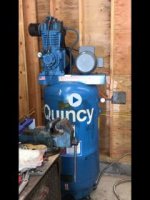
  • IMG_1274.jpg
    IMG_1274.jpg
    11.8 KB · Views: 55
Last edited:
To avoid these ads, REGISTER NOW!
OP
6

63Denied

Member
Joined
Oct 6, 2013
Messages
20
Location
Mahopac, NY
It's a 325 model. I can't tell if it's the high pressure or low pressure side. I can tell you it's on the discharge side (high pressure?) right above where the intercooler pipe comes into the head.
 

pcmeiners

Well-known member
Joined
Aug 13, 2009
Messages
7,901
Location
In the only town in Pennsylvania, Bloomsburg.
The relief valve is the one positioned within the first to second stage cooling, the pressure between the cylinders is much lower then the second stage output that is why the relief is 100 lbs. Could be defective or one of the valves has dirt/rust buildup.You should take all the valves apart and clean them up, referenced many times in the forum .

relief part # 2961-100
 
Last edited:

bsaint

Well-known member
Joined
Apr 26, 2010
Messages
5,109
Location
Manchester, CT
Most likely the relief valve isnt bad, there is a bad valve intake valve on the high pressure side in the head. But the safety relief valve is the cheapest option. Should be 70#. Usually the srv is interstage. Take the srv valve out and put in a gauge. If the gauge reads higher than 80 or so psi, you need a head job.
 
To avoid these ads, REGISTER NOW!
OP
6

63Denied

Member
Joined
Oct 6, 2013
Messages
20
Location
Mahopac, NY
Follow up. I took the valves apart and you all were right. The compressor had sat for a couple years and one of the valves was rusted open. In the process now of refinishing the valves and head. Thanks all for the help
 

md21722

Well-known member
Joined
Nov 30, 2015
Messages
1,840
Location
Mt Juliet, TN
Most likely the relief valve isnt bad, there is a bad valve intake valve on the high pressure side in the head. But the safety relief valve is the cheapest option. Should be 70#. Usually the srv is interstage. Take the srv valve out and put in a gauge. If the gauge reads higher than 80 or so psi, you need a head job.

This. If the interstage safety is blowing then its probably time for valves.
 

redmondjp

Well-known member
Joined
Nov 25, 2014
Messages
2,318
Location
Redmond, WA
Yup. I've got this same compressor sitting in my garage. This is a known problem with compressors that have steel poppet valves - they like to be in constant use. Else, you can have this exact same problem with the valves/seats rusting.

So if you don't use the compressor on a regular basis, a pump having stainless steel reed valves in it is superior in this one respect. They can sit for years without use and not have any valve problems.
 

MacMcMacmac

Well-known member
Joined
Oct 21, 2014
Messages
1,583
Location
canada
A faulty relief valve is the last thing you should suspect if one is popping.

It's trying to tell you something.

I have found them removed and replaced with a pipe plug more than once.
 

johnnyradiant

Well-known member
Joined
Mar 27, 2017
Messages
833
Location
Vancouver, BC
A faulty relief valve is the last thing you should suspect if one is popping.

It's trying to tell you something.

I have found them removed and replaced with a pipe plug more than once.

I guess the bright side to that is they were still in such a state to be declared a compressor with a pipe plug instead of a relief valve as opposed to a permanently dead or mangled compressor.
 
To avoid these ads, REGISTER NOW!
Top Bottom