To avoid these ads, REGISTER NOW!

Quincy QR series compressor: how old is too old?

EngineerNate

Well-known member
Joined
Oct 19, 2019
Messages
206
Location
Bristol, TN
I'm looking at a used QR series compressor (350 model) for my home shop. If I get it, I'm undecided whether to put a VFD on the existing 10 horse motor or for now get a 5 or 7.5 horse single phase and let it chug chug chug at a nice low RPM, and use the 10hp motor it comes with as a base for an RPC for other tools I might pick up in the future (3 phase unisaws for example often sell cheap compared to the single phase versions).

It's a Rev 15, and according to Quincy that's a 1975ish build. They picked a couple of random part numbers (gaskets) for me and they were avialable.

Would you guys have any qualms running a Quincy of that age? How is availability of the more involved parts (Say I need a new set of valves at some point? Can I get them?) How worried do I need to be about tank integrity? It has some exterior surface rust but nothing that looks deep in the photos, and the owner claims it builds and holds pressure just fine.

Cheers,
Nathan
 
To avoid these ads, REGISTER NOW!

isb cornbinder

Well-known member
Joined
Nov 3, 2010
Messages
7,073
Location
Pacific South West, BC, Canada
The phase converter I bought is a 10 horsepower unit. It is truly heavy duty. The rotor converter is made in USA by Baldor.
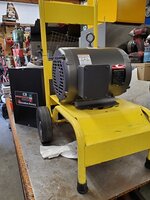
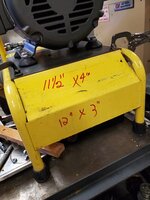
I mounted my phase converter on a Craigslist pressure washer cart. I can roll the phase converter to where I need it then plug any 3 phase into a receptacle on the cart. The cart has a heavy 6 meter welder extension cord that plugs into my welder outlets.
Over the years, I have optioned out on buying some really nice machinery because it was three phase.
My research showed that a VFD is not good at a heavy load start situation, like a heavy duty compressor.
 

Attachments

  • AMERICAN ROPTARY BASE 2.jpg
    AMERICAN ROPTARY BASE 2.jpg
    64.5 KB · Views: 45
  • AMERICAN ROTARY PHASE CONVERTER.jpg
    AMERICAN ROTARY PHASE CONVERTER.jpg
    67.2 KB · Views: 37
  • Rotary cart dimensions.jpg
    Rotary cart dimensions.jpg
    62.3 KB · Views: 41
  • rotary front view.jpg
    rotary front view.jpg
    74.5 KB · Views: 42
  • Rotary Phase copnverter.jpg
    Rotary Phase copnverter.jpg
    11.9 KB · Views: 47
Last edited:
OP
E

EngineerNate

Well-known member
Joined
Oct 19, 2019
Messages
206
Location
Bristol, TN
I'm familiar with both rotary phase conversion and VFDs, I have some experience from past professional work and some from hobby stuff. There are definite tradeoffs either way.

There's certainly VFDs beefy enough to run a 10hp motor (they do it on big mill spindles every day around the country in countless machine shops), the question is largely whether it's cost effective or not, and whether something that beefy will run nicely on single phase input power.

The compressor will happily put out ~15 CFM at 175 psi on a 5 horse single phase motor with a pulley sized to hit 400 rpm at the pump crank, which is likely more than enough for me. If I did that I'd have a "free" 10 horse idler motor for a future rotary phase converter for other equipment.

There is always a Tim the Tool man bigger is better temptation though, hence looking into beefy VFDs for the compressor. I'm not super keen on running the compressor on a rotary. I don't want to have to futz with the converter every time I want to use air.

My biggest concern is whether I'm going to be SOL if the thing needs rebuilding or not. I'm sure I can handle the work with some guidance, but if parts are unobtainium or priced so high they might as well be it's a nonstarter.

Cheers,
Nathan

Almost forgot--I like your cart setup.
 
Last edited:

redmondjp

Well-known member
Joined
Nov 25, 2014
Messages
2,318
Location
Redmond, WA
A Quincy 350 is one of my bucket-list compressors, to spin low and slow with a 5HP motor. If it turns over and makes the usual wheezing noises, I'd go for it. They have full-pressure lubrication that unloads the pump if it loses oil pressure. Your hardest task will be moving the darn thing.

Pull a fitting and use an inspection camera (can get bluetooth ones that work with your smart phone) to check the inside of the tank.

I've got a Quincy 325 from the early 1990s. It will still be functioning long after I'm gone! I'd say go for it.
 
OP
E

EngineerNate

Well-known member
Joined
Oct 19, 2019
Messages
206
Location
Bristol, TN
Thanks!

Just realized, I meant to put this in general tool not general garage. My apologies. If a mod sees this feel free to relocate.
 

930dreamer

Super Moderator
Staff member
Joined
Oct 7, 2009
Messages
22,994
Location
Amarillo,TX and Stinnett,TX
Not sure how well the larger vfd work for air compressors, if you'll be buying other 3 phase machines I'd look at a rotary phase converter. I made a 10 hp RPC to run my 5 hp compressor. I have a good (Kellogg American) tank and pump from 1957.
 
Last edited:

yelchevelle

Well-known member
Joined
Jun 15, 2018
Messages
178
Location
Hoover, AL
I rebuilt a310 and sold one to a friend with roc 19 on both. Only parts I had made were piston/rod pins/bushings on the smaller high pressure pistons. For reference, roc 19 on the 310 is sling oiled and so old Quincy doesn’t know the year built. They estimated 1948-1950. The pin floats with aluminum buttons on each side to hold it in place. I bought a kit on eBay for all the seals and stuff. Really straight forward to rebuild. I personally would probably run it on a 5hp motor if it can spin it fast enough (I think 400 rpm minimum), and be done with it. If you need more air as a hobbiest, get something gas or diesel powered. I am going to set up a 240 on 5hp and another 240 on gas so I can run them together if I need to blast something.
 

American Locomotive

Well-known member
Joined
Jan 8, 2017
Messages
11,016
Location
Rhode Island
I really don't know where the "VFDs can't work with compressors" myth came from. VFDs have no problem starting compressors - most can offer 150-200% of the motor's rated torque, which is actually more torque than the motor would have on a normal "direct line" start. A 10HP single-phase (or 20HP 3 phase input) input VFD will run you about $800-900 these days. That's about half the cost of an equivalent American Rotary RPC.

If you plan on getting a lot of 3 phase equipment, it might make more sense to go with an RPC and install 3-phase wiring throughout the building off a 3-phase panel run off the RPC. However, VFDs are also super cheap these days. So if you might only get one or two more machines, VFDs still might make more sense. My buddy has been buying 3-phase equipment, and he just buys the cheap Teco VFDs. If the equipment is 1HP or lower, you can even use the super nifty 120v > 240v step-up drives. Sure is a neat party trick plugging a 240v 3phase grinder into a 120v outlet.
 
OP
E

EngineerNate

Well-known member
Joined
Oct 19, 2019
Messages
206
Location
Bristol, TN
My thought was actually to use a 15 hp VFD to keep costs down and if necessary put a slightly smaller drive pulley on the motor if the drive can't hack it, effectively limiting it's output to 7-8 hp and making it quieter in the process. Chances are with some tuning a 15 horse could run at the full 10 but it'd be right on the line, at least based on the math.
 

seber

Well-known member
Joined
May 31, 2016
Messages
4,207
Location
Deep East Tx.
For years I ran a 25 hp Quincy on a five hp motor. Chug chug. You could carry a conversation next to it. Check with Quincy to see haw slow it can run without problems. Most pumps have no lower limit. If you don't need the extra air, I'd go with a five hp. As far as age, there is no such thing as too old. The tank is almost certainly certified and even if badly corroded will simply leak.
 
OP
E

EngineerNate

Well-known member
Joined
Oct 19, 2019
Messages
206
Location
Bristol, TN
For years I ran a 25 hp Quincy on a five hp motor. Chug chug. You could carry a conversation next to it. Check with Quincy to see haw slow it can run without problems. Most pumps have no lower limit. If you don't need the extra air, I'd go with a five hp. As far as age, there is no such thing as too old. The tank is almost certainly certified and even if badly corroded will simply leak.
400 rpm minimum, if the datasheet is to be taken at face value.

I figure the tank is the biggest liability, and if it's no good replacement are easy to come by. Plenty of 60 gallon big box store compressors out there with burned up motors or pumps. Put two next to one another and put a nice plate across the top and you've got 120 gallons on the cheap.
 

Iron Beaver

Well-known member
Joined
May 3, 2020
Messages
684
There IS a minimum RPM for compressor pumps. Splash lubricated pumps need enough splashing to go round. On pressure lubricated pumps lubrication pressure is proportional to speed. I don't think that vintage of Quincy pump has a pressure adjustment either.

That said, I think 5HP would probably be enough. In re your other question, looks like an OEM Quincy major overhaul kit is about $440.
 
OP
E

EngineerNate

Well-known member
Joined
Oct 19, 2019
Messages
206
Location
Bristol, TN
There IS a minimum RPM for compressor pumps. Splash lubricated pumps need enough splashing to go round. On pressure lubricated pumps lubrication pressure is proportional to speed. I don't think that vintage of Quincy pump has a pressure adjustment either.

That said, I think 5HP would probably be enough. In re your other question, looks like an OEM Quincy major overhaul kit is about $440.
The datasheet lists is as a 5-15 horse unit, with the former intended to spin it at that 400rpm mark.

I'd come in under a grand even with that kit included not counting my time, so I think it's a good deal.
 

bsaint

Well-known member
Joined
Apr 26, 2010
Messages
5,109
Location
Manchester, CT
Don't get a vfd with an old motor. Get a rotary phase converter.

If you do get a VfD you should upgrade to an inverter rated motor.
 
OP
E

EngineerNate

Well-known member
Joined
Oct 19, 2019
Messages
206
Location
Bristol, TN
I've seen a lot of mixed messaging regarding VFDs on older motors. If the motor isn't being asked to do anything outside of it's normal operation range (no running at half speed etc) is there really all that much danger?
 
To avoid these ads, REGISTER NOW!
OP
E

EngineerNate

Well-known member
Joined
Oct 19, 2019
Messages
206
Location
Bristol, TN
Some good discussion of VFD use on older motors here:


Getting a smaller pulley that takes 20% or so of the load off the motor to give it a bit more thermal headroom might be prudent if I chose to run the existing motor on a VFD.

I need to think about this more, but the fact that the motor in question is a dual voltage unit might be helpful in this case. Since it was designed to hold 460V and not just 230V it should have been specced to a higher standard insulation wise.
 

bsaint

Well-known member
Joined
Apr 26, 2010
Messages
5,109
Location
Manchester, CT
I've seen a lot of mixed messaging regarding VFDs on older motors. If the motor isn't being asked to do anything outside of it's normal operation range (no running at half speed etc) is there really all that much danger?
Well it's because it "makes" 60hz by pulsing at a high carrier frequency (sometimes 10khz). It's why VFD driven motors have that high frequency whine. It tends to break down insulation over time. Granted old motors are made better but also less efficient for a the mating VFD so they should be tuned. It's a big mess imo to just run at 60hz. I've done it before too. Tbh you don't use the compressor everyday you're fine.

Also compressors have low current starts, they are usually unloaded esp a Quincy.
 

yelchevelle

Well-known member
Joined
Jun 15, 2018
Messages
178
Location
Hoover, AL
I have posted before that I daily run my 1947 Quincy 310. I replaced the valve discs, springs and gaskets around 1983 other than that it is all original including the tank. Pacific Air Compressor has quality parts for Quincy and most other brands. I bought a major overhaul kit for my 325 from them
What roc is your 310
 

American Locomotive

Well-known member
Joined
Jan 8, 2017
Messages
11,016
Location
Rhode Island
VFDs are really a non-issue for home shop use. Some older motors, on higher voltage (480v drives) with really long leads, being used very hard 24/7, may have issues.

The biggest thing to watch for with VFDs in home-shop use is overloading the motor at low speeds. VFDs (especially with sensorless vector mode) can allow motors to have a very high amount of torque at very low speed. This can cause the motor to heat up, as the motor's cooling fan won't be spinning very fast.

Just watch your motor temps and everything will be fine.
 

Renegade1LI

Well-known member
Joined
Mar 11, 2018
Messages
5,032
Location
long island ny
Not sure where people get there VFD info, but all the equipment we install in industrial plants seems the be run by vfd. Most hvac stuff that runs 24/7 is vfd controlled, stuff we installed 10 years ago still running no problems. They offer so many advantages, plus save a ton of energy why not install a vfd. My powermatic 90 lathe runs smooth, infinitely adjustable speed, added a braking resister. I have added a bunch of old 3 phase machines I picked up for great prices, I like people being leary of vfd, more cheap 3 phase machines available, lol.
 

csp

Well-known member
Joined
Mar 23, 2010
Messages
5,720
Location
Franktown, CO
I think a lot of the don't use a VFD on a compressor talk comes from compressors that start loaded and the additional umph it takes to get those going. Not an issue with a Quincy.

I bought my 325 for $350 with a 3phase, 5hp motor and plan on using a 10hp rated VFD on it if I ever get around to it.
 

u3b3rg33k

Well-known member
Joined
Dec 18, 2017
Messages
4,051
I've seen a lot of mixed messaging regarding VFDs on older motors. If the motor isn't being asked to do anything outside of it's normal operation range (no running at half speed etc) is there really all that much danger?
the "issue" is VFD's don't make a sine wave, they approximate it by chopping DC bus voltage which is about 1.4x the "line" voltage. so if you see 240V RMS on your meter, the motor windings will see 330V. granted they're technically seeing that anyways (Peak to peak voltage is higher than RMS). the problem is the harmonics from the PWM action. the longer the wires between the VFD and the motor, the higher those spikes can stack. if you put a motor on a VFD, keep it close.

we have a LOT of motors at work that aren't listed for VFD use, running just fine for YEARS. And i'm not talking about 'i've had my toy with a VFD on it that gets used once a month for 20 minutes' years, I'm talking '24/5, turn it on monday, turn it off friday, no stopping' hours.
I doubt whatever you're planning is going to hit those hours.

other VFD benefits:
it's a soft starter if you set the acceleration time right. great for not dimming your neighbors lights, and having them call the power company to complain, then the power company showing up at your door and reminding you you're not allowed to DOL start motors over 5hp on your service.

VFDs generally will tell you WHY they error out, especially if you put in the right motor data. overloaded motor? VFD will shut it off and let you know why it stopped.


running half speed isn't a problem if you've got the cooling to match. if you aren't sure, hook up the temp sensor that's in most bigger motors to the VFD, and tell it to stop if it trips.

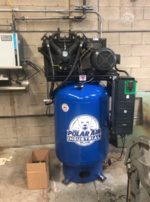
This is my new compressor at work. 10hp. came with a VFD. runs down to 30Hz before it shuts off. it starts unloaded, except when it doesn't. VFD has no problem getting it to turn over with 150PSIG in the aftercooler.

motor is rated SF 1.15 @ 60Hz, 1.0 @ 50Hz. 10HP at both frequencies. cooling fan looks tiny to me but I can hold my hand on it after it's been running for 100 hours straight so it must be fine.
1641444203838.png
Some good discussion of VFD use on older motors here:


Getting a smaller pulley that takes 20% or so of the load off the motor to give it a bit more thermal headroom might be prudent if I chose to run the existing motor on a VFD.

I need to think about this more, but the fact that the motor in question is a dual voltage unit might be helpful in this case. Since it was designed to hold 460V and not just 230V it should have been specced to a higher standard insulation wise.

that's not the data you need to look at. a dual voltage motor's windings never see more than 230V. at 460V they're just running in series. you want to look at the class of insulation. motors that run on VFDs tend to have higher rated insulation, and they often do a better job of gluing the windings together to prevent vibration from the VFD's carrier frequency.


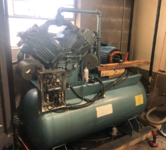
Here's our shop's QR-25.

It's very old. ran alot before the new compressor showed up. found out it wasn't unloading properly (probably for years). fixed that. now it runs when I do maintenance on the new one.
1641444422786.png
 
Last edited:
OP
E

EngineerNate

Well-known member
Joined
Oct 19, 2019
Messages
206
Location
Bristol, TN
Hmm. In series you get more windings but the peak to peak voltage seen by the motor isn't affected by that right? You just have more windings in a row vs parallel.

So if it's a wye wound motor with two sets of coils, on 230v you have double wye configuration (230v on each winding) running at amperage A.

On 460v you have the two sets wires in series in a single wye so amperage is A/2 but the windings all see the higher voltage still, no?
 
Last edited:

csp

Well-known member
Joined
Mar 23, 2010
Messages
5,720
Location
Franktown, CO
With all of the talk about machines that run 24/7 on a VFD, is there a difference between the output of a VFD that has three phase input vs a VFD that has single phase input?

I would assume that these machines that run 24/7 in an industrial setting probably have three phase input into the VFD. I don't know if that makes any difference to the output to the motor.
 

American Locomotive

Well-known member
Joined
Jan 8, 2017
Messages
11,016
Location
Rhode Island
With all of the talk about machines that run 24/7 on a VFD, is there a difference between the output of a VFD that has three phase input vs a VFD that has single phase input?

I would assume that these machines that run 24/7 in an industrial setting probably have three phase input into the VFD. I don't know if that makes any difference to the output to the motor.
The output is identical between a single phase input and 3 phase input drive.
 
  • Like
Reactions: csp

u3b3rg33k

Well-known member
Joined
Dec 18, 2017
Messages
4,051
With all of the talk about machines that run 24/7 on a VFD, is there a difference between the output of a VFD that has three phase input vs a VFD that has single phase input?

I would assume that these machines that run 24/7 in an industrial setting probably have three phase input into the VFD. I don't know if that makes any difference to the output to the motor.
not to type it all out again but this might help:
 

csp

Well-known member
Joined
Mar 23, 2010
Messages
5,720
Location
Franktown, CO
not to type it all out again but this might help:
For one not trained in electrical diagrams, I may as well by trying to read Arabic with that, but thanks. The simple answer American Locomotive gave was sufficient.
 

seber

Well-known member
Joined
May 31, 2016
Messages
4,207
Location
Deep East Tx.
With all of the talk about machines that run 24/7 on a VFD, is there a difference between the output of a VFD that has three phase input vs a VFD that has single phase input?

I would assume that these machines that run 24/7 in an industrial setting probably have three phase input into the VFD. I don't know if that makes any difference to the output to the motor.
The first thing a VFD does is chop the input into very high frequency. Then it is transformed to proper voltage and finally 60 cycles. Input is pretty much a non issue by then.
We also used VFDs on most of our production machines. They would start up cold on Monday morning and turn off on Saturday night. Some of those motors were 50 years old. Most were at least 30. There were 50 machines on the floor. Mostly five horse three phase. A few were 10 hp and one was 20.
 
  • Like
Reactions: csp

u3b3rg33k

Well-known member
Joined
Dec 18, 2017
Messages
4,051
The first thing a VFD does is chop the input into very high frequency. Then it is transformed to proper voltage and finally 60 cycles. Input is pretty much a non issue by then.
We also used VFDs on most of our production machines. They would start up cold on Monday morning and turn off on Saturday night. Some of those motors were 50 years old. Most were at least 30. There were 50 machines on the floor. Mostly five horse three phase. A few were 10 hp and one was 20.
maybe if you have an active front end or PFC supply. otherwise none of that is happening. check my post above for the 10,000ft view of how a VFD works.
 

250

Well-known member
Joined
Oct 16, 2014
Messages
537
Location
West of the Sierras
I was in the same boat a while back, though my 350 is newer than yours. I ultimately went for the 5 hp 1ph motor option instead of the VFD mainly because of price, and at that point I didn't have any experience with a VFD, especially one needed for a 10 hp. I consulted the Quincy literature as to pump speed, calc'd the pulley size and asked a lot of noob questions along the way. One down side of I've observed is that the high pressure exhaust valve can get real crusty if it doesn't have a chance to get hot to deal with the moisture generated.

In our first house, I used it with some aux air storage to blow out our own sprinklers each fall. Did it take longer than the lawn guy with a tow behind? Sure but every year there was another couple hundred bucks staying in house. I'd set it to continuous run and let it run. The 350 is probably bigger than I really need now. But it's 'paid for' so as long as long as I can find a spot for the big foot print is needs, it will stay.

If you feel the price works for you and the mechanicals seem ok, probably a good deal.
 

MKSJ

Active member
Joined
Apr 1, 2018
Messages
34
Location
Tucson, AZ
Size of motor and single vs. 3 phase/VFD choice probably comes down to amount of CFM you need, duration of use, service panel amperage and cost. If you do not need more than say 15 CFM, then the least expensive and easiest option is a single phase 5 or 7.5 Hp motor belted to the appropriate compressor speed. You can pick up a 5 Hp WEG or similar motor for $400-500, a 7.5 Hp for $650. When you go above 7.5 Hp, then 3 phase is probably a better option. I have worked with a few other people who had 3 phase 10 Hp motors on their compressors and if I recall the most cost effective VFD was the Fuji Electric Micro Drive FRN0060C2S-2U (3 pahse input 20 Hp 60A output run in a derated mode) they run around $650. Do not get the HY or cheap generic VFD's, they will mostly likely burn up quickly with compressor loads. The issue you will have with VFD's is the panel service and wiring will be much more amps, NEC code is you need a minimum of 125% of the VFD's rated input. I am not aware of how one factors in derating for single phase, which will draw higher current peaks vs. 3 phase. If you go that route I would either call the distributor or the VFD manufacturer technical and ask them the service requirements. You also need to factor in costs of an enclosure, wiring, disconnect, etc.

If you are running a difficult load you want to keep the VFD carrier frequency lower, and also for older motors. Insulating rating is usually not an issue as most 3 phase motors are dual rated and you are running them off of the lower voltage windings. Can't really see the need for variable speed, so probably stay with a single phase 5/7.5 Hp motor but you also need to factor in a magneter starter control box with a contactor and thermal overload which run around $150 for a WEG 7.5 Hp unit.

I have a Champion HR5-8, the pump can either use 5 or 7.5Hp motor. My motor is a 5 Hp single phase 1750 RPM WEG, which seems to be a bit more common these days. It can flow around 17 CFM @ 90 PSI.
 
To avoid these ads, REGISTER NOW!
Top Bottom