To avoid these ads, REGISTER NOW!

R-19 for 2X6 cavities??

Rosco

Well-known member
Joined
Jan 4, 2009
Messages
1,140
Location
South Georgia
I am looking at insulating some of my wall cavities with JM MR faced R-19 bat insulation. It says it is for 2X6 construction, but the package states the insulation is 6 1/2 inches thick, and 2X6 cavities are only 5 1/2 inches deep. Will this amount of compression reduce the R value?

I know they make an R-21 that is 5 1/2 inches thick, but I cannot find anyone locally who can get it.

Will I go wrong with the MR Faced R-19 bats in a 2X6 cavity (5 1/2" deep)? It says the MR facing is mold resistant and acts as a vapor barrier. I am not to sure that I need an interior vapor barrier in south Ga. I have house wrap on the garage, and the summer heat is more draining on the energy bill.

Thanks!

http://www.rebelinc.com/pdfs/MR Faced Batts.pdf
 
To avoid these ads, REGISTER NOW!

aar0s

Well-known member
Joined
Jan 22, 2010
Messages
1,905
Location
So.Il.
The place i work at sells r19 insulation for 2x6 walls. You should be fine with that product.
 
OP
R

Rosco

Well-known member
Joined
Jan 4, 2009
Messages
1,140
Location
South Georgia
Lowes is where I want to get it. The JM brand is formaldahyde free and has an MR facing (supposedly mold resistant. I was just wondering about the thickness issues. Also havent heard much about the MR facing vs. the Kraft paper facing.
 

jkeyser14

Well-known member
Joined
Dec 19, 2008
Messages
1,819
Location
(rural) Maryland
Lowes is where I want to get it. The JM brand is formaldahyde free and has an MR facing (supposedly mold resistant. I was just wondering about the thickness issues. Also havent heard much about the MR facing vs. the Kraft paper facing.

The 6 1/2" insulation really isn't that thick. I put it in my attic and it fit my 2x6's perfectly. The MR stuff isn't bad but I was under the impression it's not a moisture barrier?
 

Horses Ghost

Well-known member
Joined
Feb 25, 2009
Messages
78
Location
Bismarck ND
I bought R-21 at Menard's but had to ask for it. It was about the same price as R-19, but thought the better the R value the better you are.
 

jklingel

Well-known member
Joined
Nov 29, 2007
Messages
441
Location
Frbnks, AK
What you have for insulation will be fine, even if an odd batt needs to be compressed a tad. On the vapor barrier, I know some folks say "the foil IS the vapor barrier, so no visqueen is needed on top of it". I don't buy that for one second. You can not, IMO, install fiberglass as it is manufactured and seal up all the edges. Perhaps that stuff will RETARD moisture transport a bit, but it sure is NOT a vapor barrier. If your area needs a vap barr, and most do, install 6 mil visqueen.
 
OP
R

Rosco

Well-known member
Joined
Jan 4, 2009
Messages
1,140
Location
South Georgia
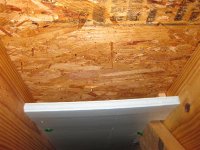
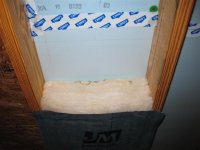
Thanks! This is the configuration I am going with. The DOW 3/4" board has a 1 1/2" vent space behind it (furred with 1x2 strips). I think the R-19 will do fine in the space, but I am glad I only bought 1 bag for now cause I think I will need to do away with the facing on the insulation since I have the DOW board behind (was told never use a vapor retarder on both sides).
 

Attachments

  • IMG_0707 (Medium).JPG
    IMG_0707 (Medium).JPG
    50.1 KB · Views: 46
  • IMG_0709 (Medium).JPG
    IMG_0709 (Medium).JPG
    88.2 KB · Views: 42

mpraddict

Well-known member
Joined
Jan 28, 2007
Messages
269
Location
Central Ohio
What you have for insulation will be fine, even if an odd batt needs to be compressed a tad. On the vapor barrier, I know some folks say "the foil IS the vapor barrier, so no visqueen is needed on top of it". I don't buy that for one second. You can not, IMO, install fiberglass as it is manufactured and seal up all the edges. Perhaps that stuff will RETARD moisture transport a bit, but it sure is NOT a vapor barrier. If your area needs a vap barr, and most do, install 6 mil visqueen.

Visqueen isn't really a vapor barrier either, it is also a vapor retarder. Vapors still move through it, just at a much slower rate.
 
To avoid these ads, REGISTER NOW!

WVBrady

Well-known member
Joined
May 5, 2005
Messages
1,679
Location
WV
Visqueen isn't really a vapor barrier either, it is also a vapor retarder. Vapors still move through it, just at a much slower rate.

I was curious about this statement and did some searching; it doesn't look good for Visqueen:

"Why can't I just use 6 mil or 10 mil Visqueen as my vapor barrier?"

http://www.stegoindustries.com/faqs...l_or_10_mil_visqueen_as_my_vapor_barrier.html


"So more Northeast Florida builders and contractors have been using thicker, more costly polyethylene products, which they say provide better protection from moisture and damage."

http://jacksonville.bizjournals.com/jacksonville/stories/2005/01/17/focus3.html
 

benjamming

Well-known member
Joined
Jun 29, 2009
Messages
899
Location
Alabama
That Energy Savers link seems to contradict the Building Science article concerning placement of vapor barriers at locations throughout the US.
 
OP
R

Rosco

Well-known member
Joined
Jan 4, 2009
Messages
1,140
Location
South Georgia
I have tried that route through all of the stores here. I can order R-21 from lowes, but it works out to be almost 75% more (over R-19)for what I can get. I am in south Ga. so it might be worth a trip to Atlanta. Not sure if an R factor of 2 is worth the extra cost.
 

jklingel

Well-known member
Joined
Nov 29, 2007
Messages
441
Location
Frbnks, AK
some comments

Rosco: I did not know you were in southern Ga. You may want to do a quick heat loss analysis, as you may find that r-11 is more cost effective for you. I don't know the weather in Ga, but it does not impress me as a particularly cold spot! As for vapor barrier vs retarder.... sheeesh! OK; nothing is a perfect "barrier", but for practical purposes 6 mil visqueen is pretty close. Houses do breathe a tad, too, so will release a BIT of moisture that sneaks through the vapor "barrier". Regardless of what is used, you can't install anything perfectly, so you will always get a smidge of moisture sneaking out here and there. The link that said "6 mil is useless and a waste of money" is interesting, but that seemed like a competitor's statement. 6 mil vis has been used here and in many states for eons, and if it were "useless" there would be millions of homes rotting on site. I take that comment w/ a grain of salt, if it was applied to walls (read article real fast). Under a slab, I would sure use something w/ more horse power than 6 mil; likely 10, or maybe the stuff in that article, as under a slab will get more abuse during construction. Good link w/ the permeability numbers, etc; will have to read there more. Thanks for all. Together we will conquer the mysteries of construction. j
 
OP
R

Rosco

Well-known member
Joined
Jan 4, 2009
Messages
1,140
Location
South Georgia
J, you are correct on cold issue. I am more concerned with the summer heat in the bonus room, but it does get cold here in the winter (ok, cold for us). The main issue here is folks not being able to keep their bonus rooms cool enough, especially with charcoal colored shingles.

It seems that there are so many conflicting papers/research on vapor retarders, especially if you take our different climates into account. I almost bit the bullet and did the closed cell spray foam, but in my opinion the long term jury is still out. Just do not see how any moisture can escape unless you use a hybrid approach, and there must be some kind of air exchange for air quality issues. I do see the huge benefits of having all of your HVAC equipment in a conditioned environment and the air sealing properties. Plus, I can buy my mini-split A/C unit and pay for the plumbing to the full bath with the savings between spray foam and batts.

Thanks to all for being helpful and offering advice from years of experience. I listen to all of it and try to get smarter (thats a stretch!).
 

jklingel

Well-known member
Joined
Nov 29, 2007
Messages
441
Location
Frbnks, AK
The main issue here is folks not being able to keep their bonus rooms cool enough, especially with charcoal colored shingles.
I
Oh, yeah. Keeping heat OUT. I've read of places like that, but doubt that they exist.:bounce: My sister has been near Atlanta for several years, and I think she said they even saw snow for a couple of hours; maybe that was farther north?? It sounds like you have your situation under control. Good luck w/ keeping the bonus room cool, whatever that is. j
 

mpraddict

Well-known member
Joined
Jan 28, 2007
Messages
269
Location
Central Ohio
Re: some comments

Rosco: I did not know you were in southern Ga. You may want to do a quick heat loss analysis, as you may find that r-11 is more cost effective for you. I don't know the weather in Ga, but it does not impress me as a particularly cold spot! As for vapor barrier vs retarder.... sheeesh! OK; nothing is a perfect "barrier", but for practical purposes 6 mil visqueen is pretty close. Houses do breathe a tad, too, so will release a BIT of moisture that sneaks through the vapor "barrier". Regardless of what is used, you can't install anything perfectly, so you will always get a smidge of moisture sneaking out here and there. The link that said "6 mil is useless and a waste of money" is interesting, but that seemed like a competitor's statement. 6 mil vis has been used here and in many states for eons, and if it were "useless" there would be millions of homes rotting on site. I take that comment w/ a grain of salt, if it was applied to walls (read article real fast). Under a slab, I would sure use something w/ more horse power than 6 mil; likely 10, or maybe the stuff in that article, as under a slab will get more abuse during construction. Good link w/ the permeability numbers, etc; will have to read there more. Thanks for all. Together we will conquer the mysteries of construction. j

The recommendation for over 6 mil was for under slab, not in walls. 4-6 mil is all you need in a wall.
The point with the barrier vs retarder is to emphasize the fact that none of these materials completely keeps vapor from moving through them even if installed perfectly. They all allow some movement through, the just slow it down a lot...and there's absolutely nothing wrong with that. I used the incorrect terminology for years too.
 

mpraddict

Well-known member
Joined
Jan 28, 2007
Messages
269
Location
Central Ohio
In southern GA, I'd go with no vapor retarder. We've found that it's actually better to have none in these humid regions. I'd avoid fiberglass insulation too if possible. At least one major restaurant chain I work with absolutely refuses to use fiberglass in the deep southeast because of moisture issues.
 

jklingel

Well-known member
Joined
Nov 29, 2007
Messages
441
Location
Frbnks, AK
Re: some comments

I used the incorrect terminology for years too.
Yeah, I had to laugh at the "new" terminology. What was it? Pressure differentially stratified vapor impedance modulating material? Yes, Ga may be one of those places where vapor-tweaking material is best on the outside, or not at all. Curious: if restaurants (I can imagine tons of moisture in a restaurant) don't use 'glass, then what do they use? Fiberglass is pretty impervious to water, as far as I know, and if given time will dry after heavy wetting. Maybe the restaurant just keeps dumping in too much water for ANYTHING to dry???? I'm sometimes glad I live in the cold; life is simpler.... j
 
To avoid these ads, REGISTER NOW!
Top Bottom