FarmerPete
Well-known member
Hey guys, I'm getting close to being able to do the new wiring for my garage!  I've relocated my 60 amp subpanel from my basement into my garage successfully! I didn't get electrocuted once, and the magic smoke is still properly stored inside the cables! I'm getting ready to start wiring the new circuits, but I'm not exactly sure on the proper way to exit the wires from my subpanel. Above all else, I want to make sure that I do things right. Not just because I'm going to get inspected, but because i don't want to explain to my wife why all our stuff went up in smoke.
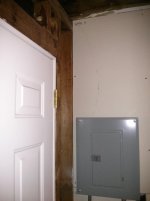
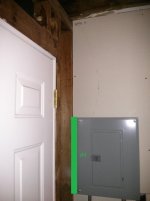
My subpanel is surface mounted on the shared house/garage wall right in the corner. The cleanest option would have been to run the wires out the back of the subpanel into the wall cavity. I did't do that because the wall behind the subpanel is fire rated, and I didn't want to puncture it if I could avoid it.
The way I'm lookin at it, I've come up with four options for how to run the cables to get them into the studs of the unattached walls. The unattached walls are currently wide open. I'm planning on insulating and covering them with OSB for what it's worth.
1. I can go up out of the subpanel with conduit and run the wires the few inches to the left and go down into the stud cavaties. The subpanel is 30 inches from the ceiling. I think I would either have to run a bunch of smaller conduits the 30 inches to the ceiling or run the biggest conduit my box can handle and only go 24 inches or less. Any longer than 24 inches and I believe I would have to derate the wires.
2. I can go out the side of the panel in conduit. Only issue is that the wall is like 2 inches away from the subpanel and the first stud is in the way of a straight conduit run from the subpanel. I'd have to bend the conduit to get it so that it wouldn't run in to the stud.
3. Run the conduit straight up a few inches and then hook to the left. THis should give me a little more room to bump the conduit away from the wall so I don't hit the stud. Not sure how many conduit runs I'd need or what size I could use.
4. Build a wooden box/bump-out flush with the sub panel faceplate that goes between the subpanel and the left wall. THen I could run all of the cables inside that box and into the wall cavity. Would I need to do anything special with this? I seem to recall reading that I may have to use a metal cover for this to protect the wires. Could I build it with a 2x4 for the top and bottom of the box and 1/2" OSB for the faceplate?
Thoughts? I personally like option #4 the best, because it doesn't require pulling romex in conduit. After pulling #6 through conduit, which isn't supposed to be that bad, I REALLY don't want to find out why every post I've seen about romex in conduit mentions how much of a PITA it is.
Hopefully the pictures will help. I suppose I should have mentioned that I'm planning on running 6*20 amp circuits and 2*50 amp circuits. Hopefully that isn't too much for a 60 amp panel. I doubt I'll run more than a few amps off the panel 99% of the time. I don't even own anything that can plug in to the 50 amp plugs. I just want to have them there in case i ever get the welding bug. I don't intend on running THHN in any conduit leaving the subpanel into the garage, because I really don't want any junction boxes if I can avoid it. That means it's going to be romex leaving the subpanel.
Oh, one last oddball question. As I mentioned, I'm running two 50 amp 220v plugs for future aspiring welder dream realizations. I tricked my wife into okaying the 50 amp recepticles by claiming that I could convert them into an electric vehicle plug down the road if we ever decided to buy an EV. My question is, does anyone know what is required wiring wise for an EV plug? Primarily, is #6/2 going to be sufficent, or should I run #6/3?
I've relocated my 60 amp subpanel from my basement into my garage successfully! I didn't get electrocuted once, and the magic smoke is still properly stored inside the cables! I'm getting ready to start wiring the new circuits, but I'm not exactly sure on the proper way to exit the wires from my subpanel. Above all else, I want to make sure that I do things right. Not just because I'm going to get inspected, but because i don't want to explain to my wife why all our stuff went up in smoke. My subpanel is surface mounted on the shared house/garage wall right in the corner. The cleanest option would have been to run the wires out the back of the subpanel into the wall cavity. I did't do that because the wall behind the subpanel is fire rated, and I didn't want to puncture it if I could avoid it.
The way I'm lookin at it, I've come up with four options for how to run the cables to get them into the studs of the unattached walls. The unattached walls are currently wide open. I'm planning on insulating and covering them with OSB for what it's worth.
1. I can go up out of the subpanel with conduit and run the wires the few inches to the left and go down into the stud cavaties. The subpanel is 30 inches from the ceiling. I think I would either have to run a bunch of smaller conduits the 30 inches to the ceiling or run the biggest conduit my box can handle and only go 24 inches or less. Any longer than 24 inches and I believe I would have to derate the wires.
2. I can go out the side of the panel in conduit. Only issue is that the wall is like 2 inches away from the subpanel and the first stud is in the way of a straight conduit run from the subpanel. I'd have to bend the conduit to get it so that it wouldn't run in to the stud.
3. Run the conduit straight up a few inches and then hook to the left. THis should give me a little more room to bump the conduit away from the wall so I don't hit the stud. Not sure how many conduit runs I'd need or what size I could use.
4. Build a wooden box/bump-out flush with the sub panel faceplate that goes between the subpanel and the left wall. THen I could run all of the cables inside that box and into the wall cavity. Would I need to do anything special with this? I seem to recall reading that I may have to use a metal cover for this to protect the wires. Could I build it with a 2x4 for the top and bottom of the box and 1/2" OSB for the faceplate?
Thoughts? I personally like option #4 the best, because it doesn't require pulling romex in conduit. After pulling #6 through conduit, which isn't supposed to be that bad, I REALLY don't want to find out why every post I've seen about romex in conduit mentions how much of a PITA it is.
Hopefully the pictures will help. I suppose I should have mentioned that I'm planning on running 6*20 amp circuits and 2*50 amp circuits. Hopefully that isn't too much for a 60 amp panel. I doubt I'll run more than a few amps off the panel 99% of the time. I don't even own anything that can plug in to the 50 amp plugs. I just want to have them there in case i ever get the welding bug. I don't intend on running THHN in any conduit leaving the subpanel into the garage, because I really don't want any junction boxes if I can avoid it. That means it's going to be romex leaving the subpanel.
Oh, one last oddball question. As I mentioned, I'm running two 50 amp 220v plugs for future aspiring welder dream realizations. I tricked my wife into okaying the 50 amp recepticles by claiming that I could convert them into an electric vehicle plug down the road if we ever decided to buy an EV. My question is, does anyone know what is required wiring wise for an EV plug? Primarily, is #6/2 going to be sufficent, or should I run #6/3?