dave377
Well-known member
I am a retired newbe at work with wood and I need a saw but not sure what one to get.


Same... sort of.In fact the first power woodworking tool I ever used was a RAS, dadoing face frames at me dads cabinet shop. I was about 12 at the time.
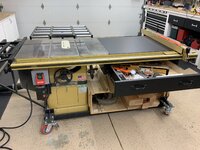
That's a really nice table saw setup. I hope to have something similar one day.
This is Garage Journal so the answer is always BOTH.
whatever you do get good quality blades and a good saw. Tablesaw is the first thing. I use both of my setups equally.
This is Garage Journal so the answer is always BOTH.
whatever you do get good quality blades and a good saw. Tablesaw is the first thing. I use both of my setups equally.
Same here. He still has it and that saw taught me healthy respect for power tools. So I'd probably choose the RAS just because it's what I'm familiar with.Same... sort of.
The only big tool dad had growing up was the RAS, so that's what we used. Cross cuts, miter cuts, even ripping large sheets of plywood. They can be very good tools with the right precautions.
The radial arm saw blade moves towards one - that's scarier to meTable saws scare me with that blade sitting right there. But then I never learned to use one.
 . I've had radials grab the wood and shoot forward - no thanks. The table saw can chuck things, but one learns to stand to one side...
Those were the heavy duty tow behind a truck model and a 12" saw. Most ran 240v. They made gang cutting and cutting of headers in one pass, nice and square, easy and efficient. They were and still are money makers. But we now have options that didn't exist then.For years every construction site had a DeWalt Radial Arm saw in a site built shed.
They got by without a Table Saw, the worm drive Skill handled everything the RAS could not.
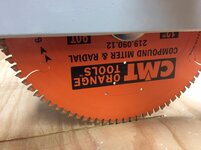
 Both saws will remove body parts if not seriously respected. Always use good quality sharp blades that are designed for the tool. The RAS requires a certain negative hook blade and a firm grip on the handle. Both saws need to be fed properly too. I have never had any issues with either…after I watched my shop teacher (yeah I am that old) send part of an index finger across the shop.


That's been a few years ago to put it mildly.For years every construction site had a DeWalt Radial Arm saw in a site built shed.
They got by without a Table Saw, the worm drive Skill handled everything the RAS could not.
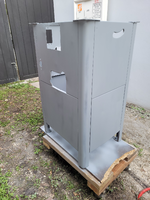
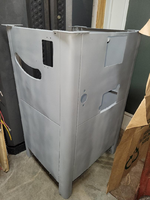

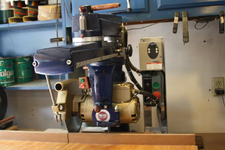
Those unisaw jr's are pretty rare birds. To do that saw justice you really do need to get all that rust off the acme threads.Here's a Unisaw Junior, a Delta (Milwaukee)-Rockwell 8 inch cabinet saw I have had stored for many years after using it for several years. I bought it from a Miami water company that was bought by PepsiCo, and liquidated (heh-heh). It works well, but the steel cabinet was rusty. I sanded the outside, and sandblasted the inside of the cabinet. Today it got two coats of oil-based primer. Maybe tomorrow for the color coat. I don't think I'm going to disassemble the trunions to paint, I just want to reassemble the cabinet saw and sell it. I have two Powermatics, an Artisan saw (Model 64, 10 inch contractor's saw) and a Model 66 cabinet saw. I also have a 12" Craftsman RAS (240V) I bought new in ~1979, cast-iron tower and arm.
I agree. While everyone would like to have a big Powermatic or Delta, there are some good quality portable table saws available for much less money.If you don't have a lot of space and are starting out, I wouldn't rule out a "portable" table saw either. I used to poo-poo them, but then met several contractors who pretty much only use them (because of the portability, and they build entire houses). They take up less space, can be moved around easier, and take care of a lot of the smaller jobs. For big panels, use a circular saw on saw horses with a guide plate (I used a 6' long piece of half-height unistrut with a c-clamp on each end).
Building construction using dimensional lumber means 90% of the work was crosscutting. That is bread and butter work for a RAS. Especially in a time where plywood was not widely used, every thing, from sheathing on exterior, roofs, and oftentimes floors came as bunks of lumber.For years every construction site had a DeWalt Radial Arm saw in a site built shed.
They got by without a Table Saw, the worm drive Skill handled everything the RAS could not.
I‘d be hard pressed to recommend a RAS to a new woodworker, unless they had a need for lots of wide crosscutting or dados.