To avoid these ads, REGISTER NOW!

Radiant Floor Help

bauer0667

Member
Joined
Nov 6, 2017
Messages
10
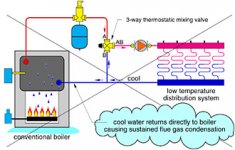
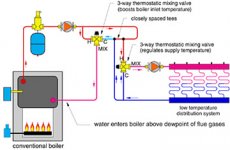
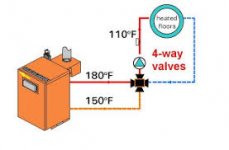
I have a Cast Iron Crown 105,000 BTU boiler hooked up to my radiant floor. Unfortunately my current setup is bringing the return temp back at 90 degree's. Which is 30 degrees to low. I installed a 3 way thermostatic mixing valve thinking that would solve my problem and ended up creating another problem. After some research it appears i have 2 ways to solve this and I would appreciate some advice. Please see the attachments below.
 

Attachments

  • New Problem.jpg
    New Problem.jpg
    60.5 KB · Views: 50
  • Option A.jpg
    Option A.jpg
    54.2 KB · Views: 48
  • Option B.jpg
    Option B.jpg
    8 KB · Views: 36
Last edited:
To avoid these ads, REGISTER NOW!

yeldogt

Well-known member
Joined
Jan 2, 2012
Messages
18,184
If all you have is low temp (radiant is low temp) -- and the crown is not designed for low temp return. You will have to set up a primary secondary piping arrangement.

Do you have radiators? what controls the boiler -- outdoor reset?

I always use Buderus boilers -- they have the ability to take lower return water. I also like panel radiators w/ my radiant ... so I use the panels as my primary loop w/ outdoor reset and the low temp for the radiant comes off of that using a 3 way w/ outdoor or a simple temp control on really simple setups.

You need a little book called "pumping away" ... worth buying and reading.
 

Radix2

Well-known member
Joined
May 28, 2014
Messages
1,853
Location
the thumb!, MI
You seem to have the issue in hand, what is your question?

Adding a second thermostatic valve and pump seems to be the way to go using what you have already.

The four way valve would need a thermostatic control and actuator and two temp sensors which sound more expensive and complex.

This points to the advantage of condensing style boilers for low temp radiant, they love low return temps...but are $$
 

yeldogt

Well-known member
Joined
Jan 2, 2012
Messages
18,184
You seem to have the issue in hand, what is your question?

Adding a second thermostatic valve and pump seems to be the way to go using what you have already.

The four way valve would need a thermostatic control and actuator and two temp sensors which sound more expensive and complex.

This points to the advantage of condensing style boilers for low temp radiant, they love low return temps...but are $$

If he is only needs one temp he does not need two expensive mixing valves ... and the single 4 way is problematic. It's being asked to do two things and will not.


German high mass boilers work beautifully with radiant -- they are designed for the lower temps and work great. With NG and the space/ chimney I actually prefer old school over the new condensing boilers. Simple and easy to control -- nothing to wear out .. they last forever (well almost). yes .. you give up some efficiency. It's not much with NG .. and any service on the expensive condensing and you are down for the year. I have a 20+ years old Buderus w/logmatic -- the flue damper was replaced under a warranty and the Honeywell relay failed. My other one is about 15 and had the same damper replaced. They will get like replacements if i still own the house when the need to be
 
OP
B

bauer0667

Member
Joined
Nov 6, 2017
Messages
10
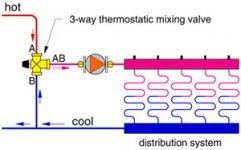
If the heat output rating of the boiler is at least four times greater than the design load of the low-temperature distribution subsystem, the second three-way valve may not be needed. I have a 105,000 BTU boiler and I have been told my heat load would be 28,600. Should I try it with one valve like the picture below?
 

Attachments

  • Boiler.jpg
    Boiler.jpg
    44.6 KB · Views: 9

yeldogt

Well-known member
Joined
Jan 2, 2012
Messages
18,184
If you have a 105 boiler supplying only 28k of load you should not be having such a drop after the boiler heats up. Any boiler will have a cold start initially.

I see you have asked the same question many places ... I told you above you need to do primary and secondary if all you have is low mass .. you did not answer if thats all you have.

Also, told you how to get the information ... pumping away. Spend the $25 -- do it correctly and have no more worries or cost
 
OP
B

bauer0667

Member
Joined
Nov 6, 2017
Messages
10
If all you have is low temp (radiant is low temp) -- and the crown is not designed for low temp return. You will have to set up a primary secondary piping arrangement.

Do you have radiators? what controls the boiler -- outdoor reset?

I always use Buderus boilers -- they have the ability to take lower return water. I also like panel radiators w/ my radiant ... so I use the panels as my primary loop w/ outdoor reset and the low temp for the radiant comes off of that using a 3 way w/ outdoor or a simple temp control on really simple setups.

You need a little book called "pumping away" ... worth buying and reading.

_________________________________________________________________

Thank you for your help. I do not have any radiators just the pex in the concrete. No outdoor reset yet. I'll be buying the book.
 

koditten

Well-known member
Joined
Apr 10, 2008
Messages
5,528
Location
Midland, Michigan
I wouldn't waste time with outdoor reset if you are using a conventional boiler. Your boiler does not ramp down, so using outdoor reset is not going to gain you anything.

The primary/secondary is the correct way. My system is set up this way and it works flawlessly.

With radiant floors, keeping it symple is the best.

Whatever you do, install some flow meters on each loop. The ability to see how fast the water is moving is a god send.

My primary loop is spinning rapidly around the boiler. My floor loops are just crawling along.
 
To avoid these ads, REGISTER NOW!
OP
B

bauer0667

Member
Joined
Nov 6, 2017
Messages
10
I think i'm going to go with setting up the primary /secondary how do i decided what size circulator's will i need?
 
Last edited:

Radix2

Well-known member
Joined
May 28, 2014
Messages
1,853
Location
the thumb!, MI
I think i'm going to go with setting up the primary /secondary how do i decided what size circulator's will i need?

I think this is a good plan, and you can use your tempering valve just to protect the floor piping from overtemp.

Since your boiler is oversized, you should be able to assure that there is hot flow in the primary loop to protect the boiler.

You size your circulators based on a desired temperature drop and a desired BTU load ( since the delta t x flow is basically your BTUs). So you need to verify your desired BTU output, decide on a 20-30 degree delta t and then calculate the flow required to supply your needed BTUs. Use a larger flow in your primary loop, and your return temps will be higher than your floor return temps.

So, for example you want 28000btu=500x20xgpm. Gpm=2.8.
Now figure out your head loss from your pipes.
Now look up a circulator that gives about 2.8gpm at that head pressure.

Since you have the power, I would size for more than the min BTUs you need, but you get the idea.

One thing to consider is how you will be using the system. If you are going to repeatedly start from very cold floors, it makes sense to take every precaution to protect the boiler from cold returns( say with a second valve). If you are going to heat all the time, you can focus on returns near 60-70 degrees and calculate the amount of hot boiler water needed to be mixed with that to get above your 120-140 condensing bogie - size your primary circulator to provide that extra flow above what the floor will e returning.
 
Last edited:

Radix2

Well-known member
Joined
May 28, 2014
Messages
1,853
Location
the thumb!, MI
If he is only needs one temp he does not need two expensive mixing valves ... and the single 4 way is problematic. It's being asked to do two things and will not.


German high mass boilers work beautifully with radiant -- they are designed for the lower temps and work great. With NG and the space/ chimney I actually prefer old school over the new condensing boilers. Simple and easy to control -- nothing to wear out .. they last forever (well almost). yes .. you give up some efficiency. It's not much with NG .. and any service on the expensive condensing and you are down for the year. I have a 20+ years old Buderus w/logmatic -- the flue damper was replaced under a warranty and the Honeywell relay failed. My other one is about 15 and had the same damper replaced. They will get like replacements if i still own the house when the need to be

I agree that the buderus boilers are nice, but be aware that the logmatic controls inherently control the circulators to prevent excessive condensing. The boiler can handle any water return temp its true, but they still want return temps above a set point within some time limits and above (decently low) temps for extended operation.

I think the situation here is that the boiler is already purchased, so he needs to set up the controls to protect his investment...i.e. Keep everything in the required range.
 

yeldogt

Well-known member
Joined
Jan 2, 2012
Messages
18,184
I wouldn't waste time with outdoor reset if you are using a conventional boiler. Your boiler does not ramp down, so using outdoor reset is not going to gain you anything.

The primary/secondary is the correct way. My system is set up this way and it works flawlessly.

With radiant floors, keeping it symple is the best.

Whatever you do, install some flow meters on each loop. The ability to see how fast the water is moving is a god send.

My primary loop is spinning rapidly around the boiler. My floor loops are just crawling along.


Outdoor reset with a conventional boiler -- turns the boiler on and off .. with high mass it takes a while for the temps to drop and the the boiler fires back up.
 

yeldogt

Well-known member
Joined
Jan 2, 2012
Messages
18,184
I agree that the buderus boilers are nice, but be aware that the logmatic controls inherently control the circulators to prevent excessive condensing. The boiler can handle any water return temp its true, but they still want return temps above a set point within some time limits and above (decently low) temps for extended operation.

I think the situation here is that the boiler is already purchased, so he needs to set up the controls to protect his investment...i.e. Keep everything in the required range.

Buderus CI boilers with logmatic are continuous circulation unless the outside temp go above your set temp. Any time the temps are lower the main circulator is on. CI boilers like to run and stay warm -- ideal for radiant. I normally use panel radiators with single pipe and individual thermostats on the panels -- the logmatic controls the temp to the panels based on outside temps .. the secondary loop for the radiant is on a separate module within the eccomatic.

My discussion above was in answer to various parts of the thread.

I like the small grundfos brut pumps -- 80w .. run forever. < $100.
 

yeldogt

Well-known member
Joined
Jan 2, 2012
Messages
18,184
I think i'm going to go with setting up the primary /secondary how do i decided what size circulator's will i need?

You will not need much ... I always use the small grundfos brut up pumps.

With that boiler you are going to need two pumps -- I don't see how you can do it without. You will have to keep the boiler warm with the primary and use the secondary pump to inject heat to the secondary loop going to the radiant.

I have used manual three way -- preset three way -- you can also get a 3 way valve with a bulb that will sample the air or floor temp. It's sometimes easier to adjust the temp in the space by raise the temp of the water going to the loop vs having a thermostats turning the whole thing on and off. I think to be safe getting a preset 3 way may be the safest -- they have a temp gauge. You also don't have to have the boiler running at 180 degrees -- you will have to pay with it.
 
Last edited:
To avoid these ads, REGISTER NOW!
Top Bottom