To avoid these ads, REGISTER NOW!

Radiant floor insulation - installing it right

xrdad

Well-known member
Joined
Mar 14, 2011
Messages
487
Location
Ontario Canada
I've searched the threads and the net, asked the vendors and still have questions. I guess this is more a poll now?


I have my insulation panels for my floor. How will I install them?
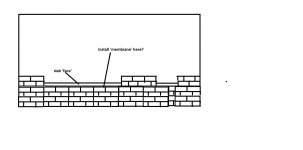
Inside the garage, from the top of the frost wall to the footing is a little over 5'. There are 2 courses of blocks that will be above grade.

I'm under the impression that I want to simply insulate the slab from the ground and the perimeter. So the 20" panels I have could be glued to the foundation wall, and they would be wide enough to be below the insulation panels under the floor effectively creating a 'bowl' for the slab to be in. Nowhere will the slab touch earth... the entire slab is insulated around the sides and underneath*

But there are some that tell me I should be insulation much lower along the foundation wall, maybe even all the way to the footing?

I'm not against doing this, but I don't understand why? Even if the ground freeze inside the garage below the slab, because the cold comes through the foundation wall... the slab is still insulated. So why insulate any lower?

*There is a part 2 question:
The slab is exposed to the elements in each door. When it's poured, the slab rest on the foundation wall in each door, so the 'side' of the slab will see the outdoors. I was told to use a fiber membrane (kind of like what separates sidewalk slab sections) between the slab and the foundation wall. Easy enough, but is that right?
Once the concrete apron is done, I can insulate between it and the slab, and just make a metal cap for the insulation (someone else on GJ did this). Until then, should I just bring the grade (gravel) to the slab?
 

Attachments

  • question.jpg
    question.jpg
    63.8 KB · Views: 102
  • face.jpg
    face.jpg
    63.4 KB · Views: 90
To avoid these ads, REGISTER NOW!

theoldwizard1

Well-known member
Joined
Feb 22, 2011
Messages
43,106
Location
SE MI
But there are some that tell me I should be insulation much lower along the foundation wall, maybe even all the way to the footing?
ABSOLUTELY !

You need to run foam board down the inside of the foundation wall, down to the frost line. I would even say that this insulation should be DOUBLE the thickness of what you are putting under the floor.

Even if the ground freeze inside the garage below the slab, because the cold comes through the foundation wall... the slab is still insulated. So why insulate any lower?
So just how much insulation are you planning under the slab ? Which would easier, insulating against 10°-15°C ground, or potential -20°C ground ?

I have seen pictures of a garage, in MN, that had no foundation insulation and the ground OUTSIDE of the garage for 1-2m NEVER FROZE !
 
OP
X

xrdad

Well-known member
Joined
Mar 14, 2011
Messages
487
Location
Ontario Canada
Thank wizard, but this is exactly my question:

"why would the ground under the slab be 10 degrees C?"

It's supposed to be insulated from the slab. In theory, the space above the floor should be the direction heat will go to. The ground could be -20C, as I have no intention of heating the ground... only the air above the slab.

I have R11 panels to go under the floor AND along the wall where the two panels will meet.


Again, not trying to be difficult.. I just don't understand how the heat is going into the earth using panels to "hold" the slab.
 
OP
X

xrdad

Well-known member
Joined
Mar 14, 2011
Messages
487
Location
Ontario Canada
ABSOLUTELY !

I have seen pictures of a garage, in MN, that had no foundation insulation and the ground OUTSIDE of the garage for 1-2m NEVER FROZE !


With no insulation, this is the expected result. Mine will be insulated from the wall and the ground.
 
OP
X

xrdad

Well-known member
Joined
Mar 14, 2011
Messages
487
Location
Ontario Canada
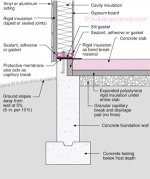
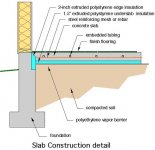
These images I 'borrowed' from the web may better explain what I'm trying to say?

Again, with insulation under the floor I don't understand the idea of insulating a frost wall to keep the earth under the insulated floor from freezing. I'm not sure that even insulating to the footing would keep the earth from freezing (if there is insulation under the floor) since there is no heat source on either side of the foundation wall. The only thing I can imagine is heat loss through the floor insulation, but geez... radiant heat should go up and in the shop air (easy) vs down through R11 insulation into the dirt (harder?).

All the while.... it's 50/50 what I'm being told is the "right" way.

Can someone settle this?
 

Attachments

  • BSCInfo_513_Figure_02.jpg
    BSCInfo_513_Figure_02.jpg
    33.1 KB · Views: 119
  • designing-for-high-performance-slab-on-grade-detail-part-i-enlarged-detail-41-1024x878.jpg
    designing-for-high-performance-slab-on-grade-detail-part-i-enlarged-detail-41-1024x878.jpg
    104.1 KB · Views: 107
  • services_heatedslab.jpg
    services_heatedslab.jpg
    47.9 KB · Views: 109
Last edited:

Chris705

Well-known member
Joined
Nov 1, 2012
Messages
834
Location
The Finger Lakes of NY
xrdad - I understand your question and I believe the answer is you don't have to insulate the foundation wall to the footing in your case (your bathtub offers all the thermal protection of your heated area that the slab needs).....However I would like to point out why you may want to consider it....if ground water is problem in the grade around your foundation then most likely it is also inside the foundation walls. Simply insulating the side walls to the footing depth alleviates the freezing of the soils within the foundation wall and prevents frost lifting/heaving/expanding within your foundation. The other reason is to simply help the underslab insulation work better. Heat flows to cold so the warmer the subgrade is/remains the less heat transfer you will have thru the slab to the soils below....if the soil below slab is exposed to the freezing temps of the foundation edge then you will lose more heat (that is relevant to the r-value of insulation board you install under slab). If you insulate the foundation wall down you keep the earths heat contained like and inverted bathtub...... Hope that helps!
 

Chris705

Well-known member
Joined
Nov 1, 2012
Messages
834
Location
The Finger Lakes of NY
Also your thoughts on the second question seem appropriate. I don't think you need expansion material here though if you are not pouring your apron right away. it sounds very similar to what I will be doing on my build.....concrete next week!!! And I insulated both underslab and foundation walls to my footing.....my OH doors will have the underslab insulation come right to slab edge, I will leave my form board in place and gravel up to it for the time being. When I pour my aprons I will replace the form board with rigid insulation and span that with a steel plate.
 

stingry

Well-known member
Joined
Oct 14, 2006
Messages
732
Location
Western Nebraska
I'm not against doing this, but I don't understand why? Even if the ground freeze inside the garage below the slab, because the cold comes through the foundation wall..


Before you decide how to insulate your slab you need to know a little more about thermodynamics (heat flow). First of all cold does not move. Cold is defined as the lack of heat. What you are trying to do is keep the heat produced by your radiant system and the earth confined and not lost to the surrounding atmosphere and soil. Even though you insulate under the slab, some heat will be lost thru the insulation by conduction, not radiation. Also the soil under your slab will receive heat from the earth under the slab. I don't know about where you are but here in Western Nebraska, the soil has a constant temp of 50 degrees or so 5 feet down. By effectively creating a "container" with insulation, your soil temp under the slab will approach the soil temp deeper in the earth. For this reason, the soil will not freeze under the slab and if for some reason your radiant heat system fails, the slab will not immediately freeze, assuming that you have a well insulated building.

I know this is contrary to what a lot of people on this forum preach but I have observed my own shop and believe this to be the way an insulated slab performs. Let me explain:

As I said before, I live in Western Nebraska and we have fairly cold winters. We are in zone 4b and a typical winter day will see highs in the 30's and 40's with lows in the teens or twenties with occasional lows well below zero. My shop is set up for radiant heat with loops in 5" concrete. I have 2" of EPS insulation under the floor and 2' down the sides of the footings. The shop is 3600 sq ft and is very well insulated, R25 walls and R40+ ceiling. I have not finished the floor heat system so last winter I had no heat. I do have a temperature probe located just under the slab. Last winter the temperature just under the slab was 49 degrees all winter!! I also monitored the air temperature and the interior of the building never got below 33 degrees, and that was during a time of subzero temps. The inside temperature varied according to the outside temps, sunshine and wind conditions. On sunny days, the inside temp would actually be warmer than the outside temp. At night, the inside temps would drop because the slab could not radiate enough heat to over come the losses from the building envelope.

Kind of long and rambling but I hope this helps

Cheers
Steve
 
OP
X

xrdad

Well-known member
Joined
Mar 14, 2011
Messages
487
Location
Ontario Canada
Thanks Chris!
So I'm not losing my marbles :)

In my area, the soil is like nothing you've ever seen. It's all sand. I hit clay around 5' deep. In all the digging (30x40' of footing 4' deep and 180' of trench for electricity 4' deep), I never hit one stone and it was nothing but sand.
In the 6 or so month here, I've never seen a puddle of water in any of the low spots. We had a wicked winter last year with lots of snow. Spring time revealed no standing water anywhere around. Water in my shop (or under it) is not an issue.

I wish you luck with your pour! Congrats on your build.
I will be pouring the floor next spring, after the ground has had time to settle completely. I will be flooding it next week, just in time to turn it into a skating arena! LOL!
Thanks for the advice on part 2 question. Exactly what I had in mind.
 
OP
X

xrdad

Well-known member
Joined
Mar 14, 2011
Messages
487
Location
Ontario Canada
I know this is contrary to what a lot of people on this forum preach
Cheers
Steve

Thank you Steve :beer:
This is what got me to post... I want to do it right, but I want to understand why also. The advice I got was from both sides, making it difficult to decide what to do.

I understand conductance, radiation and convection (I think).
It's why I felt that the slab would heat the cold air above the floor much easier than the ground under the insulation. Of course, there is heat loss through the insulation in the floor, but no more than through the walls, doors, ceiling, windows...

So now it's a question of where to draw the lines.
If the slab is in an insulation bowl (and not bubble wrap which is still being suggested!!:confused:), the "heat" will move to a 'colder' space, ideally the shop air.

The slab is being heated, and that heat is controlled by the thermostat in the shop area. As the shop comes up to temperature, the heat is "shut off". As long as the air is easier to heat than the ground, this should work. The insulation keeps the slab heat from moving into the ground (although some form of conductance is likely even through the insulation, right?). But radiation should move to the shop air, not the ground.

I'm near tempted to build a simulator and test the theory!
 

stingry

Well-known member
Joined
Oct 14, 2006
Messages
732
Location
Western Nebraska
You need to do some reading on radiant slab heating as I don't think that you fully understand the concept even though you say you do. Think of it this way: The slab is your heat source just as a hanging heater or some other device is. It is heated by circulating liquid and then "radiates" heat to the shop interior. It's just like standing next to a roaring fire in a fireplace. You can "feel" the heat radiating from the fire. This is exactly how the slab heats your shop although at lower temps. Radiant heat warms objects primarily but the air is also warmed by convection. That is why you can feel warm in a radiant heated space even though the air temp is lower than you would think comfortable. As for insulation: The cold air and soil outside is the enemy! You need to insulate the slab and the soil under the slab from the enemy, which wants to steal your heat.

Your first sketch in your first post would be an effective way to insulate although I would extend it farther down to keep heat from the warm soil under the slab from migrating to the colder soil outside the foundation. No need to build a simulator, this is proven technology.

Cheers
Steve
 

Steve in Mi

Well-known member
Joined
Mar 13, 2007
Messages
1,042
Location
Mid Michigan
This is how I insulated my foundation & floor in 1981 expecting to do in-floor-hot water heat but later decided to go with gas forced air. I'm extremely happy with the result (comfort & economy) and heat all Winter 24/7 at 63 to 65. 28' X 48' two story shop.
 

Attachments

  • Shop CD Exterior Wall & Foundation a.jpg
    Shop CD Exterior Wall & Foundation a.jpg
    102.5 KB · Views: 94

JCByrd24

Well-known member
Joined
Jul 21, 2005
Messages
493
Location
Bath, ME
A lot of good information here. Another vote for insulating the stem walls and the big reason why is $$. You don't need this to keep your building from heaving as it sounds like your building your footer down below the frost line. However, insulating along the stem walls will be more effective and save you more money in heating for money spent in insulation than the slab insulation. Heat transfer rate various with difference in temperature. The biggest difference in temperature is your warm slab edge and the cold air just above ground outside the building and the ground near that air. You want as much insulation as possible between the slab/stem wall and air for sure, at least 4" of foam to come close to what your regular walls are. I would carry this amount of insulation at least a foot below grade, and then perhaps reduce to 2" of foam. What this insulation will do is decrease the temperature differential of the slab and the ground below the slab substantially, significantly reducing the heat loss through the slab insulation. Now alternatively you might add more insulation underneath the slab, however I think this isn't as good for 2 reasons. 1) It's more expensive as the slab is likely more square footage to cover than the frost wall by a factor of about 2 to 1. 2) By insulating your frost wall you create the same bath tub effect you mentioned, only upside down, creating a cap and very effectively locking the ground heat in, end again, raising the ground temp and reducing the temperature differential that your slab insulation has to deal with. It also basically completely eliminates any chance of heaving due to freezing even if the building sits unheated as has been mentioned.
 
To avoid these ads, REGISTER NOW!

stingry

Well-known member
Joined
Oct 14, 2006
Messages
732
Location
Western Nebraska
A lot of good information here. Another vote for insulating the stem walls and the big reason why is $$. You don't need this to keep your building from heaving as it sounds like your building your footer down below the frost line. However, insulating along the stem walls will be more effective and save you more money in heating for money spent in insulation than the slab insulation. Heat transfer rate various with difference in temperature. The biggest difference in temperature is your warm slab edge and the cold air just above ground outside the building and the ground near that air. You want as much insulation as possible between the slab/stem wall and air for sure, at least 4" of foam to come close to what your regular walls are. I would carry this amount of insulation at least a foot below grade, and then perhaps reduce to 2" of foam. What this insulation will do is decrease the temperature differential of the slab and the ground below the slab substantially, significantly reducing the heat loss through the slab insulation. Now alternatively you might add more insulation underneath the slab, however I think this isn't as good for 2 reasons. 1) It's more expensive as the slab is likely more square footage to cover than the frost wall by a factor of about 2 to 1. 2) By insulating your frost wall you create the same bath tub effect you mentioned, only upside down, creating a cap and very effectively locking the ground heat in, end again, raising the ground temp and reducing the temperature differential that your slab insulation has to deal with. It also basically completely eliminates any chance of heaving due to freezing even if the building sits unheated as has been mentioned.

Well stated

Cheers
Steve
 

bzinsky

Well-known member
Joined
Oct 27, 2014
Messages
5,565
By insulating your frost wall you create the same bath tub effect you mentioned, only upside down, creating a cap and very effectively locking the ground heat in, end again, raising the ground temp and reducing the temperature differential that your slab insulation has to deal with. It also basically completely eliminates any chance of heaving due to freezing even if the building sits unheated as has been mentioned.

To back up your point, all you need to do is go to the grocery store. Usually the dairy isle has refrigerators that are completely open so you can reach in and grab something, even freezers sometimes. The only reason they work is because of the bath tub effect you're talking about. The cold air stays at the bottom, so you could effectively cut the top of you're refrigerator off and it would still function. I would assume heating is the same principal but upside down. It's also why attic insulation is so darn important.
 

bzinsky

Well-known member
Joined
Oct 27, 2014
Messages
5,565
Also recently I've been looking heavily into geothermal. Anyone who lives on a lake/pond has it made.

The temperature of the water like 10+ feet down is always warmer than the surface. I think around 40 degrees.

You can just pump water out of the lake, through your radiant heat slab, and then back out to the lake, this will keep your garage always above freezing, and then have an alternate heat source to heat it up when needed. Your alternate heat source will have a much easier time since the place is already semi-heated.

You could also use a heat pump to actually pull the heat out of the water to heat it year round, but then it starts getting complex.
 

BeachBoy

Well-known member
Joined
Dec 28, 2010
Messages
540
That's a really good point.

I am getting my garage/house built by a lake and because there is no well water I will have to get water from a bore hole that goes in 8ft deep water in the lake (very $$ because the hole is curved to exit in the lake bottom so it needs a remote controlled boring thingy)

The water at the bottom of a lake is never below (and mostly always at) 39F.

I never thought about using that as a geothermal system. 40F is good to keep from freezing but not sure how that would work to heat the slab.

I could use 39° water to keep the driveway above freezing though...
 

stingry

Well-known member
Joined
Oct 14, 2006
Messages
732
Location
Western Nebraska
Also recently I've been looking heavily into geothermal. Anyone who lives on a lake/pond has it made.

The temperature of the water like 10+ feet down is always warmer than the surface. I think around 40 degrees.

You can just pump water out of the lake, through your radiant heat slab, and then back out to the lake, this will keep your garage always above freezing
, and then have an alternate heat source to heat it up when needed. Your alternate heat source will have a much easier time since the place is already semi-heated.

You could also use a heat pump to actually pull the heat out of the water to heat it year round, but then it starts getting complex.

Actually circulating 40 degree water thru the slab would REMOVE heat from the slab in most cases. My slab stays at a fairly constant 45 - 50 degrees all winter due to the heat from the ground mass. Furthermore, a 40 degree slab cannot radiate enough heat to overcome large losses of heat from the building on very cold days. In other words, the building envelope is losing more heat than the slab can provide.

Cheers
Steve
 

bzinsky

Well-known member
Joined
Oct 27, 2014
Messages
5,565
Actually circulating 40 degree water thru the slab would REMOVE heat from the slab in most cases. My slab stays at a fairly constant 45 - 50 degrees all winter due to the heat from the ground mass. Furthermore, a 40 degree slab cannot radiate enough heat to overcome large losses of heat from the building on very cold days. In other words, the building envelope is losing more heat than the slab can provide.

Cheers
Steve

I'm not sure how in an unheated garage the slab could be 45-50 degrees when outside the garage the soil is frozen.

Why would the slab be warmer than the ground outside?
 

stingry

Well-known member
Joined
Oct 14, 2006
Messages
732
Location
Western Nebraska
I'm not sure how in an unheated garage the slab could be 45-50 degrees when outside the garage the soil is frozen.

Why would the slab be warmer than the ground outside?

Read my post #8 above. The soil under the slab is a tremendous source of heat. As long as the building above the slab is WELL INSULATED and the edges of the slab are insulated, the heat from the ground will keep the slab at a relatively constant temp, in my case 45-50 degrees. I know this sounds contrary to common thinking but this what I have observed in my shop. I have started taking daily temp measurements and will post them so anyone interested can see how a well-insulated building and slab reacts to cold temperatures.

Cheers
Steve
 

thedoc

Member
Joined
Feb 2, 2009
Messages
19
Location
Iowa
I heated my 28x40 shop with radiant heat. Footings poured 5 ft deep. Four foot walls poured on top of footing. Foundation stuck above ground about a foot. 2x6 stick built on top of walls. I cut 2 inch foam board insulation about a foot tall strips and place around perimeter. (12 in wide by 8 ft long) Also beveled the top at a 45 so the slab covered it up when floor was poured. So the side insulation went below floor insulation about 6 inches. Then I laid the floor insulation down and taped the seams. Then laid down 4x8 sheet hog panels and zip tied my pex to it. Rebar was laid every six ft and pinned to footings. Then poured the floor 4 inches thick.
I insulated walls with bat insulation and dry walled. Ceiling got blown in insulation about 16 inches deep.
Radiant made simple electric boiler system and walla!!
Keep it at 55 in the winter and bump it up when working out there. Only takes 30 min to raise temp 5 degrees.
Live in iowa.
 
To avoid these ads, REGISTER NOW!
Top Bottom