To avoid these ads, REGISTER NOW!

Radiant floor using existing oil furnace

rheger

Member
Joined
Jan 2, 2024
Messages
5
We have baseboard oil heat. It has 2 zones. One for 1st floor and 2nd for upstairs. We have run heat PEX to convert 1st floor to radiant floor heating. We have the PEX run with the metal fins to disperse heat more efficiently and most of it insulated (wanting to complete a pressure test first). So the plan now is to use the 1st zone heat to run the radiant system and leave the 2nd zone to run upstairs. The manifold has separate pressure and flow controls for each loop (3-180ftloops) and a valve to shut off flow to there whole thing. I imagine I will need a separate circulation pump to run things smoothly and possibly a separate expansion tank for safety. I need to turn just the 1 zone temp down obviously so where does that occur? Through a taco? Before the manifold I would guess? It's finally gotten cold here in CT and we have a garage under the house so the sooner I could get this up and running the better. Simplest solution appreciated;)
 
To avoid these ads, REGISTER NOW!

PoorUB

Well-known member
Joined
Mar 29, 2021
Messages
11,614
Location
Fargo, ND
The fin tube baseboard will use up to 180F water, except for the PEX running to it. Do you know the working temperature the PEX is rated for?

The floor heat will need much lower temp, maybe 120F

You will need a mixing valve, or some sort of mixing control to keep the floor heat at a lower temp. Taco and Tekmar has mixing controls, some use a mixing valve.

How you plumb it will depend on the equipment you use.
 

MongoTA

Well-known member
Joined
Mar 10, 2018
Messages
990
Location
CT
I can tell you about my system...

Old school boilers and baseboard heat need the water to be hot, generally in the 160-180F range. RFH need the water to be cooler. For my example, with hardwood floors throughout, my RFH feed is at about 118F and the RFH return is about 110F.

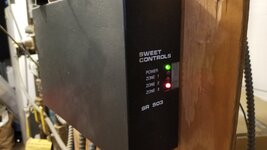
I have an oil boiler (Burnham/Beckett combo) for my whole house RFH and domestic hot water. Closed loop. For the RFH I used a Tekmar controller with a 4-way mixing valve. A thermocouple on each floor's RFH loop feed manifold and another on the loop return manifold will show the delta-T for each floor system. I have ten loops on my 1st floor and eight on my second floor. Each floor is serviced by it's own RFH manifold, each manifold by its own Taco circulating pump. The "on the wall" thermostats on each floor feed into the Tekmar box. The Tekmar box also feed a control box by Sweet Controls, it has relays to allow the signal from the low voltage t-stats to power the 120v Taco pumps.

If there is a demand for heat from the T-stat, the Tekmar controller signals the respective Taco pump to circulate. Once the water is circulating, if the RFH water temp (from the thermocouple) falls below its setpoint (say 118F) , the Tekmar can adjust the 4-way mixing valve so more 160F boiler water is added to 110F (roughly) water returning from the RFH manifold to raise the outgoing RFH water to 118F.

If the boiler's water gets too cool as a result, the boiler's own aquastat causes the burner to light, replenishing the boiler water back up to 160F.

So my temperature control for the RFH is after the boiler and before the manifold, and it's done with a 4-way mixing valve that is controlled by a Tekmar controller.

Each loop (10 loops on the 1st floor and 8 loops on the 2nd floor) on my manifold has an individual flow adjustment. So even though each loop is getting the same temp water, I can adjust the volume of water flowing through that loop to fine tune the temperatures in the rooms that those loops feed.

I set my system up when I built the house back in 1995. I've tweaked the loop flows just a couple of times over the years, once to fine tune the house as a whole, the other when my kids moved out and I choked their bedroom loops down.

The setup has been pretty much bulletproof through 25+ years of New England (also in CT) winters.

You may not NEED a controller like the Tekmar controller, there might be better ways to run a system today. But I think it'd be advantageous to have some sort of mixing valve to drop the water temp off the boiler from 160F down to a more RFH friendy temperature. A 4-way valve could do that, either automated or manual. Manual, you could monitor the system temperatures during the first winter and manually adjust the valve yourself to get to a Goldilocks setting where the outflow to your feed manifold is at 118F (or what you need). That single valve setting might be pretty good 80% of the time, maybe the water would run a little warm 10% of the time, and maybe a little cool 10% of the time.

There are other ways to do it, I'd venture with RFH being much more common today than back when I built my house that there are better or simpler ways. I installed my system before I had access to the informational wonders of the interweb.

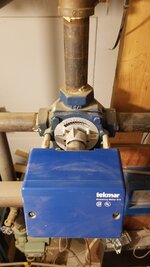
Edit to add photos. The blue box "bolted" to the front of the Tekmar 4-way mixing valve is a Tekmar motorized actuator. Without that the valve would be adjusted manually.

Not sure if any of this will help, but this is how I DIY'd my system back in 1995.

20240105_102850_resized.jpg

20240105_102903_resized.jpg

20240105_102930_resized.jpg
 
Last edited:
OP
R

rheger

Member
Joined
Jan 2, 2024
Messages
5
It's PEX b oxygen barrier rated from -47-230*F. I believe it will def be needed somewhere below 120F maybe somewhere around 100F. We will be able to adjust how fast they flow is to help control temp also but will need to separate the temps on the zones for sure. So as of now planning to splice into the first floor existing piping that used to service the fin radiators. So splice in and then mixing valve to circulating pump into manifold( I've seen them out the pump between the intake and output manifolds also) our loops are only 180 as opposed to the closer to 300 ft max so might be over kill with the pump but that should be adjustable as well?
 
OP
R

rheger

Member
Joined
Jan 2, 2024
Messages
5
I can tell you about my system...

Old school boilers and baseboard heat need the water to be hot, generally in the 160-180F range. RFH need the water to be cooler. For my example, with hardwood floors throughout, my RFH feed is at about 118F and the RFH return is about 110F.

I have an oil boiler (Burnham/Beckett combo) for my whole house RFH and domestic hot water. Closed loop. For the RFH I used a Tekmar controller with a 4-way mixing valve. A thermocouple on each floor's RFH loop feed manifold and another on the loop return manifold will show the delta-T for each floor system. I have ten loops on my 1st floor and eight on my second floor. Each floor is serviced by it's own RFH manifold, each manifold by its own Taco circulating pump. The "on the wall" thermostats on each floor feed into the Tekmar box.

If there is a demand for heat from the T-stat, the Tekmar controller signals the respective Taco pump to circulate. Once the water is circulating, if the RFH water temp (from the thermocouple) falls below its setpoint (say 120F) , the Tekmar can adjust the 4-way mixing valve so more 160F boiler water is added to 110F (roughly) water returning from the RFH manifold to raise the outgoing RFH water to 118F.

If the boiler's water gets too cool as a result, the boiler's own aquastat causes the burner to light, replenishing the boiler water back up to 160F.

So my temerature control for the RFH is after the boiler and before the manifold, and it's done with a 4-way mixing valve that is controlled by a Tekmar controller.

Each loop (10 loops on the 1st floor and 8 loops on the 2nd floor) on my manifold has an insidivual flow adjustment. So even though each loop is getting the same temp water, I can adjust the volume of water flowing through that loop to fine tune the temperatures in the rooms that those loops feed.

I set my system up when I built the house back in 1995. I've tweaked the loop flows just a couple of times over the years, once to fine tune the house as a whole, the other when my kids moved out and I choked their bedroom loops down.

The setup has been pretty much bulletproof through 25+ years of New England (also in CT) winters.

You may not NEED a controller like the Tekmar controller, there might be better ways to run a system today. But I think it'd be advantageous to have some sort of mixing valve to drop the water temp off the boiler from 160F down to a more RFH friendy temperature. A 4-way valve could do that, you can monitor the system during the first winter and manually adjust the valve yourself to get to a Goldilocks setting where the outflow to your feed manifold is at 120F. That valve setting might be pretty good 80% of the time, maybe the water would run a little warm 10% of the time, and maybe a little cool 10% of the time.

There are other ways to do it, I'd venture with RFH being much more common today that there are better or simpler ways.
Awesome reply sounds right on with what I'm trying to accomplish. It's the last little push to have the system up and running so I'm being super cautious to not mess up the boiler while it's 20F today. Thank you!
 

MongoTA

Well-known member
Joined
Mar 10, 2018
Messages
990
Location
CT
You're welcome!

Read up on "outdoor reset" as well. I have one in my system.

This will be a poor description, but it's an outdoor temperature sensor that helps modulate the RFH system and boiler as a whole to sort of lead turn the outdoor temperature. Example, yesterday it was 40F. Today it is 25F. The outdoor temp sensor KNOWS it is 25F, but your house is still "warm". The outdoor reset can modulate the heat curve to balance out heat demand highs and lows. I don't know if it's the right way to state it, but the outdoor reset sort of gives your heating system advance warning if more heat will be needed (outdoor temperature drop) or less heat will be needed (you were in a cold snap but the outdoor temperature has suddenly increased.
 

Sumboodie

Well-known member
Joined
Mar 20, 2021
Messages
10,647
Location
AK
I can tell you about my system...

Old school boilers and baseboard heat need the water to be hot, generally in the 160-180F range. RFH need the water to be cooler. For my example, with hardwood floors throughout, my RFH feed is at about 118F and the RFH return is about 110F.

I have an oil boiler (Burnham/Beckett combo) for my whole house RFH and domestic hot water. Closed loop. For the RFH I used a Tekmar controller with a 4-way mixing valve. A thermocouple on each floor's RFH loop feed manifold and another on the loop return manifold will show the delta-T for each floor system. I have ten loops on my 1st floor and eight on my second floor. Each floor is serviced by it's own RFH manifold, each manifold by its own Taco circulating pump. The "on the wall" thermostats on each floor feed into the Tekmar box. The Tekmar box also feed a control box by Sweet Controls, it has relays to allow the signal from the low voltage t-stats to power the 120v Taco pumps.

If there is a demand for heat from the T-stat, the Tekmar controller signals the respective Taco pump to circulate. Once the water is circulating, if the RFH water temp (from the thermocouple) falls below its setpoint (say 118F) , the Tekmar can adjust the 4-way mixing valve so more 160F boiler water is added to 110F (roughly) water returning from the RFH manifold to raise the outgoing RFH water to 118F.

If the boiler's water gets too cool as a result, the boiler's own aquastat causes the burner to light, replenishing the boiler water back up to 160F.

So my temperature control for the RFH is after the boiler and before the manifold, and it's done with a 4-way mixing valve that is controlled by a Tekmar controller.

Each loop (10 loops on the 1st floor and 8 loops on the 2nd floor) on my manifold has an individual flow adjustment. So even though each loop is getting the same temp water, I can adjust the volume of water flowing through that loop to fine tune the temperatures in the rooms that those loops feed.

I set my system up when I built the house back in 1995. I've tweaked the loop flows just a couple of times over the years, once to fine tune the house as a whole, the other when my kids moved out and I choked their bedroom loops down.

The setup has been pretty much bulletproof through 25+ years of New England (also in CT) winters.

You may not NEED a controller like the Tekmar controller, there might be better ways to run a system today. But I think it'd be advantageous to have some sort of mixing valve to drop the water temp off the boiler from 160F down to a more RFH friendy temperature. A 4-way valve could do that, either automated or manual. Manual, you could monitor the system temperatures during the first winter and manually adjust the valve yourself to get to a Goldilocks setting where the outflow to your feed manifold is at 118F (or what you need). That single valve setting might be pretty good 80% of the time, maybe the water would run a little warm 10% of the time, and maybe a little cool 10% of the time.

There are other ways to do it, I'd venture with RFH being much more common today than back when I built my house that there are better or simpler ways. I installed my system before I had access to the informational wonders of the interweb.

Edit to add photos. The blue box "bolted" to the front of the Tekmar 4-way mixing valve is a Tekmar motorized actuator. Without that the valve would be adjusted manually.

Not sure if any of this will help, but this is how I DIY'd my system back in 1995.
20240105_102850_resized.jpg

20240105_102903_resized.jpg

20240105_102930_resized.jpg
Pretty much same now, just with newer parts. Sweets Control looks like a std Taco zone controller.
 
To avoid these ads, REGISTER NOW!

HoosierBuddy

Well-known member
Joined
May 9, 2006
Messages
2,913
Location
Southern Indiana
I'm glad MongoTA was able to make his underfloor radiant work and good luck to the OP as well.

When I did my garage addition I put radiant in the floor and also used PEX loops under the floor above (bonus room) as zone 2 and PEX loops in the breezeway that we built to tie the new garage to the house.

The garage heat works great, but I found the loops under the subfloor in the bonus room and the breezeway to be marginal, leaning toward ineffective.

The metal plates that clip over the PEX and attach to the bottom of the subfloor, along with insulation definitely helped a lot. I was able to do that in the breezeway which is built over a crawlspace, but didn't want to have to take out the ceiling in the garage to do the same thing for the bonus room. Up there, I ended up installing a gas space heater on a separate thermostat. I set it 3 degrees below the T-stat for the bonus room zone. When it gets down to about 10 degrees F outside (or below) the heater needs to run some at times to keep the bonus room comfortable.

To finally make it all really work though, without having to push the underfloor radiant to high, I had to install a couple of hydronic heaters as well in breezeway. These are on the same loop as the underfloor radiant. They run off a t-stat that kicks on when hot water is being pumped through the zone. Once that flow stops, the water in the heaters quickly drops down and the heater shuts off.


Kaizen

Well-known member
Joined
Jan 9, 2015
Messages
6,936
Location
New England
I added pex in floor heat to my boiler. Kind of a down and dirty way to do it. I ran an open loop with a circulator not running through any of my zones......just off the end of the zone manifold on boiler. i put a mixing valve in that set up. so basically i run the cirulator 24/7 and it ***** in x amount of new hot water to keep the loop at the temp i manually set using shut off valves. I bought a real set up and one of these years i'll be installing it with each loop on its own zone etc etc.
fyi i found AFTER i pulled the baseboard that i'm always cold. just not transmitting enough heat through the floors as my baseboard had. then add a carpet and forget about it.
 
OP
R

rheger

Member
Joined
Jan 2, 2024
Messages
5
You're welcome!

Read up on "outdoor reset" as well. I have one in my system.

This will be a poor description, but it's an outdoor temperature sensor that helps modulate the RFH system and boiler as a whole to sort of lead turn the outdoor temperature. Example, yesterday it was 40F. Today it is 25F. The outdoor temp sensor KNOWS it is 25F, but your house is still "warm". The outdoor reset can modulate the heat curve to balance out heat demand highs and lows. I don't know if it's the right way to state it, but the outdoor reset sort of gives your heating system advance warning if more heat will be needed (outdoor temperature drop) or less heat will be needed (you were in a cold snap but the outdoor temperature has suddenly increased.
Yes I have heard of that in my research and forgotten about it. That is a good idea.
 
OP
R

rheger

Member
Joined
Jan 2, 2024
Messages
5
I'm glad MongoTA was able to make his underfloor radiant work and good luck to the OP as well.

When I did my garage addition I put radiant in the floor and also used PEX loops under the floor above (bonus room) as zone 2 and PEX loops in the breezeway that we built to tie the new garage to the house.

The garage heat works great, but I found the loops under the subfloor in the bonus room and the breezeway to be marginal, leaning toward ineffective.

The metal plates that clip over the PEX and attach to the bottom of the subfloor, along with insulation definitely helped a lot. I was able to do that in the breezeway which is built over a crawlspace, but didn't want to have to take out the ceiling in the garage to do the same thing for the bonus room. Up there, I ended up installing a gas space heater on a separate thermostat. I set it 3 degrees below the T-stat for the bonus room zone. When it gets down to about 10 degrees F outside (or below) the heater needs to run some at times to keep the bonus room comfortable.

To finally make it all really work though, without having to push the underfloor radiant to high, I had to install a couple of hydronic heaters as well in breezeway. These are on the same loop as the underfloor radiant. They run off a t-stat that kicks on when hot water is being pumped through the zone. Once that flow stops, the water in the heaters quickly drops down and the heater shuts off.

That is a great idea too,I have been seeing those pop up whole looking through stuff, my son's room in the walk out basement would be a good candidate for them. Thanks for the input
 

PoorUB

Well-known member
Joined
Mar 29, 2021
Messages
11,614
Location
Fargo, ND
IMO, outdoor reset is not as important with radiant floor as it is with fin tube baseboard. The floor gets heated and holds the heat. Granted a lower water temp will lower the chance of over shooting the room temp from heating the floor too fast, but keep in mind we are heating thousands of pounds of concrete. It doesn't warm up very fast.

With fin tube baseboard imagine matching the water temp to the heating load in the house so the water circulates at a lower temp and at a longer time. You will get more even heat instead of having the heat on, heat up quickly, then off again. Utopia would be to have the heat on at a lower constantly, but matching the heat loss in the building and never going over the set point.
 

doctordirt

Well-known member
Joined
May 15, 2014
Messages
492
Brain storming here with not much technical experience except owning a home with oil fired base board heat.
What if a heat exchanger was installed and out going temp set for your RFH say 118 degrees and your boiler water could still be 180 for base board heat. No mixing valves required.
 

PoorUB

Well-known member
Joined
Mar 29, 2021
Messages
11,614
Location
Fargo, ND
Brain storming here with not much technical experience except owning a home with oil fired base board heat.
What if a heat exchanger was installed and out going temp set for your RFH say 118 degrees and your boiler water could still be 180 for base board heat. No mixing valves required.
That can be done, but you still need a controller to regulate the water temperature. There is no dollar savings over any other method, plus now you have two hydronic systems, one more air eliminator and pressure tank. It probably is the most expensive way to go.
 

75gmck25

Well-known member
Joined
Jul 21, 2014
Messages
1,313
Location
Alexandria, VA
My system is a single zone with old cast iron radiators, but I've converted the connections to a PEX manifold with oxygen barrier PEX home runs from the basement up to each radiator. Due to the mass of the iron radiators my system is set to 100 degree minimum and 140 degrees maximum.

One reason I didn't consider using in-floor hydronic heat for an addition is that I wasn't comfortable with it getting more complex because I needed to drop the temp down for only that zone. I know all the components are out there and it's not really that hard to have two temp zones, but it was just easier to also use radiators in the addition. The new radiators don't have the same mass as the old cast iron, but seem to heat a room about the same. I just followed the manufacturer recommendations for room size and BTUs needed.
 
To avoid these ads, REGISTER NOW!
Top Bottom