To avoid these ads, REGISTER NOW!

Radiant foil barrier in ceiling joist question

giantsean

Well-known member
Joined
Dec 8, 2014
Messages
61
Location
CT Shore
Hi All,

Over the winter I insulated my now-heated garage (24" OC trusses) with R19 fluff. I was able to hit most of the ceiling except for two areas around my lift (Atlas PVL-10). One is the lift bay... bottom of my joists are only 11'2" and so the lift at lowest height sits in between two joists as you can see in below pic (I realize I have to drop that bar as well if I want it to work as a shutoff :D). The other is the light which sits inside the bay to stay clear of cars. There is storage space w/ a plywood floor up top but you can see there are gaps.

I rigged up some XPS to sit over the area... the one around the light is foamed in and sits a couple inches above the light.

I'm sure it's fine as is, but I'm debating running some radiant foil barrier the length of both open areas, tight to the foam/wood. I know it has very little insulating value but better than plywood, and it looks nicer than the current state too. I know RFB relies on an air gap but if I believe in my use case, the whole area from the floor to the foil is the air gap and at best it just bounces the heat downward, or at worst does nothing but looks better.

Anyone see any issues to this approach? Many thanks!
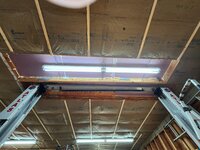
20240318_174104.jpg
 
Last edited:
To avoid these ads, REGISTER NOW!

C-S-H

Well-known member
Joined
Jan 18, 2024
Messages
145
If you install a vapor impermeable barrier on the inside of the layup, you will need to keep the building inside temperature warmer than the outside dew point in order to prevent condensation under some weather conditions. Use of a semi-permeable ceiling like drywall, plus a dehumidifier during the worst weather circumstances, tends to keep the ceiling assembly free from condensation and mold-free.

Reading through your post again it seems you are just considering the foil in the two blockout areas. That should work fine. The foil reflects radiant heat, and does not emit radiant heat. So it works winter and summer. Hopefully it is fireproof, too.
 
Last edited:
OP
G

giantsean

Well-known member
Joined
Dec 8, 2014
Messages
61
Location
CT Shore
If you install a vapor impermeable barrier on the inside of the layup, you will need to keep the building inside temperature warmer than the outside dew point in order to prevent condensation under some weather conditions. Use of a semi-permeable ceiling like drywall, plus a dehumidifier during the worst weather circumstances, tends to keep the ceiling assembly free from condensation and mold-free.

Reading through your post again it seems you are just considering the foil in the two blockout areas. That should work fine. The foil reflects radiant heat, and does not emit radiant heat. So it works winter and summer. Hopefully it is fireproof, too.
Thanks, and you are correct. My thought is that they are installed directly on garage doors without an air gap (presumably to radiate the heat back inward) so in theory I should be able to do the same in the joist bays.

Wasn't sure for the condensation comments whether you were referring to the XPS.. it is 2" thick and rates at R10... the garage is attached to the house so the downstairs should be able to stay warmer in the winter than the attic area, certainly will with heat. Winters in CT are fairly dry so I am hoping the overall risk of condensation is lower, and then only perhaps where you see plywood in the bays.

Thx for the reply!
 

C-S-H

Well-known member
Joined
Jan 18, 2024
Messages
145
I figured you had an exterior vented attic, so the condensation issue needs to be rethought. The foil works when facing the air and reflecting or not emitting radiant heat. If you put it up against a solid you are into conduction heat transfer on that side.
 
Last edited:
To avoid these ads, REGISTER NOW!
OP
G

giantsean

Well-known member
Joined
Dec 8, 2014
Messages
61
Location
CT Shore
I figured you had an exterior vented attic, so the condensation issue needs to be rethought. The foil works when facing the air and reflecting or not emitting radiant heat. If you put it up against a solid you are into conduction heat transfer on that side.
Thanks... still trying to visualize the issue. I would think risk would be warm moist air getting behind the foil and condensing on the top side of the foil which is up against the coldest surface (the wood or XPS). In that case not sure if an air gap between foil and ceiling is better or worse - better if it can dry faster, worse if more moist air gets behind it.
 

C-S-H

Well-known member
Joined
Jan 18, 2024
Messages
145
The foil should be installed airtight to the XPS. R10 should be enough to keep either side of the assembly from going below the dew points.

Installing the foil on the bottom of the plywood floor over the lift could be problematic whether installed airtight to the wood or not. I would let the plywood breathe to both sides unless you are going to put 2" XPS over that spot in the attic. There looks to be a thin piece of XPS over the lift on one side. Hmm...

Just think through the condensation scenarios. Warm moist spring air fills the attic, and the attic floor is cold like the garage below. Also, warm moist winter garage air wants to condense on the cold attic floor above. Also, hot moist summer air in the attic wants to condense on the garage air-conditioner-cooled attic floor. If you add a vapor impermeable layer in the ceiling assembly (XPS, foil), then you need to add enough vapor impermeable insulation to prevent condensation.
 
OP
G

giantsean

Well-known member
Joined
Dec 8, 2014
Messages
61
Location
CT Shore
The foil should be installed airtight to the XPS. R10 should be enough to keep either side of the assembly from going below the dew points.

Installing the foil on the bottom of the plywood floor over the lift could be problematic whether installed airtight to the wood or not. I would let the plywood breathe to both sides unless you are going to put 2" XPS over that spot in the attic. There looks to be a thin piece of XPS over the lift on one side. Hmm...

Just think through the condensation scenarios. Warm moist spring air fills the attic, and the attic floor is cold like the garage below. Also, warm moist winter garage air wants to condense on the cold attic floor above. Also, hot moist summer air in the attic wants to condense on the garage air-conditioner-cooled attic floor. If you add a vapor impermeable layer in the ceiling assembly (XPS, foil), then you need to add enough vapor impermeable insulation to prevent condensation.
Makes sense! Not sure how much XPS I could stuff over the lift, maybe 3/4" to 1" tops, and need to make it removeable so that the lift channel can be accessed if needed. The "thin piece" is actually the same 2" but sitting higher up. Same with sitting on the floor above... it's being used as storage so will be a little awkward. MIght be the best bet to just leave that section alone.
 
To avoid these ads, REGISTER NOW!
Top Bottom