To avoid these ads, REGISTER NOW!

Radiant Heat: Not enough GPM when really cold

shooon

Well-known member
Joined
Aug 30, 2016
Messages
68
Location
Dawson Creek, BC
When it get's really cold outside (-15 to -20 F) my system isn't flowing enough to fire the in floor heat. If I rig up a bypass loop between supply and return manifold the heater fires up, I can close the loop and it continues to run fine.

The heater has a 0.40 GPM activation flow with 0.26GPM min flow to maintain. I'm thinking the glycol is getting too thick to flow enough to meet the activation permissive. Everything works fine when its not brutally cold. Used a refractometer and I'm rocking a 52/48 propyelene mix so I dont think ill want to dilute anymore. 4 loop manifold with 200 - 220' loops of 1/2" pex pushed by a grundfos 15-58 on highest speed setting.

I have a probe in the slab right now and am trying to maintain the slab at 40 F until I get the ceiling fully insulated. I might just keep the slab at around 40 to 45 F and use my reznor heater when I want to work in there.

Just wondering how to address this issue. Had a couple ideas was wondering if someone had any better suggestions?

-Second pump in parallel or 1555 pump to boost gpm ?
-reverse acting thermostat loop between supply and return manifold: closes bypass when hot coolant (90 - 100 F) flows across it ?
-Zone control valve plumbed in as bypass loop on time delay timer: kicks off after 30 seconds of pump receiving power ?
 
To avoid these ads, REGISTER NOW!

Jackfre

Well-known member
Joined
Dec 26, 2010
Messages
4,417
Location
N CA
What is the manuf and model? Whose tankless water heater have you used to drive this?
 

Northislander

Well-known member
Joined
Dec 7, 2016
Messages
479
Location
Vancouver Island
Do you have a lowloss header between boiler and rfh manifold if not that would solve it still two pumps but putting two in series isnt going to solve the high resistance it might work but you will be replacing pumps periodically
 

finn

Well-known member
Joined
Mar 27, 2005
Messages
16,383
Location
The UP, God's country
It sounds like your bypass loop is akin to a primary /secondary loop which is a recommended configuration for radiant systems from what I've seen.

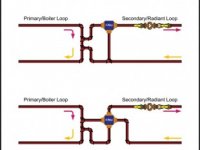
Install a close coupled tee configuration and a second pump. The primary loop is then just a racetrack between the boiler outlet and inlet. The manifold and floor loops have their own pump which draws and returns boiler water via the close coupled tees.
 

pstnbly

Well-known member
Joined
Jul 20, 2010
Messages
766
Location
So. Vermont
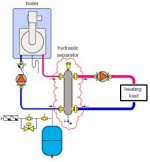
Is this a boiler or water heater. If it is a boiler look in the manual, as others have said you probably need a low loss header or primary loop. The manual should have the details for installing a primary loop. Other options are a hydraulic separator or buffer tank.
 

Northislander

Well-known member
Joined
Dec 7, 2016
Messages
479
Location
Vancouver Island
Attached is a page from the rheem on demand installation manual
Piping for Space Heaters
Local codes or plumbing authority requirements may vary from the instructions or diagrams provided in this manual and take precedence over these instructions� Combination Potable and Space Heating Application DANGERS: When this system requires water for space heating at elevated temperatures (above 125°F [52°C]), a mixing or tempering valve must be installed in the hot water supply line to the house in order to reduce the scald hazard potential. • Any piping or components used in the installation of this water heater in a combination potable and space heating application must be suitable for use with drinking water.
• If this water heater is installed in an application intended to supply domestic hot water needs and hot water for space heating purposes, do not connect the heater to an existing heating unit or components of a heating system that have previously been used with a nondrinking water system. Toxic chemicals such as those used for boiler treatment may be present and will contaminate the drinking water supply causing possible health risks. Never introduce toxic chemicals, such as those used for boiler treatment, into this system. • This water heater is not approved as the dedicated space heating unit. This water heater must be used for combination applications with air handler only and not for indoor heating applications.
Air Handler
As you can see the rheem as most on demands is not approved for dedicated space heating
primary reason is the high friction losses in the heat exchanger coupled with friction loss in the radiant floor and now the higher viscosity of the heating fluid in your install.
Its the same thing with a condensing boiler and that's why you need a low loss header, primary/secondary piping with closely spaced tees to decouple the heater from the friction loss in the floor
 
OP
S

shooon

Well-known member
Joined
Aug 30, 2016
Messages
68
Location
Dawson Creek, BC
Thanks for all the info!

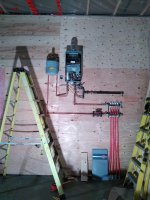
I've attached a picture of my setup- the bypass hose (not shown) is installed between the 2 stainless manifolds. I'm using a rheem tankless RTG-94DVLN.

No, it is not designed for in floor heating purposes. I do not have a low loss header and I will have to look into that. My only concern is recirculating glycol that's too warm back into the inlet (I don't think the tankless heaters heat ex changers are meant to handle the higher inlet temps)

I'm attempting to keep my system temp rise, inlet temp, and flow rates within spec to prolong life of the heater.. Guess that's one of the challenges of using something outside of it's intended purpose.

Edit:
I'm going to attempt to draw up plans the include a low loss header into the existing system and see if I can get this right.
 

Attachments

  • IMG_20161216_195629.jpg
    IMG_20161216_195629.jpg
    142.1 KB · Views: 77
Last edited:
To avoid these ads, REGISTER NOW!

pstnbly

Well-known member
Joined
Jul 20, 2010
Messages
766
Location
So. Vermont
No, it is not designed for in floor heating purposes.

There is your problem. Heating appliances are designed for space heating, water heaters are designed to create hot water for domestic water uses. We here should strive to use the proper tool for the job. I understand there is an upfront cost issue that make going this direction attractive, but in the long run there is no "free lunch".
 
OP
S

shooon

Well-known member
Joined
Aug 30, 2016
Messages
68
Location
Dawson Creek, BC
Been googling a lot. So a close couple T configuration is essentially a bridge between inlet and discharge of the heater?

And the low loss header, can it be installed as shown ?

Also pump is installed between exp tank and manifold, forgot to correct that.
 

Attachments

  • Radiant Heat Layout2.jpg
    Radiant Heat Layout2.jpg
    53.3 KB · Views: 50

98ssuck

Well-known member
Joined
Oct 21, 2012
Messages
349
Location
British columbia
You cannot install a low loss leader as you have drawn. I put a drawing below. Also with a low low header or closey spaced tees you need two pumps. One for the primary loop and one for the secondary.

Another issue with your drawing is that you are pressurizing your expansion tank with the pump. The expansion tank should be on the suction side of the pump.

Here is a drawing of how to plumb a low loss header.

 
Last edited:

mygarageone

Well-known member
Joined
Oct 16, 2013
Messages
2,691
Location
Munising , Mich
You could use a higher flow pump and a bypass . You will need to do a friction loss to size the pump properly.
Or as recommended , a low loss header with a pump and a seperate pump for floor.
 
To avoid these ads, REGISTER NOW!
Top Bottom