To avoid these ads, REGISTER NOW!

Radiant Heat Outlet and Return Temps

thoyer

Well-known member
Joined
Feb 26, 2007
Messages
80
Location
Warminster PA
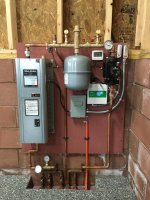
Trying to get a handle on my floor temp. Seems like the highest boiler out temp I can get with the pump on slow speed is around 80 degrees with a return temp around 72 degrees.

950 sq ft, three "zones" plumbed into one inlet and outlet at the panel. Each "zone is approx 250 ft long.

Electric boiler - seems like I should see higher boiler out temp then 80 degrees or so....

5" slab with 2" foam under. 7/8" Tubing spaced approx 15" tied to rebar. Temp sensor in the center of the slab

Tom
 
To avoid these ads, REGISTER NOW!

ambenz

Well-known member
Joined
Dec 12, 2010
Messages
4,236
Location
NW Chicago Suburbs
What is the BTU rating of your electric boiler?
Sounds like the boiler or the exchange of heat from the element is your issue.
The DAT should be higher...
 

engineer2

Well-known member
Joined
Dec 13, 2009
Messages
11,803
Location
Chicago burbs
If you know the GPM flow of your pump and the temperature differential you cans easily calculate BTUs you use to heat the floor. Compare that to your boiler BTU output and you can calculate what the system is capable of.

I think my indoor basement system is closer to 90F inlet temps.
 
OP
T

thoyer

Well-known member
Joined
Feb 26, 2007
Messages
80
Location
Warminster PA
Had same issue last winter. Contacted system designer and boiler manufacturer. Both in agreement that based on the current draw and calculated flow I should be seeing higher temps.

At that time we chalked it up to the building not being insulated at the time. Now it is 2x6 walls - R19 plus attic insulation.

If I adjust the valves - close them about half way - I can get the temp up into the low 90's. Tells me that the flow is still too fast even with pump on the lowest setting.

Thought of this last night - My installation boiler / pump plumbing is laid out a little different then what the system designer proposed due to location. I have three less 90 degree elbows then their layout called for. This could be the source of the increased flow.

So if the flow is too high can I throttle it back by adjusting the valves? There is a main valve where the water enters the floor then one on each of the three legs coming out of the floor. Better to throttle it at the inlet or outlet?

I'm going to touch base again with the system designer today but wanted some "real world users" input.

thanks,
Tom

i
 

tdkkart

Well-known member
Joined
Jun 17, 2006
Messages
6,887
Location
Eastern Iowa
Unless it's 75* outside, you should be getting WAY more than 8* drop through the floor. Slowing the flow will allow the boiler to add more heat and the floor to take it.
 

yeldogt

Well-known member
Joined
Jan 2, 2012
Messages
18,184
Unless it's 75* outside, you should be getting WAY more than 8* drop through the floor. Slowing the flow will allow the boiler to add more heat and the floor to take it.

actually the reverse occurs ..... faster flow cause more heat to flow from the boiler. Do you slow the water pump down if your car is overheating ?

With high flow the delta drops and you are taking more heat out ..... 20 delta is not a "rule" it's a formula parameter for setting up a system. All of mine work with much lower delta .. this lowers overall temp and saves on fuel.
 
Last edited:

yeldogt

Well-known member
Joined
Jan 2, 2012
Messages
18,184
What's the inside room temp?

What temp are you trying to hit?

A return temp of 72 with proper radiation should get you in the upper 60's

I would have done 1/2 tubing at 12" as a min ....

Do you know the floor temp in the middle of the space between the tubes?

Is the boiler always "On" ?
 

yeldogt

Well-known member
Joined
Jan 2, 2012
Messages
18,184
You not on another thread the use of a mini .... that's going to throw it all off depending on controls.

Also -- the mini will be more cost efficient vs the floor using electric .... the COP of the mini could be 3 or 4x the boiler
 
OP
T

thoyer

Well-known member
Joined
Feb 26, 2007
Messages
80
Location
Warminster PA
What's the inside room temp?

What temp are you trying to hit?

A return temp of 72 with proper radiation should get you in the upper 60's

I would have done 1/2 tubing at 12" as a min ....

Do you know the floor temp in the middle of the space between the tubes?

Is the boiler always "On" ?

What I would like to have is the floor around 60 degrees - which I can obtain the way the system is currently running. As you note, I also have a mini so I use that to supplement the heat when I'm working in the garage.

My concern is that the boiler does not seem to output "hot" water which leads to longer run times to keep the floor warm which leads to higher electric bill. My thought was if I can get the outlet temp up close to 100 deg then the "on" time of the boiler would reduce.

Using a thermal gun and also backed up with a thermocouple measurement, the floor is heated pretty evenly with maybe a 1 degree delta between tubing locations in the center of the floor. I'll check this again in more detail over the weekend - Time to get methodical - the engineer in me coming out.

My thought right now is that the flow is too fast even with the pump on the slow setting. If I remember correctly we calculated about a 5.8 gpm flow last year when I went through this with the boiler mfg and the system designer.

I'm going to rerun those tests again to confirm the calculated flow rate.

I have an ammeter on the boiler supply lines and it is pulling max current so it never hits it's internal setpoint (I believe I have it set to 114 deg F) to start modulating the heating elements. Again - in my mind - pointing to too much flow, the water is not staying in the boiler long enough to allow the elements to get hot.

Maybe my understanding is flawed....... Wouldn't be the first time!

The boiler does turn off when the floor hits the setpoint temp. Temp sensor is in the middle of the floor.

For this week I have set the floor to 50 deg and am running the mini at 60 unless I'm out there and then I bump it to 70.

thanks for the input
Tom
 
OP
T

thoyer

Well-known member
Joined
Feb 26, 2007
Messages
80
Location
Warminster PA
You not on another thread the use of a mini .... that's going to throw it all off depending on controls.

Also -- the mini will be more cost efficient vs the floor using electric .... the COP of the mini could be 3 or 4x the boiler

I have nat gas at the house but township said no to running gas to garage when we were getting the variances so I went with electric for the boiler.
 

theoldwizard1

Well-known member
Joined
Feb 22, 2011
Messages
43,179
Location
SE MI
Seems like the highest boiler out temp I can get with the pump on slow speed is around 80 degrees with a return temp around 72 degrees.

I want to give you credit for installing the proper equipment to actually obtain this information ! Without it, you are just shooting in the dark !!
 

yeldogt

Well-known member
Joined
Jan 2, 2012
Messages
18,184
I have nat gas at the house but township said no to running gas to garage when we were getting the variances so I went with electric for the boiler.

In PA ...really .... why? Did they give you a reason?
 

yeldogt

Well-known member
Joined
Jan 2, 2012
Messages
18,184
What I would like to have is the floor around 60 degrees - which I can obtain the way the system is currently running. As you note, I also have a mini so I use that to supplement the heat when I'm working in the garage.

My concern is that the boiler does not seem to output "hot" water which leads to longer run times to keep the floor warm which leads to higher electric bill. My thought was if I can get the outlet temp up close to 100 deg then the "on" time of the boiler would reduce.

Using a thermal gun and also backed up with a thermocouple measurement, the floor is heated pretty evenly with maybe a 1 degree delta between tubing locations in the center of the floor. I'll check this again in more detail over the weekend - Time to get methodical - the engineer in me coming out.

My thought right now is that the flow is too fast even with the pump on the slow setting. If I remember correctly we calculated about a 5.8 gpm flow last year when I went through this with the boiler mfg and the system designer.

I'm going to rerun those tests again to confirm the calculated flow rate.

I have an ammeter on the boiler supply lines and it is pulling max current so it never hits it's internal setpoint (I believe I have it set to 114 deg F) to start modulating the heating elements. Again - in my mind - pointing to too much flow, the water is not staying in the boiler long enough to allow the elements to get hot.

Maybe my understanding is flawed....... Wouldn't be the first time!

The boiler does turn off when the floor hits the setpoint temp. Temp sensor is in the middle of the floor.

For this week I have set the floor to 50 deg and am running the mini at 60 unless I'm out there and then I bump it to 70.

thanks for the input
Tom

BTU's are BTU's .... the time it needs to run is the time it needs to run. Getting higher temps at the boiler .. are not going to the floor.
 
OP
T

thoyer

Well-known member
Joined
Feb 26, 2007
Messages
80
Location
Warminster PA
BTU's are BTU's .... the time it needs to run is the time it needs to run. Getting higher temps at the boiler .. are not going to the floor.

I need to educate myself more.......... (Electrical Engineering background, not thermodynamics........)

Say slab is at 55 and I want to get to 60, a 5 degree rise. If I pump in 80 degree water it will take "X" amount of time to increase the slab by 5 degrees.

If I pump in 100 degree water wouldn't that decrease the amount of time it takes to get that 5 degree rise?

Both scenarios assume that the boiler is running full tilt at 36ish amps or 9kW

Electro Industries EMB-H-9 boiler 31k BTU

Tom
 

yeldogt

Well-known member
Joined
Jan 2, 2012
Messages
18,184
I need to educate myself more.......... (Electrical Engineering background, not thermodynamics........)

Say slab is at 55 and I want to get to 60, a 5 degree rise. If I pump in 80 degree water it will take "X" amount of time to increase the slab by 5 degrees.

If I pump in 100 degree water wouldn't that decrease the amount of time it takes to get that 5 degree rise?

Both scenarios assume that the boiler is running full tilt at 36ish amps or 9kW

Electro Industries EMB-H-9 boiler 31k BTU

Tom


It's all about the BTU output of the boiler .... The water is just transferring the heat. If you cut down the flow and raise the temp of the water ... nothing changes ... the slab is getting the same BTU's. In your case the return will drop and the temp will drop again. I'm assuming the boiler is static -- one output.

even with different outputs it's the same ... then it depends on outdoor temp.

You want enough flow to fully heat the slab .... that's why delta is different with radiant. With a radiator -- this is higher temp water giving up heat in a different way.

With a floor you want the temp at the end to come close to the beginning .. unless you have made provisions for that lower heat output.


XXXX -- I'm really surprised about the gas line .... is that in the township code or was this something said in passing? I would have fought that ... good job for John VanLuvanee
 

engineer2

Well-known member
Joined
Dec 13, 2009
Messages
11,803
Location
Chicago burbs
I'm really surprised about the gas line ...
They might be worried about fire safety. An ignition source inside a garage from a gas flame + leaky or spilled jug of gasoline. What could go wrong?

Around here it seems like it's more common for structure fires to start in the garage. Perhaps some of the GJ firemen know more about this.
 
To avoid these ads, REGISTER NOW!
OP
T

thoyer

Well-known member
Joined
Feb 26, 2007
Messages
80
Location
Warminster PA
XXXX -- I'm really surprised about the gas line .... is that in the township code or was this something said in passing? I would have fought that ... good job for John VanLuvanee

Ok on the BTU stuff - I'm going to experiment over the next few days. Outdoor temps are not going to fluctuate much over the next 5 days or so.

I had to get a variance for the "accessory building" as the township only allows up to 500 sq ft for this type of structure. Since it was presented as a garage and was over 1k sq ft they started throwing restrictions on it so I could not turn it into an apartment. They were not too thrilled on granting the variance in the first place so my architect and I didn't want to give them ammunition to turn it down and drag it out further.

Took a little over two years from planning to getting my "occupancy permit" on the finished building.

I wanted a concrete pad out front - nope - too much "disturbed earth" need to install storm water management if I go over 1k sq ft. Another expense I didn't want to incur.

What about a crushed stone driveway - nope, they consider crushed stone impervious in my township. Different Township right across the street doesn't care....

If I was able to tie the garage to the house all of this would become moot as it would no longer be considered and accessory building and would be an addition to the house. Driveway, gas, over 1k sq ft - all good. Problem is the way my lot is situated there is no way I could get it attached to the house - needed to go in the yard.

Either way, I'm a happy camper. Been on this property since 1991 and when I moved in I said one day I was going to build a garage. Well, two kids and college and 30 years later I finally got it done.

Just tweaking things now - like the heat.

Thanks for the help.

Tom
 

Lonnies Performance

Well-known member
Joined
Aug 20, 2017
Messages
267
Location
Pittsburgh, PA
Concrete gives off approx 2 btu/square foot per degree of temperature....
Meaning a 50deg room with a 60deg floor (10 deg delta) at 1,000sf = 20,000 btu energy output.

In your case your floor (950 sq ft) needs to be 16.3 deg warmer than the room to give off 31,000 BTU.

Also 1 yard of concrete takes approx 718 btu of energy to raise its temp 1 degree.
This assumes no heat is lost to the ground.

You have about 14.6 yds of concrete which means you can raise the floor temp about 3 deg/hr minus what is lost to the room.

Take yards of concrete in your floor & figure the energy to raise it + the amount of loss to the air & you can determine the rate the boiler (in hours) can raise the floor temp.

Now if you know the flow in your system.... (do you have flow indicating circuit setters on the loops?) you can calculate the boiler temp rise.

Formula for boiler heating the water...
500 x GPM x temperature rise = BTU

Your boiler is 31K BTU so it should be able to produce an 8 deg rise while flowing 7.75 gpm. Looks like you have way too much flow.

Irregardless, you are putting the same energy into the floor if you send it half the flow & get twice the temperature drop.

You should verify your loop flows, as I would guess each loop should be set to flow about 1.2-1.5 gpm. At 1.5 gpm x 3 loops, you should see approximately a 14 deg drop across the boiler.

FYI... my system is on its lowest setpoint of 85 deg & has no problem keeping the building at temp. I see a 13 deg drop, supply to return & my floor is about 4 deg above the room temp on a 25-30 deg day.
 
Last edited:
OP
T

thoyer

Well-known member
Joined
Feb 26, 2007
Messages
80
Location
Warminster PA
Concrete gives off approx 2 btu/square foot per degree of temperature....
Meaning a 50deg room with a 60deg floor (10 deg delta) at 1,000sf = 20,000 btu energy output.

In your case your floor (950 sq ft) needs to be 16.3 deg warmer than the room to give off 31,000 BTU.

Also 1 yard of concrete takes approx 718 btu of energy to raise its temp 1 degree.
This assumes no heat is lost to the ground.

You have about 14.6 yds of concrete which means you can raise the floor temp about 3 deg/hr minus what is lost to the room.

Take yards of concrete in your floor & figure the energy to raise it + the amount of loss to the air & you can determine the rate the boiler (in hours) can raise the floor temp.

Now if you know the flow in your system.... (do you have flow indicating circuit setters on the loops?) you can calculate the boiler temp rise.

Formula for boiler heating the water...
500 x GPM x temperature rise = BTU

Your boiler is 31K BTU so it should be able to produce an 8 deg rise while flowing 7.75 gpm. Looks like you have way too much flow.

Irregardless, you are putting the same energy into the floor if you send it half the flow & get twice the temperature drop.

You should verify your loop flows, as I would guess each loop should be set to flow about 1.2-1.5 gpm. At 1.5 gpm x 3 loops, you should see approximately a 14 deg drop across the boiler.

Great info - thank you.

I have no flow meter in the system - perhaps I should install one but I'm not too thrilled having to open the system up, purge it and repressurize it at this point in the winter. A project for the summer when I can drag the hose from the house to the garage definitely!

For now I'll rely on the calculation method for the flow. I'll get some detailed temp reading over the next few days.

Tom
 

yeldogt

Well-known member
Joined
Jan 2, 2012
Messages
18,184
Ok on the BTU stuff - I'm going to experiment over the next few days. Outdoor temps are not going to fluctuate much over the next 5 days or so.

I had to get a variance for the "accessory building" as the township only allows up to 500 sq ft for this type of structure. Since it was presented as a garage and was over 1k sq ft they started throwing restrictions on it so I could not turn it into an apartment. They were not too thrilled on granting the variance in the first place so my architect and I didn't want to give them ammunition to turn it down and drag it out further.

Took a little over two years from planning to getting my "occupancy permit" on the finished building.

I wanted a concrete pad out front - nope - too much "disturbed earth" need to install storm water management if I go over 1k sq ft. Another expense I didn't want to incur.

What about a crushed stone driveway - nope, they consider crushed stone impervious in my township. Different Township right across the street doesn't care....

If I was able to tie the garage to the house all of this would become moot as it would no longer be considered and accessory building and would be an addition to the house. Driveway, gas, over 1k sq ft - all good. Problem is the way my lot is situated there is no way I could get it attached to the house - needed to go in the yard.

Either way, I'm a happy camper. Been on this property since 1991 and when I moved in I said one day I was going to build a garage. Well, two kids and college and 30 years later I finally got it done.

Just tweaking things now - like the heat.

Thanks for the help.

Tom

Buckingham would have wanted sprinklers ...!!!

My weekend place is around 1/2 hour north of you ... that 1k soil limit is a real pain.

It really boils down to the building need and the boiler output.

In the old days with all cast iron boilers --- the boilers needed a minimum return temp of at least 140. You could not send cold water back to the boiler -- if you did this would cool the flue and cause condensation or .... even thermal shock to the boiler (crack the heat exchanger). The solution was to design the big cast radiators with the output in that 20 delta range --- at 170 degrees .. 150 back to the boiler allowed some safety.

With fintube after WWII the boiler temps kept going up .... if you are an installer and trying to save money you install less fintube and more basic copper pipe .... Raise the boiler temp to 200 or more. This allows the shorter length of fin to supply the same BTU's to the rooms. It costs the homeowner more money for the next 50 years to run.

With radiant -- it all goes out the window. Years ago the germans came up with special Cast Iron designs that allowed lower temp return without any problems ... I have one running for the past 25+ years in NJ. The germans often did combinations -- floor and wall panel units. Sort of what you have with the mini-split -- they lower the floor and control the upper limit with the panels. This allows faster response and more set back. It's also more expensive to build .... in Germany with high fuel coast -- important.

The goal with radiant in the slab -- even heat all through the slab. The only way to do this is to pump fast enough and provide enough heat to have the water came back close to the temp it went out ... it's common to have around a 5. But less is very possible ..and the lower the water temp needed the less delta you want. In a very well insulated building the floor temp needed drops so low that the delta has to fall to almost zero.

Since you are using an electric boiler and it can be piped direct -- you are not seeing the BTU production the same way as when doing a primary/ secondary loop. There you would be making hot water in a tight loop around the boiler -- But with the correct flow to the floor it would still drop everything down
 
Last edited:

Firebrick43

Well-known member
Joined
May 12, 2015
Messages
14,062
Location
West central Indiana
I need to educate myself more.......... (Electrical Engineering background, not thermodynamics........)

Say slab is at 55 and I want to get to 60, a 5 degree rise. If I pump in 80 degree water it will take "X" amount of time to increase the slab by 5 degrees.

If I pump in 100 degree water wouldn't that decrease the amount of time it takes to get that 5 degree rise?

Both scenarios assume that the boiler is running full tilt at 36ish amps or 9kW

Electro Industries EMB-H-9 boiler 31k BTU

Tom

From this post I would assume your trying to quickly raise the temp of the slab??

The huge mass of the slab means you set the temp and leave it! I have 3 times the Btu capacity and it takes 3 days to bring it up to temp in the mild fall weather. In the could I would even max out the btu capacity of my boiler. On the other hand I was doing some tile work and wanted it a little cooler a couple of weeks ago and turned off the system for the day, Three days later i noticed it a little chilly and realized that it was still off and had fallen 10 degrees over 3 days in 30 degree weather.
 
OP
T

thoyer

Well-known member
Joined
Feb 26, 2007
Messages
80
Location
Warminster PA
From this post I would assume your trying to quickly raise the temp of the slab??

The huge mass of the slab means you set the temp and leave it! I have 3 times the Btu capacity and it takes 3 days to bring it up to temp in the mild fall weather. In the could I would even max out the btu capacity of my boiler. On the other hand I was doing some tile work and wanted it a little cooler a couple of weeks ago and turned off the system for the day, Three days later i noticed it a little chilly and realized that it was still off and had fallen 10 degrees over 3 days in 30 degree weather.

Nope.

I understand the thermal mass and thermal lag issues. My concern is not raising the floor temp quickly, but the time the boiler is running to maintain the floor temp.

My though process - turning out to be ill conceived - was if the water flow was slowed down it would allow the boiler to heat the water to a higher temp thus putting "hotter" water into the slab. since the slab would have say 100 degree water going in vs 80 degree water it would "warm" quicker thus reducing the run time on the boiler which ultimately would reduce my electric bill.

I'm learning through this thread that my thinking is somewhat flawed...
 

yeldogt

Well-known member
Joined
Jan 2, 2012
Messages
18,184
Nope.

I understand the thermal mass and thermal lag issues. My concern is not raising the floor temp quickly, but the time the boiler is running to maintain the floor temp.

My though process - turning out to be ill conceived - was if the water flow was slowed down it would allow the boiler to heat the water to a higher temp thus putting "hotter" water into the slab. since the slab would have say 100 degree water going in vs 80 degree water it would "warm" quicker thus reducing the run time on the boiler which ultimately would reduce my electric bill.

I'm learning through this thread that my thinking is somewhat flawed...


Saying it another way ... doing what you say above will heat that first section of the slab to a higher temp .... but, the temp will fall as it goes through the pipe. and the return will be colder ... so they whole thing will even out in no time. If the boiler is never off ... you are getting the max out of it.

Since you have the load -- you should be able to factor the BTU to the building and see if they match up.
 
OP
T

thoyer

Well-known member
Joined
Feb 26, 2007
Messages
80
Location
Warminster PA
Saying it another way ... doing what you say above will heat that first section of the slab to a higher temp .... but, the temp will fall as it goes through the pipe. and the return will be colder ... so they whole thing will even out in no time. If the boiler is never off ... you are getting the max out of it.

Since you have the load -- you should be able to factor the BTU to the building and see if they match up.

Just some quick numbers from this evening.

When I got home from work the floor set point was at 50. Floor was at 52 deg, outlet was at 55 and return at 48 (approx)

I raised the setpoint to 60 deg at 5:10pm.

Checked it at 7:30pm and the outlet temp was 80, return was 68 and floor is 54.5

I then adjusted the return valves to reduce the flow. This raised the outlet temp to approx 92 and after about 30 min running this way the return temp was about 62.

Am I headed the right direction by throttling back the return valves - gives me a bigger delta saying the floor is absorbing the heat better?

I returned the setpoint to 55 for the evening but left the valves in their "adjusted" position.

Right now My brain is done thinking for the day - so I'll crunch some numbers tomorrow.

Again, thanks for the help!

Tom
 

Firebrick43

Well-known member
Joined
May 12, 2015
Messages
14,062
Location
West central Indiana
Just some quick numbers from this evening.

When I got home from work the floor set point was at 50. Floor was at 52 deg, outlet was at 55 and return at 48 (approx)

I raised the setpoint to 60 deg at 5:10pm.

Checked it at 7:30pm and the outlet temp was 80, return was 68 and floor is 54.5

I then adjusted the return valves to reduce the flow. This raised the outlet temp to approx 92 and after about 30 min running this way the return temp was about 62.

Am I headed the right direction by throttling back the return valves - gives me a bigger delta saying the floor is absorbing the heat better?

I returned the setpoint to 55 for the evening but left the valves in their "adjusted" position.

Right now My brain is done thinking for the day - so I'll crunch some numbers tomorrow.

Again, thanks for the help!

Tom

Almost all equipment involved with thermodynamic principals works best if it runs continuously at an even load. Unfortunately most equipment it has to be oversized to a degree to handle extremes. But your thinking about delta t being higher is better is not so. A 5 degree delta t is much better for equipment life than a 30 degree delta t.

Also with electric heat you will not save any money either way. It’s 100 percent efficient at the source, just not the generating or transmission. I guarantee you you can not make the heater itself any more efficient.

Shutting down the return valve adds resistance and therefore higher load/ electricity usage. It adds up over time and will cost possibly even hundreds of dollars of extra electricity over the life of the system.

If you want to improve electric usage improve the building envelope with additional insulation and air sealing.
 

Lonnies Performance

Well-known member
Joined
Aug 20, 2017
Messages
267
Location
Pittsburgh, PA
The floor is not absorbing heat better, you are still putting the same amount of energy into it.

Half the flow at twice the delta is the same BTU output.
Without flow numbers you are just guessing.

The way to check the boiler output is to set the output temp higher (say 120deg) so it goes full output & cannot achieve it. Let it run for 15 minutes & compare supply vs return. Use the calcs I showed you & figure the flow.

Adjust flow with the balance valves full open at first & change pump speed.
If flow is still too high, then slightly close the balance valves.

Too high of a delta (like 30 deg) & the corresponding low flow only promotes an uneven floor temperature & potential temperature overshoot.

If 1 part is 90, another part is 60..... the average is 75.
If you do the same with 80 deg supply & 70 return the average water temp is still 75.

Adjust it for about 15 deg delta & don't worry about the supply temp unless the boiler never shuts off & the room is never satisfied... then the boiler temp setpoint needs raised.
Run it as low as possible.

The longer the system runs the higher the water temp will be. Once the boiler hits it's setpoint it throttles back & runs till the room is satisfied.
 
Last edited:

yeldogt

Well-known member
Joined
Jan 2, 2012
Messages
18,184
Just some quick numbers from this evening.

When I got home from work the floor set point was at 50. Floor was at 52 deg, outlet was at 55 and return at 48 (approx)

I raised the setpoint to 60 deg at 5:10pm.

Checked it at 7:30pm and the outlet temp was 80, return was 68 and floor is 54.5

I then adjusted the return valves to reduce the flow. This raised the outlet temp to approx 92 and after about 30 min running this way the return temp was about 62.

Am I headed the right direction by throttling back the return valves - gives me a bigger delta saying the floor is absorbing the heat better?

I returned the setpoint to 55 for the evening but left the valves in their "adjusted" position.

Right now My brain is done thinking for the day - so I'll crunch some numbers tomorrow.

Again, thanks for the help!

Tom

Think like water ...... or your car. If your car is running and you clog the water pump outlet .... is the engine making more heat? Or does it just get hotter because the flow is lower ? What happens to the radiator .... is it getting hotter or colder ? It's getting colder ....

release the water and the radiator gets hotter for a moment ..

Your floor is the same


I have a modulating gas boiler .... with constant circulation the pump and boiler never shut off. With modulation the boiler runs to match the load and the floor delta drops and drops. A delta close to zero occurs when you have a well insulated building and plenty of tubing. My systems can't run even at a 10 delta the input temp is too high.

Does your boiler have more than one output level?
 
OP
T

thoyer

Well-known member
Joined
Feb 26, 2007
Messages
80
Location
Warminster PA
Think like water ...... or your car. If your car is running and you clog the water pump outlet .... is the engine making more heat? Or does it just get hotter because the flow is lower ? What happens to the radiator .... is it getting hotter or colder ? It's getting colder ....

release the water and the radiator gets hotter for a moment ..

Your floor is the same


I have a modulating gas boiler .... with constant circulation the pump and boiler never shut off. With modulation the boiler runs to match the load and the floor delta drops and drops. A delta close to zero occurs when you have a well insulated building and plenty of tubing. My systems can't run even at a 10 delta the input temp is too high.

Does your boiler have more than one output level?

Between you and Lonnie - the light bulb is starting to go off..... Car analogy helped!

The boiler is an Electro Industries EMB-H-9. There are several temp setpoints on it. I have it set to 114 deg which it never gets close to. Lowest is 90 deg.
 
OP
T

thoyer

Well-known member
Joined
Feb 26, 2007
Messages
80
Location
Warminster PA
Some numbers from today.

At 10:50 AM I adjusted the floor setpoint from 55 to 60. At this time the system was "off" and the floor was at 56.3. Outlet temp was 61 and inlet 54.5.

At 1:50, 3 hours later, the floor had reached 61.1 and just shut off as the setpoint was reached. Outlet temp was 82 and inlet temp 69.

I then decided to bump it up two more degrees.

Started there at 2pm with the floor temp at 61.1.

At 2:30 it had reached setpoint and shut off at 63.1. The outlet temp was 85 and inlet 72.

I checked the floor temp (sensor temp reading) approx every hour after shut off to see how the slab cooled. So at 2:30 the slab temp was 63.1. Last reading was at 8pm and temp was 63.3. So slab is holding temp pretty well.

I also have a thermocouple taped to the floor approx above where the temp sensor is and at 8pm it read 62.4

Outside air was between 29 and 31 during these tests.
Garage ambient air was around 63 - mini split set to 60 deg for these tests.

This is with the three circuit valves full open and the pump on slow

If I use Lonnie's equation and solve for flow using 31k btu and a temp delta of 13, the flow comes out to approx 4.7gpm. Assuming I can manipulate that equation and use the rated boiler btu then solve for GPM.

So that's where things stand as of today.

Thanks for reading
Tom
 

Lonnies Performance

Well-known member
Joined
Aug 20, 2017
Messages
267
Location
Pittsburgh, PA
Now set your boiler to 90 deg & leave it alone.

If the room meets setpoint you are good to go.

Also remember to turn your mini splits off if you do not need them.

They operate in a setback mode if the room is over setpoint, which just circulates air.
This is bad, (as are ceiling fans) as it blows cold air across the floor.
 
To avoid these ads, REGISTER NOW!
Top Bottom