To avoid these ads, REGISTER NOW!

Radiant heat/Pre pour questions

rosshurlow1

Active member
Joined
Mar 20, 2019
Messages
25
Location
Clinton, IN
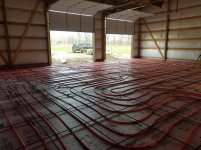
So I've been slowly building this barn back home in indiana. Never done radiant heat before, but Im slowly learning.
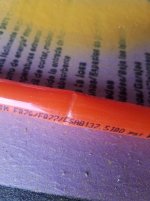
1. I cinked a pex pipe when I was laying a circuit, it may hold pressure. But you think I should I should splice a new section in?

2. I cut out the insulation to make a deeper section for a two post lift. Could I just leave it as in the picture or deep it deeper and put the insulation squares back in?

I'm doing 1/2" rebar in a 2' OC both directions. But if you see anything else in need, let me Know. My first Radiant floor and I've got alot of hours in it. Thanks!
 

Attachments

  • 20190403_151649.jpg
    20190403_151649.jpg
    131.2 KB · Views: 156
  • 20190403_151714.jpg
    20190403_151714.jpg
    108.9 KB · Views: 165
  • 20190403_163604.jpg
    20190403_163604.jpg
    146.3 KB · Views: 171
To avoid these ads, REGISTER NOW!

yeldogt

Well-known member
Joined
Jan 2, 2012
Messages
18,184
look up the type of PEX -- some you just hit with a hair dryer -- heat gun.

Others you should fix mechanically -- it's all about pipe type
 

Copymutt

Well-known member
Joined
Sep 3, 2016
Messages
3,407
Location
Colorado
The times I’ve done in floor I always fill the pipe w/ water or the antifreeze prior to pouring concrete. Keeps it from floating should fasteners fail or dislodge during slab prep & pour. I don’t think code requires a pressure test prior to pour, but it would be great to know integrity before hand as there’s not much your going to fix after the pour.
 

aar_man

Well-known member
Joined
Apr 28, 2012
Messages
110
Location
Pennsylvania
Is it my eyes or is the rebar on top of the pex?
I pressurized my loops during the concrete placement and kept an eye on the gauge . I also used 90 degree plastic conduit sweeps, i think 3/4 for 1/2" pex, to protect the pex as it exits the slab. Run the pex inside the conduit.
One other trick I used was on the perimeter insulation. I used 1" blue board and cut a 45 degree miter on the board and put the top edge on my top of concrete line. Made things really easy to see during the placement.
Do yourself a favor and make a measured drawing of your layout, spacing between tubes, distance from side walls, etc, so that you can recreate and measure before you drill into the floor for anything. Photos will help the memory as well.
 

gnpenning

Well-known member
Joined
Jan 25, 2015
Messages
2,754
Location
I have more questions than answers.
Agree with the heat gun depending on the pex and sleeving it were it comes up. Also add insulation in the holes. Pressure the lines and leave it. Watch the gauge. Make sure you have insulation around the perimeter of the slab.

Are the footings for the lift matched to the manufacturers requirements??

If you have natural gas you will love the radiant heat.
 
Last edited:

xyster101

Well-known member
Joined
Jul 3, 2013
Messages
640
Location
Upstate NY
+1 to a heat gun. Heat it up until it is almost clear then let it cool by itself. The kink will vanish. Is it still strong? Should be fine once concrete surrounds it. Plus you only run 12psi on heating systems anyway.
Once you put a metal fitting in there, the concrete will start to eat away at it over the years.
+1 to running the pex through conduit as it leaves the concrete floor.
 

Jackfre

Well-known member
Joined
Dec 26, 2010
Messages
4,417
Location
N CA
Get the X/Y dimensions to the spot where the kink is so if something goes sideways you know precisely where the problem is. You don't want to be in the "I think it right there" camp. I used to add a couple drops of peppermint to wintergreen oil and pressurize the system for the pour. That way if some meathead scores the tubing you know it. Rare, but it happens.
 
To avoid these ads, REGISTER NOW!

mcbane

Well-known member
Joined
Jul 23, 2017
Messages
794
Location
California
Is it my eyes or is the rebar on top of the pex?
I pressurized my loops during the concrete placement and kept an eye on the gauge .

Good idea. My hydronics design book says to use a compressor during the pour to keep lines pressurized and flow enough air that if you damage a line during the pour you will see air bubbles blowing out of the concrete. You should have a couple PEX repair kits on hand so you can quickly repair any leak and then finish the concrete work.
 

kj_mustang

Well-known member
Joined
Feb 9, 2011
Messages
1,213
Location
Harrisonburg, VA
Pressurize the pex with air and put the rebar on dobies/chairs to hold it off the pex. Those concrete workers are going to be stepping on the rebar so you want a little protection for the pex.
 

Firebrick43

Well-known member
Joined
May 12, 2015
Messages
14,218
Location
West central Indiana
Heating a kink ONLY works with PEX A. The kink should be cut out in PEX B and C. Wrap the splice well with electrical tape.

Pressurize to 20 psi and it should hold for a day plus before the pour.

Good job putting the rebar on top of the pex, that where it should be. Unfortunately many don't.
 

road_king

Well-known member
Joined
Dec 17, 2018
Messages
77
Location
Eastern USA
Leave the rigid foam insulation under lift columns. Check with the lift manufacture to see what the min requirements are for a new concrete pour and go with at least that thick concrete.
Be sure to pressure fill the pex lines before any concrete to confirm there are no leaks.
 

86turbodsl

Well-known member
Joined
Jul 1, 2005
Messages
6,558
Location
Michigan
I did the same thing. Pulled the foam under the 2 post lift pads. Makes it 6" at that location. No problems in 20 years. It's fine. Tiny bit more expensive to heat is all. Not worth worrying about.
 

crook038

Well-known member
Joined
Nov 3, 2010
Messages
113
Location
South Eastern MA
When I was setting up my radiant floor for the pour, I kinked the last loop because I was rushing to meet a deadline 1 week out. It kept me up all night thinking about splicing it and what could happen down the road. I replaced the whole loop and slept like a baby once the floor was poured. It was $100 for 300' to replace the loop, I hate to throw money away on a costly mistake but for peace of mind it was worth it.
Sean
 
OP
R

rosshurlow1

Active member
Joined
Mar 20, 2019
Messages
25
Location
Clinton, IN
How did the pex stapler work for you? I am debating zip tying to mesh or using the stapler.

I used the malco stapler, The key to keep it from jamming is make sure it is loaded to the capacity or it will constantly miss fire. Really expensive at 260, but you can rent them at menards now. Saved alot of time and complication.
 
OP
R

rosshurlow1

Active member
Joined
Mar 20, 2019
Messages
25
Location
Clinton, IN
I did the same thing. Pulled the foam under the 2 post lift pads. Makes it 6" at that location. No problems in 20 years. It's fine. Tiny bit more expensive to heat is all. Not worth worrying about.

I think this is the route I'm going to take. My construction professor told me to form the pad footings and pour them separately, but run rebar both ways to tie it into the rest of the slab. But I think If I 45 the edges of that cut, like they do for load bearing walls with slab on grade foundations, it should be fine.

For the pex kink the best option seems to be splice in another section, and pressure test it.

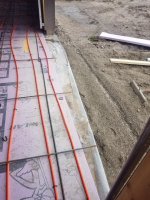
The Last thing I wondered about was the best way to finish the entrance to the Barn? I will put my form board on the edge of the grade board. One option is to finish it out with 2" to the form, or 1" (15 psi), or not put any insulation at all. The form board will have 1" vertical attached to it, to separate the slab and the front apron. One doors floor thickness is closer to 4" and I assume it going to take the most abuse.

And yes Cheez it Groves are present on all my job sites!
 

Attachments

  • 20190405_132217.jpg
    20190405_132217.jpg
    143.7 KB · Views: 38

GrayFlattop

Well-known member
Joined
Jan 18, 2018
Messages
1,051
Location
Chicago
I pressurized my PEX to 60 PSI for a couple days before the pour - and kept the PEX pressurized - continually checking the pressure during the pour. I made a little manifold with 2 tees, two PEX compression connectors a liquid-filled pressure gauge, a ball valve and a quick disconnect air fitting. Used it many times.

At the point where it emerges from the slab, you may want to thread the PEX through some 90 degree 3/4 PVC electrical conduit ells to give the PEX a bit of additional protection.
 
To avoid these ads, REGISTER NOW!
Top Bottom