To avoid these ads, REGISTER NOW!

Radiant heat questions

bmwpower

Super Moderator
Staff member
Joined
Apr 24, 2005
Messages
12,578
Location
NJ
I've seen a bunch of the pictures people have posted in another thread. I have some questions:

(1) I guess you have to use metal in the slab, either wire mesh or rebar, right? Otherwise you'd have no place to mount the PEX.

(2) What are the components/tools that you need to install/run the system? I've seen the tubing, some sort of manifold and some sort of boiler.

(3) What is the overall cost per square foot?
 
To avoid these ads, REGISTER NOW!

Baer

Active member
Joined
Oct 29, 2006
Messages
32
Location
SE Pa
BMW,
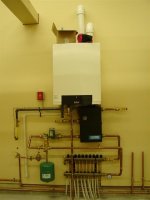
Just having those components installed now. Here's what I've got so far:
(I'll get a better shot tonight)
Most of the peices are there. Went with Buderus boiler (white box on top) that vents directly to the outside, black control box underneath then tubing manifold at bottom. Off to the left are a circulation pump and expansion tank. There are a couple ball valves capped off where I can add a Buderus HWH at a later date that will work off the same boiler. Not the cheapest set up but it seems like it'll be very efficient and trouble free. Hope this helps.
 

Attachments

  • Work continues 29Jun07 (3) (Small).JPG
    Work continues 29Jun07 (3) (Small).JPG
    43.5 KB · Views: 65
OP
B

bmwpower

Super Moderator
Staff member
Joined
Apr 24, 2005
Messages
12,578
Location
NJ
Thanks for the info and the links guys. My Dad will be building his workshop in the future and I though radiant heat might be the way to go for him.

Say, with regards to the concrete pour, I know I've seen people say that the tubing needs to be pressurized during the pour. What if you have a leak or a circuit gets damaged? What do you do to repair it quickly? I always wondered this, but never saw it mentioned. I guess it doesn't happen much...
 

Baer

Active member
Joined
Oct 29, 2006
Messages
32
Location
SE Pa
As I understand it, the most common (although infrequent) cause of a tubing problem during the pour is someone cutting the tubing with the block above the tire used for dumping the concrete. If they get a puncture they can quickly pull up the affected hose, patch/repair, and get on with the pour. Luckily I didn't need to see that in action. The guys doing mine used 16" wide pieces of plywood to run and dump the wheelbarrows from (see pic)-- worked well.
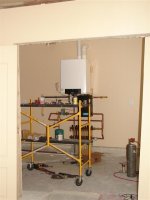
Also, here's a better picture of my system
 

Attachments

  • Light and plumbing progress 3Jul07 (1) (Small).JPG
    Light and plumbing progress 3Jul07 (1) (Small).JPG
    39.2 KB · Views: 75
  • Floor pour 14May07 (19) (Small).JPG
    Floor pour 14May07 (19) (Small).JPG
    58.9 KB · Views: 58
To avoid these ads, REGISTER NOW!
OP
B

bmwpower

Super Moderator
Staff member
Joined
Apr 24, 2005
Messages
12,578
Location
NJ
You say "they". You don't mean the concrete guys obviously. They would have no idea how to fix it, right? It's not as simple as throwing some duct tape on it. I'm just curious what exactly is used to fix it.

It sounds like the person who will install the radiant heat (me) should be there for the pour and be equiped with the proper tools and fittings to fix things.
 

RPH

Well-known member
Joined
Dec 17, 2006
Messages
4,190
Location
Michigan Thumb
From my research into this tube repair. Locate leak, cut tubing in half and install brass push lock union. Clamp, test and wrap the brass up to protect from the cement,
And they do spec. brass only.
 

5wndwcpe

Well-known member
Joined
May 1, 2007
Messages
1,143
Location
Southeastern, PA
I think with all of the research I'll have in by the time I pour the slab, I'll write my own book. From what I've seen so far, it seems the union used to repair the damaged tubing depends largly on whose tubing you use. Zurn uses crimp fittings for example, others prefer compression fittings. I think pressurizing the system with air rather than water during the pour is a better idea. If pressure should suddenly drop due to a breach in the PEX, you should be able to see some air bubbles rising up from the concrete. If you lose pressure using water it may be much more difficult to locate the leak. You'll have to re-pressurize the line, which, the extra water introduced at the point of the damage may compromise the strength of the concrete. Substantially ? Probably not, but why make more of a mess than you have to.
 

Baer

Active member
Joined
Oct 29, 2006
Messages
32
Location
SE Pa
The guys doing the concrete ("they") are my contractor's crew so they're pretty versatile. The plumber left a kit with fittings and tools to fix any breaks -- along with a stern warning to be very careful wheeling the concrete so they didn't have to use it!
 

G M

Well-known member
Joined
Jun 10, 2005
Messages
114
Location
Winnipeg
You will need a boiler, circ pump, manifold, expansion tank. If you would like to zone the system that can be done with actuators on the manifold. Depending on the brand of tubing you use the manufactuer might have fittings that work with their product. You really need a professional to tell you exactly what size of tubing, boiler, expansion tank and circ pump you need.

Your best bet is to go to your local wholesale plumbing heating place and see if they will sell you the parts if you plan on installing it yourself, they will size the parts to your building. It is more important to have it pressurized before the pour to make sure that there are no leaks. Rather then keeping your attention on a guage during the pour, watch the guys carefully to make sure they aren't doing anything to damage the tubing but with that said the tubing is pretty rezilliant.

Unless they are wearing stilletos and spreading the concrete with an axe I honestly don't see how anyone can damage tubing during a pour.

DSCN4075.jpg
 
Last edited:

ChadB

Member
Joined
Jun 14, 2007
Messages
6
Location
Minnesota
BMW, To answer question #1 I used the (pricey) plastic staples to hold my tubing to the foam, and the rebar went on top. Worked great.
 
To avoid these ads, REGISTER NOW!
Top Bottom