To avoid these ads, REGISTER NOW!

radiant heat system pressure

Kapt

Well-known member
Joined
Jul 24, 2005
Messages
168
Location
Maryland
I have a closed radiant system that has worked well since I installed it about five years ago. When I filled the system I charged it to a static pressure of around 15psi. Not sure why, but I know I read it somewhere. Over the years it has gradually gone down to about 10psi. Should I charge it back up and what is the concern if it eventually goes to zero? Theoretically the fluid should still circulate - right?
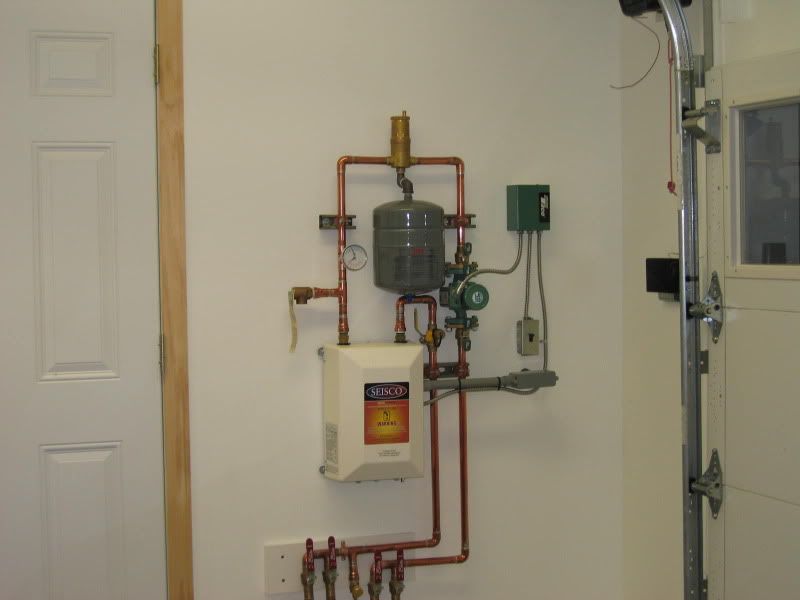
garagedoors021-1.jpg
 
To avoid these ads, REGISTER NOW!

Fastback

Well-known member
Joined
Oct 5, 2010
Messages
518
Location
Indy
Ya know that's an interesting question. My system is darn near just like yours and it would seem that since it does not boil or make steam the pressure difference between full on hot and middle of the summer off should not be huge,so what would the advantage be of having 15psi over 10psi if all of the air is purged?
Does it have to do with heater efficiency or heat exchange between the fluid and the PEX/concrete?
 

69satelite

Active member
Joined
Jan 25, 2008
Messages
33
it should not have lost any pressure over any period of time. If it has lost pressure you may have a leak in the system somewhere or your expansion tank may be bad.
 

Fastback

Well-known member
Joined
Oct 5, 2010
Messages
518
Location
Indy
I would guess a tanks bladder can stretch over time and allow some pressure loss.
 

69satelite

Active member
Joined
Jan 25, 2008
Messages
33
The bladders are factory set and they can fail after time. Is there a valve stem on the tank? if there is you can get an pressure reading from that and compare it to the factory setting on the tank. Make sure the heat is off or your reading won't be accurate.
hot water expands alot when it is heated.
 

koditten

Well-known member
Joined
Apr 10, 2008
Messages
5,528
Location
Midland, Michigan
Good question. I notice mine goes to 15 psi during the heating season and 12 psi when the boiler is not in use during the warmer months.

KO
 

Jackfre

Well-known member
Joined
Dec 26, 2010
Messages
4,411
Location
N CA
All the relief valves and safeties are calibrated to operate off a "set" pressure +/- some. Water going from 32* to 212* will expand about 1/23 of its vol. or about 4%. The expansion tank comes pre-charged and it's pressure should be set to match your operating pressure.

Your 10# system has lost 1/3 of its original operating set-point. Why? do you have anti-freeze in the system? If so, you should be maintaining it. If not, you probably have a small leak somewhere. Either find the leak or bump the operating pressure back to whatever it started at. If in fact there is a leak the air will work its way to the top and the circ will not be able to push thru it and the heating will stop. Is the system air-bound?
 

overdriv

Well-known member
Joined
Jul 26, 2010
Messages
189
Location
Central IL
I think a new system will lose a few psi over the first few days as the air in the water is removed. When pressure testing mine it lost 5PSI overnight. Ten held steady for a three weeks.

If it keeps losing pressure over time, might be a small leak somewhere??
 
To avoid these ads, REGISTER NOW!

Fun pain

Well-known member
Joined
Jan 28, 2012
Messages
111
Location
Crestline, Ohio
from a physics point of view, heat transfer is increased with more pressure (faster trans).... but take in account wear and tear and your pump may use more power to flow (doubt it) and coupling integrity... and you may not really notice the heat transfer speed going from 10 to 15psi (we aren't talking linear changes here).... So more pressure quicker the heat transfer. I would say from and engineering stand point. PLAY with it. If you notice temp changes happen noticably faster, let us know... to many variables to know easily, what will happen in YOUR slab, Your insulation, Your heat lose, your bills, Your preferences.
 

Rich H.

Well-known member
Joined
Nov 30, 2010
Messages
285
Location
SE Michigan
I knew I had a small air bubble when I first fired mine up, purged the heck out of it and the bubble was still there, charged it with 15psi from the garden hose, the air bubble gradually worked it's way out, the pressure dropped to 12psi and has held there ever since.
 

dirttracker18

Well-known member
Joined
Aug 10, 2009
Messages
3,191
Location
Slate River, ON
Is a lower pressure optimal for operation?

Seems most posters in this thread are hanging around that 15 psi range but I have sem systems running anywhere from that up to 60 psi.

Is there a downside to higher pressure? Why such a low pressure?
 

this-guy

New member
Joined
Jan 3, 2015
Messages
1
I'm pretty sure the pressure helps with efficient heat transfer, but the more important need for the pressure is to meet the minimum reservoir pressure for the pump to operate without cavitation. If the system looses too much pressure the pump will not circulate the working fluid due to cavitation. This is not good for your pump.
Maintain good operating pressure.
 

anthony666

Well-known member
Joined
Dec 29, 2007
Messages
987
Location
kirkfield ontario
on a system with no make up water you lose between a pound & two pounds a year like clockwork through the expansion tank bladder .. pressurized air slowly migrates through the bladder into the system's water, it's unavoidable .. you don't notice on a system with make up water because it will fill up when the system pressure drops below the setting on the pressure reducing valve .. often times an in experienced guy will replace a 'water logged' expansion tank when all it really needed was 10 or 15 pounds of air in it and a half a gallon of water taken off the boiler drain valve

which is why everyone should check the air pressure at the schraeder valve and add air as needed at the beginning of heating season .. it must be done cold if possible to be accurate .. the factory preset is clearly marked on the label

hydronic pumps are not really pumps .. they are impellers .. they create a lower pressure at the outlet than the inlet, and as the water moves to equalize the pressure it causes flow .. they need some pressure in order to create a lower pressure

you also need pressure in the system to keep the vent on the air eliminator closed so it doesn't pull air back into the system

the pressure makes the volume of water conform to the inside of the all the components of the boiler, which prevents cavitation and water noises and aids in heat transfer inside the boiler heat exchanger

i could go on, but i'm bored already
 

Radamsiii

Member
Joined
May 24, 2014
Messages
9
The higher pressures are for taller building to keep water completely filled in the system. Your radiant system should have no problem operating at the 10 psi. This is because the heating loops are below the heating system so we are not trying to push the water above the boiler. I would no worry about the pressure or adjusting it until it gets down to around 5 psi. Most diapham tanks are factory set to 14psi because most systems are set at 14 to 15 psi. This means the tanks are setup for 90% of its applications. To check and adjust the pressure in the tank the tank MUST be removed from the system and use a tire pressure gauge to check the pressure. The tank should be adjust to what ever the operating pressure of the system. If you have a tank set at 14 psi and the operating pressure of the heating system is 14 psi you should measure no pressure on the tank when connected to the system. hope this helps
 

anthony666

Well-known member
Joined
Dec 29, 2007
Messages
987
Location
kirkfield ontario
hope this helps

you fell into the same trap as me .. someone commented on a 2 year old thread, i didn't notice til i was halfway through typing but hit 'send' anyway

If you have a tank set at 14 psi and the operating pressure of the heating system is 14 psi you should measure no pressure on the tank when connected to the system.

i agree with 99% of what you said, except if you have 12 pounds of air in the tank you will show 12 pounds on a tire gauge .. the water pressure and air pressure don't cancel each other out .. if it did, then a water pressure gauge would logically show zero as well, yes ?? if your tire gauge says zero you need to add air

i let the pressure out of the water side til it reads zero psi .. remove the core of the schraeder, look for debris, water or signs of water which would tell me the bladder is busted .. then i'll fill i with air and give it a bit to make sure it's holding pressure, refill the water side and call it done

if a tank has frozen by any chance it will usually show signs like the sides aren't parallel anymore or the paint is coming off in long strips .. ill always change a frozen tank after i have figured out the freeze issue
 
To avoid these ads, REGISTER NOW!
Top Bottom