To avoid these ads, REGISTER NOW!

Radiant in floor heat system help

DEFENDER89

New member
Joined
Oct 24, 2023
Messages
4
Location
Putnam Ontario
Hi guys,

We moved into a new place a little while ago and the shop in floor heat does not heat the shop up past 4ish Celsius when it’s -10 to -15 c outside. The shop is 48’x28’ interior, 12’ ceilings, gambrel roof with upstairs, 6” roxol in the walls downstairs, 4” fiberglass in the gambrel roof upstairs up to about 4 feet from the peak, they then put up sheets of 2” xps flat to create an airspace at the peak, no insulation between floors. I believe the slab has 1.5” xps under. The shop is heated with a standard 40 gallon electric hot water heater. There are 5 loops running the length of the shop. They have a couple manual timers wired in… one turns the water heater on and off - every couple hours. The other timer turns the pump on for roughly 5 mins then off for 10 mins, repeat. My guess is he put the timers on for a couple reasons; save electricity and give the water heater a chance to heat up the water before it circulates. The delta T is minimal (couple degrees) once the water heater is say 30 mins into its on cycle. I know the heater is likely insufficient BTU for the space and I likely don’t have enough pex in the floor. I don’t currently have NG to the shop but I can certainly run a line. This hot water heater costs roughly $150-$200 a month in electricity so I’d like to go to NG if it’s more efficient from a cost standpoint.

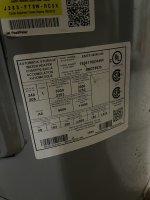
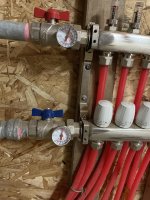
Knowing I can’t change the pex, I assume my only option is to upgrade the heater. What make/model would you recommend (readily available in Canada). I am hoping I can reuse most of the components but I assume I need some sort of controller and scrape the DIY timers. What would you recommend for control? Attached are a few pictures of the system.
 

Attachments

  • IMG_1043.jpeg
    IMG_1043.jpeg
    903.3 KB · Views: 30
  • IMG_1048.jpeg
    IMG_1048.jpeg
    747.4 KB · Views: 30
  • IMG_1040.jpeg
    IMG_1040.jpeg
    770.7 KB · Views: 34
  • IMG_1039.jpeg
    IMG_1039.jpeg
    655.8 KB · Views: 37
  • IMG_1041.jpeg
    IMG_1041.jpeg
    809.6 KB · Views: 36
  • IMG_1049.jpeg
    IMG_1049.jpeg
    726.9 KB · Views: 32
  • IMG_1050.jpeg
    IMG_1050.jpeg
    766.7 KB · Views: 29
To avoid these ads, REGISTER NOW!

PoorUB

Well-known member
Joined
Mar 29, 2021
Messages
11,652
Location
Fargo, ND
You could try remove the timers and just let it run, but it won't be cheap! It will never heat like it is. The timers are really killing the ability to heat the space. The water heater is about half the heating capacity I would expect and then not letting it run constantly kills the ability to heat.

Assuming the tubing was installed properly around 40,000 BTU should heat the slab or 30 BTU per square foot. You can push only so many BTU into floor tubing, it does no good to over size the boiler.

Which gas boiler? I don't now what is available up there, but make certain you don't go much larger than needed. Again, a too large boiler will not help.
 

The Cobbler

Super Moderator
Staff member
Joined
Oct 24, 2013
Messages
25,912
Location
Niagara Region, Ontario, Canada
manual timers wired in… one turns the water heater on and off - every couple hours. The other timer turns the pump on for roughly 5 mins then off for 10 mins
I would try disabling the timers and see what the temperature does. the timers are starving the system from working to capacity

The shop is heated with a standard 40 gallon electric hot water heater.
40 gallon is not as relevant as the wattage of the heater element. and when a water heater is cold only the top element heats to get some hot water quickly, then when it warms up the stat switches to the lower element to give you volume.
 

bornbadbob

Well-known member
Joined
Jan 3, 2025
Messages
215
In floor heat is meant to be left on, not on timers, it takes a long time to heat the slab then heat the space above it.
 

NitroGarage

Well-known member
Joined
Mar 2, 2016
Messages
203
Location
Cleveland, OH
If you can run NG to the shop then that's a no-brainer. A modern NG condensing high efficiency tankless water heater or boiler in place of that tanked unit and let it rip. The 15-58 pump wont be enough for a tankless water heater since they are designed with 50+psi of domestic supply pressure coming in, so a little re-pipe might be required if you go that route vs a lower head loss condensing boiler.

A modern condensing water heater will modulate down to 10-15kbtu output, so it wont be an issue, if you go 80% efficient cast iron boiler, you're going to want something closer to what that building will need on its coldest day, aka design day, whether it be 40 below and 30 inside, or 0 out and 25 inside. Need to do some calcs on it.

Your electric company is going to love you if you take those timers off and let it run 24/7...
 

98ssuck

Well-known member
Joined
Oct 21, 2012
Messages
347
Location
British columbia
Talk to your local viessman rep. I used to install them in bc. Parts and manufacture support was great on the west coast. Nice units.

Timers or not. Your hwt is only 6000w. That’s not enough energy to heat your space all year round. It may barely keep up above 0*c.

Then there’s insurance issues too with a hwt being used for space heating.
 

jlv03

Well-known member
Joined
Jan 19, 2020
Messages
346
Location
SE IA
Yikes. My attached garage is roughly half the square footage and uses a 6kW boiler. If your water heater is wired like a normal water heater, you are only using 3000W at a time (top, then bottom). Then the timer on it is making sure you are only getting half of that 3000W!

At a minimum, I'd keep that water heater on 24/7 and see how the system performs. Next step would be to get a thermostat on the pump and let that run for a spell to see how the building reacts.

If you pull a second 10/2 feed, you can modify the lower element to work independent of the top and get 6kW of heat into the water heater. That will help keep up, but I suspect you are still short on BTUs.
 
OP
D

DEFENDER89

New member
Joined
Oct 24, 2023
Messages
4
Location
Putnam Ontario
If you can run NG to the shop then that's a no-brainer. A modern NG condensing high efficiency tankless water heater or boiler in place of that tanked unit and let it rip. The 15-58 pump wont be enough for a tankless water heater since they are designed with 50+psi of domestic supply pressure coming in, so a little re-pipe might be required if you go that route vs a lower head loss condensing boiler.

A modern condensing water heater will modulate down to 10-15kbtu output, so it wont be an issue, if you go 80% efficient cast iron boiler, you're going to want something closer to what that building will need on its coldest day, aka design day, whether it be 40 below and 30 inside, or 0 out and 25 inside. Need to do some calcs on it.

Your electric company is going to love you if you take those timers off and let it run 24/7...
I was looking at the navien, rinnai or IBC combo units (I also have a 20 gallon DHW heater I’d like to get rid of), in the 120-150k BTU range. As you mention they modulate down, it’s my understanding it won’t be a waste of energy and it has capacity if I want to crank it up for a day to heat the shop to say 18c. Is that correct? I just don’t want to undersize as I feel like I have a decent amount of heat loss (2x 10’ overhead doors, 6 windows, minimal insulation in the upstairs etc).

Regarding the pump, if I go the route I mention above, do I need a new pump or what re piping is needed?

I appreciate the help!
 

98ssuck

Well-known member
Joined
Oct 21, 2012
Messages
347
Location
British columbia
For the pump. It really depends on the model of boiler you go with. A low loss header could be installed to decouple the flow rates between the boiler and the slab. This would require two pumps

Boiler sizing is a tricky one. As the efficiency generally starts at 80% and goes up over the length of time it fires for. The initial flue losses are the cause of this. Low and slow is generally the way to go. In floor slabs are also notoriously slow to respond to heat calls. If you want a warmer shop at noon. Turn up the thermostat at 8am.
 

fitter30

Well-known member
Joined
Jun 23, 2019
Messages
2,981
Location
Peace Valley,mo
E water heaters normally wired run one element at a time. First element is the bottom after it satisfy the thermostats sends power to top element. Satisfy top thermostat send power back down to lower. 3000 watt element 12.5 amps @240 vac 10,230 btu. Can change the wiring to continuous will power both elements at the same time If on a 30 amp breaker. 1/2" pex is 32 btu's per ft. Most systems design for 1 gpm flow per loop. Timer doesn't make sense. The slab has to brought up to temperture. If timer doesn't let slab get up to temp most of the btu's going just tring to heat the slab.
 

ipgenie

Well-known member
Joined
Jan 29, 2020
Messages
562
Location
Idaho
I have both an electric water heater (wired with two circuits to run both elements together) and a Weil-McClain high efficiency condensing boiler for my home in floor heat. We have solar panels to produce electricity and time of use rates so I have the heating system programmed to use the least cost heat source.

With both electric elements running, I can produce about 30,000 BTU. It's enough for my home most of the time, but when it can't keep up, the boiler (90,000 BTU) can easily handle any temperature we've experienced here in Idaho.

I'd run the gas line and convert your shop to gas. You might consider adding a smaller unit heater to the shop for the quick warm-up when needed. It'll warm the space a lot faster than the boiler can. Use the comfortable quiet warm floor heat for your everyday temp and the unit heater to bump it up when you plan to work or just want it warmer for a while. The floor will still be warm and the space will be comfortable.

Last, keep your boiler temp under 150 degrees, 140 is often considered max source temp for concrete. I don't know a lot about it but apparently too high temps can over time make the concrete become less conductive and more of an insulator and won't transfer the heat from the fluid to the slab as well. I have a buddy who studies that stuff and does a lot of work with steam systems at his day job and taught me that. Lower temps are more efficient but shoot for at least a 10 degree delta between source and return temps. I use an outdoor reset calculation to raise source temps based on how cold it is outside.
 
OP
D

DEFENDER89

New member
Joined
Oct 24, 2023
Messages
4
Location
Putnam Ontario
Alright just took the water heater timer off. I confirmed that both elements are not running simultaneously, I can’t run both with my breaker and wiring unfortunately. Also noticed each loop is running 0.4 gpm and the temp coming out of the heater is 16c and coming back is 14c.
 

ipgenie

Well-known member
Joined
Jan 29, 2020
Messages
562
Location
Idaho
shoot for at least a 10 degree delta between source and return temps.

I should have specified that is at least 10 degrees Fahrenheit. That's about 5 degrees Celsius (delta conversion, not temperature conversion). I suspect you'll want a higher source temperature, I typically use 120F (49C) to heat our house to 68-70F (20-21C) with a little higher boiler temp as it gets colder. You can use a lower boiler temp to heat your shop to a lower thermostat set point but I think you still need to have enough BTUs to push at least 80F (26C) before you will get enough heat to transfer it through the slab to warm up the room more.

If you have a 3000 watt heating element, it's only capable of producing about 10,000 BTUs (4500W is about 15,000 BTU) so you really don't have much of a heater for that big space.
 
To avoid these ads, REGISTER NOW!

JohnX14

Well-known member
Joined
Jun 2, 2014
Messages
575
Location
Boston 'burbs
I'd be putting in a wall mount NG or propane boiler. No way a 40 gallon electric is putting out enough to heat that. And as someone said, the timers are not helping.
 

ipgenie

Well-known member
Joined
Jan 29, 2020
Messages
562
Location
Idaho
16° c = 60.8°f two 3000 watt elements 20,460 btu's at 240 vac less volts means less watts.


That's only if both elements run together. OP confirmed his only runs one element at a time so 10K BTUs in this case. (not disagreeing, just clarifying)
 

PoorUB

Well-known member
Joined
Mar 29, 2021
Messages
11,652
Location
Fargo, ND
Any way, probably not enough heat that space in severe cold, but it might do it at outdoor temps around freezing. The only way to find out is try it. It is all there, just bypass the timers. It often is surprising how little BTU one needs to heat a space.
 

ipgenie

Well-known member
Joined
Jan 29, 2020
Messages
562
Location
Idaho
I was surprised to learn that 2000 BTU - - EDITED TO CORRECT TO 25000 BTU AS STATED BELOW-- (7500 W resistance heater) is enough to keep my 36x42x15 shop at 55 degrees F down into the single overnight digits and still cycles off and on. It's pretty well insulated but not completely done yet. Should be pretty inexpensive to heat once the mini split is installed and all the walls are sheeted and done. If a well sealed/insulated building is up to temp, it really doesn't take a lot of energy to hold it. Of course opening big doors often and turning heat down and up means a bigger heater is needed.
 
Last edited:

PoorUB

Well-known member
Joined
Mar 29, 2021
Messages
11,652
Location
Fargo, ND
I was surprised to learn that 2000 BTU (7500 W resistance heater) is enough to keep my 36x42x15 shop at 55 degrees F down into the single overnight digits and still cycles off and on.

You might want to check your math. 7500 watts is 25,000 BTU.

One winter my garage furnace died in a big way. I had to order parts and they took a few days. I turned on all the lights, 22, 2 bulb 4 ft florescent fixtures at the time, plugged in a couple 400 watt halogen work lights, an small 750 watt 120 volt heater and a well ventilated generator load bank, about 2800 watts. maybe 6,000 watts. My garage actually gained heat in the few days the heat wasn't working.
 

ipgenie

Well-known member
Joined
Jan 29, 2020
Messages
562
Location
Idaho
You might want to check your math. 7500 watts is 25,000 BTU.

One winter my garage furnace died in a big way. I had to order parts and they took a few days. I turned on all the lights, 22, 2 bulb 4 ft florescent fixtures at the time, plugged in a couple 400 watt halogen work lights, an small 750 watt 120 volt heater and a well ventilated generator load bank, about 2800 watts. maybe 6,000 watts. My garage actually gained heat in the few days the heat wasn't working.

I should have read my post closer. My phone seems to have missed the 5 when I typed 25000. Thanks for correcting my error.
 

Mr onetwo

Well-known member
Joined
Apr 6, 2011
Messages
2,009
Location
Coastal Maine
plus 1 on Viessmann Vitodens 100 :thumbup: You need to invest in a lot more insulation first.Assuming there is enough tubing in the floor (BIG IF) then I would recommend the properly sized Grundfos pump and some Tekmar controls.Run it at a steady lower temp and install a spot radiant heater to heat up a specific work area fast.

 
OP
D

DEFENDER89

New member
Joined
Oct 24, 2023
Messages
4
Location
Putnam Ontario
Just checked on the shop, its still -1 but holding with the water heater constantly on. Not bad I suppose, considering it was -15c overnight. I noticed the pressure on the system is 0psi. I believe when the system was off it was at 12PSI which is what I precharged it to at the start of the year. Is this normal?
 

ipgenie

Well-known member
Joined
Jan 29, 2020
Messages
562
Location
Idaho
You probably need to add some glycol. I was told that (for my system at least), 12lb minimum, 15lb is ideal.
 

jmdirk

Well-known member
Joined
May 4, 2015
Messages
706
Just checked on the shop, its still -1 but holding with the water heater constantly on. Not bad I suppose, considering it was -15c overnight. I noticed the pressure on the system is 0psi. I believe when the system was off it was at 12PSI which is what I precharged it to at the start of the year. Is this normal?

I wouldn't consider it normal for my system. Also in Ontario so we've been experiencing the same cold temps. Mine gets precharged up to about 15 psi or so and pretty much stays there the entire heating season.

Sounds like you've you've made some progress based on input from others. Feels like the previous owner really didn't have a clue what they were doing when they installed that. A domestic water heater is way under sized for that space especially given it only runs one element at a time. I have a similarly sized shop, 30 x 40 and 10 ft walls. It's a metal building with R19 insulation throughout. I run a 10 kW boiler by a company called Thermolec (made in Canada). Typically I'll run it full time at the beginning of the heating season to get the slab up to temp and then only run it between 11 pm and 7 am as I'm on the Ultra Low Overnight plan, which really helps to minimize the heating cost.

Once that slab is warm, it's does a decent job of keeping the shop relatively warm through the day. Depending on outdoor temp, I'll lose a few degrees during the day, and then it gets 'recharged' overnight. If it's below -10 or so, I might lose a degree or two day to day, but then it recovers when it's a bit warmer out.

If you can go natural gas, probably the most efficient cost wise for you in the long term. Though you'll spend several thousand on a boiler and hookup. But probably save you money over time. You could upgrade your circuit and run a bigger electric boiler like mine. Radiant in floor heat, as others have said, is designed to maintain a set temp mostly. It's not well suited for on demand heating. If you really only want to heat it occasionally, you could consider a mini split instead. Which comes with the added benefit of having A/C in the summer.
 

American Locomotive

Well-known member
Joined
Jan 8, 2017
Messages
10,969
Location
Rhode Island

jblnut

ALLIANCE MEMBER
Joined
Jan 17, 2015
Messages
7,041
Location
In the Middle of MN
I was looking at the navien, rinnai or IBC combo units…
I have three IBC boilers on my property and they’ve all been trouble free. No idea what they cost as they were all part of a larger HVAC bill in all three buildings.

Put in an outdoor wood boiler and you’ll get to experience all the fun of making wood !! I love mine as it offsets around 3,000gal of LP a year for me.

I have a few neighbors with water heaters powering their floors and they work fine but they’re all set to run constantly. One guy has a 60x140x18 build in the early 90’s with floor heat and has an entire room full of water heaters lol. He keeps talking about swapping out for a couple boilers but replacing one water heater at a time is less expensive lol.
 

finn

Well-known member
Joined
Mar 27, 2005
Messages
16,269
Location
The UP, God's country
I have 120k IBC boilers in both the house and shop. I had to replace the fan on one in December, to the tune of $780, installed.

I’m also getting carbon buildup on the heat exchanger that has to be manually scraped off. The tech said the flame is adjusted properly. The regional rep confirmed that the carbon buildup is not uncommon, and recommends an annual disassembly and cleaning, using a drill to open the passages in the cast heat exchanger. I never heard of this issue, but that’s not my field, either.

I set my glycol out temperature to 111 degrees, although this year I bumped it a little. Typically there’s a 10-11 degree delta across the floor. When I looked into this years ago, the guru’s said that running much higher would lead to concrete cracks along the tubing.

The house has staple up pex, and runs a higher water out temp, about 125 F.

One thing to consider if you’re contemplating a condensing boiler is that you need a way to dispose of the condensate, ie, a drain of some sort.

You can’t just poke a hole in the wall in a cold climate, and not have the drain freeze up.
 
To avoid these ads, REGISTER NOW!
Top Bottom