To avoid these ads, REGISTER NOW!

Radiant tubing layout questions

juddspaintballs

Well-known member
Joined
Sep 1, 2011
Messages
324
Location
Hedgesville, WV
I'm in the process of starting to build a house for myself. I have an outdoor wood boiler, so hot boiler water is free and unlimited. The house is planned to be on a slab with 2" foam insulation underneath. My plan was to staple the PEX in loops to the foam and pour the floor on that. Reading around the internet, it looks like some people greatly encourage the PEX to be within 2" of the surface of the concrete. General consensus is 1/2" tubing and loops no longer than 300'. 10" spacing should be good enough.

Should I staple the PEX to the foam or figure out some way to set it higher in the concrete? That seems like a royal PITA. My builder friend helping me with this house suggested 200' loops instead of going as long as 300'. Thoughts?

Here's a shot of the first floor layout:
i-q9DTf2x.jpg
 
To avoid these ads, REGISTER NOW!

TurnipTruck

Well-known member
Joined
Aug 28, 2005
Messages
1,612
Location
Southcentral Alaska
Most of the houses I’ve helped with here in Alaska since about 2005 have had pex stapled to the foam, with mesh above. The rest have had crawl spaces with pex stapled to the subfloor and gypcrete poured.
 
OP
J

juddspaintballs

Well-known member
Joined
Sep 1, 2011
Messages
324
Location
Hedgesville, WV
Doing it with the PEX stapled to the foam and mesh above is what I was hoping to do. It doesn't get as cold here in WV as it can in Alaska, so if it works there, it should work just fine here as well.

This also won't be my only heating source. It will be primary, but the garage and 1st floor will be on their own (separate) mini-splits as well and the second floor will have a traditional heat pump system with air handler. The whole house is 2x6 walls and spray foam. We're also going to have a pellet stove on the 1st floor just because we like the look of a fire once in a while.
 

fitter30

Well-known member
Joined
Jun 23, 2019
Messages
3,026
Location
Peace Valley,mo
There is tons of information on the web for radiant from design companies to you tube. Tubing needs to have a oxygen barrier, up to 300' for 1/2" in no problem, floor coverings have to addressed wood max temp usually 85°f or less. Well design system water temp can run 5-10° over thermostat set point. Wood boiler running two water temps can be piped but it is more involved. One for heat the other dhw. Zones, pump sizing, tubing lay out all have to be engineered because once the floor is poured your stuck with it. Piping needs to be pressurised to 30 psi with air for the pour.
 
Last edited:

jack stand

Well-known member
Joined
Feb 29, 2012
Messages
3,399
Location
Lakes Region Maine
I put my tubing closer to the living space than the insulation per instruction from my design company. He said that it's minor but you always want to direct your heat towards the living space. Obviously sitting on a foam it's being directed to the ground and not necessarily fully encased in the concrete, another negative.
I used regular "bolsters" above the foam and poly, then #4 bar on 2' grid and 6x6 sheets of mesh on top top. That's a convenient place to zip tie the tubes to and is helpful to keep the tubes straight and evenly spaced.
These bolsters or "chairs" are available in different heights. Skip the "big box" stores and find a place that caters to the concrete industry. 👍
 

Mr onetwo

Well-known member
Joined
Apr 6, 2011
Messages
2,023
Location
Coastal Maine
Staple down is the only way to go all day, every day.I am old fashioned...#4 rebar 12" OC on chairs... not mesh.2 loops with 6" spacing on exterior walls ...12" spacing the rest of the way.300 ft loops are fine...try to keep them within 5 ft total length of each other and you do not have to do any mechanical balancing.Don't skimp on pipe...1 ft to 1 sq ft is not quite enough.I would shoot for 1200 ft of tubing for every 1000 sq ft of floor.Use a Grundfos Alpha 2 variable pump and you will have no troubles.It's your money, but I would recommend going with a 6" slab as opposed to 4". Extra tubing means a more responsive floor but don't go over board.I find that most engineers and installers tend to run the floor to cold...makes it too sluggish in my opinion.I also recommend Viessmann Vitodens boilers.
 
Last edited:

Mr onetwo

Well-known member
Joined
Apr 6, 2011
Messages
2,023
Location
Coastal Maine
I put my tubing closer to the living space than the insulation per instruction from my design company. He said that it's minor but you always want to direct your heat towards the living space. Obviously sitting on a foam it's being directed to the ground and not necessarily fully encased in the concrete, another negative.
I used regular "bolsters" above the foam and poly, then #4 bar on 2' grid and 6x6 sheets of mesh on top top. That's a convenient place to zip tie the tubes to and is helpful to keep the tubes straight and evenly spaced.
These bolsters or "chairs" are available in different heights. Skip the "big box" stores and find a place that caters to the concrete industry. 👍
Sorry man, but your "design" company is dead wrong.That old premise has been completely debunked over the years especially in commercial/industrial situations.You are not directing heat anywhere.You are using hot water to heat up a big concrete surface plate which then radiates to the living space.The purpose of the 2" foam is to stop radiation into the ground below.Stapling tubing to the foam instead of tying it to the reinforcement mid slab makes absolutely no measurable difference what so ever in operation of the system.Also, a big plus in having tubing directly on the foam is protecting the pipe after the slab is poured.Tubing at the bottom of a 6" slab is much less apt to be struck by a fastener or anchor than if it is floating around tie wrapped to mesh.
 

jblnut

ALLIANCE MEMBER
Joined
Jan 17, 2015
Messages
7,271
Location
In the Middle of MN
Both my shop and house have it stapled to the foam and it works great. I put the pipes 6" apart on the outside 4 runs and 12" apart inside everywhere else. My master shower is close to the mech room so I ran all the pipes through there before fanning out into the rest of the house so my toes would be nice and warm. It is soooooo nice !!

The more pipe you have the less the pump will have to run to bring the temp up. I'm sure there is a point where too many pipes in the floor is too much or a waste but the more the better in my mind. Put them 8" apart if you want. You'll need a larger pump to pump the larger amount of water at a certain point though.

Make sure you install a floor thermostat !! I set the floor stat in the house at 70f and the forced air furnace that is mainly for the upstairs at 70f so the forced air keeps the upstairs warm and "tops off" downstairs. When we ran the infloor off air temp the pump would run a lot over night and heat the slab up to get the air temp up and during the day it would be 3-4f warmer in the house because of all the heat that was put into the slab over night. Using the floor stat made those temp swings go away. Run a capped off pex line to the center of your living area and you can add a floor stat later as well. Cheap to run the pipe now.

Already having a wood boiler I'm sure you know all about plate exchangers and mixing valves but don't skimp there either. I have my mixing valves set as low as possible to keep the water returning to the stove above 140f. I'd gladly post pics of how I did mine if you'd like.
 

jack stand

Well-known member
Joined
Feb 29, 2012
Messages
3,399
Location
Lakes Region Maine
Sorry man, but your "design" company is dead wrong.That old premise has been completely debunked over the years especially in commercial/industrial situations.You are not directing heat anywhere.You are using hot water to heat up a big concrete surface plate which then radiates to the living space.The purpose of the 2" foam is to stop radiation into the ground below.Stapling tubing to the foam instead of tying it to the reinforcement mid slab makes absolutely no measurable difference what so ever in operation of the system.Also, a big plus in having tubing directly on the foam is protecting the pipe after the slab is poured.Tubing at the bottom of a 6" slab is much less apt to be struck by a fastener or anchor than if it is floating around tie wrapped to mesh.
This was 15 years ago! 😆👍
 

jack stand

Well-known member
Joined
Feb 29, 2012
Messages
3,399
Location
Lakes Region Maine
You know how the "industry" can have a hand in steering things, stapling down to foam is a massive labor savings (cost) over what I did. In an effort to be more competitive with other more conventional heating it makes me wonder especially about the contact with the tubes having 1/3 or more less contact vs. being totally encased if there may be some efficiency lost? On the other hand I think the tubes placement within the slab is probably irrelevant.
Even with the smallest aggregate in the concrete I'd argue that the contract was closer to 50%. Just getting a little "geeky" here on the topic and you seem like you may be in the business. My only experience is my installation. 👍
 

larry4406

Well-known member
Joined
Jan 27, 2006
Messages
20,174
Location
Northern Virginia
I have no experience what so ever with this.

That said, I would think that the tubing lying on the bottom is similar to making a control joint in a slab making it more prone to likely crack there. I would think that having the tubing more towards the middle would improve the strength of the concrete and improve the heat transfer since the tubing is fully encapsulated. :dunno:
 
OP
J

juddspaintballs

Well-known member
Joined
Sep 1, 2011
Messages
324
Location
Hedgesville, WV
Both my shop and house have it stapled to the foam and it works great. I put the pipes 6" apart on the outside 4 runs and 12" apart inside everywhere else. My master shower is close to the mech room so I ran all the pipes through there before fanning out into the rest of the house so my toes would be nice and warm. It is soooooo nice !!

The more pipe you have the less the pump will have to run to bring the temp up. I'm sure there is a point where too many pipes in the floor is too much or a waste but the more the better in my mind. Put them 8" apart if you want. You'll need a larger pump to pump the larger amount of water at a certain point though.

Make sure you install a floor thermostat !! I set the floor stat in the house at 70f and the forced air furnace that is mainly for the upstairs at 70f so the forced air keeps the upstairs warm and "tops off" downstairs. When we ran the infloor off air temp the pump would run a lot over night and heat the slab up to get the air temp up and during the day it would be 3-4f warmer in the house because of all the heat that was put into the slab over night. Using the floor stat made those temp swings go away. Run a capped off pex line to the center of your living area and you can add a floor stat later as well. Cheap to run the pipe now.

Already having a wood boiler I'm sure you know all about plate exchangers and mixing valves but don't skimp there either. I have my mixing valves set as low as possible to keep the water returning to the stove above 140f. I'd gladly post pics of how I did mine if you'd like.
I'd love to see some pictures of your setup. I'm really glad you mentioned the floor thermostat. I was wondering if that would be the way to go, but I've never seen one so I had no idea. I'd like to keep my floor in the 68-71 degree range, I think, and use the mini splits on the 1st floor and garage to maintain air temp at whatever I feel is comfortable from there. The 2nd floor will be normal forced air and have nothing from the boiler for heat, like your setup.

I've had the wood boiler setup in 2 houses so far and helped my dad install his in 3 houses. I'm familiar with plate exchangers, but we've never had the need to use mixing valves so I'm unfamiliar with those. The only place I'd need a plate exchanger is IF I decide to use the wood boiler to heat the domestic water. If it complicates the system too much, I won't do it because I'm already planning a propane powered on-demand water heater anyways. I don't know much about mixing valves or the types of manifolds and pumps I'd want for this system yet. I do not plan on using a traditional boiler in conjunction with the outdoor boiler for heating this slab.
 

jblnut

ALLIANCE MEMBER
Joined
Jan 17, 2015
Messages
7,271
Location
In the Middle of MN
I'd love to see some pictures of your setup. I'm really glad you mentioned the floor thermostat. I was wondering if that would be the way to go, but I've never seen one so I had no idea. I'd like to keep my floor in the 68-71 degree range, I think, and use the mini splits on the 1st floor and garage to maintain air temp at whatever I feel is comfortable from there. The 2nd floor will be normal forced air and have nothing from the boiler for heat, like your setup.

I've had the wood boiler setup in 2 houses so far and helped my dad install his in 3 houses. I'm familiar with plate exchangers, but we've never had the need to use mixing valves so I'm unfamiliar with those. The only place I'd need a plate exchanger is IF I decide to use the wood boiler to heat the domestic water. If it complicates the system too much, I won't do it because I'm already planning a propane powered on-demand water heater anyways. I don't know much about mixing valves or the types of manifolds and pumps I'd want for this system yet. I do not plan on using a traditional boiler in conjunction with the outdoor boiler for heating this slab.
How do you get the wood stove water into the floor if you don't use a plate exchanger or heat exchanger of some kind ?

My the water in the house loop goes stove -> side arm on water heater -> 40 plate exchanger for in floor -> fin type exchanger (think car radiator) in my forced air plenum -> back to stove.

When the stove is running the LP boilers are tuned off and there is a mechanical aquastat that intercepts the wire from the thermostat for the forced air and keeps the LP burner from coming on until the water is below 140f.

The mixing valves are used only on the plate exchangers for the in floor heat as I want to keep the temp of the water in the floor around 100f which in turn keeps the return water temp going back to the stove above 140f, usually above 145f. I run the stove at 185f when it's below 10f and at 180f when it's above 10f.

The infloor pumps and thermostats are all controlled by the Taco boxes. Not sure what voodoo goes on in there but they make it all work lol

Are you going to have have AC in the house running through the forced air furnace ? If so you sure could use the forced air furnace as the "topper" for the entire house.

Entire mess in the house .....
KIMG1644.JPG

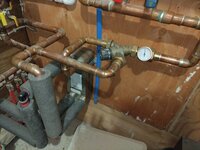
Mixing valve on in floor plate exchanger. No way I want 185f water running through my floor. The thermometer on the output side let's me fine tune it as needed but I set it as low as it goes last fall and haven't touched it since.
KIMG1647.JPG

Side arm on the water heater. It's a SS tube inside a larger SS tube. Simple, cheap and won't plug up with our crappy water nearly as fast as a plate exchangers will. Also have a rusco spin down filter before it goes to the plate exchanger for the infloor. The bottom of the side arm plumbs into the drain on the water heater.
KIMG1645.JPG

Crappy pic of the aquastat and fin type exchanger in the forced air furnace.
KIMG1646.JPG
 
Last edited:
OP
J

juddspaintballs

Well-known member
Joined
Sep 1, 2011
Messages
324
Location
Hedgesville, WV
I guess I do need a plate exchanger if I don't want 185F water running through the floor. I'll have an underground loop from the boiler with the insulated PEX that goes into the house and through a plate exchanger only I suppose. On the house side, a bunch of loops, a pump or pumps with controller, and a mixing valve. How does the mixing valve cool the water leaving the flat plate? Is it using cold domestic water or cool loop water?

I will have a forced air heat pump for the second floor only. Heat and AC. I don't think I'll be putting a coil in it to have boiler heat out of the air handler like I did in my past two houses. I want to keep my heating sources entirely separate this time, so I'm only using the boiler for the in-floor heat. 1st floor will be on one mini split with two heads (36k total), garage will have a 18k head from an identical mini split that also feeds a 18k head in the storage attic. 2nd floor will have a 3 ton heat pump forced air for heat and AC in all the rooms. Only the 1st floor will have the radiant slab and it's a wide open design, so I can make loops weave any which way I want to make it all work.
 

jblnut

ALLIANCE MEMBER
Joined
Jan 17, 2015
Messages
7,271
Location
In the Middle of MN
The mixing valves use the loop water to maintain temp. Or glycol mix or whatever it is.

Why do you not want to use the wood stove water to heat the air as well ? It's simple to set up to run off the wood stove heat and you can still use it the other way as a backup. Just need an aquastat to decide which heat source to use. Above 140 water temp, use the wood stove. Below 140 water temp use the alternative source of heat. The rad for the furnace is cheap.

Whatcha got for a stove ? Is it large enough to supply the entire house or do you just not want to cut that much wood lol. I think we'll have gone through a little North of 20 cord this year between the house and shop. Didn't expect that :lol_hitti

If you don't have it already spend the money on the fancy spray foam type pipe from the stove. In 175' of pipe I have 1f in loss in water temp when nothing is calling for heat. That's pretty damn good !!
 
Last edited:

jblnut

ALLIANCE MEMBER
Joined
Jan 17, 2015
Messages
7,271
Location
In the Middle of MN
Yep, I'll use the closed-cell foam insulated pipe like Thermo-Pex or Rehau. That's the only way to go.
Sweet. I don't remember the brand of my pipe but it looked like a 4" black plastic water line with 1-1/4" pipes in it. I went 1-1/4" as I had 175' to get to the house and 150' to get to the shop and was told it was on the edge for 1". This 1-1/4" stuff is really only a 1" pipe anyway the way the PEX stuff works out. I think it was $15/ft last spring if I remember correctly. Well worth yue money though. Saves lots of wood.
 
To avoid these ads, REGISTER NOW!

Mr onetwo

Well-known member
Joined
Apr 6, 2011
Messages
2,023
Location
Coastal Maine
Definitely do not skimp on the underground loop...I have used only Rehau pex for many years without a problem.I prefer using injection style systems using pumps with primary/secondary piping and Tekmar controls but that is just my preference.There are many ways to control this type of system.
 

Mr onetwo

Well-known member
Joined
Apr 6, 2011
Messages
2,023
Location
Coastal Maine
I have no experience what so ever with this.

That said, I would think that the tubing lying on the bottom is similar to making a control joint in a slab making it more prone to likely crack there. I would think that having the tubing more towards the middle would improve the strength of the concrete and improve the heat transfer since the tubing is fully encapsulated. :dunno:
makes no difference what so ever...you are over thinking it.Never had a floor crack because of tubing and I've put in miles of it.
 

Mr onetwo

Well-known member
Joined
Apr 6, 2011
Messages
2,023
Location
Coastal Maine
You know how the "industry" can have a hand in steering things, stapling down to foam is a massive labor savings (cost) over what I did. In an effort to be more competitive with other more conventional heating it makes me wonder especially about the contact with the tubes having 1/3 or more less contact vs. being totally encased if there may be some efficiency lost? On the other hand I think the tubes placement within the slab is probably irrelevant.
Even with the smallest aggregate in the concrete I'd argue that the contract was closer to 50%. Just getting a little "geeky" here on the topic and you seem like you may be in the business. My only experience is my installation. 👍
You are correct sir....it's all about labor savings and speed.If anyone here worked in the trade in years past then you know what a ***** it is to tie 1/2" or worse yet 3/4" pex down to a rebar mat or mesh.We stated out using wire ties and twisters.By the end of the day you were wasted.Plastic zip ties were a small improvement, but when we went to standing upright and just holding the pipe straight to the layout line and stapling, productivity literally went up 400%. In the real world, there was no discernible difference in operation, but pipe damage and penetrations went down to zero, a big plus.
I am retired now but used to do this in a commercial setting, both engineered and design/build installations.
 

jblnut

ALLIANCE MEMBER
Joined
Jan 17, 2015
Messages
7,271
Location
In the Middle of MN
Do you have a link to the controller and pumps you used?
This is the thermostat. It's a Tekmar 519 with a slab sensor. I believe it can use the aux thermostat as an outdoor temp sensor as well but I have it setup for slab temp. I've got four of these total on the property and they are simple and work very well. They can be found less expensive than on Amazon if you look elsewhere as well .....

They're Grundfos brand and are an ECM style. They were spendy but I don't think they save enough on electricity to ever make up the difference in price. My rough pencil scratching says they will each save roughly $25 in power a year. Takes a while to make up the price being almost triple.

Pumps in the house....
KIMG1649.JPG

Mixing valve in the house .....
KIMG1651.JPG

Pumps behind the stove .... 26-99's. They'd be better suited for a multi zone install that uses those little solenoids to open one or multiple loops at a time instead of having it just pump water as it can be run in a couple different auto pressure modes where it ramps up and down depending on the load. It has found a happy spot behind the stove and stayed there without adjusting so ya live and learn lol
KIMG1652.JPG

Back of stove. I put an InkBird BBQ thermometer back there to keep an eye on the supply/return temps. It's really nice !!
KIMG1653.JPG

One thing to remember is that you must protect the underground loop and the tubing in the floor with a manual reset aquastat that trips at around 140 degrees. https://www.supplyhouse.com/Resideo...-Aquastat-100-200-Degree-F-Range-Manual-Reset
100% agree you do not want that hot of water going through the floor but if you're using a mixing valve and have it set properly why do you need this ? Sure isn't a bad secondary safety deal but other than that maybe I'm missing something .....

Definitely do not skimp on the underground loop...I have used only Rehau pex for many years without a problem.I prefer using injection style systems using pumps with primary/secondary piping and Tekmar controls but that is just my preference.There are many ways to control this type of system.
Ditto. OP said he was going to use the fancy pipe already so no worries about the cheap **** that fills with water.

The primary/secondary piping .... Is that referring to using a heat exchanger in the house to pull heat out of he boiler loop to keep the systems separate or something else ?

Tekmar stuff rocks !!!
 

Attachments

  • KIMG1652.JPG
    KIMG1652.JPG
    885.8 KB · Views: 5
Last edited:
OP
J

juddspaintballs

Well-known member
Joined
Sep 1, 2011
Messages
324
Location
Hedgesville, WV
This is the thermostat. It's a Tekmar 519 with a slab sensor. I believe it can use the aux thermostat as an outdoor temp sensor as well but I have it setup for slab temp. I've got four of these total on the property and they are simple and work very well. They can be found less expensive than on Amazon if you look elsewhere as well .....

They're Grundfos brand and are an ECM style. They were spendy but I don't think they save enough on electricity to ever make up the difference in price. My rough pencil scratching says they will each save roughly $25 in power a year. Takes a while to make up the price being almost triple.

Pumps in the house....
KIMG1649.JPG

Mixing valve in the house .....
KIMG1651.JPG

Pumps behind the stove .... 26-99's. They'd be better suited for a multi zone install that uses those little solenoids to open one or multiple loops at a time instead of having it just pump water as it can be run in a couple different auto pressure modes where it ramps up and down depending on the load. It has found a happy spot behind the stove and stayed there without adjusting so ya live and learn lol
KIMG1652.JPG

Back of stove. I put an InkBird BBQ thermometer back there to keep an eye on the supply/return temps. It's really nice !!
KIMG1653.JPG


100% agree you do not want that hot of water going through the floor but if you're using a mixing valve and have it set properly why do you need this ? Sure isn't a bad secondary safety deal but other than that maybe I'm missing something .....


Ditto. OP said he was going to use the fancy pipe already so no worries about the cheap **** that fills with water.

The primary/secondary piping .... Is that referring to using a heat exchanger in the house to pull heat out of he boiler loop to keep the systems separate or something else ?

Tekmar stuff rocks !!!
What is that big IBC stainless box thing above the mixing valve?
 
OP
J

juddspaintballs

Well-known member
Joined
Sep 1, 2011
Messages
324
Location
Hedgesville, WV
And to note, I don't mind if the garage is the same exact temperature as the rest of the 1st floor radiant heat. If I want my living room to be 70 on the floor, I'm fine with the garage also being 70. I should just need one slab probe on the living side of the slab to control the whole temperature and be happy.

I'll sit down this week and draw up some loop designs. I might arbitrarily aim for 250' loops so I can buy 1000' rolls of PEX and make 4 loops from each. I can find a way to make them all the same length so controlling the whole thing should be easy. A pump, a thermostat, a mixing valve, a plate exchanger, and a mixing valve. Anything else for the house side of things? I have the pump for the boiler loop already (Grundfos 26-99) and I'll buy some new underground piping to go with it.
 

jblnut

ALLIANCE MEMBER
Joined
Jan 17, 2015
Messages
7,271
Location
In the Middle of MN
What is that big IBC stainless box thing above the mixing valve?
LP boiler for the in floor heat. When the shop was built in 2020 and the house in early 2022 I didn't have the wood boiler yet. They have went from primary sources of heat to backups.

They sit there and are online ready to go if the stove temp drops below 90f. The water circulates through them like before and since it's hotter than the setpoint they're looking for they don't fire up. Same concept as how the forced air furnace starts using LP again. If for some reason the stove doesn't light or something goes wrong out there I don't want anything to freeze when it's -25f here !!
 

jblnut

ALLIANCE MEMBER
Joined
Jan 17, 2015
Messages
7,271
Location
In the Middle of MN
Also you'll need a control box of some kind. I have a Taco SR502 in the house and the shop. It's a 2 zone switching relay box that takes input from the thermostats and tells the pumps when to run.
 

PoorUB

Well-known member
Joined
Mar 29, 2021
Messages
11,900
Location
Fargo, ND
And to note, I don't mind if the garage is the same exact temperature as the rest of the 1st floor radiant heat. If I want my living room to be 70 on the floor, I'm fine with the garage also being 70. I should just need one slab probe on the living side of the slab to control the whole temperature and be happy.
You are assuming the heat loss in both areas are the same. No way I would put the house and the garage on the same loop. I would plumb them as two separate zones, two separate thermostats.
 
OP
J

juddspaintballs

Well-known member
Joined
Sep 1, 2011
Messages
324
Location
Hedgesville, WV
I’m not assuming the heat loss is the same, but rather I don’t care if the garage is physically cooler than the living area. It won’t be so far off the garage could freeze while the house stayed warm unless someone leaves the doors open, and then the warm floor won’t stop the air from getting cold anyways.
 

jblnut

ALLIANCE MEMBER
Joined
Jan 17, 2015
Messages
7,271
Location
In the Middle of MN
It'll function just fine with the whole works on one slab but it isn't that much more expensive to do two zones.

That being said ..... You could close the little valves on the manifold to the garage loops to keep it a little cooler out there if you wanted. Simple. :dunno:
 

PoorUB

Well-known member
Joined
Mar 29, 2021
Messages
11,900
Location
Fargo, ND
I’m not assuming the heat loss is the same, but rather I don’t care if the garage is physically cooler than the living area. It won’t be so far off the garage could freeze while the house stayed warm unless someone leaves the doors open, and then the warm floor won’t stop the air from getting cold anyways.
Sorry, but it just seems wrong to me!

At the very least put the garage on it's own manifold so if you change your mind all you need to do is add the controls and perhaps a circ pump.
 

19D2P

Well-known member
Joined
Mar 31, 2008
Messages
56
Location
NW Montana
Do a search for LoopCAD software. It comes with a 30-day free trial and you will get your heat loss, tubing layout, flow rates, temps, etc. all in one software package.

As for the tubing location, my answer is there is no clear answer. Every method has it's advantages and drawbacks. Disclaimer here is I stapled the tubing to my foam in my shop. However, I knew it would mean I would need to run the fluid at a slightly higher tamp and the slab would take longer to respond. However, it meant an easier (for me working solo) installation and a reduced risk of hitting a tube when I install a lift or cut the concrete. If I was doing a house, I would have done a mid slab or as close to the surface as I could in order to get the faster response times and increased output.

Either way, there is no wrong answer IMO. Just do what makes the most sense in your situation.
 

Mr onetwo

Well-known member
Joined
Apr 6, 2011
Messages
2,023
Location
Coastal Maine
This is the thermostat. It's a Tekmar 519 with a slab sensor. I believe it can use the aux thermostat as an outdoor temp sensor as well but I have it setup for slab temp. I've got four of these total on the property and they are simple and work very well. They can be found less expensive than on Amazon if you look elsewhere as well .....

They're Grundfos brand and are an ECM style. They were spendy but I don't think they save enough on electricity to ever make up the difference in price. My rough pencil scratching says they will each save roughly $25 in power a year. Takes a while to make up the price being almost triple.

Pumps in the house....
KIMG1649.JPG

Mixing valve in the house .....
KIMG1651.JPG

Pumps behind the stove .... 26-99's. They'd be better suited for a multi zone install that uses those little solenoids to open one or multiple loops at a time instead of having it just pump water as it can be run in a couple different auto pressure modes where it ramps up and down depending on the load. It has found a happy spot behind the stove and stayed there without adjusting so ya live and learn lol
KIMG1652.JPG

Back of stove. I put an InkBird BBQ thermometer back there to keep an eye on the supply/return temps. It's really nice !!
KIMG1653.JPG


100% agree you do not want that hot of water going through the floor but if you're using a mixing valve and have it set properly why do you need this ? Sure isn't a bad secondary safety deal but other than that maybe I'm missing something .....


Ditto. OP said he was going to use the fancy pipe already so no worries about the cheap **** that fills with water.

The primary/secondary piping .... Is that referring to using a heat exchanger in the house to pull heat out of he boiler loop to keep the systems separate or something else ?

Tekmar stuff rocks !!!
The thing about the pex is not only the type of pex (Pex-A is best) and the quality, but also the fitting system for connections.Rehau is the best brand IMHO.
A mixing valve is not a protective device and they can be very inaccurate.A manual reset aquastat is a must (especially with a wood boiler system) and is code under some circumstances.Just imagine if your wood boiler ran wild and damaged or melted the pex....yikes!
The primary/secondary piping is to separate the 2 systems hydraulically...works very well with no moving parts.Plate type heat exchangers are too prone to plugging up IMHO and are very restrictive by nature.
ECM variable speed pumps may be fairly expensive up front but are really fantastic.Here in Maine there are rebates on them...check to see if there are any in your state.
Tekmar is very very good...not sure about Watts taking them over however.Hopefully that won't ruin them.
 

jblnut

ALLIANCE MEMBER
Joined
Jan 17, 2015
Messages
7,271
Location
In the Middle of MN
The thing about the pex is not only the type of pex (Pex-A is best) and the quality, but also the fitting system for connections.Rehau is the best brand IMHO.
A mixing valve is not a protective device and they can be very inaccurate.A manual reset aquastat is a must (especially with a wood boiler system) and is code under some circumstances.Just imagine if your wood boiler ran wild and damaged or melted the pex....yikes!
The primary/secondary piping is to separate the 2 systems hydraulically...works very well with no moving parts.Plate type heat exchangers are too prone to plugging up IMHO and are very restrictive by nature.
ECM variable speed pumps may be fairly expensive up front but are really fantastic.Here in Maine there are rebates on them...check to see if there are any in your state.
Tekmar is very very good...not sure about Watts taking them over however.Hopefully that won't ruin them.
The pumps on the back of my stove are the ECM type. They really have no reason to be variable speed as they are running the same speed all the time to keep the water coming into the shop and house. Not sure why a variable speed pump is a benefit there. I can see a variable speed pump being of benefit when the amount of water being pumped can be varied such as when you have one pump and one manifold with multiple solenoids to open each run of PEX in the floor individually instead of multiple pumps and multiple manifolds to supply each individual zone.

I've got a spin down filter before each plate exchanger to help prevent plugging :dunno:

I'm probably being dense here but I still don't understand where the manual reset aquastat would be ? On the back of the stove to shut down the pumps or what purpose does it serve ?

I do not want the same water from my wood stove running through my floor as the floor systems have a glycol mix and the stove does not. The floor systems are also under pressure to keep the backup LP boilers happy. I'm not sure how to achieve that in this case with the primary/secondary system you say is a must without using some sort of heat exchanger to separate the different liquids.

I'd agree that supply house is a good place to deal with. Most of my stuff came from them.
 

Mr onetwo

Well-known member
Joined
Apr 6, 2011
Messages
2,023
Location
Coastal Maine
Your system is yours...my comments have not been about your system...I am trying to help out the OP.Like I said...there are many ways to achieve the same thing.Some are better than others.I never said anything about glycol and didn't pick up on that.My bad.HX's are the only way if you have a glycol system.The aquastat I talked about is a fail safe protective device.It goes in the supply from the wood boiler....don't use one if you don't want to...no skin off my nose. I put them in every system that has pex.
 
OP
J

juddspaintballs

Well-known member
Joined
Sep 1, 2011
Messages
324
Location
Hedgesville, WV
Please tell me about this primary/secondary piping. I don't think I understand how that works. I don't plan on glycol.

My boiler already has aquastats to prevent the water from running away too hot. It shuts the whole thing down if water temperature reaches 200, though the normal cycle is 160 low to 180 high as long as there isn't an issue.
 
To avoid these ads, REGISTER NOW!
Top Bottom