To avoid these ads, REGISTER NOW!

Radiant up and running

Redraptor

Well-known member
Joined
Dec 15, 2016
Messages
100
Location
Greenville, PA
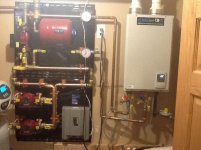
Finally got some time to get this put together.
38647172664_4078737914_z_d.jpg

This an update to my other thread. I read and followed the directions on the components, followed the schematic, bled it, and got some nice heat. Got it set at 55*. In the frigid temps this week, the cycle time is nearly the same, maybe a couple times in an hour and a half for 5 minutes. Temp measures the same everywhere so I'm happy.
https://www.garagejournal.com/forum/showthread.php?t=373890
 
To avoid these ads, REGISTER NOW!

Burl

Well-known member
Joined
Sep 21, 2007
Messages
791
Location
Where Mountaineers are free
I'm heating my 900 sf garage with a HWH, and its not working in this frigid weather, and I need to covert to a boiler. This one and a HydroSmart are on my list. I'm watching 2 different applications, yours is one. Can you post a few updates within the next couple weeks in this colder weather? Thanks. Also, where did you buy the boiler?
 

sstec

Well-known member
Joined
Jul 31, 2014
Messages
45
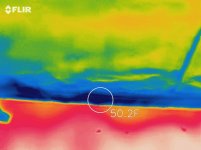
Got mine started last Saturday as well, then the temperature dropped below zero. . . Slab sensors said 34º F took a few days but slab is 77º room temp 60º - 65º now, boiler ran pretty much non stop for the first two days. I will say it's quiet and much lower humidity then propane heaters. We'll see how bad the first NG bill is. IR shows 6" closed cell foam wall compared to slab 24 hours in to start up. sstec
 

Attachments

  • flir_20171226T153257.jpg
    flir_20171226T153257.jpg
    74 KB · Views: 135
  • IMG_20171225_171542065.jpg
    IMG_20171225_171542065.jpg
    143.5 KB · Views: 203

Rc_Guy

Well-known member
Joined
Apr 14, 2013
Messages
4,438
Location
Minnesota
-21° when I left for work Tuesday morning and the house is 72° and the garage is 60°.

On second winter in new house and we love the infloor heat.
 

sstec

Well-known member
Joined
Jul 31, 2014
Messages
45
120 miles due west just over the border in SD. Tomorrow's high is -12º & low of -21º. I need to get use to opening the windows in the truck when I pull in. Left them up the other day and got in it later and was damn cold in there. sstec
 

yeldogt

Well-known member
Joined
Jan 2, 2012
Messages
18,184
I'm heating my 900 sf garage with a HWH, and its not working in this frigid weather, and I need to covert to a boiler. This one and a HydroSmart are on my list. I'm watching 2 different applications, yours is one. Can you post a few updates within the next couple weeks in this colder weather? Thanks. Also, where did you buy the boiler?

You need to do a heat load and size accordingly. When maintaining a temp you want to match the boiler to the need. When a boiler only runs for a short time every hour in very cold temps it's way oversized ... you don't get all the benefits.

The calculations are not difficult .. most on demand water heaters are too large and are designed for a different application.

Many standard water heaters only have 26k burners -- at 80% with a poorly insulated or leaking building --- not enough nearing zero degrees
 
Last edited:
OP
R

Redraptor

Well-known member
Joined
Dec 15, 2016
Messages
100
Location
Greenville, PA
This one and a HydroSmart are on my list. I'm watching 2 different applications, yours is one. Can you post a few updates within the next couple weeks in this colder weather? Thanks. Also, where did you buy the boiler?
As mentioned in my previous thread this is on demand HWH. I bought the whole system at a local HVAC distributor called Thermo Supply. I told the technician what I had and what I wanted to do then backed up to the dock. I argued a little about the sizing of the heater but if this what I wanted to use, this is what I needed. I'll keep you updated.
 
OP
R

Redraptor

Well-known member
Joined
Dec 15, 2016
Messages
100
Location
Greenville, PA
Got mine started last Saturday as well, then the temperature dropped below zero. . . Slab sensors said 34º F took a few days but slab is 77º room temp 60º - 65º now, boiler ran pretty much non stop for the first two days. I will say it's quiet and much lower humidity then propane heaters. We'll see how bad the first NG bill is. IR shows 6" closed cell foam wall compared to slab 24 hours in to start up. sstec
Wow, that is an awesome layout.:beer:
 

Burl

Well-known member
Joined
Sep 21, 2007
Messages
791
Location
Where Mountaineers are free
You need to do a heat load and size accordingly. When maintaining a temp you want to match the boiler to the need. When a boiler only runs for a short time every hour in very cold temps it's way oversized ... you don't get all the benefits.

The calculations are not difficult .. most on demand water heaters are too large and are designed for a different application.

Many standard water heaters only have 26k burners -- at 80% with a poorly insulated or leaking building --- not enough nearing zero degrees

I agree with this. I have done a heat load calculation and it comes up to 38K, which is a rather small boiler. I have yet to talk to someone at a boiler mfgr., I figure they will want to sell me something that may not be quite what I need (oversized). People on this board seem to have good luck with the Hydro Smart stuff.
 

Jackfre

Well-known member
Joined
Dec 26, 2010
Messages
4,410
Location
N CA
Burl, there are a number of boiler manuf who are making wall hung boilers that will peak at the 50kbtu range, so you fall in the mid range at design condition. The thing about using a boiler as opposed to a tankless is the boiler will be equipped with the outdoor reset (check that).
Tankless water heater are designed to see a widely variable flow rate and a high Delta T. In a heating application they see a fixed flow and a small Delta t and consequently they run on low fire most of the time and it can kill them. I have seen some radiant systems with tankless consume vast quantities of gas. They may work, but in my experience, it is a **** shoot.
 

yeldogt

Well-known member
Joined
Jan 2, 2012
Messages
18,184
Here is my setup.

Looks like primary/ secondary piping -- all "pumping away" a good way with multi temp applications.

When I use panel radiators I pipe them as the primary and take off for the lower temp applications. This eliminates the extra circulator. Most shop situations only require one temp water to the floor -- so the piping is even easier and only one circulator.

Low loss headers are often used today in home systems as they eliminate piping screwups. But, they require an extra pump.
 

yeldogt

Well-known member
Joined
Jan 2, 2012
Messages
18,184
Got mine started last Saturday as well, then the temperature dropped below zero. . . Slab sensors said 34º F took a few days but slab is 77º room temp 60º - 65º now, boiler ran pretty much non stop for the first two days. I will say it's quiet and much lower humidity then propane heaters. We'll see how bad the first NG bill is. IR shows 6" closed cell foam wall compared to slab 24 hours in to start up. sstec


With the floor at 85 -- you get about 35 btu's per sf. That's really the maximum comfortable temp for a floor. Although I did a small green house where I need to do a bit more .. and eventually added a panel radiator.

Radiant is very forgiving .... big boiler w/ wide spaced tubing will heat a space .. but a proper sized boiler with close spaced tubing running at the correct GPM will get you all the benefits and fuel savings/ greater comfort w/o over heating.
 

Burl

Well-known member
Joined
Sep 21, 2007
Messages
791
Location
Where Mountaineers are free
Burl, there are a number of boiler manuf who are making wall hung boilers that will peak at the 50kbtu range, so you fall in the mid range at design condition. The thing about using a boiler as opposed to a tankless is the boiler will be equipped with the outdoor reset (check that).
Tankless water heater are designed to see a widely variable flow rate and a high Delta T. In a heating application they see a fixed flow and a small Delta t and consequently they run on low fire most of the time and it can kill them. I have seen some radiant systems with tankless consume vast quantities of gas. They may work, but in my experience, it is a **** shoot.

So what does a person in my (and many others) situation do who are kinda "on the bubble" as to a boiler versus a water heater? Boilers in this class are much more expensive than a tankless, though more suited to the conditions. The tankless mfgrs. say their products are suited for radiant, and offer good guarantees for such. Thanks for your experienced opinion, it is very easy to understand.
 

sstec

Well-known member
Joined
Jul 31, 2014
Messages
45
With the floor at 85 -- you get about 35 btu's per sf. That's really the maximum comfortable temp for a floor. Although I did a small green house where I need to do a bit more .. and eventually added a panel radiator.

Radiant is very forgiving .... big boiler w/ wide spaced tubing will heat a space .. but a proper sized boiler with close spaced tubing running at the correct GPM will get you all the benefits and fuel savings/ greater comfort w/o over heating.

All I know is that the floor feels great on my cold, old tired feet. . . . This is only phase #1 1800 sq ft in 2 zones of 900', with 1800' of 1/2" pex 1' a part and 200' of 3/4" pex. I'm oversized for this stage @140,000 btu. Phase #2 is DHW for shop and house. Phase #3 is 1000' of staple up radiant heat in the house.
sstec
 

yeldogt

Well-known member
Joined
Jan 2, 2012
Messages
18,184
All I know is that the floor feels great on my cold, old tired feet. . . . This is only phase #1 1800 sq ft in 2 zones of 900', with 1800' of 1/2" pex 1' a part and 200' of 3/4" pex. I'm oversized for this stage @140,000 btu. Phase #2 is DHW for shop and house. Phase #3 is 1000' of staple up radiant heat in the house.
sstec

You still measure output by SF of the floor -- not length of pipe. Boiler is based on needed BTU's for the structure. As I said ... radiant is very forgiving. Getting all the benefits requires some thought ... saving are achieved when you deliver low temp water to the floor directly from the boiler -- don't when you produce hight temp water and reduce it later or when you pump high temp water into the floor and have a large delta. The floor does not care how it get the heat -- the key it to process whats needed as cheaply as possible.

I normally like to have about 90k into the indirect 40g HW tank for proper hot water production.
 

sstec

Well-known member
Joined
Jul 31, 2014
Messages
45
You still measure output by SF of the floor -- not length of pipe. Boiler is based on needed BTU's for the structure. As I said ... radiant is very forgiving. Getting all the benefits requires some thought ... saving are achieved when you deliver low temp water to the floor directly from the boiler -- don't when you produce hight temp water and reduce it later or when you pump high temp water into the floor and have a large delta. The floor does not care how it get the heat -- the key it to process whats needed as cheaply as possible.

I normally like to have about 90k into the indirect 40g HW tank for proper hot water production.

yeldogt,
PM sent don't want to hijack RED's post.
sstec
 

Jackfre

Well-known member
Joined
Dec 26, 2010
Messages
4,410
Location
N CA
So what does a person in my (and many others) situation do who are kinda "on the bubble" as to a boiler versus a water heater? Boilers in this class are much more expensive than a tankless, though more suited to the conditions. The tankless mfgrs. say their products are suited for radiant, and offer good guarantees for such. Thanks for your experienced opinion, it is very easy to understand.

I do, sincerely, hope this works out well for you. HTP is a reputable manuf. Please keep us posted...and may you be economically comfortable. Happy New Year!
 

yeldogt

Well-known member
Joined
Jan 2, 2012
Messages
18,184
So what does a person in my (and many others) situation do who are kinda "on the bubble" as to a boiler versus a water heater? Boilers in this class are much more expensive than a tankless, though more suited to the conditions. The tankless mfgrs. say their products are suited for radiant, and offer good guarantees for such. Thanks for your experienced opinion, it is very easy to understand.

Radiant wants low temp water. How you get that temp determines overall efficiency. On demand water heaters produce high temp -- so you have to devise a way to reduce this temp. Some can be made to work -- others need to have blend/mixing valves.

It's all a question of factoring in upfront cost, operating cost and longevity/maintenance. What is suitable for use in a garage may not be something that would provide the comfort level for a house .. so while the idea is the same .. the controls for a garage don't need to be as complex.

I did a project a few years ago and used a conventional Buderus boiler -- as I have in the past. The cost to install a condensing boiler was going to add over 6k-8K to the project and the possible 10-12% efficiency gain was never going to pay me back with NG and a chimney in the house. Sometimes simple wins -- and simple tents to be less costly to maintain.
 
OP
R

Redraptor

Well-known member
Joined
Dec 15, 2016
Messages
100
Location
Greenville, PA
In a heating application they see a fixed flow and a small Delta t and consequently they run on low fire most of the time and it can kill them. I have seen some radiant systems with tankless consume vast quantities of gas. They may work, but in my experience, it is a **** shoot.
Agreed. And I have a return temp lower than I expected which will probably add to it's demise. Then we'll talk boiler. But at the moment it's working within my expectation for my limited knowledge.
 
To avoid these ads, REGISTER NOW!

Burl

Well-known member
Joined
Sep 21, 2007
Messages
791
Location
Where Mountaineers are free
Radiant wants low temp water. How you get that temp determines overall efficiency. On demand water heaters produce high temp -- so you have to devise a way to reduce this temp. Some can be made to work -- others need to have blend/mixing valves.

What is considered low temp water (I assume you mean for water going into the floor)? I have talked to people who install/supply parts and some say the hotter the better, though not too hot, usually less than 120 deg. How much should you lose coming back (temp-wise)? All in all, its these steady abnormal frigid outdoor temps that make a system like mine want to change to a system like Redraptor's, something that maintains a good ingoing temp. Again, thanks for all the great info, and Redraptor, your system is about as sanitary as they come! Great job! :rocker:
 

86turbodsl

Well-known member
Joined
Jul 1, 2005
Messages
6,556
Location
Michigan
Baseboard temps are like 180F, radiant panels and floors are usually in the 100-120F range although it can be lower depending on what your surface is. I run about 100 in the concrete and maybe 110-120F in my wood floors when at design temp. ANYTHING high mass like concrete radiant should be looking at outdoor reset. I started out without it and added it because the temps swings were killing me. Its much better now.
 
OP
R

Redraptor

Well-known member
Joined
Dec 15, 2016
Messages
100
Location
Greenville, PA
and Redraptor, your system is about as sanitary as they come! Great job!
Thanks, Burl.:bowdown:
My set temp going in is 110, ideally the return should be 10 - 20 degrees less. Mine is 40.:scared: Between adjusting the flow meters and pump speed, 70 seems to be the best I get. My loops terminate in the center of the building so that temp is still above my t-stat setting. From what I've read I'm not doing my HWH any favors.
 

Burl

Well-known member
Joined
Sep 21, 2007
Messages
791
Location
Where Mountaineers are free
Thanks, Burl.:bowdown:
My set temp going in is 110, ideally the return should be 10 - 20 degrees less. Mine is 40.:scared: Between adjusting the flow meters and pump speed, 70 seems to be the best I get. My loops terminate in the center of the building so that temp is still above my t-stat setting. From what I've read I'm not doing my HWH any favors.

My return temps are about the same as yours, and with with the colder water coming back to the tank it makes the ingoing temps drop off fast. At least your ingoing temps can remain steady, which makes your system run a lot less than mine. I also think, theory-wise, that if the temps coming back are lower, it means that the heat from the piping is staying in your floor, which should be a good thing, though maybe not so good for your heater. So many things to consider, how do you make everything perfect (except with money!)? After this winter, if it ever ends, my heater will end up like yours, I just know that my tank HWH cannot keep up in this type of weather.
 

86turbodsl

Well-known member
Joined
Jul 1, 2005
Messages
6,556
Location
Michigan
Can you elaborate on this?
Outdoor reset is a nice thing to have. It references outdoor temp and adjusts the input temp to compensate. It is especially useful on high mass emitters. Like concrete slabs. Prevents overswing.

Sent from my SM-N910T using Tapatalk
 

Reflex

Well-known member
Joined
May 19, 2015
Messages
49
Simply put, the idea is to match the burner output to your heat loss. Example: most 40 gallon natural gas water heaters have an input of 40,000 BTU/h (contractor grade). Those basic heaters have a thermal efficiency of roughly 80% (slightly less). So, 40,000 x 80% = 32,000 BTU/h of output.

In this example, if your space is losing more than 32,000 BTU/h at design temp, you'll never get to your desired temperature. That's why it's so important to run a heat loss calculation. If you don't run this calculation, there's no way to properly size whatever water heating appliance you choose. BTU's are BTU's and k/W is k/W, it doesn't mater type of appliance you choose from an input/output standpoint. (longevity is another subject)

In addition, the system has to be designed properly. The temperature drop across the coil/loop should be no more than 20 degrees. 10 degrees is preferred for areas where better comfort is needed (homes vs. shops).

Regarding using a tank type water heater, it's fine as long as you set it up properly and your local code authorities allow it to be used for heating. It just needs to be set up properly to last. Any appliance that is undersized will wear out more quickly than one that is properly sized. Also, pressure kills tank type water heaters.

Short version - Do what yeldogt suggests and do a proper heat load calculation. Rework your sizing set up (water temp, fluid velocity, head loss, etc.) so you an buy/install the proper water heating appliance. If the system is laid out properly for your heat loss, the rest can be fixed with relative ease. If the system is not set up properly, you'll be spending money and chasing comfort for years.

For anybody trying to install or troubleshoot a radiant system, calculating the heat loss is by far the most important step and the most misunderstood.

Reflex
 

yeldogt

Well-known member
Joined
Jan 2, 2012
Messages
18,184
With a large temp swing you are not controlling your floor temp --- if the water is dropping 70 degrees .. that's the temp of the slab at the end of the loop. Long loop length -- greater drop. Cold slab .. greater drop. You are not evenly heating the slab.

The key with radiant -- you have to design in your temps. How can you expect to put water into a very cold floor and have warm water come out the other end?

Reverse looping will help some -- I like to do parallel in high loss rooms. With radiant it's much better to pick a temp and keep it running.

outdoor reset was developed in europe along with high mass boilers able to take colder return water without cracking ... remember, most US high mass boilers need water in the 130-140 (return) as a minimum .. some want close to 160. High mass is great for any type of radiators and works great for radiant. Most reset controllers have a basic setup that will get you a typical heating curve -- colder outdoor temps require higher temp water -- as the outdoor temp changes the controller fires the boiler matching what is called the heating curve. Outdoor reset requires some playing around -- but once you get it adjusted it just runs. High mass boiler run up to design temp and since they hold a lot of water will take some time to cool down .. then the controller fires it up again. Low mass boilers require modulation or constant on a and off to keep the temps accurate -- they don't have a lot of water or heavy cast iron to act as a big flywheel of heat.

IMO -- the old school boilers are still better for radiators and baseboard ,,, and work great for radiant .. but the condensing units are taking over. but they are often not saving any $$ in the long run unless a very big house.
 
Last edited:
OP
R

Redraptor

Well-known member
Joined
Dec 15, 2016
Messages
100
Location
Greenville, PA
Outdoor reset is a nice thing to have. It references outdoor temp and adjusts the input temp to compensate. It is especially useful on high mass emitters. Like concrete slabs. Prevents overswing.

Sent from my SM-N910T using Tapatalk
I know what it is, I was referring to the symptoms specifically. Seems to me this would be different for every building.
 
OP
R

Redraptor

Well-known member
Joined
Dec 15, 2016
Messages
100
Location
Greenville, PA
With a large temp swing you are not controlling your floor temp --- if the water is dropping 70 degrees .. that's the temp of the slab at the end of the loop. Long loop length -- greater drop. Cold slab .. greater drop. You are not evenly heating the slab.

The key with radiant -- you have to design in your temps. How can you expect to put water into a very cold floor and have warm water come out the other end?
This is true. I could have squeezed in another loop, made the others shorter and been properly insulated.( read as spent more money) But it is what it is. I'm only a week into frigid temps so we'll see what happens.
 

yeldogt

Well-known member
Joined
Jan 2, 2012
Messages
18,184
This is true. I could have squeezed in another loop, made the others shorter and been properly insulated.( read as spent more money) But it is what it is. I'm only a week into frigid temps so we'll see what happens.

What's important for all to understand. A big boiler .. and 190k input is big for typical house or garage ... will overcome a very leaky building, poorly installed slab with bad radiant design. You will say .. this is great .. I'm comfortable.

When they built Levitowns in the 50's -- it was ..uninsulated slabs -- copper pipes buried in the slabs and big boilers ... large circulator pumps. The snow melted all around the house out past 4' ... but everybody inside was toasty and the owners loved and thought the system great. Fuel oil was .17 and cheap electric.

The key is both efficiency and comfort -- doing so with as simple a design as possible.
 
OP
R

Redraptor

Well-known member
Joined
Dec 15, 2016
Messages
100
Location
Greenville, PA
I'm watching 2 different applications, yours is one. Can you post a few updates within the next couple weeks in this colder weather?
After a month or so of rollercoaster temps I'm still happy. The t-stat is still mounted on an outside wall. When it's colder out it runs a little more. When it's warmer out it runs less. It doesn't short cycle although I did move the t-stat set point from factory from half degree to full degree. I didn't see any snow melt around the building which I'm very surprised. So far this is a win.
 

Burl

Well-known member
Joined
Sep 21, 2007
Messages
791
Location
Where Mountaineers are free
Great news Redraptor! Being in my general area, we've had a lot of cold sustained temps, a good test for your system. Have you regulated the in/out temps?
 

theoldwizard1

Well-known member
Joined
Feb 22, 2011
Messages
43,142
Location
SE MI
-21° when I left for work Tuesday morning and the house is 72° and the garage is 60°.

On second winter in new house and we love the infloor heat.
I don't think I have ever heard a complaint from anyone with a radiant heated floor. Assuming, of course, they have properly sized the source of heat.
 

theoldwizard1

Well-known member
Joined
Feb 22, 2011
Messages
43,142
Location
SE MI
This is true. I could have squeezed in another loop, made the others shorter and been properly insulated.( read as spent more money) But it is what it is.
Do you have any way to know what the return water temperature is, loop by loop ?
 

yeldogt

Well-known member
Joined
Jan 2, 2012
Messages
18,184
Radiant is forgiving -- when William Levitt built his Levittown's they buried looped copper pipe in the uninsulated slabs and connected it up to what was an oversized boiler -- often oil w/ a loop for the HW. You could grow flowers along the foundation in the dead of winter and the steps stayed clear -- and even with wide spaced tubing .. people were happy.

They were not efficient -- but small houses with inefficient heat were still not expensive to heat with .25 gallon oil.

pump enough heat into a slab and it's going to get warm.
 
To avoid these ads, REGISTER NOW!
Top Bottom