To avoid these ads, REGISTER NOW!

Rafter Help

Geobound

Well-known member
Joined
Aug 14, 2016
Messages
95
Location
Ontario
I'm hoping that somebody on here can help me out with a few rafter questions.

First let me say that I tried to hire a company to make them for me, and they agreed, but then came back with a 12 week minimum.

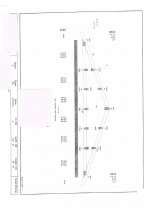
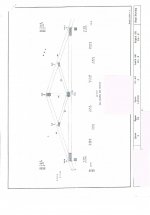
So I was given a copy of their plans, but I'm not sure if I am reading them right.

My shed/garage will be 14 wide x 20 long x 8 high, and I was looking for a 1' overhang on all 4 sides.

I making the shed/garage as a 4/12 pitch.

What I can't tell for sure is the dimensions of the wood that I am suppose to cut, and their angles?

The scale on the bottom isn't a proper scale, and though I've tried to make mine up the dimensions just don't seem right?

The ceiling joists appear to be a bit shorter than 14'

The rafters appear to be about 8' 3", and the rise 2'4".

I have mucked around with several online calculators, and they all seem to come up with something different.

I've also noticed in the bottom of the two attached pictures, that they say Left 10 OH 8 and Right 10 OH 8.

So then I thought that they were saying that the rafters were 10'8"?

I know that most of you have built yours without the ceiling joist, and I'm fine with that, but I'm just not sure how.

So again, could somebody either dimension off the attached drawings for me, or provide me with dimensions of rafters using a ridge board.

Thanks in advance if you are able to help.

John
 

Attachments

  • Rafters 1.jpg
    Rafters 1.jpg
    107.7 KB · Views: 87
  • Rafters 2.jpg
    Rafters 2.jpg
    118.8 KB · Views: 69
To avoid these ads, REGISTER NOW!
OP
G

Geobound

Well-known member
Joined
Aug 14, 2016
Messages
95
Location
Ontario
Yes sorry you are correct, the complete systems are called trusses! LOL..

Let me go and look at what you posted.
 
OP
G

Geobound

Well-known member
Joined
Aug 14, 2016
Messages
95
Location
Ontario
Okay I double checked my homemade scale, and I think I've got it figured out!

Yeah me...........possibly?? LOL......

So I think the rafter (with a 1 OH) comes out to be 8' 5" 3/16.

That should give me a rise of about 2' 6", and an angle cut of 18.4°....so I will round it down to 18° just to make it easier on the mitre saw.

That will probably now make my rafter length 8' 5" 1/16, so that won't be the end of the world to make that adjustment.

If I am wrong and somebody wants to chime in great, but I think I'm good to go now.
 

Marctrees

Well-known member
Joined
Mar 5, 2015
Messages
6,265
Location
TX/LA border - Toledo Bend
So, you now want to make them yourself, or from the beginning, and then looked for a designer ???

That's why you are looking at the angle degrees of the cuts at all the joints?

It's usually the most cost effective to give the length, type, and pitch of trusses, and order them readymade.


Maybe I'm misunderstaing your issue.

Otherwise I don't understand the question. Marc
 
Last edited:

mkbrower

Active member
Joined
Aug 11, 2010
Messages
44
Location
Foot Hills of North Carolina
If you have a span of 14 feet, you have a run of 7 feet. If your pitch is 4/12 then you have a rise of 28 inches (4X7). your point of reference will be 1/2 the width of the diagonal board. if you use a 2x6 for your diagonal board, mark a line at half the width, (2.75") the length of your board.

length of diagonal board= 88 9/16" - ridge to edge of wall, measured on the line you drew, not at the edge. Add 12" for over hang. subtract half the thickness of ridge board.
plumb cut = 18.43 degrees
level cut = 71.57 degrees

plumb cut and level cut should = 90 degrees
 
Last edited:

OccupantRJ

Well-known member
Joined
May 15, 2009
Messages
10,965
Location
Eastern North Carolina
Lay it out in actual size on a concrete floor or driveway, then copy that. After the first one, nail small wood stops to the truss and use it for the master build jig. The chord (what you are calling ceiling joist) length will equal the width of the building. The end trusses are different and are called gable trusses. A dropped end truss can also be used to make a more sturdy rake overhang. You can likely buy them cheaper than building them if you can find another supplier to get it in gear.
 

red61cj5

Well-known member
Joined
Mar 31, 2016
Messages
3,739
Location
West Virginia
Just call a local lumber yard and ask if they have stock 14 foot trusses in stock, they will have a 12 inch overhang and be about 30 bucks each, a little more delivered, usually about a 4 pitch. Way easier and usually cheaper too.
 
Last edited:
OP
G

Geobound

Well-known member
Joined
Aug 14, 2016
Messages
95
Location
Ontario
Thank you everybody for your replies.

I have called 3 people local to me that makes trusses, and talked to all the big box stores and they have all said I am **** *** out of luck.

The first truss co said that it would take 12 weeks at a minimum, the second one said spring at the earliest and the third said that they weren't taking on any new clients.

The big box store that I have bought all my material from couldn't source them either, so that's why I'm on my own.

The big box store that I am buying the rest of my material from are the ones that provided me with that drawing, so they are fully aware of what it is that I am trying to do.

Believe me, if I could have somebody make them I would.

I even tried a local contractor that I know, and he wasn't available to help for a few weeks either.

I have never been shy about paying somebody for things I couldn't do, but in this particular case I can't find anybody!

So onwards and upwards I suppose.

To the question about the overhang......yes I want to add 1' to the rake end as well.

I will just make a ladder end truss (he says like it's a piece of cake), and then put those on the end of my gable trusses.

If all goes well it won't take me more than the 12 weeks I was quoted for the factory built ones. LOL.........

I will update you to how the build goes when I get to it.
 

bczygan

Well-known member
Joined
Nov 4, 2009
Messages
22,002
Location
DETROIT! Arsenal of Scrappers
You CAN NOT make them yourself!!!

Let me say that again!

You do not have the equipment to make the plate connections that give the truss it's strength.

You do not have the engineering savvy to choose species and strengths of materials for each member.

Buy trusses or install a system of ceiling joists and rafters, with the members properly sized.

Bill
 
Last edited:
To avoid these ads, REGISTER NOW!

finn

Well-known member
Joined
Mar 27, 2005
Messages
16,202
Location
The UP, God's country
Menard has 14' 4/12 stock trusses for $35, but with 2' overhang.

Buy stock trusses and cut off the extra foot of overhang if you can't deal with the additional overhang.
 

Jlbc212

Well-known member
Joined
Dec 7, 2013
Messages
1,530
Location
Northeast MA
You CAN NOT make them yourself!!!

Let me say that again!

You do not have the equipment to make the plate connections that give the truss it's strength.

You do not have the engineering savvy to choose species and strengths of materials for each member.

Buy trusses or install a system of ceiling joists and rafters, with the members properly sized.

Bill

Locations that are regulated by building codes most often require a plan of the truss designed and stamped by a structural engineer. Most trusses today are built in a factory to the engineer's specifications. However, there was a time before building codes were adopted when trusses were built on site with bolted connections or plywood gusset plates. It's easy enough to find a plan for a truss and build it with plywood gusset plates.
 
Last edited:

walrus

Well-known member
Joined
Nov 12, 2008
Messages
11,674
Location
Maine
You CAN NOT make them yourself!!!

Let me say that again!

You do not have the equipment to make the plate connections that give the truss it's strength.

You do not have the engineering savvy to choose species and strengths of materials for each member.

Buy trusses or install a system of ceiling joists and rafters, with the members properly sized.

Bill
Plate connections can be done with plywood, glue, screw, nail, etc. Trusses have been made by others besides Truss companies
 

Kevin54

MEMBER EMERITUS
Joined
Jan 12, 2005
Messages
29,341
Location
Urbana, Ohio
Plate connections can be done with plywood, glue, screw, nail, etc. Trusses have been made by others besides Truss companies

^^^^THIS^^^^

Building a truss isn't really rocket science, and you can buy truss plates to make a truss yourself....BUT....at only 14' wide, with a 1' overhang, get some 2x6's and build a rafter. If you plan on putting a ceiling in, then tie the ceiling joist in off of the ridge beam. I have a 12'x20' shed, 1' overhang, 1' on the gable ends, and it is built all out of 2x4's. I have moved this shed all over the place and it hasn't affected anything. My shed is only 2' smaller on the width.

And as said above, pick up a book at Lowes, or one of the other box stores, and build your own. As long as you can figure out the correct angles, you can use 2x4's, and OSB for the ties. Some glue, some screws, and you are good to go.
 

2mJps

Well-known member
Joined
Feb 20, 2012
Messages
1,797
Location
north central Mo
You CAN NOT make them yourself!!!

Let me say that again!

You do not have the equipment to make the plate connections that give the truss it's strength.

You do not have the engineering savvy to choose species and strengths of materials for each member.

Buy trusses or install a system of ceiling joists and rafters, with the members properly sized.

Bill

Negative Nacy. Its not brain surgery. Go to a old time hardware store or a lumberyard and ask if they know of anyone that would help you build a truss for a pattern and tell them you will pay well.
 

bczygan

Well-known member
Joined
Nov 4, 2009
Messages
22,002
Location
DETROIT! Arsenal of Scrappers
Locations that are regulated by building codes most often require a plan of the truss designed and stamped by a structural engineer. Most trusses today are built in a factory to the engineer's specifications. However, there was a time before building codes were adopted when trusses were built on site with bolted connections or plywood gusset plates. It's easy enough to find a plan for a truss and build it with plywood gusset plates.

This is why you shouldn't build them yourself. If you build them as trusses, you may not get approval. The reason is that codes require you to meet certain load conditions for your area. DIY trusses have no engineering, so you cannot show that you met these requirements.

There is an alternative.

Build it as rafters and joists, that meet the load requirements, and then add any intermediate members that you might want, including gussets. It will be overbuilt, because the rafters and joists will do the job alone, but it will meet code based on them.

Or just use rafters and joists alone and be done with it.

Use #2 and better hem-fir for rafters and joists. 2x6 rafters and 2x8 joists 24" on center.
(Assuming a 20# snow load for rafters and a 20# live load for the ceiling joists and 10# dead load and L/240.)

What are your snow load requirements? Finished ceiling planned?

Bill
 
Last edited:

csp

Well-known member
Joined
Mar 23, 2010
Messages
5,719
Location
Franktown, CO
Bill you're so hung up on code and that kind of stuff that you're forgetting that this is only 14 feet wide. Frame of reference

And you can absolutely DIY your own trusses with engineering involved if they are built in accordance with an engineered drawing. I built the gable trusses in my garage when those supplied by the truss company were incorrect and we had a schedule to meet. My framing inspector paid a little more attention to them vs the other trusses, but they passed with flying colors.
 
Last edited:

bczygan

Well-known member
Joined
Nov 4, 2009
Messages
22,002
Location
DETROIT! Arsenal of Scrappers
Bill you're so hung up on code and that kind of stuff that you're forgetting that this is only 14 feet wide. Frame of reference

And you can absolutely DIY your own trusses with engineering involved if they are built in accordance with an engineered drawing. I built the gable trusses in my garage when those supplied by the truss company were incorrect and we had a schedule to meet. My framing inspector paid a little more attention to them vs the other trusses, but they passed with flying colors.

You are absolutely correct.

Most places in this country require permits for this kind of structure, and if using trusses, they need to be engineered, no matter who builds them. And of course they must be built according to the engineered drawings.

14 feet wide or 40, there's hundreds of pounds over your head. Code and engineering simply assure that a specific safety factor is engineered into the structure.

My mentioning these things, is so that unknowing owners don't find themselves in a fix. If the OP builds these and later has to tear them off, it would be a shame. He needs to consult with his inspector on all the particulars.

Can you build trusses? Sure. And if no governing authority is involved, do whatever you want. Personally, I wouldn't design my own, but rather follow a design already engineered. And for a span like this, I would use rafters and joists anyway, to open it up. But then I'd use a 12/12 pitch or a Gambrel roof if height restrictions allowed.

Bill
 

Justanoldguy

Well-known member
Joined
Jun 1, 2008
Messages
3,673
Location
Atiamuri. Central North Island. New Zealand
You CAN NOT make them yourself!!!

Let me say that again!

You do not have the equipment to make the plate connections that give the truss it's strength.

You do not have the engineering savvy to choose species and strengths of materials for each member.

Buy trusses or install a system of ceiling joists and rafters, with the members properly sized.

Bill

Also pro built trusses have a camber built into them.
This camber is dependent on the span, pitch and roof type.
I use to make them for a living and an amateur built one is never ideal.:dunno:
 

gungatim

Well-known member
Joined
Jan 8, 2013
Messages
8,101
Location
west mich
Buy a rafter book and stick frame it.

This. if you are going to do all the labor of making trusses, you lose the benefit. just hand rafter it like normal. it's easier and faster. or order the trusses from Menards or a local truss company...they can bang them out in a few hours, so find one not so busy.
 

the GOAT

Well-known member
Joined
Dec 8, 2015
Messages
81
You CAN NOT make them yourself!!!

Let me say that again!

You do not have the equipment to make the plate connections that give the truss it's strength.

You do not have the engineering savvy to choose species and strengths of materials for each member.

Buy trusses or install a system of ceiling joists and rafters, with the members properly sized.

Bill
:lol_hitti

Canada plan service:

Scroll down and look at the plans for the span and on center spacing you need. There is also nailing information.

https://www.ag.ndsu.edu/extension-aben/buildingplans/construction
 

csp

Well-known member
Joined
Mar 23, 2010
Messages
5,719
Location
Franktown, CO
Most places in this country require permits for this kind of structure, and if using trusses, they need to be engineered, no matter who builds them. And of course they must be built according to the engineered drawings.

Are you always this captain obvious and repetitive in the same thread?

Personally, I wouldn't design my own, but rather follow a design already engineered.

Isn't that what I said? Interesting that first you say you can't DIY because there's no engineering involved, but now you're backtracking.

BTW, do you have a roof yet?
 

bczygan

Well-known member
Joined
Nov 4, 2009
Messages
22,002
Location
DETROIT! Arsenal of Scrappers
Are you always this captain obvious and repetitive in the same thread?


Isn't that what I said? Interesting that first you say you can't DIY because there's no engineering involved, but now you're backtracking.

BTW, do you have a roof yet?

Seems we agree completely.

I didn't backtrack, but rather added more explanation.

Bill
 
Last edited:
To avoid these ads, REGISTER NOW!
Top Bottom