To avoid these ads, REGISTER NOW!

Rafter insulation

garretts

Member
Joined
Mar 25, 2024
Messages
17
I just became the proud owner of a new (to me) garage in central Florida - I'm planning on putting in framed walls and a mini split. I currently have a 12K BTU AC in the window and it works fairly well except on the hottest of days. I know the big roller garage is a huge cooling loss no matter what, but I want to do what I can otherwise to make the AC as efficient as possible.

My main question is, given properly insulated and framed out walls, how would you approach this ceiling? It is a 30 ft span of 2x4 trusses with a shallow "attic" space - the truss brackets have no markings that I can see, so I don't know what kind of load the chord could take for a ceiling, and I would prefer to keep it open for maximum flexibility anyway. I don't need it to be insulated like a living space, but an improvement over just plywood would be nice. No venting that I can see (ridge, soffit, gable) but possible to add some when we get the roof redone in the near future.

My thought was rafter vents and 24 inch batt insulation stapled - would that be a good strategy? I don't really care how it looks up there.
 
To avoid these ads, REGISTER NOW!

firebirdparts

Well-known member
Joined
Jun 8, 2016
Messages
10,601
Location
Kingsport, TN
With 2 by 4's, you don't have enough material to attach big batts to. You could put R13 up there hot roof style, but that's not adequate. You could do it anyway, of course. better than nothing.
 

NUTTSGT

Super Moderator
Staff member
Joined
Sep 14, 2009
Messages
50,907
Location
Northern Central Ohio
Each area of the country does stuff differently. Some southern states with make the attic space a "conditioned" area. Up here in our area, we separate attic space from conditioned spaces.

I would put insulation in the truss chords and attach a ceiling to the bottom of them.
 

PCustoms

Well-known member
Joined
Jul 23, 2011
Messages
22,627
Location
VT
Does that open space go above a dwelling area, or is this detached?

I don't see any benefits to leaving this open. Put some liner panel, drywall or thin plywood up as a ceiling to support insulation.
 

Gozo

Well-known member
Joined
Oct 10, 2013
Messages
250
Location
Central VA
You could sister some 2x10 or such to get a deeper space for more insulation. I’d also add ridge and soffit vents. Then you can drywall or whatever over it.
Its Florida, I bet it’s gets warm up there. Insulation helps, especially to lessen the load on the A/C.
 

PCustoms

Well-known member
Joined
Jul 23, 2011
Messages
22,627
Location
VT
You could sister some 2x10 or such to get a deeper space for more insulation. I’d also add ridge and soffit vents. Then you can drywall or whatever over it.
Its Florida, I bet it’s gets warm up there. Insulation helps, especially to lessen the load on the A/C.
If you do blow in or later the batts there's no reason to sister anything.
 

billconner

Well-known member
Joined
Jul 20, 2021
Messages
6,963
Location
Thousand Islands NYS
The capacity of the trusses to bear the weight of liner panel and cellulose is a good question. If you can't find their origin, maybe ask building department. Ideally a structural engineer but unless you gave one as a friend, it gets pricey.

Rather than framing a wall inside block, consider just rigid foam. Could even look at the combo OSB and foam sheathing. Less space lossed, better insulation, less work.
 

BillK

Well-known member
Joined
Aug 24, 2006
Messages
9,320
Location
Beautiful Southern Maryland
Thats a tough one because of how shallow the roof pitch is. If you ever needed to get up there for wiring etc it will be a pain if you insulate at the bottom of the trussess.
 
OP
G

garretts

Member
Joined
Mar 25, 2024
Messages
17
Does that open space go above a dwelling area, or is this detached?

I don't see any benefits to leaving this open. Put some liner panel, drywall or thin plywood up as a ceiling to support insulation.

It is attached to a mobile home. A previous owner added it for his RV (that's why it has a 12ft rolling garage door).

The part that intrudes into the garage is a laundry room that has the hot water heater and washer/dryer. I'm probably going to rip that all out to reclaim the garage space (and get a door that can go straight to the garage).

 
OP
G

garretts

Member
Joined
Mar 25, 2024
Messages
17
With 2 by 4's, you don't have enough material to attach big batts to. You could put R13 up there hot roof style, but that's not adequate. You could do it anyway, of course. better than nothing.

Now that I look closer, i may have soffit vents, but no ridge vent. I also have 7.5KW of solar covering most of this roof (not that it matters much other than blocking heat).

If I went with 4 inch batt stapled/strapped and did a "hot roof" would I want rafter vents also if these are soffit vents?

 
OP
G

garretts

Member
Joined
Mar 25, 2024
Messages
17
Rather than framing a wall inside block, consider just rigid foam. Could even look at the combo OSB and foam sheathing. Less space lossed, better insulation, less work.

Would that pass fire code and be ok with regard to vapor issues? How would you handle the electrical with that approach?
 

PCustoms

Well-known member
Joined
Jul 23, 2011
Messages
22,627
Location
VT
It is attached to a mobile home. A previous owner added it for his RV (that's why it has a 12ft rolling garage door).

The part that intrudes into the garage is a laundry room that has the hot water heater and washer/dryer. I'm probably going to rip that all out to reclaim the garage space (and get a door that can go straight to the garage).

That's an odd setup.

Typically a fire rated wall would be required there, not sure how that changes if the garage attic is built over the mobile home roof.
 

billconner

Well-known member
Joined
Jul 20, 2021
Messages
6,963
Location
Thousand Islands NYS
Would that pass fire code and be ok with regard to vapor issues? How would you handle the electrical with that approach?
With ply or OSB or drywall covering, I believe it would comply with code.

I think it will be bulletproof as far as moisture. Nothing better than concrete and foam as far as moisture is concerned.

Simplest electrical is surface in conduit or raceway. You could route channels in the foam and recess boxes in it.
 
To avoid these ads, REGISTER NOW!
OP
G

garretts

Member
Joined
Mar 25, 2024
Messages
17
What do you think about furring strips over the foam with spring spikes then cover with drywall like these guys do?


7echo

Well-known member
Joined
Feb 16, 2008
Messages
432
Location
coastal Georgia
How long before it needs a new roof? If it is time for a roof add 4" of polyiso on the deck, then re-roof.
Maybe get a price on 3" of closed cell spray foam directly to the deck?
 

Firebrick43

Well-known member
Joined
May 12, 2015
Messages
14,023
Location
West central Indiana
Hot roofs should only be done with spray foam or sheet foam tightly fitted and perimeter sealed.

Fiberglass batts against the roof deck is a good way to rot the roof deck out. Leave the insulation at the bottom of the truss and cut in either vents on the gables or a ridge vent.
 
OP
G

garretts

Member
Joined
Mar 25, 2024
Messages
17
How long before it needs a new roof? If it is time for a roof add 4" of polyiso on the deck, then re-roof.
Maybe get a price on 3" of closed cell spray foam directly to the deck?

The roof will be replaced this year - it is vented on the gables so I don't think insulation on the deck would work?
 
OP
G

garretts

Member
Joined
Mar 25, 2024
Messages
17
Hot roofs should only be done with spray foam or sheet foam tightly fitted and perimeter sealed.

Fiberglass batts against the roof deck is a good way to rot the roof deck out. Leave the insulation at the bottom of the truss and cut in either vents on the gables or a ridge vent.

When I get the roof replaced I'm thinking of adding a ridge vent (already have gable vents) then using ridge vents and R-13 insulation over those - I would still have to cover the batts to make it fire resistant which seems like a lot - no product seems great for 24 inch rafter covering.

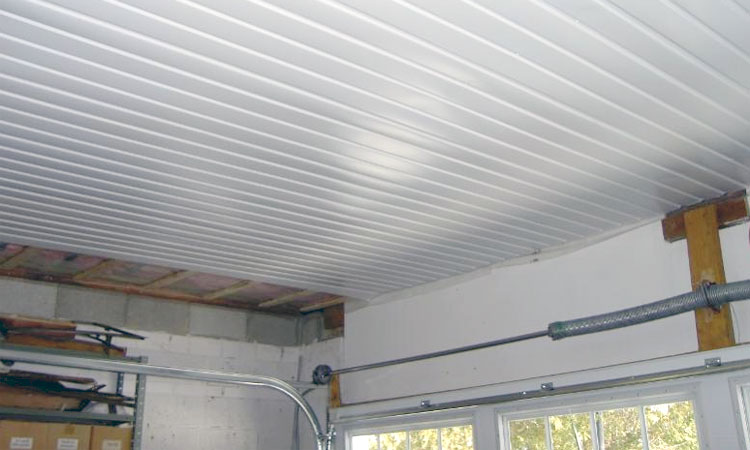
For a ceiling solution on the bottom of the truss I'm looking at one of these alternatives to drywall for the ceiling. Given my 2x4 trusses I'm worried about weight. The vinyl beadboard soffit looks pretty good and won't echo as bad as metal (not sure the fire/code ramifications of that stuff).


billconner

Well-known member
Joined
Jul 20, 2021
Messages
6,963
Location
Thousand Islands NYS
Hot roofs should only be done with spray foam or sheet foam tightly fitted and perimeter sealed.

Fiberglass batts against the roof deck is a good way to rot the roof deck out. Leave the insulation at the bottom of the truss and cut in either vents on the gables or a ridge vent.
Off topic a little, but what would you think of a "hot roof" 2x12s sensed packed with cellulose and then 4 or more inches of rigid foam on top of deck? I was thinking of maybe ice and water shield on deck, then foam and purlins for metal roof. No interior vapor barrier, so it can dry inward if necessary.
 

paredown

Well-known member
Joined
Jan 12, 2012
Messages
544
Location
Pomona, NY
Sorry, I mean for the walls - Bill suggested using foam for the concrete block instead of a full 2x4 stud wall.
There's a good 'This Old House' segment where they do a basement wall-rigid foam and strapping. It is less deep than a full 2x wall, but still allows wire pulls and standard electrical boxes. Rigid foam is getting expensive, but this is a fast and efficient way to get usable wall framing.


As far as the ceiling, I would be tempted to use R13/R15 for 2x walls inside the cavities formed by the 2x trusses, and then whatever thickness of batts running across the top of the trusses. Standard practice for old attics where the ceiling joists are usually lighter than what is used now.

To hold the insulation, even 1/2" lightweight drywall is a lot of weight--I would be tempted to use Luan, even if you had to add a light nailer on the large openings.
EDIT: apologies--you already pulled up that TOH link. I think it is a smart way to go.
 
Last edited:

Firebrick43

Well-known member
Joined
May 12, 2015
Messages
14,023
Location
West central Indiana
Off topic a little, but what would you think of a "hot roof" 2x12s sensed packed with cellulose and then 4 or more inches of rigid foam on top of deck? I was thinking of maybe ice and water shield on deck, then foam and purlins for metal roof. No interior vapor barrier, so it can dry inward if necessary.
I am not a fan of hot roofs period because of the difficulty of repairs if necessary down the road especially with R panel or shingles. A good terne metal roof or standing seam, then meh, ok.

As far as dense pack cellulose against the roof I have actually done it in one little shed, 14” thick and I think it will probably be alright as there is no convection currents in it that are formed like there is in fiberglass. It’s been in place since 2006 now and from my roof inspections I have not seen and soft spots in the roof.

Foam doesn’t have the issue for the same reason.

It is hard to do right as the weight of the insulation wants to sag. I packed it dense enough but used duraplate for a ceiling which is much stiffer than drywall or a metal liner.

The other thing I have thought about is if I really would want to do it in a house? There is a lot more moisture produced in a home due to showers, cooking, and other steamy things that happen under the roof.

I have always over built things with first class materials with an emphasis on durability and longevity being first and foremost with energy efficiency second. After my experiment with one in my little piddle shed I think I would have been just as happy with a conventional ceiling/truss structure.

Also I guess I should note I really had not seen the horrors of what an improperly insulated cathedral ceiling could wrought until I witnessed it in 2010 or so and started researching it further. It’s not isolated and quite common problem.

I do like the idea of foam on top of the deck. It moves the due point into the foam where it won’t have a chance to do any harm if the foam is thick enough, say 1.5”
 
Last edited:

Hank11

Well-known member
Joined
Aug 19, 2019
Messages
1,148
Location
Tennessee
I'd waterproof the block, build a stud wall right against the block, spray foam it full and then cover the walls with drywall. For the roof/ceiling, I'd block the soffit vents and spray the roof deck with as much open cell foam as I was willing to pay for. Then spray it with fire retardant coating. Since its getting a roof soon, I might have the new roof put on first just in case something had to be changed or replaced.

Consult with local foam people to see what is the accepted method in your area. I think it will be open cell.
 

7echo

Well-known member
Joined
Feb 16, 2008
Messages
432
Location
coastal Georgia
@Firebrick43
"I do like the idea of foam on top of the deck. It moves the due point into the foam where it won’t have a chance to do any harm if the foam is thick enough, say 1.5” "

In the zone where the building is located 1" on the deck is enough to avoid the condensation issue.
Hot roofs should only be done with spray foam or sheet foam tightly fitted and perimeter sealed.

Fiberglass batts against the roof deck is a good way to rot the roof deck out. Leave the insulation at the bottom of the truss and cut in either vents on the gables or a ridge vent.
Agree with this. If you do insulate at the truss' you should air seal that ceiling.
 

7echo

Well-known member
Joined
Feb 16, 2008
Messages
432
Location
coastal Georgia
I'd waterproof the block, build a stud wall right against the block, spray foam it full and then cover the walls with drywall. For the roof/ceiling, I'd block the soffit vents and spray the roof deck with as much open cell foam as I was willing to pay for. Then spray it with fire retardant coating. Since its getting a roof soon, I might have the new roof put on first just in case something had to be changed or replaced.

Consult with local foam people to see what is the accepted method in your area. I think it will be open cell.

Closed cell is the way to go, particularly against the roof deck. In addition to the insulation value it adds strength.
 
To avoid these ads, REGISTER NOW!
Top Bottom