To avoid these ads, REGISTER NOW!

Rafters & Ridge Board are separating

brouser01

Well-known member
Joined
Dec 2, 2009
Messages
91
Hello,

I have read many threads on this subject, obviously there are many conflicting opinions.

The rafters on the north side of my 1923 craftsman house are moving away from the 1" x 6" ridge board. The house is basically a rectangle with a load bearing wall running down the center, the roofs peak is over the load bearing wall. The load bearing wall is running east & west.

-The rafters on the south side are still touching the ridge board.
-About half of the rafters on the north side are NOT touching the ridge board (not touching = the first 25' of the house).

The house is leaning, just for illustration purposes 95 degree south.

Do I attempt to pull the north side rafter towards the ridge board?
Do I sister boards on the north side to touch/connect back to the ridge board?
Do I install collar ties?

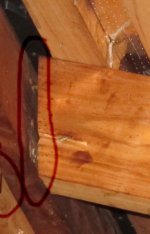
I do not have any pics of my place but attached is basically what my attic looks like. My roof is 2x4 rafters + 1"x6" ridge board + 1" planks (not plywood).

Thanks for any & all info,
brouser01
 

Attachments

  • gap-pic.jpg
    gap-pic.jpg
    23 KB · Views: 278
To avoid these ads, REGISTER NOW!

boobag

Well-known member
Joined
Aug 15, 2010
Messages
397
normally roofs sag over time. seems like you have the opposite problem.
 
OP
B

brouser01

Well-known member
Joined
Dec 2, 2009
Messages
91
I will get pics as soon as possible.

My house is the same as most (especially in my area built on clay, soil = clay lots of movement). Foundation (perimeter) is ok (ok = the concrete does not have any major cracks etc), there are definitely ups & downs throughout the house.

The entire roof definitely sags/bows, my thought is a few of the diagonal braces "purlins"? maybe pushing up while everything else is sagging down.

Should I attempt to raise the peak of the roof up?
Should I attempt to lower the floor (adjust piers under load bearing wall)?
 

DekeT

Well-known member
Joined
Aug 12, 2011
Messages
2,234
Location
USA
Without an on-site review there is no way someone can tell you what is going wrong.
 
OP
B

brouser01

Well-known member
Joined
Dec 2, 2009
Messages
91
Of course, I am looking for more info or personal insight/experience on similar situations.

For example, if someone says early construction did include collar tie type of braces and that is why in general the roof is sagging. That information would be helpful in understanding at least some of what is going on.

Knowledge is power.
 

Radix2

Well-known member
Joined
May 28, 2014
Messages
1,853
Location
the thumb!, MI
you say the center wall is load bearing - are there supports to the ridge board from this center wall (throughout the run)? or is the center wall just supporting the ceiling?
 
OP
B

brouser01

Well-known member
Joined
Dec 2, 2009
Messages
91
you say the center wall is load bearing - are there supports to the ridge board from this center wall ? or is the center wall just supporting the ceiling?

There are no vertical supports from the top of the load bearing wall to the ridge board.
There are only diagonal rafters supports here & there.
 
Last edited:

Radix2

Well-known member
Joined
May 28, 2014
Messages
1,853
Location
the thumb!, MI
you say the center wall is load bearing - are there supports to the ridge board from this center wall ? or is the center wall just supporting the ceiling?

There are no vertical supports from the top of the load bearing wall to the ridge board.
There are only diagonal rafters supports here & there.


so one would have to ask what is holding the ridge board/roof up ? (if the ridge board/roof moved down, it would close the gap you have there...

any possibility to take a few pictures to show the attic ?
 

kbs2244

Well-known member
Joined
Nov 11, 2006
Messages
14,065
For whatever reason the outside south wall has bowed out.
You should have joists tieing it to the top plate of the center wall.
Most likely the nails at the ends of them have failed for some reason.
They have been subjucted to too much strain.

Jacking up the ridge board without fixing the joist problem is not enough.

I would start in the basement with a laser level and get the floor level and then work your way up.

Your basic style of construction is fine..
There are millions of houses built this way.
But they need a solid base.
 
OP
B

brouser01

Well-known member
Joined
Dec 2, 2009
Messages
91
For whatever reason the outside south wall has bowed out.
You should have joists tieing it to the top plate of the center wall.
Most likely the nails at the ends of them have failed for some reason.
They have been subjucted to too much strain.

Jacking up the ridge board without fixing the joist problem is not enough.

I would start in the basement with a laser level and get the floor level and then work your way up.

Your basic style of construction is fine..
There are millions of houses built this way.
But they need a solid base.

I believe this (nails have failed at the ends of the ceiling joists) is 100% what has happened & what is needed to be fixed.

I spent about 5 hours today under the house & in the attic.
Like I said the floors have ups & downs, from crawling under the house I can see there was a water pooling issue a while ago. It looks like some of the piers have sank & some have tilted. And a quick laser check shows the north side is atleast 1.5" higher than the south side.

I can get the floors flatter than they are now, I don't perceive an issue with that.
Getting the ceiling joists back in place at the ends and getting the rafters to meet back up at the ridge board, what are your suggestions?

I am attempting to attach a couple of pics, one shows one side away from the ridge board & the other was a spot where both sides were pulling away.


Thanks.
 

Attachments

  • image.jpg
    image.jpg
    139.6 KB · Views: 110

pstnbly

Well-known member
Joined
Jul 20, 2010
Messages
766
Location
So. Vermont
Some of the gap may be due to shrinkage, those rafters appear to be rough sawn and were most likely not KD. You need to inspect the collar tie (ceiling joist) to make sure there hasn't been any slippage, if there has the building will need to be drawn together and the collar tie reinforced or new collar ties sistered in.
 

brouser0101

New member
Joined
Jun 26, 2015
Messages
1
Can you explain the "drawn together" procedure? Special tools, steps, or any info is greatly appreciated.
 

CNGsaves

Well-known member
Joined
Sep 26, 2012
Messages
13,233
Location
KS and OK
Too little information . . . . where is "my area" . . . . . you in Canada or Florida??

If in Florida and sinkhole under one side of building, then there's your answer.

Update GJ Profile with City/State/Country.

You'll NEED to post LOT's more pics . . . . various angles of exterior walls, roof, etc. . . . . plus a slew of interior pics.

What methods used to handle rain runoff ?? Structure have proper clean gutters that direct all water far away from footings?? What is lay of land?? Is slope of land directing lots of water all to that one side of building, thus causing just that one side to settle??

More info . . . more info . . . more info.
 

CNGsaves

Well-known member
Joined
Sep 26, 2012
Messages
13,233
Location
KS and OK
Can you explain the "drawn together" procedure? Special tools, steps, or any info is greatly appreciated.

Why do you have TWO logins to GJ . . . ?????
. . . .
. . . . . Brouser01
. . .
. . . . . . . AND . . .
. . .
. . . . Brouser0101
 

like2wheel

Well-known member
Joined
Oct 29, 2014
Messages
1,693
Location
On an as needed basis
Some of the gap may be due to shrinkage, those rafters appear to be rough sawn and were most likely not KD. You need to inspect the collar tie (ceiling joist) to make sure there hasn't been any slippage, if there has the building will need to be drawn together and the collar tie reinforced or new collar ties sistered in.

Lumber doesn't shrink lengthwise,

Drawing the rafters back to the ridge could be complicated by whatever roofing material might have been installed after any separation occured. May be time to install a ridge vent.
 
Last edited:
OP
B

brouser01

Well-known member
Joined
Dec 2, 2009
Messages
91
Login = brouser01
tapatalk app = brouser0101 (I must have miss type the login registering in the app)
 
OP
B

brouser01

Well-known member
Joined
Dec 2, 2009
Messages
91
I believe I recognize the issues of why the house has settled the way it has. I will do everything to prevent these same issues in the future.
I am at the point were I am attempting to get it closer to where it needs to be. If anyone can advise on drawing the house back together, tieing the ends of the ceiling joists back in place or raising the ridge board that would be great.
Thanks
 
To avoid these ads, REGISTER NOW!

Hpozzuoli

Well-known member
Joined
Dec 11, 2013
Messages
3,428
Location
Rhode Island
I see some sort of under pinning, but no collar ties. The collar ties prevent just this by not allowing the two sides to pull off the ridge.
 
OP
B

brouser01

Well-known member
Joined
Dec 2, 2009
Messages
91
Lumber doesn't shrink lengthwise,


Drawing the rafters back to the ridge might be complicated by whatever roofing material might have been installed after any separation occured. Might be time to install a ridge vent.


Can you tell me what your thoughts are on a ridge vent?
Thanks
 

Radix2

Well-known member
Joined
May 28, 2014
Messages
1,853
Location
the thumb!, MI
Can you tell me what your thoughts are on a ridge vent?
Thanks

Like2wheel is making the same point I made earlier - normal forces of gravity will not allow the rafters to separate from the ridge - the weight of the roof will push that joint together (the roof planes are leaning on each other).

So what is expected is the roof to sag if the walls bow out. If that is not happening either the ridge board is being held up ( doesn't appear to be) or the roofing materials are supporting the weight and holding the joint apart.

If you want to get the rafters tight, you would have to remove this bind. Cutting a ridge vent would be an obvious way to make sure that there is nothing holding the two sides of the roof apart since it involves cutting the center of the roof out.

But realize that doing so will allow the roof to sag unless you draw the walls in to regain support of the rafters.

Are the ceiling joists in two pieces with a lap joint over the center wall? Do you see slippage in that joint. - cracks in the ceiling joints? Do you see the slippage at the wall top connections ?

If this problem is so old that the plaster has been fixed and the roof material interferes, I really question the value if cutting all that apart to bring these joints together. I would consider adding collar ties to stabilize, stabilizing whatever is allowing the ceiling/ walls to spread and calling it a day.
 

pstnbly

Well-known member
Joined
Jul 20, 2010
Messages
766
Location
So. Vermont
Lumber doesn't shrink lengthwise,

Drawing the rafters back to the ridge might be complicated by whatever roofing material might have been installed after any separation occured. Might be time to install a ridge vent.

You better rethink that opinion. As a home builder, timber framer, and someone who has worked a great deal whit rough cut green lumber for 42 yrs I will assure you it most certainly does, and especially when exposed to harsh conditions as in an attic. There are probably no better conditions than attic climates for drying lumber, hot, dry, and ventilated.

Now did I say shrinkage accounted for all the gap we see here? I did not.
 

pstnbly

Well-known member
Joined
Jul 20, 2010
Messages
766
Location
So. Vermont
Can you explain the "drawn together" procedure? Special tools, steps, or any info is greatly appreciated.

Sorry, I was gone for a while.

Buildings can be drawn with any number of methods. A couple of common come-alongs strategically placed may be enough. When more is needed I have fabricated bridles that have been mounted in the walls and draw bars with turn buckles were used to pull. On one job I was able to pull an 11" bow out of an outside bearing wall where the ridge had settled over 8" on a house with a supposed structural ridge and no collar tie.

Whatever method you use patience is the key, don't expect immediate results. Apply steady pressure evenly, then go around with a small sledge and bump things, preferable in the direction you want them to move but just the vibration will help overcome the sticktion of the fasteners. Go a little at a time rinse repeat. if there is a sag in the ridge you may have to jack vertically at the same time.

Pull and jack at multiple points. Be safe, don't get in over your head.
 
OP
B

brouser01

Well-known member
Joined
Dec 2, 2009
Messages
91
Rafters & Ridge Board are separating

Are the ceiling joists in two pieces with a lap joint over the center wall? Do you see slippage in that joint. - cracks in the ceiling joints? Do you see the slippage at the wall top connections ?


-Yes the ceiling joists are two piece that over lap. I opened the ceiling on the south side, the end of the ceiling joists is approximately 1" from the outside of the top plate. FYI, the walls are old 2"x3"s not 2x4s.


If this problem is so old that the plaster has been fixed and the roof material interferes, I really question the value if cutting all that apart to bring these joints together. I would consider adding collar ties to stabilize, stabilizing whatever is allowing the ceiling/ walls to spread and calling it a day.


-There are no issues with cracked drywall because of this wall bowing out. About two years ago I had the plaster ripped out and replaced with drywall, so the issue is at least two old and hasn't continued to move (it is an assumption based on no new damage to the two year old drywall).


pstnbly

If I am going to attempt to bring the exterior wall back in, would you suggest securing the come-alongs then cutting the nails that are/were holding the rafters & ceiling joists in place? Also, so the wall has somewhere to go should I cut the drywall in corner of the wall (where the wall & the ceiling meet?


Thanks
 
Last edited:

Kevin54

MEMBER EMERITUS
Joined
Jan 12, 2005
Messages
29,341
Location
Urbana, Ohio
My initial reply is to say "dude, you're screwed", but everything is fixable. Are you currently living in the house....is this a remodel you are doing.....or is this a problem that you have ran into and want to fix on the cheap, or are you willing to put some money into it?

With that out of the road, I would buy a huge tarp for one, as you are going to need it. Plus you are most likely going to have to reroof the house. You will also have some holes knocked in here and there along the outside top plates where you can fasten a cable and a come-a-long to pull in the walls. If the house is plaster and lath, you can put holes in the ceiling in areas, then consider drywalling the entire ceiling in the house with lightweight drywall.

I have to disagree with some of the above replies about shrinkage. The wood that shrunk, did that 80 years ago. This is a problem that seems to have been rather recent (possibly the last 10-20+ years. For the OP.....what does the foundation of the house look like? Any new or huge cracks in it? And if so, how long have they been there (if you know) or have they gotten worse recently?

If your ceilings have no cracks in them, and have not been repaired, your roof is starting to drop and pushing your walls out. But if that is the case, then you should have cracks around the perimeter of the ceiling(s). It's hard to tell without more pics, but you have a lot of things that will be working against you to pull things back into shape. You have first off the roof. If you look at your nails on your rafters, they are going in at an angle on one side. This will take some force to pull back in. also if you have to pull your wall(s) back in, you have a lot of plaster and lath that is going to hold things back from happening. One board is not bad to pull back together, but now you have hundreds of pieces of lath, the plaster on the lath, multiple rafters, crooked nails, and so on.

Myself, if it was my house, the first thing I would consider is whether the walls were bad enough to even mess with. How much damage do you want to do to the ceiling? If you don't want to have to redo the complete ceiling, then you need to just consider the roof. I would strip it down bare, and sister some new rafters alongside the existing rafters, then add new OSB for your sheeting, then reroof. I'd also use some collar ties, and some joist hangers to hold the rafters to the ridge beam. You can try to pull one rafter ate a time, and work your way back and forth a few times to pull each one a little bit at a time. You can do this by making an adapter to go on each rafter so you can pull each rafter with the adjoining rafter with a come-a-long.

If you would, could you post up some more pics of any ceiling damage you may have, along with the wall(s) that are bowed out, and any damage to the foundation if you have any?
 

tcianci

Well-known member
Joined
Feb 7, 2009
Messages
4,242
Location
Walpole, Ma
We just had a similar thread about a guys garage. He had the advantage of not having to deal with a finished interior.

You have had lots of advice, two things you need to remember, 1: the gap between the ridge board and the rafters is not the problem, its the result of the problem and 2: you're not going to be able to do anything to the rafters individually to get them back, they're held real well by the roof sheathing.

If I understand your post correctly, you're saying that the ceiling joists have moved in relation to the top plate of the exterior wall, and you're looking into the condition of the foundation. This is good information. You need to determine how much, if any, the walls have settled vertically and how much, if any, the walls have tipped outward at the top. The determination of the source of the problem will dictate the solution and may involve both shimming the sill of the building to correct the vertical component of the problem and then pulling the walls together to draw the rafters back into place. The advice about the BFH was very good. You're going to be applying a lot of force and see nothing happen until you "persuade" it a bit.

In the last thread, I advised against using cables to secure the building once it is adjusted because they're putting a lot of force on a few points. Since your house is finished, you may have no choice if you can't get long lumber up into the attic.

If the ceiling joists have indeed separated from the connection at the base of the rafters and top plate of the wall, your best bet would be to take up the first few courses of roofing and the associated sheathing to access some points along the top plate to pull from and to be able to re- establish the connection between the rafters, top plate and ceiling joists. By all means, supply several complete "across the building" members in tension to keep the walls from spreading again and install collar ties on each bay.

BTW, the center wall of the house has nothing to do with bearing the roof loads in your case and be prepared to clear any recent drywall that would prohibit the movement of the walls during jacking.

Hope this helps.
 

Zeke

Well-known member
Joined
Aug 13, 2009
Messages
17,176
Location
Long Beach CA, the sewer by the sea.
i didn't read every word in every post so apologies if it was mentioned: install some cables and turnbuckles where the ties would go, preferably low, and tighten them every few days until things are right. Then install some hardware like joist hangers to keep the rafters in place. Use screws not nails.

Edit: after reading the post above me, #29, that is indeed good advice. However, I think maybe one thought might be that the roof sheathing appears to wood strip sheathing which may give way to allow the roof to be pulled back. I mean I only see like a half to 3/4 of an inch gap.

Also, the roof pitch is so low that collar ties are nearly useless as the ceiling joists are really serving that purpose. Make sure that after any adjustments are made to pull this back together that they are connected to the roof rafters. You may have trouble accessing that area down by the top plate, but do what you can. Collar ties would help only because you probably can't get to the intersection of ceiling joists and roof rafters unless you pull off the roof.

Speaking of which, if the roof is in need of replacement that would be the perfect time to do this work.

@ brouser01 and brouser0101, why do you have 2 user names?
 
Last edited:

Kaizen

Well-known member
Joined
Jan 9, 2015
Messages
6,948
Location
New England
brouser I'd not get into this too much. I doubt you have pictures of this from ten years ago to compare but I'm guessing its been like this for a while. attempting to put it back the way it was originally will definitely cause some other issues. fix the foundation/piers.
I'd think for the heck of it I'd drill some 1inch bolts through the rafters a few feet down and use a come along to see if they moved back. start on the best one and give it a try. if it works cut a collar tie out of 2x12 and sister next to the tightened rafters/ridge. put some gorilla glue in there and use exterior screws long enough to get most of the way through both.
don't go for perfection just tighten them up and secure so you can watch it. if you ever open the walls below it you can pull the wall in but don't think for a minute that all of this was perfect. they might have cut it short. impossible to tell at this point.
 
OP
B

brouser01

Well-known member
Joined
Dec 2, 2009
Messages
91
Thanks for all of the insights, techniques, information etc etc to all. I really appreciate it all.

I will continue getting the floor as level as possible, then move my way up to the rafter ends & ceiling joists ends + the ridge board.

I will report back with whatever success I have or don't have.

Thanks again
 

pstnbly

Well-known member
Joined
Jul 20, 2010
Messages
766
Location
So. Vermont
Re: Rafters & Ridge Board are separating

pstnbly

If I am going to attempt to bring the exterior wall back in, would you suggest securing the come-alongs then cutting the nails that are/were holding the rafters & ceiling joists in place? Also, so the wall has somewhere to go should I cut the drywall in corner of the wall (where the wall & the ceiling meet?


Thanks

Yes, but I would do so judiciously. Start with the nails on the tie closest to the come-along and look for movement, you should also be able to tell how much tension the member is under. Also after placing the come-along(s) I think it would be a good idea to put some temporary supports under the ridge for safety's sake. Go slow, be aware, check every thing you can think of. String lines and levels are your friend for seeing changes. If you know about "3 blocks and a string" you are good to go. If you haven't heard of that I'll explain.
 
OP
B

brouser01

Well-known member
Joined
Dec 2, 2009
Messages
91
Thanks again, I will definitely be moving in baby steps & my eyes + ears will be 100% focused on the task at hand.

I did a quick google search for 3 blocks and a string, please explain in relation to my crooked house.
 

CNGsaves

Well-known member
Joined
Sep 26, 2012
Messages
13,233
Location
KS and OK
Thanks again, I will definitely be moving in baby steps & my eyes + ears will be 100% focused on the task at hand.

I did a quick google search for 3 blocks and a string, please explain in relation to my crooked house.

Without MORE PIC's we haven't really seen any "crooked house" other than some gaps in rafters. Also, haven't got any idea of ROOT CAUSE of . . . .
. . . . WHY . . . has the movement happened in the first place ??

Is the ground/foundation settling?? Walls bowing out??
 

Daniel Dudley

Well-known member
Joined
Sep 4, 2009
Messages
3,546
You might be able to draw those in with Timberlock type screws. Even without collar ties, rafters don't usually separate like that. Usually the walls bow, and the ridge sags.

I would like to see more pictures as well. I see some unusual diagonal braces in one of your pictures, and I am wondering if there may be some other area of the house where something in the ceiling joists or whatever might be separating as well.

There are a number of ways you can fix that, but it is still unusual.
 

pstnbly

Well-known member
Joined
Jul 20, 2010
Messages
766
Location
So. Vermont
I did a quick google search for 3 blocks and a string, please explain in relation to my crooked house.

Three blocks and a string goes like this; find an area along the wall near the top where you can pull a stringline from corner to corner (this may have to be outside), cut three blocks about 2"x3" from one piece of wood (I like to use 1/2" or 3/4" plywood), nail one block flat to each corner and pull the string between them so the string is tightly across the blocks, the third block is your gauge use it along the string to check progress. This method allows the string to have no interference with what you are gauging.

If you have to go to the outside to place your blocks you may just have to use long blocks depending on the bow. The corner blocks need to be exactly (within reason 1/8" or so) the same length on the corners and make it so the string barely misses the high point of the bow. Then use a tape measure to check progress.
 
OP
B

brouser01

Well-known member
Joined
Dec 2, 2009
Messages
91
Three blocks and a string.
Oh yeah, I am a big fan of string lines & plumb bobs. When I googled Three blocks and a string apparently there is a physics formula/theory behind the same name.

Everyone requesting pics, thanks for the interest but I do not have more pics. When I have time to work on the house the last thing I think to do is take pics. Thanks again for the interest though.

I will report after I have made progress.
 
To avoid these ads, REGISTER NOW!
Top Bottom