To avoid these ads, REGISTER NOW!

Raising Ceiling Joists / Collar Ties

CCRT

Member
Joined
Feb 12, 2008
Messages
14
I’m planning to install a 4 post lift in my existing garage and need ceiling clearance.

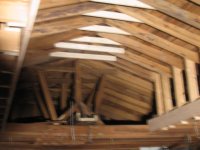
The current ceiling height is 118.50” The garage is 24’ wide by 22’ deep. 2 X 4 wall and 2 x 6 rafters and 2 x 6 ceiling joist(all 16’ OC). The ceiling joist run front to back. My plan is to raise 7 of the ceiling joists over one bay and convert them into collar ties 1/3 of the way down from the peak.

Roof is a 6.5/12 pitch

Is this the best method (short of raising the building) of achieving addition ceiling height for my new lift?


Any information is appreciated

Thanks,

--Dave


p324130518.jpg
 
To avoid these ads, REGISTER NOW!

CraigFL

Well-known member
Joined
Nov 1, 2005
Messages
704
Location
Panama City, FL
What you're going to do concerns me because the ceiling joists are there to tie the walls together so they don't spread out from the roof load. If you essentially eliminate them and just use collar ties at the top, the existing rafter is just too flexible to hold the walls. You can do this but it may require special beam-like sill plates to add back the rigidity lost from the joists.
 
OP
C

CCRT

Member
Joined
Feb 12, 2008
Messages
14
Craig--

Thanks for the good info.

I guess the current ceiling joists are acting as Rafter ties. I wonder if it would be adequate if I sistered the current rafters and raise the rafter ties less than 50% the distance from the top wall plate to the peak. (35.75")

--Dave
 

ovilla

Well-known member
Joined
Dec 18, 2005
Messages
2,342
Location
Plainfield, IL
Do you have the "W" roof trusses in place now? If so, that's what I have too and am planning on sistering 2X10's next to them along with collar ties about 1/3 of the way down.
 

Matti

Well-known member
Joined
Nov 16, 2007
Messages
412
Location
Canada
I tried to get some raised tie trusses designed and built but no one would do it. Perhaps it is doable if there was no snow load. I did buy some coffered/tray ceiling trusses. These vault the ceiling 2 feet above the wall height for the middle 18 feet. The outer 4 feet is at the wall height. I supposed you could strip the roof off of the one bay and add these kind of trusses. You could also look at scissor trusses but I doubt they would give you adequate height with a 6.5/12 roof.
 

kbs2244

Well-known member
Joined
Nov 11, 2006
Messages
14,065
If you have the traditional joist and rafter’s construction now, with the joists at the top of the walls, you can do what you are thinking about.
How high you can go will depend on your local code, which will be based on the local snow load requirements.
I have seen them vary from 1/3 to ½ to 2/3 of the rafter length.
The joists are there to keep the walls from spreading apart. But they are placed at the top of the walls just as a convince during the building.
It is not a structural need.
With a good connection with the rafters to the walls you can go to an “A” shaped, “collar joist” vs. the more common triangle shape.
Check what your local code is.
Add the good sheet metal reinforcing brackets at the rafter to wall joint, (toe nailing is not enough) put in your collar joists, and cut out your low ones.
 
OP
C

CCRT

Member
Joined
Feb 12, 2008
Messages
14
I believe I would call this traditional construction. No "W" trusses

Can you give me a example of the sheet metal brackets you are refering to?
Would I use one on each side of the rafter at the top of the wall?

p1027329372-4.jpg


p955181412-4.jpg


p755172716-4.jpg


p858070224-4.jpg


p674080185-4.jpg


Thanks for all the great info so far
 

Matti

Well-known member
Joined
Nov 16, 2007
Messages
412
Location
Canada
You have a ridge board "stick built" roof (not to be confused with a ridge beam) and not trusses. I wouldn't touch those joists without consulting an architect.
 

Ironcrow

Well-known member
Joined
Sep 30, 2005
Messages
1,169
Location
Arizona
I would be tempted to reinforce the rake walls at each end, replace the ridge board with a ridge beam, and dispense with the joists altogether.
 

CraigFL

Well-known member
Joined
Nov 1, 2005
Messages
704
Location
Panama City, FL
OK... Here's what's happening in that kind of construction. The combination of the two rafters and the lower (ceiling) joist is essentially a (triangular) truss. The roof loads are carried to the ends of the Joist/rafter connection and the joist is under tension so the spreading force on the upper wall is kept to a minimum. Therefore the roof loads just appear as vertical downward forces on the upper sill plate. Removing the lower chord of a truss(ceiling joist) would weaken the structure significantly, in that the roof loads would become horizontal spreading forces at the top of the wall. Most architects/engineers will allow for some removal of the lower truss chord if it is properly stiffened by a new chord above the removed one, typically for tray type ceilings.

I'm not convinced a ridge beam would add anything to the structure because a beam of this type would be typically supported on the ends and really not carry any of the roof load to the walls. Without the ceiling joist the real load problem is the spreading of the top of the wall. I would rather see a beam replace the top sill plate to stiffen the top of the wall horizontally.
 
Last edited:

Matti

Well-known member
Joined
Nov 16, 2007
Messages
412
Location
Canada
A ridge beam roof would work as it would be totally vaulted. With this design the ridge beam carries a significant part of the load which is transmitted to the gable ends and walls. That is why the beams are engineered and large. The joists that extend to the walls are also not just 2x4's. I was looking at this design but nobody was interested in stick building and architects are not interested in designing garages around here. A ridge beam design would require a whole new roof obviously which then opens up all of the options of which many might well be cheaper ie pre-engineered trusses.
 
OP
C

CCRT

Member
Joined
Feb 12, 2008
Messages
14
By moving the 7 rafter ties up 24" I could fit the lift with a car (67 Camaro).

This would place the rafter ties in the bottom 2/3 of the peak to wall top plate distance. I could gusset the new raised ties to the rafters and add rafter brackets at the top wall plate.

Would this significantly affect structural integrity?


Thanks,

--Dave
 

Ironcrow

Well-known member
Joined
Sep 30, 2005
Messages
1,169
Location
Arizona
I'm not convinced a ridge beam would add anything to the structure because a beam of this type would be typically supported on the ends and really not carry any of the roof load to the walls. Without the ceiling joist the real load problem is the spreading of the top of the wall. I would rather see a beam replace the top sill plate to stiffen the top of the wall horizontally.
Yes, a ridge design would be carrying the roof load through the end two walls instead of all four walls. Whether the structure is capable of this modification is a good question.

Stiffening the wall horizontally is certainly a more economical design, but with a ridge beam you get more space too.

The advice to have an engineer or architect look at the problem is good.
 

Ironcrow

Well-known member
Joined
Sep 30, 2005
Messages
1,169
Location
Arizona
By moving the 7 rafter ties up 24" I could fit the lift with a car (67 Camaro).

This would place the rafter ties in the bottom 2/3 of the peak to wall top plate distance. I could gusset the new raised ties to the rafters and add rafter brackets at the top wall plate.

Would this significantly affect structural integrity?


Thanks,

--Dave
This plan would work, but I might sister deeper section rafters in the area of the roof effected. Again, this is a case of paying an engineer $500 to look at it or spend an extra $500 and shove so much wood up there, you'll never have to worry :beer:
 

tcianci

Well-known member
Joined
Feb 7, 2009
Messages
4,242
Location
Walpole, Ma
CC, you have several things working in your favor... 1) you are only going to relocate 7 ceiling joists. 2) you are going to re-install them as low collar ties. 3) your roof is sheathed in plywood which helps to form a "stress skin" panel of the entire roof deck. What you ae proposing is pretty common and you are still cancelling the forces that tend to want to spread the outside walls apart. There is no rule that says you have to have ceiling joists sitting on the top plate of the outside walls. Just be sure to use several of 12-16D nails at each connection and drive the nails at an angle so that they point toward the center line of the building, The more horzontal forces that pull on the the new ceiling joists the more the nails bite into the rafters. Taking advantage of using nails at an angle can make the simplest joint even stronger...if you think about it, any joint that uses nails installed at an angle needs to move in 2 directions at once in order fro the joint to come apart.
 

Fiberglass Fred

Well-known member
Joined
Feb 5, 2009
Messages
46
Location
Texas
CC, you have several things working in your favor... 1) you are only going to relocate 7 ceiling joists. 2) you are going to re-install them as low collar ties. 3) your roof is sheathed in plywood which helps to form a "stress skin" panel of the entire roof deck. What you ae proposing is pretty common and you are still cancelling the forces that tend to want to spread the outside walls apart. There is no rule that says you have to have ceiling joists sitting on the top plate of the outside walls.
I agree 100%. Taking out 7 beams should be fine as long as other parts are reinforced. Metal brackets and lots of "triangles" in the framing are your friend.

Just be sure to use several of 12-16D nails at each connection and drive the nails at an angle so that they point toward the center line of the building, The more horzontal forces that pull on the the new ceiling joists the more the nails bite into the rafters. Taking advantage of using nails at an angle can make the simplest joint even stronger...if you think about it, any joint that uses nails installed at an angle needs to move in 2 directions at once in order fro the joint to come apart.
wouldn't some 3.5" long wood/deck screws be even better? Framing guns are handy, but if someone really wants something to stay in place, I would think a bunch of screws or bolts to work better.
 
Last edited:

tcianci

Well-known member
Joined
Feb 7, 2009
Messages
4,242
Location
Walpole, Ma
There are several newer types of screw fasteners that work really well for wood connections. Fastenmaster and Spax are a couple of names that come to mind. Believe it or not decking fasteners are sometimes useless as far as shear strength goes. So if you use a screw fastener, be sure it is designed for the application. Also most of these fasteners are ridiculously expensive so it doesn't make any financial sense to use them when some well placed nails would do the job.
 

krooser

Well-known member
Joined
Jun 3, 2005
Messages
2,377
Location
Waupaca, Wisconsin
To avoid these ads, REGISTER NOW!

BWS

Well-known member
Joined
Sep 3, 2006
Messages
923
Location
Mnts of Va
Just some ideas here for anyone thinking about doin this...........You could make sissor trusses utilizing the removed ceiling joists.It requires some thought and effort on exactly how to phase your joinery...alittle tricky but very doable.

If you want to just move the joists up as OP suggested,I'd really think about runnin an extra collar tie on opposing side.IOWs 2 collar ties with exst rafter sanwiched in between.Most eng. specify carrige bolts over screw fasteners on these types of setups.....I could argue FOR a SS deck screw but deffinately stay away from long sheetrock screws.These are crispy critters and will snap over time through repeated movement.


Making a beam out of ridge will work,again alittle tricky but cost efective IF it can be supported on both ends.If you have to run length of building to get that support it stating to press the budget.Theres ways around that,but would have to make site inspection.

One more.....you can make a "whaler" out of plate.IOWs where rafters are tied into,THAT plate.Its hard to describe but a whaler is usually refering to horiz. bracing used on concrete forms.But it also refers to any brace with that effect.Think a wide azz shelf at plate line.Its pupose is to keep top of wall from bowing,in this case,out.Have used this trick on vaulted ceilings that uhhh frankly,the engineers F***ed up.

Theres many ways to skin that *****.....hope the above get's ya'lls grey matter movin.Have a great dayBW
 

e-tek

Well-known member
Joined
Dec 19, 2007
Messages
10,690
Location
Saskatoon, SK
I had to do this exact same thing in my garage, except I did the entire ceiling length, nt just enough for a lift. Check my thread, you can see how my contractor used two new LVL's and knee walls to do what the orignal chords did.

http://www.garagejournal.com/forum/showthread.php?t=36703&highlight=stump

I have been very happy with how it turned out and it is very strong.

~James

Thanks for inserting you thread here STUMP, I re-learned a lot! I think I'll be raising the celing over my lift this summer - though I'll be doing it the cost-effective [OK CHEAP!] way!
 

sixtnut

Well-known member
Joined
Nov 28, 2009
Messages
73
Location
Huntington, WV
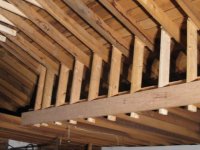
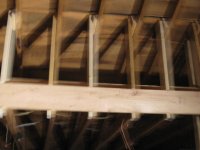
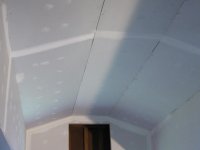
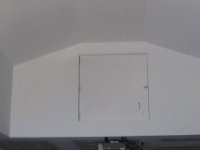
I just had my garage ceiling removed so I could install a 4 post lift. The opening is 24' by 9'. He used 24'x10" boards length ways and supported with 2x6 and 2x4's on the sides and roof. I had storage area enclosed at both ends. (see profile)
 

Attachments

  • IMG_1099.JPG
    IMG_1099.JPG
    61.2 KB · Views: 499
  • IMG_1100.JPG
    IMG_1100.JPG
    43.6 KB · Views: 441
  • IMG_1108.JPG
    IMG_1108.JPG
    24.1 KB · Views: 381
  • IMG_1139.JPG
    IMG_1139.JPG
    20.6 KB · Views: 316
  • IMG_1097.JPG
    IMG_1097.JPG
    50.5 KB · Views: 539

e-tek

Well-known member
Joined
Dec 19, 2007
Messages
10,690
Location
Saskatoon, SK
I just had my garage ceiling removed so I could install a 4 post lift. The opening is 24' by 9'. He used 24'x10" boards length ways and supported with 2x6 and 2x4's on the sides and roof. I had storage area enclosed at both ends. (see profile)

Great THREAD again (above).

Sixtnut's post shows how easy it can be, how much room is added and how it makes some easier-to-access storage avaialble.

I'm looking forward to doing this now!
 

tcianci

Well-known member
Joined
Feb 7, 2009
Messages
4,242
Location
Walpole, Ma
A few of the posters mentioned deck screws and stainless steel screws. Check out the specifications for those fasteners. They have practically no shear strength at all. Decking screws and stainless decking screws are designed for holding down composite and PVC decking and they are barely strong enough to do that. Those screws claim to fame is their corrosion resistance in treated lumber, they were never intended for structural applications.
 

Chris05gto

Well-known member
Joined
Nov 17, 2009
Messages
463
Location
Shinnston WV

ovilla

Well-known member
Joined
Dec 18, 2005
Messages
2,342
Location
Plainfield, IL
Anybody find pics yet of engineered roof trusses that have been modified or have had other trusses sistered to them?
 

Matti

Well-known member
Joined
Nov 16, 2007
Messages
412
Location
Canada
Based on my understanding of the structure, adding a ridge beam would essentially mean replacing the entire roof.
When I was doing the research for my roof I couldn't find any definitive answer on the raised tie stick build roof and I couldn't find anybody who would build trusses in this fashion.
There was a couple of posts here with pics that show a knee wall?? to accomplish what you are looking to do. I had trusses built that vaulted my roof but I would think that you would have to replace the whole roof to use these. http://www.garagejournal.com/forum/showthread.php?t=21953&page=2
 

ponjohn

Well-known member
Joined
Jan 1, 2006
Messages
237
Location
CT
Thanks for all the links, photos and suggestions.

I am faced with the same task, except I have a hip roof.

What I have been thinking of doing is, construct a scissor truss with the removed lumber.
The design info I have seen on the web says the lower cord is 1/2 the pitch of the roof.

I have 12 feet of height to the inside peak, using the 1/2 pitch method it makes the useable height 11 feet.

There has been some mention of what fasteners should be used. Can it be nailed in place then through-bolted?
 

ponjohn

Well-known member
Joined
Jan 1, 2006
Messages
237
Location
CT
Sixtnut-

The newly added beams, are they sitting on top the existing rafter or nailed into?

Thanks-
john
 

Snap50

Well-known member
Joined
Dec 29, 2009
Messages
145
Location
New England
With any rafter system, you need your ties right at the base or you need a ridge beam (not a ridge board).
Raised ties are an old carpenter's tale that does not work; it would create tremendous bending in the rafters by the time it started to work.

Back to the rafters, there is a simplistic explanation.
Think of you ladder against the wall. All of the vertical load is taken out at the base. The wall does not hold up weight, but provides a horizontal force to keep the ladder from pushing into the wall. My Newton told us that all forces on a body must be in equilibrium (fully balanced to equal zero in all directions) so that horizontal wall load must be opposed by something; that would be the force that we all have experienced by "toeing the ladder". Toeing the ladder, and/or the friction on the ground are the same function as the horizontal ties at the base of the roof rafters.

Now, if you put your ladder at a window, and you hang out the window and grab the ladder, you know that if you provide the force to hold or actually pull up on the ladder, relieving some of the weight that was on the ground, then the base of the ladder would actually move inwards. That tells you that no toeing or friction are needed at the base.
In the case of the rafters if there is a beam at the top it's the same function as hanging out the window and holding up on ladder; the outward thrust at the base (due to gravity) is gone and ties are not needed.

Now, throw in a hipped roof and you've got a problem. You've got outward thrust from rafters in 4 directions and you that to treat those hips as ridges.

By the way, scissors trusses still have outward thrust on your walls; they are not self-sufficient.
 
Last edited:

Daniel Dudley

Well-known member
Joined
Sep 4, 2009
Messages
3,546
The question is, do you get much snow ? Heavy wet snow weighs a lot. sixnut's roof is fine, but it looks a little light for heavy snow. It wouldn't take much to beef it up, but the question is, do you get much snow ?
 

wtfovr

Well-known member
Joined
May 30, 2009
Messages
145
What is the general or average cost to associate with raising or vaulting a ceiling? I have a 3 car and the single car side is used as my work area. I would love to have a 4-post lift but ceiling height is obviously a factor.

Here is an interior. The outline of the lights is what I want raised as high as I can get.
DSC01882.jpg


Here is the roof profile. I figure the roof line already gives me the angles in the vault that I need. I would just need to box it in and remove the rafters.
25.jpg

the side
22.jpg


Could the frame work be tackled by a novice?
 
To avoid these ads, REGISTER NOW!
Top Bottom