To avoid these ads, REGISTER NOW!

Range plug wiring

akpolaris

Well-known member
Joined
Jun 14, 2010
Messages
214
Location
Seward, Ak
I am installing a small electric range in an efficiency unit. The electrician that roughed in the wiring put in a 50 amp with 4 wires, 2 hots, neutral & ground. The range is strictly 220, just the heating elements. There is no 110 function , unless the light inside is in need of 110? The range connection is 2 hots, and a neutral bonded to a ground. I have had 2 differing opinions from electricians. I am seeking other thoughts thanks
a> Use a 3 prong plug, hook up the 2 hots and the ground to the neutral and wire nut the neutral back at the wall.
b> Use a three prong plug, hook up the 2 hots and the neutral, unbond it at the range connection and wire nut the ground back at the wall
 
To avoid these ads, REGISTER NOW!

rlitman

Well-known member
Joined
Oct 18, 2010
Messages
24,591
Location
Long Island
...The range connection is 2 hots, and a neutral bonded to a ground...
Yes, there are parts that use 120V. The simmerstats, the element lights, the oven lights, the clock, etc.

How old is this range? The neutral-ground bond is still commonly found on modern ranges to accommodate existing wiring, but is expected to be removed for up-to-date wiring. Check the instruction manual.
 

wyliesdiesels

Well-known member
Joined
Aug 14, 2012
Messages
19,994
Location
Modesto, CA
I am installing a small electric range in an efficiency unit. The electrician that roughed in the wiring put in a 50 amp with 4 wires, 2 hots, neutral & ground. The range is strictly 220, just the heating elements. There is no 110 function, unless the light inside is in need of 110? The range connection is 2 hots, and a neutral bonded to a ground. I have had 2 differing opinions from electricians. I am seeking other thoughts thanks
there is no 220 or 110 in the US. Its 240 and 120.

as far as the range connection goes, if it has a neutral then it does indeed have 120v requirement. The bonding of the neutral to the chassis was for older existing 3-wire circuits that HAD NO GROUNDING CONDUCTOR.

those 3-wire circuits are no longer allowed to be installed NEW. your electrician installed a 4-wire circuit so you need to unbond the neutral from the chassis (which is a very good thing because it removes the potential for shock hazard should the neutral in the circuit becomes compromised). Since the range most likely has a 3-wire cord and plug, you need to go buy a 4-wire cord and plug.

There should be no differing opinions on this subject. its quite clear. whatever electrician told you use a 3-wire setup needs to get with current wiring codes.
a> Use a 3 prong plug, hook up the 2 hots and the ground to the neutral and wire nut the neutral back at the wall.
negative. NEVER connect a ground wire to a neutral conductor.
b> Use a three prong plug, hook up the 2 hots and the neutral, unbond it at the range connection and wire nut the ground back at the wall
also negative and this will create a dangerous potential for shock should one of the ungrounded conductors short to the metal chassis of the range. :shocking:

the only correct option here is a 4-wire range cord and plug with an unbonded neutral.
 

rlitman

Well-known member
Joined
Oct 18, 2010
Messages
24,591
Location
Long Island
Thanks for the input. Its a new range install and using a 4 prong plug / wire was my initial thought but am 120 miles from store so things often get jury rigged in these settings but I'm in pursuit of the correct stuff now
Oh, then it's easy. Remove the neutral-ground bond, and wire each separately.
 

mike93lx

ALLIANCE MEMBER
Joined
Dec 9, 2013
Messages
37,457
Location
Richmond, VA
Thanks for the input. Its a new range install and using a 4 prong plug / wire was my initial thought but am 120 miles from store so things often get jury rigged in these settings but I'm in pursuit of the correct stuff now
I can't imagine. I have a half dozen home depots within 25 min, plus multiple Lowes, tractor supplies, harbor freights, a northern tool and more.

The level of planning that goes into your projects must be nuts. I get to be lazy, you can't
 
OP
A

akpolaris

Well-known member
Joined
Jun 14, 2010
Messages
214
Location
Seward, Ak
I can't imagine. I have a half dozen home depots within 25 min, plus multiple Lowes, tractor supplies, harbor freights, a northern tool and more.

The level of planning that goes into your projects must be nuts. I get to be lazy, you can't
I much more enjoy living in a rural community that does not even have a traffic light. Now that the cruise ships and touristas are winding up life is quieted down tremendously.
 
To avoid these ads, REGISTER NOW!
OP
A

akpolaris

Well-known member
Joined
Jun 14, 2010
Messages
214
Location
Seward, Ak
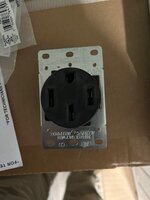
The saga continues. The cord does not have the flat design that the plug has. Is it a suitable match up?
 

Attachments

  • thumbnail_IMG_2175.jpg
    thumbnail_IMG_2175.jpg
    38.8 KB · Views: 41
  • thumbnail_IMG_2177.jpg
    thumbnail_IMG_2177.jpg
    26.3 KB · Views: 40

tvand13

Well-known member
Joined
Aug 20, 2015
Messages
76
Location
Northern Virginia
The receptical has a flat and the plug is round. They do fit together.
You're talking about the fact that the ground socket in the receptacle looks kind of "D" shaped but the plug has a round ground pin, right? That's OK, you have the correct mating parts.

If the visual helps, some of the 14-50 plugs look like this, but any 14-50 plug will work in your receptacle whether it has U shaped or round ground pins.

1000003189.jpg
 
Last edited:
To avoid these ads, REGISTER NOW!
Top Bottom