To avoid these ads, REGISTER NOW!

Ratchet lubrication basics video

DIYJus

Well-known member
Joined
Feb 13, 2017
Messages
50
Location
Central PA
I got it finished! With the help of some folks here and a bunch of research; I've made a quick video to help answer many of the basic questions about ratchet lubrication.

Link for Tapatalk users:

<iframe width="560" height="315" src="https://www.youtube.com/embed/Ryrqy1DvYH4" frameborder="0" allowfullscreen></iframe>

A big thanks goes out to: Nigelhirst, Spacecataz, Wwheeler, tonyciambrone, Infinia, Joe Mamma, 1990 Grand Wag, 1cargarage, 94_C/1500, Adam.C, M6erfan and bmwpowere36m3.

If I did an OK job, hopefully we can point new users to the video to help limit the amount of "ratchet lube" spam here. :) If anyone has comments or suggestions, let me know here, or add them to the comments under the video there. Thanks!
 
Last edited:
To avoid these ads, REGISTER NOW!

Spacecataz

Active member
Joined
Dec 20, 2016
Messages
31
Great video, man!

My only critique is that Clevite lube is not the true "Red Lube of Love". Permatex Ultra Slick 81950 is the true RLL. Might wanna edit that. ;)
 
Last edited:
OP
D

DIYJus

Well-known member
Joined
Feb 13, 2017
Messages
50
Location
Central PA
Great video, man! My only critique is that Clevite lube is not the true "Red Lube of Love". Permatex Ultra Slick 81950 is the true RLL. Might wanna edit that. ;)

Thanks! Yep, I only had the Clevite on-hand to shoot in the video. The link in the description is directly to the Permatex. :)

berkbile PFC is awesome on 60 tooth and higher ratchets.....my favorite but its hard to find

Thanks for the suggestion, I added it to the video's description. I'm not exactly sure if the order of viscosity is right in the description though. If I made a mistake, lmk!
 
OP
D

DIYJus

Well-known member
Joined
Feb 13, 2017
Messages
50
Location
Central PA
Nice video. I'll probably go with super lube for my ratchets.

Thanks, I think it's the best "all around" choice. However; mixing Superlube and RLL seems like it may be a little smoother and still won't leak. I'm going to have to get some real RLL for myself.
 

TNBurban

Well-known member
Joined
Jun 12, 2007
Messages
106
Very timely. I just took my same craftsman 1/2" apart yesterday as it was filthy. I used some Castrol 0w-40 I had laying around but it feels too thin for that ratchet. Now I think I will pick up some super lube to use instead.
 

M6erfan

Well-known member
Joined
Dec 6, 2014
Messages
10,170
Location
'Merica!
Good video, I like that you didn't slather 3oz of grease in it (like i've seen in other videos..) I especially like the blooper :)

Just to throw a wrench in the works, I've settled on moly grease for my ratchets (It's what Facom recommends). Moly grease doesn't get mentioned too often, but I find that it's a perfect consistency between Superlube and RLL, and of course very very slippery.
 
Last edited:

tonyciambrone

Well-known member
Joined
Nov 4, 2015
Messages
1,152
Location
Northern Illinois
I've never lubed a ratchet.
lube attracts dust and dirt

lube retains dust and dirt

No more dust is going to get in to a ratchet that is lubes that one that is not. Less dust and dirt will exit, however. If lube somehow attracted dust and dirt we would probably have some sort of recirculating grease trap for dust collection.
 

vettex2

Banned
Joined
Jul 30, 2012
Messages
1,146
Location
Northern Ca.
lube retains dust and dirt

No more dust is going to get in to a ratchet that is lubes that one that is not. Less dust and dirt will exit, however. If lube somehow attracted dust and dirt we would probably have some sort of recirculating grease trap for dust collection.
true, just like oil on a K&N filter
it does seem to act like a "magnet" for debris though
 
OP
D

DIYJus

Well-known member
Joined
Feb 13, 2017
Messages
50
Location
Central PA
Good video, I like that you didn't slather 3oz of grease in it (like i've seen in other videos..) I especially like the blooper :)

Just to throw a wrench in the works, I've settled on moly grease for my ratchets (It's what Facom recommends). Moly grease doesn't get mentioned too often, but I find that it's a perfect consistency between Superlube and RLL, and of course very very slippery.

Thanks! Yay, you're the 1st person to comment on the blooper. I didn't know if anyone watched that far. I knew better, but while I was trying to pay attention to where I was filming, reading the script/outline, etc... I just zoned out. (This was in the 72T 1/4" ratchet video)

On topic: Do you have a suggestion for a specific Moly grease? (Or the Facom specified stuff?) I'll add the link and possibly get some to try.
 

M6erfan

Well-known member
Joined
Dec 6, 2014
Messages
10,170
Location
'Merica!
Do you have a suggestion for a specific Moly grease? (Or the Facom specified stuff?) I'll add the link and possibly get some to try.

IIRC, Facom recommends Molykote LTW2. But I use whats on hand in my shop, either Sta Lube (CRC) Synthetic Caliper Grease or Honda M77 Moly Paste. LocTite 51048 is a good one too. I've had excellent results with all :beer:

Edit: FWIW, The Sta Lube is a bit cheaper and a bit less viscous than the pastes.
 
Last edited:

nbpt100

Well-known member
Joined
Oct 19, 2016
Messages
2,301
Location
Massachusetts
Good video. The only time I have lubed a ratchet is when the lever would have issues moving. Then I use 3 in 1 and it seemed to work for a while.
Now I am motivated to go lube my ratchets. Especially since you had one that was completely dry.
Thanks.
 

Adam.C

Banned
Joined
Jan 29, 2013
Messages
1,490
I don't get peoples' urges to post YouTube videos on subjects they don't really understand or have any expertise in.

For example, this video failed to distinguish between lubricity and corrosion prevention. It also failed to correctly identify why, and more importantly, where lubrication is required.

The video should have discussed how the head style/sealing affect the choice of lubricant and CPC.

I think I would have felt compelled to discuss what appeared to be very poor surface quality on the small HF ratchet. Best lube in the world can't fix that.

Last, the dark color of the oil or grease inside the Craftsman ratchet appeared to be nothing more than lost black oxide finish, but it also indicated how and specifically where the tool needed a better lubricant solution.
 

gdocktor3

Well-known member
Joined
Apr 18, 2015
Messages
5,419
Location
Connecticut
I don't get peoples' urges to post YouTube videos on subjects they don't really understand or have any expertise in.

For example, this video failed to distinguish between lubricity and corrosion prevention. It also failed to correctly identify why, and more importantly, where lubrication is required.

The video should have discussed how the head style/sealing affect the choice of lubricant and CPC.

I think I would have felt compelled to discuss what appeared to be very poor surface quality on the small HF ratchet. Best lube in the world can't fix that.

Last, the dark color of the oil or grease inside the Craftsman ratchet appeared to be nothing more than lost black oxide finish, but it also indicated how and specifically where the tool needed a better lubricant solution.

I agree with red highlighted comments, but the rest is just nitpicking. Even the red highlighted comments are arguable depending who you ask. I like to use oil in my sealed head ratchets and grease in my round heads. Some do the opposite. I will say this much, too heavy or thick a grease will make any ratchet a real chore to use if stored in cold weather ie: service trucks, unheated garages, personal truck tool boxes, barns/sheds, etc.
 
To avoid these ads, REGISTER NOW!

MN_Runner

Well-known member
Joined
Sep 15, 2013
Messages
186
I don't get peoples' urges to post YouTube videos on subjects they don't really understand or have any expertise in.

For example, this video failed to distinguish between lubricity and corrosion prevention. It also failed to correctly identify why, and more importantly, where lubrication is required.

The video should have discussed how the head style/sealing affect the choice of lubricant and CPC.

I think I would have felt compelled to discuss what appeared to be very poor surface quality on the small HF ratchet. Best lube in the world can't fix that.

Last, the dark color of the oil or grease inside the Craftsman ratchet appeared to be nothing more than lost black oxide finish, but it also indicated how and specifically where the tool needed a better lubricant solution.

I thought the video was fairly informative. No one is preventing you from posting a video that provide additional insights. Just let us know when it is posted and I will watch it and take notes.
 

MN_Runner

Well-known member
Joined
Sep 15, 2013
Messages
186
I don't get peoples' urges to post YouTube videos on subjects they don't really understand or have any expertise in.

For example, this video failed to distinguish between lubricity and corrosion prevention. It also failed to correctly identify why, and more importantly, where lubrication is required.

The video should have discussed how the head style/sealing affect the choice of lubricant and CPC.

I think I would have felt compelled to discuss what appeared to be very poor surface quality on the small HF ratchet. Best lube in the world can't fix that.

Last, the dark color of the oil or grease inside the Craftsman ratchet appeared to be nothing more than lost black oxide finish, but it also indicated how and specifically where the tool needed a better lubricant solution.

I thought the video was fairly informative. No one is preventing you from posting a video that provides additional insights. Just let us know when it is posted and I will watch it and take notes for my personal edification.
 

Adam.C

Banned
Joined
Jan 29, 2013
Messages
1,490
I agree with red highlighted comments, but the rest is just nitpicking. Even the red highlighted comments are arguable depending who you ask. I like to use oil in my sealed head ratchets and grease in my round heads. Some do the opposite. I will say this much, too heavy or thick a grease will make any ratchet a real chore to use if stored in cold weather ie: service trucks, unheated garages, personal truck tool boxes, barns/sheds, etc.

Last part is probably the most important. Yes, as you know I'm an engineer, actively working on applications not wholly unlike this, but you don't have to be. By examining your old ratchets, looking at wear marks, you can kinda figure out what they need.

You can learn a lot about tools with a bottle of Dykem and a little curiosity. Or a magnifying glass.

I have a set of ceramic files. I'll bet I/one could reduce the back drag of that HF ratchet.

Not nitpicking. Really trying to distinguish between actual investigation and research, and google.
 

Infinia

Banned
Joined
Oct 2, 2016
Messages
845
Location
SoCal
Not nitpicking. Really trying to distinguish between actual investigation and research, and google.
yea you said it "nitpicking". This isn't rocket science, It's video entertainment, not peer reviewed research.
I have a set of ceramic files. I'll bet I/one could reduce the back drag of that HF ratchet
uhh filing HF ratchet parts? haha, now we can see the frame of mind yer coming from. Perhaps that would be worthy of watching on YOUR channel.:)
 
Last edited:
OP
D

DIYJus

Well-known member
Joined
Feb 13, 2017
Messages
50
Location
Central PA
I don't get peoples' urges to post YouTube videos on subjects they don't really understand or have any expertise in.

I appreciate that you took the time to watch the video and return here to give some constructive criticism. I perhaps should have noted at the beginning of the video that I am not an engineer. As to "why", my intent was to help others who have the same repeating basic questions about ratchets and lubrication. Understand that I need to make it as concise as possible and can't be so technical that it confuses the average Joe. *Now I know who gave me that "thumbs down"* :)

For example, this video failed to distinguish between lubricity and corrosion prevention. It also failed to correctly identify why, and more importantly, where lubrication is required.

Agree that I didn't make that distinction. I did however at least mention that BOTH properties are important. No, I didn't explain where the lubrication is required as that is specific to each tool and that isn't the goal of this video. *I hesitate to do this*... but check out my other videos where I actually do a teardown and relubrication of a ratchet. In those I clearly explain where you want to get the lube and generally "why".

The video should have discussed how the head style/sealing affect the choice of lubricant and CPC.

I agree and will ask that you consider detailing this to me in a PM. I understand some of the ramifications/benefits of having a sealed head, but wasn't sure if that would be going too far in depth for an "overview" video.

Last, the dark color of the oil or grease inside the Craftsman ratchet appeared to be nothing more than lost black oxide finish, but it also indicated how and specifically where the tool needed a better lubricant solution.

I'm sure that was part of the coloration, but it actually is quite nasty/gritty.

You can learn a lot about tools with a bottle of Dykem and a little curiosity. Or a magnifying glass. I have a set of ceramic files. I'll bet I/one could reduce the back drag of that HF ratchet.

I have never even heard of Dykem, I'll check it out. I do agree that some time spent investigating and learning on your own is invaluable. What you're missing here is perspective though. Explaining how to diagnose areas of friction, or how (and why) to use a ceramic file to improve surface finish is not what this video was intended to be.
 

M6erfan

Well-known member
Joined
Dec 6, 2014
Messages
10,170
Location
'Merica!
Really Adam, it's a "Basics video". My thoughts are that it was well done and covered the basics of ratchet lubrication.

Perhaps there might be an "advanced" ratchet maintenance/repair video in the future to cover what you feel was lacking or left out on the OP's 1st attempt?

Or perhaps you might chime in with a more detailed post here on the forum (or your own YouTube vid) with what you consider comprehensive ratchet maintenance/repair...
 
Last edited:

nbpt100

Well-known member
Joined
Oct 19, 2016
Messages
2,301
Location
Massachusetts
I have never even heard of Dykem, I'll check it out. .

Dykem is a brand name of a group of products mostly used for making lay out marks on metals. It is typically blue or red but it may come in other colors as well. They also make a product called "High-Spot Blue" No. 107 which you can used to find areas where mating parts may be rubbing together. You basically rub it on the areas of interest and run the parts as they are intended. Disassemble and see were the "Dykem" was removed or rubbed off. It is non drying and non hardening so you can easily remove all of it when you are finished. I am sure this will be well covered in the advanced ratchet maintenance video.

I took my ratchets apart yesterday and lubed with Super Lube. Just happened to have a tube of it around. It made a nice difference. All of my ratchets (mostly C'Man) showed some signs of a light lube in there but were practically dry. Keep in mind some are 30yrs old. The one used for oil changes has some motor oil in it already.:thumbup:

As a total side note: Two of my ratchets are Chinese made C'man and at first glance they look identical to the USA C'man ratchets. But I noticed the head thickness is about 1/32" thicker on the newer Chinese made. Also, the quick release button appears to protrude even more. Other than that I can't see any obvious differences inside or out. In essence the older USA made C'man has a slightly lower profile.
 
OP
D

DIYJus

Well-known member
Joined
Feb 13, 2017
Messages
50
Location
Central PA
As a total side note: Two of my ratchets are Chinese made C'man and at first glance they look identical to the USA C'man ratchets. But I noticed the head thickness is about 1/32" thicker on the newer Chinese made. Also, the quick release button appears to protrude even more. Other than that I can't see any obvious differences inside or out. In essence the older USA made C'man has a slightly lower profile.

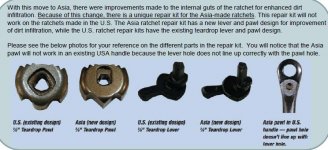
Thanks for the Dykem info. Here's some info on the Chinese/USA craftsman internal differences. It's small, but the Chinese design is supposed to be slightly better. I suspect that the materials are a little worse though, so it's probably a wash.
 

Attachments

  • azn craftsman.JPG
    azn craftsman.JPG
    70.4 KB · Views: 44

PFSard

Well-known member
Joined
Sep 12, 2013
Messages
2,423
Location
Mesa, AZ
DIYJus >> Thanks for taking the time to film the basics. I wonder if GJ should have a FAQ section. As ratchet lubrication has been covered in quite a few threads.

Adam.C >> Looking forward to your video that will further the understanding of ratchet engineering and lubrication.
 

nbpt100

Well-known member
Joined
Oct 19, 2016
Messages
2,301
Location
Massachusetts
Thanks for the Dykem info. Here's some info on the Chinese/USA craftsman internal differences. It's small, but the Chinese design is supposed to be slightly better. I suspect that the materials are a little worse though, so it's probably a wash.

Thanks that is interesting info. I did not compare the insides side by side so it is good to know that the repair kits are not interchangeable.

So far, I see no problems with my Asian made ratchets other than they could have lubed them better. But I now solved that issue. Thanks again for the good info.
:lol:
 
Last edited:

Adam.C

Banned
Joined
Jan 29, 2013
Messages
1,490
DIYJus >> Thanks for taking the time to film the basics. I wonder if GJ should have a FAQ section. As ratchet lubrication has been covered in quite a few threads.

Adam.C >> Looking forward to your video that will further the understanding of ratchet engineering and lubrication.

I know you are being a snarky ***, but I find ratchets really interesting. They are related to the physics of stick slip that governs back drag, but also effects micrometer and torque wrench accuracy. I've written quite a bit on the subject here. I agree with the OP that some of this information should be made sticky somewhere, somehow. You can search on my user name and ratchet tooth or some such and find quite a bit about ratchet design.
 

PFSard

Well-known member
Joined
Sep 12, 2013
Messages
2,423
Location
Mesa, AZ
I know you are being a snarky ***, but I find ratchets really interesting. They are related to the physics of stick slip that governs back drag, but also effects micrometer and torque wrench accuracy. I've written quite a bit on the subject here. I agree with the OP that some of this information should be made sticky somewhere, somehow. You can search on my user name and ratchet tooth or some such and find quite a bit about ratchet design.

I was being quite serious. I haven't spent much time on the multitude of ratchet threads on GJ. But I've seen enough titles.

I am interested in viewing in one place any knowledge of a particular subject. Whether it be ratchets, or some other tool. Or any other topic. That was why I suggested a FAQ. Perusing a Website's FAQ is usually quite fruitful for me. Yesterday, I browsed the following to understand more about lubricants. Much easier than searching through a multitude of threads or Websites.

NLGI FAQS – Lubricating Grease
https://www.nlgi.org/faqs-lubricating-grease/

I appreciate the OP taking the time to make a video. Of course, he did not cover everything perfectly, but I think he made a great start. He also invited criticism and suggestions graciously.

If you can put together a better video presentation on ratchets, I would appreciate it.
 
OP
D

DIYJus

Well-known member
Joined
Feb 13, 2017
Messages
50
Location
Central PA
but I find ratchets really interesting. They are related to the physics of stick slip that governs back drag, but also effects micrometer and torque wrench accuracy.....this information should be made sticky somewhere, somehow.

I appreciate the OP taking the time to make a video. Of course, he did not cover everything perfectly, but I think he made a great start. He also invited criticism and suggestions graciously.

This is the type of discourse and input I've been soliciting from the start. I appreciate it all and am willing to adjust and learn to make each video better and more helpful to more people.

If either of you (or other interested members!) would be willing to help with an outline or script for a replacement "basics" video, or a new "advanced" video; I would be happy to produce it.
 

Gmonkee

Well-known member
Joined
May 9, 2010
Messages
2,807
I find that in a hot climate the black moly grease used in CV joints is more stable. Not too thick nor thin stays inside much better.

Brand seems unimportant. They all work well.
 

Dick in Wisconsin

Well-known member
Joined
Mar 3, 2012
Messages
3,048
Location
Shawano, Wisconsin
Good video. First one I've watched on the subject.

Author could consider adding (1) taking the ratchet apart, (2) looking at the pieces for excess wear, and (3) putting the ratchet back together after examination, cleaning, and repair.
 
OP
D

DIYJus

Well-known member
Joined
Feb 13, 2017
Messages
50
Location
Central PA
Author could consider adding (1) taking the ratchet apart, (2) looking at the pieces for excess wear, and (3) putting the ratchet back together after examination, cleaning, and repair.

Thanks for the input! Consider checking out my channel (linked in my signature). I have 2 'ratchet specific' videos there that do exactly what you request. One with a single-pawl design and another with a dual-pawl design. :)

Alternatively, check out this thread:

http://www.garagejournal.com/forum/showthread.php?t=352556&highlight=youtube+ratchet
 

M6erfan

Well-known member
Joined
Dec 6, 2014
Messages
10,170
Location
'Merica!
Good video. First one I've watched on the subject.

Author could consider adding (1) taking the ratchet apart, (2) looking at the pieces for excess wear, and (3) putting the ratchet back together after examination, cleaning, and repair.

I believe he has another video that covers all that...
 

bmwpowere36m3

Well-known member
Joined
Nov 8, 2012
Messages
1,125
It ratchet lubrication... not rocket science, solving equations for motion or truss analysis.

I can't remember my father ever lubricating his rats in the shop... sure, once in a while the truck driver would rebuild them. A little grease or oil and carry on.
 

Dick in Wisconsin

Well-known member
Joined
Mar 3, 2012
Messages
3,048
Location
Shawano, Wisconsin
To avoid these ads, REGISTER NOW!
Top Bottom