To avoid these ads, REGISTER NOW!

Ratchet "smoothness"

Applesauce

Well-known member
Joined
Mar 12, 2013
Messages
273
Location
Canada, eh
Can anyone explain what directly contributes to ratchet "smoothness"? I've seen some claim that their Depression-era 24-tooth ratchets are the smoothest ever made, others that it's a Dual-80 or nothing...so I know it's not tooth count, and it probably isn't machining tolerances. What is it?!
 
To avoid these ads, REGISTER NOW!

jakemac

Well-known member
Joined
May 21, 2013
Messages
9,035
Location
New England
There's no one thing the determines smoothness. It's a combination of factors.

Tooth count
# of teeth on pawl
Tension of springs
Fit of parts
Lube
etc.

Jab enough lube into an 18 tooth ratchet and it will be smooth as butter. But it will also gum up and start skipping. Or jam when switching directions. Conversely, a 96 tooth ratchet may feel rough if the teeth are chipped, or the spring tension is too strong.

In addition, everyones tastes/feel is different. I consider my Cman RP Teardrops to be smooth, but that's what I'm used to. :dunno:
 

SMKS

Well-known member
Joined
Feb 14, 2010
Messages
5,832
Location
USA, planet Earth
It depends what you mean by "smooth."

When some people say "smooth" it seems they are talking about the amount of drag in the mechanism. Others seem to be referring to the lack of an audible/tactile click when the mechanism ratchets.

I very much care about the amount of back drag in a ratchet, because that affects the ratchet's use and ability to perform some jobs. But I don't care really at all if it makes noise or I can feel it clicking when it ratchets.

And, the lube can affect "smootheness." If you pack a ratchet with grease it will make less noise, but in some ratchets it won't work as well with grease over oil
 
Last edited:

exophyusical

Well-known member
Joined
Aug 11, 2013
Messages
100
While I do like a smooth ratchet I feel it may be overrated, and not necessarily an indication of ratchet quality. I have some 48 tooth Jet ratchets that are rough but have been very durable, while I have had major reliability issues with other ratchets that were far more smooth. Personaly I like a ratchet without much back drag but I like the "clicks" to feel very positive and solid.
 
Last edited:

bahcoswed

Well-known member
Joined
Mar 12, 2013
Messages
570
Location
Sweden
can anyone please tell me why my new(unused) long facom 1/2 round flex head ratchet (S153A) have a veryveryvery big play before it clicks? so damn anoying that i doesnt even use it! My facom 161 and a lot of other ratchet with exacly the same mechanism and head has very smooth and very little play before the first gear pops in. I have test to put the mechanism from my facom 161 into my long 153A and it feels the same??? WTF the head are the same size to between 161 and 153A
 

Nocturnal-G

Well-known member
Joined
Sep 14, 2012
Messages
825
Location
Los Angeles, CA
The smoothest ratchet I've used and own is the Hazet 863-1.

It uses the Facom design... 17 teeth engage contact with the gear I believe.

It's definitely bigger than other 1/4 ratchets... But I think it's smoother and a stronger design than most out there. I've never used a Snap On Dual 80 so take my opinion for what it's worth. :)
 

Wakefield

Well-known member
Joined
Aug 26, 2010
Messages
5,133
Location
Arlington VA (but would like to get out to country
can anyone please tell me why my new(unused) long facom 1/2 round flex head ratchet (S153A) have a veryveryvery big play before it clicks? so damn anoying that i doesnt even use it! My facom 161 and a lot of other ratchet with exacly the same mechanism and head has very smooth and very little play before the first gear pops in. I have test to put the mechanism from my facom 161 into my long 153A and it feels the same??? WTF the head are the same size to between 161 and 153A

Double pawl ratchet with only one of the two pawls working?
 

rusty65

Well-known member
Joined
Mar 20, 2012
Messages
2,279
Location
Pekin,IL
Tolerances how smooth the mating surfaces are the quality of springs how deep the teeth on the gear and pawl are cut the type of lube. There are many factors but I believe most older ratchets seem to be more smooth then others because from all the use and the springs loosing the strength so they depress easily.


Sent From Snap On Headquarters deep in China.
 

er3456df

Well-known member
Joined
Dec 1, 2009
Messages
230
When you have a bolt all the way loose but still have a lot of threads to go, some ratchets will just rotate the bolt back and forth as you swing it- there's not enough stiction in the bolt threads to let the ratchet part ratchet on the backswing.

Ratchets that have low resistance on the backswing are what I call "smooth". I have one Proto that's my best one in this regard, but I don't use it much because it's not comfortable in other ways.

My Craftsman Pro with the polished bulky handle is funny looking (to me, anyway) but is the one I use the most.

Craftsman teardrops have always been clunky, the spring/ball/cam mechanism always seems imprecise, and doesn't have enough tension in the "seating the teeth" direction (which is what causes skipping of the teeth), but somehow has plenty of tension in the "drags on the backswing" direction. Worst of both worlds. Fresh lube helps, but not completely.
 

PowderKeg

Well-known member
Joined
May 20, 2008
Messages
961
Location
Little Rock, AR
There's no one thing the determines smoothness. It's a combination of factors.

Tooth count
# of teeth on pawl
Tension of springs
Fit of parts
Lube
etc.

Jab enough lube into an 18 tooth ratchet and it will be smooth as butter. But it will also gum up and start skipping. Or jam when switching directions. Conversely, a 96 tooth ratchet may feel rough if the teeth are chipped, or the spring tension is too strong...

Ditto, and some designs are just early, poor and/or unrefined and naturally clunky. I've yet to find a New Britain Fors patent ratchet that I'd ever want to use (rough/clunky/heavy uneven backdrag), but NB's next evolutionary step - the round head Kilness patent - is one of the nicest and most consistent. NB's previous design to the Fors was head and shoulders above the successor as well, so age of the design isn't always a factor. One of the earliest reversible (and still produced today) designs that is typically very smooth, consistent, and light on the backdrag is the one found in Plomb/Proto/Pendleton oval head ratchets - a separate pawl and conical spring for each direction on a coarse toothed gear. Herbrand, Armstrong, and NB also produced ratchets with this type of action at one time, and all are normally a pleasure to use even with the coarse tooth count. I don't care much for the early Duro/Indestro design with the pressed in sideplates that can't be disassembled to clean and lube (often rough and inconsistent, at least partly due to decades of crud that won't/can't come out), while the later round and oval head models are much better. And pretty much every Thorsen sourced round ratchet has felt "meh" to me - functional but nothing to brag about.


It depends what you mean by "smooth."

When some people say "smooth" it seems they are talking about the amount of drag in the mechanism. Others seem to be referring to the lack of an audible/tactile click when the mechanism ratchets.

I very much care about the amount of back drag in a ratchet, because that affects the ratchet's use and ability to perform some jobs. But I don't care really at all if it makes noise or I can feel it clicking when it ratchets.

And, the lube can affect "smootheness." If you pack a ratchet with grease it will make less noise, but in some ratchets it won't work as well with grease over oil

Big ditto again. Smoothness to me is a light and consistent backdrag followed by a quick and firm lockup when ratcheting. I don't care if the backdrag rattles like a snake (the Craftsman/Moore Drop Forge RHFT, and the last Bonney round head design) as long as the pull is consistent and light. And finally yes, the appropriate lube (for the design/tooth count) makes a big contribution to smoothness, provided the gear and other internals are in good shape.
 
OP
A

Applesauce

Well-known member
Joined
Mar 12, 2013
Messages
273
Location
Canada, eh
It depends what you mean by "smooth."

I guess that's part of what I'm wondering. Is it just minimal back drag? Or is there some other component of smoothness?

One of the earliest reversible (and still produced today) designs that is typically very smooth, consistent, and light on the backdrag is the one found in Plomb/Proto/Pendleton oval head ratchets - a separate pawl and conical spring for each direction on a coarse toothed gear.

This is probably what I've heard most about. Is this an example? (i.e., is it what's all over eBay as a "Proto pear head"?) I'm not sure I've ever known exactly which tool people were referring to when they talked of the smoothest old Proto... I also feel like I've seen some gushing over older Plombs. Which one is that? Is the design identical to the Proto?
 

cheechi

Well-known member
Joined
Feb 29, 2012
Messages
4,384
Location
Triad, NC
I was interested in my ratchet not feeling & sounding like a worn out bearing between clicks, which to me is what 'smoothness' is. It was just a basic Stanley from back in the (maybe) 80s or so. I put it under a microscope in the materials lab.

There were some teeth that were worn down, the faces of most of them wasn't smooth with several chips & cracks on most teeth, the pawls were mostly intact. There was no lube in it at all at the time I opened it up. I don't remember how many I will assume it was 24-36 tooth count so nothing special.

The best way to describe what smoothness is to me is to experience the opposite. drag-click draaaaaag-click is not smooth to me. changing directions or jamming is not smooth to me. giving way at just the point where you would have got a nut loose, then catching after several degrees of 'oh sh--' free forward swing is not smooth.

Go to Lowe's (or equivalent) and work the mechanism on any ratchet that costs less than $20 for the rat itself. It's like a bearing with no inner race. If that's what you're trying to reduce, it's going to be broken, poorly made, or lube.
 

byoungblood

Well-known member
Joined
Apr 6, 2011
Messages
2,590
Location
Berryville, VA
A Craftsman RP and a Snap On 936 series ratchet both have 36 teeth. Try the two side by side and you'll get what people refer to as "smoothness".

In truth, tooth count really doesn't factor into it much. Proto's ratchets, which I think are only 24 teeth, have very little drag by nature of their design, and therefore could be considered to be very smooth.
 

Conductor562

Well-known member
Joined
Oct 2, 2012
Messages
2,312
Location
West "By God" Virginia
In my experience dual pawl rats tend to be smoother than singles. I can't say that's universally true. I think sometimes its a quality control issue as well. For example, I have a Blackhawk BP1338QR (single pawl 3/8") that is nice and smooth, while the BP1412QR (exact same rat in 1/2") feels stiff to the point that a rarely use it. I can't say it's the design, so it has to be a qc issue.
 

superautobacs

Well-known member
Joined
Oct 31, 2008
Messages
3,997
Location
Vancouver, BC
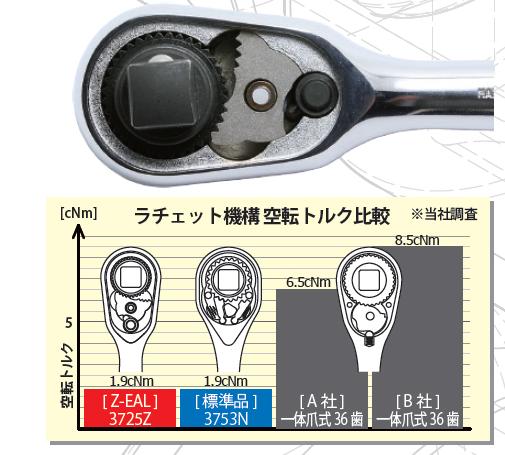
Comparative to the different American, European, and Japanese ratchets I've played with, the Ko-ken Zeal series ratchets are the smoothest I've felt. It will ratchet even with very little thread friction, making it the most user-friendly ratchet I've encountered.

kk_z_07.jpg
 
To avoid these ads, REGISTER NOW!

exophyusical

Well-known member
Joined
Aug 11, 2013
Messages
100
During the shift that I just finished I determined exactly what I feel makes some of my ratchets rougher. IMO its when the back drag is not smooth or consistant, the pawl clicking over the teeth causes a fluctuation, or small spikes in back drag. This to me is where the "rough" feeling comes from. Most likely this would be caused by tooth and/ or pawl shape or spring tension in a new ratchet, possibly by damaged teeth in an older ratchet.
 

PowderKeg

Well-known member
Joined
May 20, 2008
Messages
961
Location
Little Rock, AR
...This is probably what I've heard most about. Is this an example? (i.e., is it what's all over eBay as a "Proto pear head"?) I'm not sure I've ever known exactly which tool people were referring to when they talked of the smoothest old Proto... I also feel like I've seen some gushing over older Plombs. Which one is that? Is the design identical to the Proto?

Yep, that's it. Been produced for something like 70+ years. To me it's an oval head rather than a pear head. Proto/Pendleton also produced a ratchet with the same independent pawl design that both sideplates come off when the screws are removed. That ratchet really does have a pear shaped head, but the action and general "smoothness" is pretty much the same. Plomb came first, acquired several smaller tool companies, name changed to Proto, overall company identity eventually changed to Pendleton Tool Industries (producing several different brands), then acquired by Ingersol-Rand, and finally got sold to Stanley were it rests (some might say slowly but steadily decaying) now.
 

pepi

Well-known member
Joined
Mar 27, 2013
Messages
2,883
Location
Woodstock, GA
POST 20 ^^^^^ the way the direction change is made stinks, I like a paw I can move with the thumb, **** design on that one.
 

woody 73

Well-known member
Joined
Apr 14, 2009
Messages
11,546
Location
The Great State Up North
Some say permatex ultra slick lube but that stuff runs not for hours but forever, and some guys swear by it.

Some GJ members (although small in numbers) say they never use any lube and they swear by that motto.

Me I use the Super lube from HF for $4.99 a tube (not sure if the price is going up) and I say "I use that ShXt on everything just like the franks red hot sauce commercial".

At least that is my take on "Smoothness".
 

CWP1616L

Banned
Joined
Aug 31, 2012
Messages
3,297
Location
USA
POST 20 ^^^^^ the way the direction change is made stinks, I like a paw I can move with the thumb, **** design on that one.

The 72 tooth model has a thumb lever. JRF72 I think it's called.
 

SMKS

Well-known member
Joined
Feb 14, 2010
Messages
5,832
Location
USA, planet Earth
For those who are COO nerds-

The 72-tooth Cornwell ratchets are only assembled in the USA with a USA made handle. The mechanism is made in Taiwan and purchased by Cornwell. Then Cornwell puts the kits in a ratchet handle they make themselves.
 

CWP1616L

Banned
Joined
Aug 31, 2012
Messages
3,297
Location
USA
For those who are COO nerds-

The 72-tooth Cornwell ratchets are only assembled in the USA with a USA made handle. The mechanism is made in Taiwan and purchased by Cornwell. Then Cornwell puts the kits in a ratchet handle they make themselves.

That's not accurate. The ratchet head as well as the handle are made in the USA. The mechanism is made in Taiwan because some Taiwanese company has an international patent on the mechanism.
 

CWP1616L

Banned
Joined
Aug 31, 2012
Messages
3,297
Location
USA
Note, I wasn't singling out the the flex head versions. I was referring to all the 72-tooth ratchets in general.

You were responding to Brownsfan's post and he was talking about the JRF72.

checks and balances, checks and balances. :p
 

SMKS

Well-known member
Joined
Feb 14, 2010
Messages
5,832
Location
USA, planet Earth
You were responding to Brownsfan's post he he was talking about the JRF72.

checks and balances checks and balances. :p

Note - no post is quoted in my post. How do you know I was specifically referring to the flex head versions?

I didn't mention flex heads, did I? I only mentioned "the 72-tooth Cornwell ratchets." :pimpflash
 
Last edited:

CWP1616L

Banned
Joined
Aug 31, 2012
Messages
3,297
Location
USA
Note - no post is quoted in my post. How do you know I was specifically referring to the flex head versions?

I didn't mention flex heads, did I. I only mentioned "the 72-tooth Cornwell ratchets." :pimpflash

Yeah but you wouldn't have made that post without Brownsfan saying what he said. Admit it. :D
 
To avoid these ads, REGISTER NOW!
Top Bottom