

You are using an out of date browser. It may not display this or other websites correctly.
You should upgrade or use an alternative browser.
You should upgrade or use an alternative browser.
Ratchet/socket or combo wrench, preference
- Thread starter Widgeon
- Start date
Neither,
Ideally a 6 point socket on some form of impact.
But if i had to pick then ratchet and socket, but it's really personal preference. A good 6 point and 12 point will grip the fastener in the same location, however more material needs to be moved out the way for it to turn freely in a 12 point than a 6 point.
Ideally a 6 point socket on some form of impact.
But if i had to pick then ratchet and socket, but it's really personal preference. A good 6 point and 12 point will grip the fastener in the same location, however more material needs to be moved out the way for it to turn freely in a 12 point than a 6 point.
marineman
Well-known member
With no access issues I usually grab wrenches first. Combo wrench would be my second choice following a DBE with one ratcheting head and one non ratcheting head. I know most decent quality modern ratchets can handle some torque I'm just more comfortable leaning on a solid piece of metal than something with gears and tiny teeth.
Dave455
Well-known member
I have some Nepros 6 point ring spanners / box end wrenches which are a very tight fit on the fastener. They’re my first choice, if I can fit one on!
Next choice would probably be a 6 point socket, but it depends what you are working on. If it’s a modern vehicle, especially one with soft fasteners, the 6 point socket has to win. If it’s something with better quality fasteners I’d probably go with a wrench. It’s much easier to be in line with the bolt head if you can do it!
Next choice would probably be a 6 point socket, but it depends what you are working on. If it’s a modern vehicle, especially one with soft fasteners, the 6 point socket has to win. If it’s something with better quality fasteners I’d probably go with a wrench. It’s much easier to be in line with the bolt head if you can do it!
WWheeler
Well-known member
If the rusty/rounded fastener is smaller than ~1-1/4" (~30mm) then 6-point socket, preferably on an impact, and following that a breaker bar in the largest drive size I have room to use, followed by a long handled ratchet in the largest drive size I have room to use, and lastly a 6pt closed end wrench. I'd go with socket over wrench because I have a lot longer handle breaker bars and ratchets than wrenches. Larger than 1-1/4" 6pt or 12pt doesn't really matter unless the fastener is really damaged and then it's time for more drastic measures like a torch, 36" pipe wrench or a cutoff.
Last edited:
General Geoff
Well-known member
Without accessibility issues, probably a 1/2" drive socket and long ratchet or breaker bar.
For wrenches I also prefer double box end (DBE) over combo wrenches. Though ratcheting combos certainly make some jobs a lot faster.
For wrenches I also prefer double box end (DBE) over combo wrenches. Though ratcheting combos certainly make some jobs a lot faster.
AceofSpad3s
Well-known member
- Joined
- Oct 1, 2014
- Messages
- 1,808
Six point box end wrench because I don't feel bad hitting them with a hammer.
plinker
Well-known member
Usually a socket/ratchet, 6pt or Matco's pro non-slip.
If it's rusty, hit it with a needle scaler with spray oil and/or heat first. Smaller fasteners are likely to break without some help.
Rounded depends on how badly it's rounded, a bolt out socket or tapping on a socket with a hammer may work. If badly rounded cutting it off or trying an air chisel on the flats to loosen.
If it's rusty, hit it with a needle scaler with spray oil and/or heat first. Smaller fasteners are likely to break without some help.
Rounded depends on how badly it's rounded, a bolt out socket or tapping on a socket with a hammer may work. If badly rounded cutting it off or trying an air chisel on the flats to loosen.
Parrothead
Well-known member
Depends on the situation
6pt combination wrench using the boxed end. Hit with 3lb mini sledge.
Access issues then a 6pt socket with a 72t ratchet. Cheater may or may not be used.
Breaker bar with my linemen sized self jumping on it. Something breaks in that equation every time. It may come free, the head may snap off, or the socket may break. I’ve bent but never broken a bar yet.
6pt combination wrench using the boxed end. Hit with 3lb mini sledge.
Access issues then a 6pt socket with a 72t ratchet. Cheater may or may not be used.
Breaker bar with my linemen sized self jumping on it. Something breaks in that equation every time. It may come free, the head may snap off, or the socket may break. I’ve bent but never broken a bar yet.
Air impact with Lok-On™ Kincrome 6pt impact socket. These sockets claim to work on 85% rounded fasteners. The design is similar to Marco & others that have them kinda ribs on the socket broach. But any 6pt socket will do or many other methods too. All just depends how bad the situation is too how creative one must get.
Mr Ratchet
Well-known member
If there's no clearance issues, a wrench would be one of the last tools I reach for. I too would likely use my impact first. I seldom use my ratchets to break any fastener loose. I use my breaker bars for that. I have two different lengths each in all four drive sizes that I have (1/4"-3/4"). Especially so on a rusty bolt.
californiaHank
Well-known member
- Joined
- Nov 20, 2015
- Messages
- 487
If no impact available, probably a 6 point socket on a breaker bar.
I routinely use my long 12 pt combo wrenches to break fasteners loose, but will switch to a breaker bar and 6 point socket for 'difficult cases'.
I routinely use my long 12 pt combo wrenches to break fasteners loose, but will switch to a breaker bar and 6 point socket for 'difficult cases'.
Professional Tool User
Well-known member
A 6 point socket on a ratchet or impact gun is less likely to slip off. No one wastes their time with a wrench if a socket on a ratchet or impact can do the job.
Parrothead
Well-known member
A 6 point socket on a ratchet or impact gun is less likely to slip off. No one wastes their time with a wrench if a socket on a ratchet or impact can do the job.
Depends on what kind of force you're planning on applying. I trust a box end 6pt more than I trust a socket/ratchet combo. Impact is a different story.
WWheeler
Well-known member
Depends on what kind of force you're planning on applying. I trust a box end 6pt more than I trust a socket/ratchet combo. Impact is a different story.
You're using the wrong socket/ratchet combo.

Depends on the situation
6pt combination wrench using the boxed end. Hit with 3lb mini sledge.
Access issues then a 6pt socket with a 72t ratchet. Cheater may or may not be used.
Breaker bar with my linemen sized self jumping on it. Something breaks in that equation every time. It may come free, the head may snap off, or the socket may break. I’ve bent but never broken a bar yet.
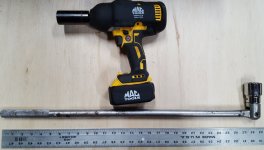
i personally have never and would never hit on a wrench with a sledge, put cheater on a ratchet, or jump on a breaker bar. I like to use the right tool for the job as best I can and none of those are close to it. I guess that's why I've never broken a wrench, ratchet, socket, or breaker bar of any brand even when I was young and dirt poor and using mostly less-than-HF grade tools. I have definitely put a cheater on a breaker bar before, especially a sliding t-handle, but at least I don't consider that abuse, and I've never broken one of those either.
But yeah, depending on how rust-seized and/or damaged it looks, before I even think to break out even my 25" snappy flex ratchet I'd probably be trying to get at it with one of these first.

Attachments

Last edited:
MikeF2316
Well-known member
Using hand tools, I prefer a wrench. If it's rounded, 6 point. But the battery impact guns are so good, that's what I end up using mostly these days. If the little one won't do it, I just step up a level (or two) to a bigger one.
You're using the wrong socket/ratchet combo.
I'm in the camp that believes a box end wrench, especially a zero offset, is less likely to slip off the fastener because the force that I'm applying is in line with, or in the same plane as, the resistance that I'm trying to overcome. A socket on a ratchet or breaker bar creates an offset. However, I admit that I am uneducated on this and GJ is a wealth of information. Can you explain how the socket/ratchet is better?
Wamsutta
Well-known member
I'll grab a wrench if I got the room.
2ndGearRubber
Well-known member
If an impact fits.... obviously impact.
If the fastener is super rotted/corroded/nasty, socket/ratchet. Why? Because I can back the fastener out 100% without removing the drive tool. Sometimes you only get one grab.
If the fastener is super rotted/corroded/nasty, socket/ratchet. Why? Because I can back the fastener out 100% without removing the drive tool. Sometimes you only get one grab.
2ndGearRubber
Well-known member
I'm in the camp that believes a box end wrench, especially a zero offset, is less likely to slip off the fastener because the force that I'm applying is in line with, or in the same plane as, the resistance that I'm trying to overcome. A socket on a ratchet or breaker bar creates an offset. However, I admit that I am uneducated on this and GJ is a wealth of information. Can you explain how the socket/ratchet is better?
Zero offset is usually 12 point. Rotted hardware demands 6 point, often undersized and hammered on. I agree with wrenches having a superior inherent load path, although paying basic attention with a ratchet makes in much closer than blindly cranking away.
Some times there simply isn't enough meat on the fastener to use 12point; I say that as someone who uses 12 point zero offsets daily. You just have to understand the limitations on the truly crusty stuff.
Moose Legs
Active member
I would grab my SK x-frames, six point box, ratcheting, zero offset, perfect. If outside the x-frames size range I would still grab a wrench
Wamsutta
Well-known member
With a wrench wouldn’t the torque being directly perpendicular to the fastener have the least likely resistence of slipping off, more even force around the bolt head as opposed to a short socket on a ratchet.
I rarely put a short socket on a ratchet without an extension unless I'm turning a gear puller.
WWheeler
Well-known member
4 decades of turning fasteners in the rust belt
Have you actually had trouble with a ratchet or breaker bar and 6pt socket slipping off? I never have. Not once. Never even seen anyone else have the issue.
My experience of ~4 decades of turning fasteners in the rust belt is that what's most important for manually breaking loose a rusted stuck fastener is the handle length for more controlled leverage, as opposed to resorting to hitting a too-short wrench with a maul, putting a pipe on it, or jumping up and down on it. IMHO that's some serious reckless nonsense for people who apparently don't give a flying f*ck about their tools or whatever they are working on.*
Better yet, use an impact.
*I say that with the admission that I've never worked flat-rate so I've not ever been so hurried to get anything done where what I consider tool abuse may actually be the most practical way of getting something done and being able to make a living doing it. That's a whole different world foreign to me. That said, if I was paying someone to work on my stuff and saw them using a sledge on or jumping up and down on a wrench / ratchet / breaker I'll be getting my **** out of there, on a wrecker if need be, and someone else someplace else will be finishing that job.
EDIT: I should definitely have added that I was strictly speaking about rusted stuck fasteners. Any tool can slip on a damaged/rounded fastener and most everyone has ran into that. If a 6pt socket or wrench doesn't fit snugly on it anymore then I probably wouldn't even try to turn it with a normal hand tool, wrench or socket. If it's visibly damaged then I look to attack it with any combination of methods to get it off. I might use heat and a pipewrench or damaged fastener extractor socket or more likely just go straight for a cutoff or nutsplitter, etc.
With a wrench wouldn’t the torque being directly perpendicular to the fastener have the least likely resistence of slipping off, more even force around the bolt head as opposed to a short socket on a ratchet.
Have you actually had trouble with a ratchet or breaker bar and 6pt socket slipping off? I never have. Not once. Never even seen anyone else have the issue.
My experience of ~4 decades of turning fasteners in the rust belt is that what's most important for manually breaking loose a rusted stuck fastener is the handle length for more controlled leverage, as opposed to resorting to hitting a too-short wrench with a maul, putting a pipe on it, or jumping up and down on it. IMHO that's some serious reckless nonsense for people who apparently don't give a flying f*ck about their tools or whatever they are working on.*
Better yet, use an impact.
*I say that with the admission that I've never worked flat-rate so I've not ever been so hurried to get anything done where what I consider tool abuse may actually be the most practical way of getting something done and being able to make a living doing it. That's a whole different world foreign to me. That said, if I was paying someone to work on my stuff and saw them using a sledge on or jumping up and down on a wrench / ratchet / breaker I'll be getting my **** out of there, on a wrecker if need be, and someone else someplace else will be finishing that job.
EDIT: I should definitely have added that I was strictly speaking about rusted stuck fasteners. Any tool can slip on a damaged/rounded fastener and most everyone has ran into that. If a 6pt socket or wrench doesn't fit snugly on it anymore then I probably wouldn't even try to turn it with a normal hand tool, wrench or socket. If it's visibly damaged then I look to attack it with any combination of methods to get it off. I might use heat and a pipewrench or damaged fastener extractor socket or more likely just go straight for a cutoff or nutsplitter, etc.
Last edited:
The idea of a breaker bar etc.. slipping off a fastener because the force isn't perpendicular can be easily fixed by having one hand on the end of the bar applying the force and one hand near the drive end pushing into the fastener slightly.
I've never had one slip off unless the fastener has rounded .
I've never had one slip off unless the fastener has rounded .
Having good tools for this kinda stuff helps. I bet we've all seen the result of a poor tool choice early on which makes a mess of the fastener. I've always wanted a set of Metrinch sockets just as an option for difficult fasteners. But I must say the ribbed sockets that many brands make under many fancy names do work grabbing whatever they can on a hex fastener. I think were privelliged with impacts these days, once upon a time there was only one impact gun in a workshop, it was heavy, expensive as hell and not that powerful. The hammering on/off impact has a magical quality too it IMO compared to brute torque from hand tools.
Finky198
Well-known member
This thread should be a sticky plenty of tried and true words in here....
I agree having and using the right tool for the job is the key. I am personally in the 6pt socket and ratchet / impact crowd. Being in the rust belt I will go to great lengths ( stubby, flex, and extra long ratchet and breaker bars, swivels, extension, universal sockets, turbo sockets, etc) rather then use wrenches it’s not that I don’t use wrenches daily, but 6 pt sockets are just less likely to make me more work.... and no pipes or gorillas are allowed on or near my tools. If the tools not big enough for the task, I walk back to my box and get bigger one and finish it...
I have to much invested in my stuff to beat it to hell... yes some things break, but its really few and far between compared to the setup as a whole.
I agree having and using the right tool for the job is the key. I am personally in the 6pt socket and ratchet / impact crowd. Being in the rust belt I will go to great lengths ( stubby, flex, and extra long ratchet and breaker bars, swivels, extension, universal sockets, turbo sockets, etc) rather then use wrenches it’s not that I don’t use wrenches daily, but 6 pt sockets are just less likely to make me more work.... and no pipes or gorillas are allowed on or near my tools. If the tools not big enough for the task, I walk back to my box and get bigger one and finish it...
I have to much invested in my stuff to beat it to hell... yes some things break, but its really few and far between compared to the setup as a whole.
Last edited:
Heavy Metal Doctor
Well-known member
Too many variables will usually push the decision to a specific tool, but for just one or two very easy access fasteners under 3/4", I grab the right size combo wrench.
Land Rover 109
Well-known member
Access is not a problem and the rounded nut in question is less than 2"?
Then I would be using a spanner.
As access is not a problem, plenty of penetrating oil and heat will have been tried first, but if all else fails, this is where all those oddball old Whitworth type spanners come in handy- they seem to be not far from standard rounded over size and can often be driven on to rounded over standard sized fixings that a next size down spanner cannot be forced on to.
Then I would be using a spanner.
As access is not a problem, plenty of penetrating oil and heat will have been tried first, but if all else fails, this is where all those oddball old Whitworth type spanners come in handy- they seem to be not far from standard rounded over size and can often be driven on to rounded over standard sized fixings that a next size down spanner cannot be forced on to.