To avoid these ads, REGISTER NOW!

Ratcheting electrical crimper?

quilty

Well-known member
Joined
Mar 31, 2022
Messages
82
Okay, I need to be schooled on ratcheting electrical crimpers.

Do you need a dedicated crimper (or at least dedicated jaws) for crimping HEAT SHRINK insulated connectors? For example, these connectors:


I was looking at the Klein 3000CRKIT kit that comes with the following (4) interchangeable dies:

- Insulated
- Non-Insulated
- Heat shrink
- Ferrule terminals


Now, I don't want this Klein tool set because it's made in CHINA.

Does anyone know if any of the Knipex offerings have a dedicated crimper or at least jaw for these heat shrink insulated connectors?

I found the Knipex MultiCrimp that comes with (5) interchanges dies:

- Non-insulated plug connectors with open cable entry
- Insulated cable lugs, plug connectors and **** connectors
- Insulated and non-insulated end sleeves (ferrules)
- Non-insulated crimp terminals. tubular cable lugs and compression cable lugs
- Non-insulated crimp terminals, **** connectors and press connectors


Unfortunately, I don't see any mention of heat shrink compatibility in that entire Knipex MultiCrimp description.

Then, I found the Knipex PreciForce 97 52 36 Crimping Pliers with (1) crimping die that's not exchangeable:

- Insulated connectors
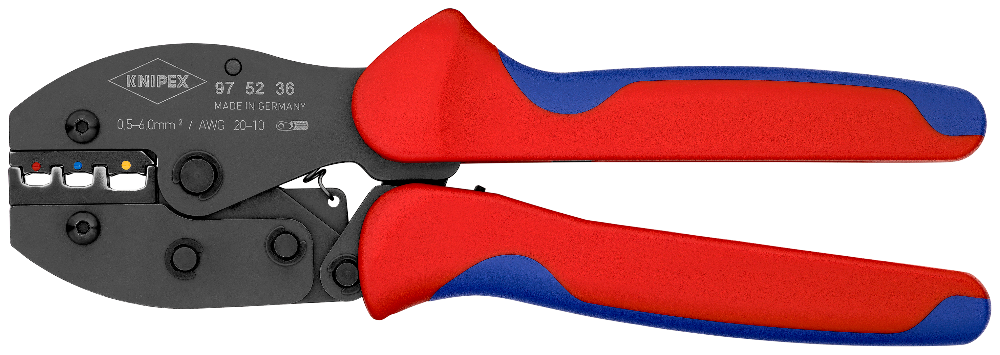

Again, no mention of heat shrink compatibility.

Now, the only Knipex crimper I can find that even mentions heat shrink is the Knipex PreciForce 97 52 37 which is described as for:

- Heat shrinkable sleeve connectors

https://www.knipex-tools.com/produc...ls-plug-connectors-and-****-connectors/975237

So what exactly are "sleeve" connectors? Are these pliers ONLY for splice/**** "sleeve" connectors and not any other type of heat shrink connector?

If ultimately Knipex does not offer a heat shrink insulated ratcheting crimper, does anyone know of a product available that does that's not made in China?

Sorry for the long post! Lots of new terminology here for me to try and understand.

Thank you
 
To avoid these ads, REGISTER NOW!

gahrajmahal

Well-known member
Joined
Dec 12, 2008
Messages
2,526
Location
Cincinnati, Ohio
Your long post made it very easy to make my recommendation, no apology necessary! Your bullet connector is a very simple one and does not require a fancy crimper, just the most basic Klein or similar crimper. I position the rounded "die" part of the tool at the split side of the connector. The post, or indent portion of the crimper goes to the non-split side of the connector. Then just give it a firm squeeze. Test pull your wire and connector trying to pull it off. If you have crimped it sufficiently you can go ahead and shrink the connector on.

Screenshot 2025-01-08 102812.jpgScreenshot 2025-01-08 102613.jpg
 
OP
Q

quilty

Well-known member
Joined
Mar 31, 2022
Messages
82
Your long post made it very easy to make my recommendation, no apology necessary! Your bullet connector is a very simple one and does not require a fancy crimper, just the most basic Klein or similar crimper. I position the rounded "die" part of the tool at the split side of the connector. The post, or indent portion of the crimper goes to the non-split side of the connector. Then just give it a firm squeeze. Test pull your wire and connector trying to pull it off. If you have crimped it sufficiently you can go ahead and shrink the connector on.

Funny enough, I actually already own the Klein 1005's.

I guess I'm looking to eventually own a ratcheting crimper that can tackle a variety of heat shrink insulated terminals...
 

cgrutt

Well-known member
Joined
Mar 4, 2016
Messages
8,200
I've been using those 1005s for many years. Note by the book the section with the point is really intended to be used on uninsulated connectors, you're supposed to use the smooth section for insulated connectors. With that said, I almost always use the section with point on insulated connectors but the point can stress the insulation, almost to the point of tearing it. I'm not sure if there is any meaningful difference between size of a standard insulated connector and a heat shrink connector, but the 1005s are pretty much "one size fits all". You'll have more options with a ratcheting crimper and set (s) of dies.

I'm interested in the S&G Tool Aid 18980 set available at FCP Euro. It says its Made in USA on FCP site. Company is out of Newark NJ but doesn't list COO in their catalog so could be made somewhere else.
 

duneslider

Well-known member
Joined
Jan 20, 2013
Messages
2,247
Location
Riverton, Utah
The klein 1005's do damage the heat shrink connectors in my experience. Not every time but I do end up with damage fairly often. Not that it is a good solution but the ratcheting crimpers I have for insulated work just fine on the heat shrink connectors. I honestly personally have mixed results with the heat shrink connectors and I am just using the heat shrink in place of insulated usually and if it is more "critical" I use the non-insulated and my own heat shrink.

This is all for personal use and low voltage, I would feel differently about stuff if I was in a professional production based environment. If I mess up a connector I just put another on and no big deal. All my ratcheting crimpers are Chinese, they work fine but I do understand the desire to not have Chinese tools.
 
OP
Q

quilty

Well-known member
Joined
Mar 31, 2022
Messages
82
Back to the Knipex 97 52 37 - I think the word "sleeve" in the product description is what really threw me off.

- Crimping Pliers For Heat Shrinkable Sleeve Connectors

Now that I think harder about this, I think Knipex is just trying to say that the actual connecter itself is sleeved with heat shrink.

I wasn't sure if the word "sleeve" was designating an actual connector type.

https://www.knipex-tools.com/produc...ls-plug-connectors-and-****-connectors/975237

You can clearly see on the website they are showing the pliers crimping a heat shrink **** connector:

1736371310447.png

I'm assuming this must be the correct plier for crimping all of the generic heat shrink connector types such as rings, spades, quick disconnects, etc.

Heat shrink connector types.jpg
 
Last edited:

BrandonV

Well-known member
Joined
Jun 9, 2023
Messages
4,030
Location
Arizona
Why not use uninsulated terminals and put your own heat shrink on them after crimping?

this is better because the hard plastic on the insulated terminals usually crack and dont form well around the crimped metal

This. ☝️ Either get the right crimper or just use your own marine grade heat shrink with uninsulated terminals.
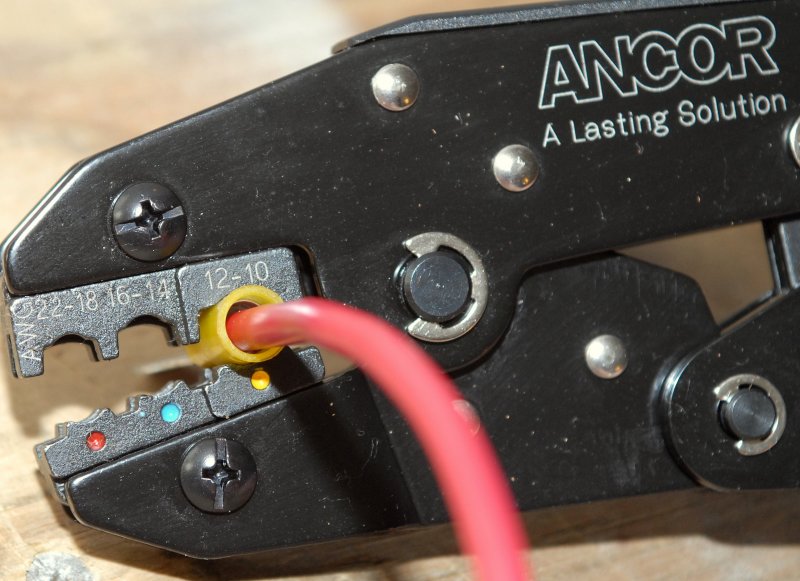
You absolutely need to use a different crimper for heat shrink terminals. Almost every other crimping die will puncture the heat shrink insulation negating its purpose. What you linked to the 97 52 37 is exactly what I would order.

This is an article I frequently link people to.


BrandonV

Well-known member
Joined
Jun 9, 2023
Messages
4,030
Location
Arizona
I will also add that you could probably use the Klein T1715 (COO of USA) to do heat shrink terminals due to the style of the crimping jaw but I'd probably just go with your Knipex at that price.

I like Klein but there website and marketing with some of these crimp tools leaves a lot to be desired.
 
Last edited:
To avoid these ads, REGISTER NOW!

gahrajmahal

Well-known member
Joined
Dec 12, 2008
Messages
2,526
Location
Cincinnati, Ohio
Quilty, I had not seen the Knipex crimpers you show in post #9. I would buy those for your project. Sometimes, if you have a gorilla grip, using the crimpers I initially suggested you can puncture the shrink tube at the crimp.

I have some crimper / strippers that have the double half moon shape as shown in post #9, but when I use them I can sometimes pull off my terminal when doing my test.

Check out rdoty’s rewiring thread for his Chrysler Imperial. He uses a special connector series for his wiring that uses ratcheting crimpers. As always other GJ’ers chime in with their suggestions too.


sparky 1971

Well-known member
Joined
Oct 9, 2018
Messages
7,967
Location
Central Iowa
A little off topic, but since this is GJ it should be expected. I had a pair of Ideal ratcheting crimpers and really thought I had something. After the first use, they went in the nearest dumpster. Too much effing around and way too slow. I like my Channellock 909's, which are no different than any other style of regular crimpers for the small stuff. #8 and larger is a different story and where my ratchet crimpers now start.
 
Last edited:

wantedabiggergarage

Member Emeritus
Joined
Feb 25, 2006
Messages
3,897
Location
Independence, MO, USA.
I bought a set years ago and after messing with all the adjustments they never would crimp enough. Sometimes I think I would like to try another set of ratcheting crimpers but the only other set I ever saw was also garbage.
 

BrandonV

Well-known member
Joined
Jun 9, 2023
Messages
4,030
Location
Arizona
I bought a set years ago and after messing with all the adjustments they never would crimp enough. Sometimes I think I would like to try another set of ratcheting crimpers but the only other set I ever saw was also garbage.

Yeah. I will admit I've had better luck using the old school T&B/Klein/Channellock dimple crimpers more than anything when you don't have the exact specified crimping tool handy.

Sometimes if you're not going to buy the actual proper tool from the manufacturer of the crimp, I've found it's easier to just rely on the dimple crimper. It highlights why I do agree with others it's best to just go non-insulated and use shrink wrap.

Some brands like GB don't even know if their crimper is for insulated terminals or non-insulated terminals. I've seen the Gardner Bender GS-388 used on insulated terminals and it's the thing of nightmare fuel. The packaging for the same tool goes back and forth depending on where you find it.
 

BillK

Well-known member
Joined
Aug 24, 2006
Messages
9,311
Location
Beautiful Southern Maryland
I have two ratchet type crimpers.

One is an actual Anderson crimper made for powerpoles. I bought it probably 10 years ago when the Anderson Power Poles started getting popular in Amateur Radio applications. It worrks great for doing powerpole fittings.

The second one is a complete set from DX Engineering that I got in a batch of stuff at an estate sale of a local ham radio guy. Personally I will say that it works great but I would certainly never buy it for something like you are doing. I have only used it one time and decided it was too slow for everyday use. I probably have 4 different pair of "manual" crimpers and I always grab one of them for day to day crimping. I have one of the Klein ones that are probably 40 years old and they are what I use most of the time for insulated or non insulated terminals. The others are for the type of terminal that goes into a housing and needs a "W" type crimp.
 

Old Man Roger

Well-known member
Joined
Apr 6, 2017
Messages
17,447
Location
Palm Coast Florida
I bought a set years ago and after messing with all the adjustments they never would crimp enough. Sometimes I think I would like to try another set of ratcheting crimpers but the only other set I ever saw was also garbage.
They’re adjustable for different sizes, maybe you‘re on the wrong setting?

I keep mine on the smallest setting, which is why I sometimes have to manually release it, but I’m usually only doing 1 or 2 at a time.

If I were doing 20 or 50 in a row I’d adjust it so the release would work as designed, but if I’m just grabbing it for 1 or 2, it’s less hassle to leave it on the smallest setting.
 

Steve_P

Well-known member
Joined
Sep 15, 2010
Messages
5,182
Why not use uninsulated terminals and put your own heat shrink on them after crimping?

This! The heat shrink type are better than the cheap ones with the thick plastic insulation, but I like to use the uninsulated ones when I can and add my own heat shrink.

The POS terminals with the thick plastic insulation are the worst; if I see one used in a repair for something that's now having an issue, I go straight for it and it's almost always the problem- pull on them and they typically come off. Yeah, maybe there are some good ones, and maybe it's user error, but I've seen enough problems with them that others have installed that I replace them and never use them.

The ratcheting crimpers are nice if you're using the automotive style terminals that require the extra crimp for the strain relief portion of the terminal. Sure, you can do without them, but they make it look like OE. Otherwise, I use the Channellock 909.
 

Nobody-named-Olli

Well-known member
Joined
Jan 9, 2025
Messages
1,574
Location
North Rhine-Westphalia; Germany
The Knipex ratcheting crimpers are excellent. You get a reliable crimp every time, no matter if you do one or hundred. And that’s what these are for, many reliable crimps of the same quality/strength. You will experience far less fatigue in your hands compared to using regular crimping pliers and therefore not have a decline in quality/ strength of the crimp. Obviously this is more or less a non-issue when you only do a few crimps occasionally. But then again, they are still much nicer to use than the regular crimping pliers, even on a single crimp. ;)

You should be able to crimp all types of heat shrink connectors as pictured with that Knipex 97 52 37.

And speaking about that confusing description, I think you have figured it out. To me it seems they ended up with “sleeve” in that description/ name because someone tried to translate the German description word by word rather than using the correct English term for it.

Kind regards,
Olli
 

reader2580

Well-known member
Joined
Dec 31, 2014
Messages
14,516
Location
Minneapolis, MN
Back to the Knipex 97 52 37 - I think the word "sleeve" in the product description is what really threw me off.

- Crimping Pliers For Heat Shrinkable Sleeve Connectors

Now that I think harder about this, I think Knipex is just trying to say that the actual connecter itself is sleeved with heat shrink.

I wasn't sure if the word "sleeve" was designating an actual connector type.

https://www.knipex-tools.com/produc...ls-plug-connectors-and-****-connectors/975237

You can clearly see on the website they are showing the pliers crimping a heat shrink **** connector:

1736371310447.png

I'm assuming this must be the correct plier for crimping all of the generic heat shrink connector types such as rings, spades, quick disconnects, etc.
This is the style of crimper I use for the insulated connectors. I can't recall which brand I bought, but it is a known brand name, not some Chinese brand from Amazon.
 

imma_stocker

Active member
Joined
Sep 22, 2024
Messages
43
Location
Waller Texas
I started using the connectors (**** and terminal) with internal solder pellet and heat shrink sleeve. Push the wire in, add heat in the middle until solder melts, then work the heat outwards until sealed. Really a game changer working behind dashboards. So far zero failures and much faster than usual soldering followed by heat shrink.

Those cheap connectors with plastic cover are garbage. I rip the plastic off, crimp with normal handheld cutter/stripper/crimper (or screwdriver or chisel or whatever depending on size), solder, then heat shrink. But that takes time and effort.
 
To avoid these ads, REGISTER NOW!
Top Bottom